Tanja Steinbach, Benjamin Roehm, Reiner Anderl (2022). Development of a Guideline for the Sensor Layout Plan. In: Production Management and Process Control. AHFE Open Access, vol. 36, pp. 56–61. https://doi.org/10.54941/ahfe1001619
With the increasing relevance of Industry 4.0 and the associated data-based processes, efficient and structured data collection is becoming increasingly important. Currently, sensors are used in a large majority of industries to enable automation processes and to check product quality. The collected data is evaluated directly in the plant to control processes. Apart from this, other production and usage data are in most cases either not collected at all or not collected in a targeted manner. This is because manufacturing companies are often more focused on the purely functional aspects of a plant and attach too little importance to the potential of data.However, the targeted collection and processing of data will become increasingly important in the future. Some application examples of this are the digital twin, condition monitoring, predictive maintenance or remote access. These applications can significantly optimize industrial production processes concerning the three most important factors of time, cost and quality. The basis of these and other applications is data that must be collected, transmitted and processed in a targeted manner. The aspect of targeting is important so that no relevant data is missing for the intended purposes and sensors have to be retrofitted at great expense. With a view to sustainability, on the other hand, unnecessary data should not be transmitted and stored, so that networks and databases are not unnecessarily burdened.To be able to collect data purposefully, appropriate sensors must be available. Since the retrofitting of such sensors is complex, expensive and sometimes not possible afterwards, the type, number and position of the necessary sensors should already be considered during product and system development. Since there is currently no standardized procedure regarding efficient sensor planning for the development department, it's necessary to develop a guideline for this area that supports the employees. The result of this development on the one hand is the guideline, which suggests and accompanies an efficient procedure for sensor planning. On the other hand, it is the Sensor Layout Plan (SLP) itself, which as a standardized document focuses on the sensor technology in products and plants and maps all relevant information in a holistic approach.The guideline for the SLP is based on a structured approach. It includes a holistic analysis of sensor needs and a model-based methodology for planning sensor selection and placement in products or plants. First step in creating an SLP according to the developed guideline is to analyze the required data and planned data usage. The company's business model plays a primary role. In the second step, the current actual and currently possible data collection is analyzed. Then the selection of the required instruments for data collection takes place. Besides sensors, calculations, for example based on artificial intelligence, or simulations are also possible. After the selection of the sensor technology, the placement and positioning are considered in the hardware and in the software. The topic of data storage and management is considered conclusively.
With the increasing relevance of Industry 4.0 and the associated data-based processes, efficient and structured data acquisition is becoming more and more important. Currently, sensors are used in large industries to enable auto- mation processes and check product quality. The collected data is evaluated directly in the plant to control processes. Apart from this, production and usage data are not collected or not explicitly collected in most cases. This is because manufacturing companies often focus more on the purely functional aspects of a plant and attach too little importance to the potential of data.
However, the future industry will no longer be based solely on the sale of products. New, data-based business models and services will emerge, and pro- duction will be optimized based on data. Some examples of this are condition monitoring, predictive maintenance or remote access. These and other appli- cations can significantly optimize industrial production processes regarding the three most important factors time, cost and quality.
STATE OF THE ART AND CHALLENGES The basis for these developments is the digital twin, which is one of the key technologies of the Industrie 4.0 vision. (Massonet et al., 2020) The goal of
Development of a Guideline for the Sensor Layout Plan 57
Industrie 4.0, among other aspects, is to improve value creation processes along the entire product life cycle. To achieve this goal, the aim is to increase product and process flexibility as well as quality and efficiency. One of the foundations of Industrie 4.0 is formed by so-called cyber-physical systems (CPS). These machines and systems have both a physical and a networked part, i.e., a digital representation. Under certain conditions, this digital repre- sentation is also called a digital twin (Kagermann H, Walster W., Helbig J., 2013; Haag, 2019). This digital representation of a physical instance contains as a Digital Twin all historical data, such as all design, production and usage information of the physical twin over the entire product life cycle (Ohnemus, 2020). According to Zimmermann et al., the Digital Twin is an instance of the Digital Master and is thus composed of the Digital Master and the Digital Shadow. The Digital Shadow archives the state data and represents the data basis for the simulations. For processing, the state data are referenced to the models of the Digital Master (Zimmermann et al., 2020).
In literature, there is still no uniform and universally valid definition of the Digital Twin. However, despite the numerous different definitions, there are some elements that form an intersection. Glaessgen and Stargel list these as follows (Glaessgen and Stargel, 2012):
exact physical image (microscopic and macroscopic) of the physical twin,
highly accurate physical model (thermal, fluid dynamic, elastostatic, etc.) of the physical twin,
bidirectional connection to the physical twin for updates of the current state via the sensor system and for control of the physical twin via the digital twin,
fleet information from other digital twins of related products
other historical and other available data.
The Digital Twin thus contains on the one hand an accurate representation of reality, which is used for simulations, optimizations and predictions, and on the other hand data from earlier life phases and related products. This data storage and simulation environment combination is available in various forms in most definitions and applications (Haag, 2019).
In summary, the Digital Twin is the virtual representation of a physical product. The Digital Twin gains its individuality and accuracy from the spe- cific data of the respective real product instance, the so-called real twin. The basis of the Digital Twin and all data-based processes is data that must be collected, transferred and processed in a targeted manner. The aspect of targeting is important so that no relevant data is missing for the intended purposes and sensors have to be retrofitted at great expense. On the other hand, with a view to sustainability, no unnecessary data should be tran- smitted and stored so that networks and databases are not unnecessarily burdened.
So far, there is no uniform, standardized approach to how such data should be planned and collected in a targeted manner. The early and holistic planning of data collection is essential to avoid costly and time-consuming retrofits if they are still possible at that point. For this reason, data planning must be
completed as early as the product and system development stage so that, for example, the type, number and position of sensors can be considered.
CONCEPT In this paper, an approach of the so-called Sensor Layout Plan is presented, which supports the employees in the above-mentioned targeted and sustai- nable data and sensor planning. The result of this development is, on the one hand, a guideline, that suggests and accompanies an efficient procedure for sensor planning. On the other hand, it is the Sensor Layout Plan (SLP) itself, which as a standardized document focuses on sensor technology in products and plants and maps all relevant information in a holistic and model-based approach.
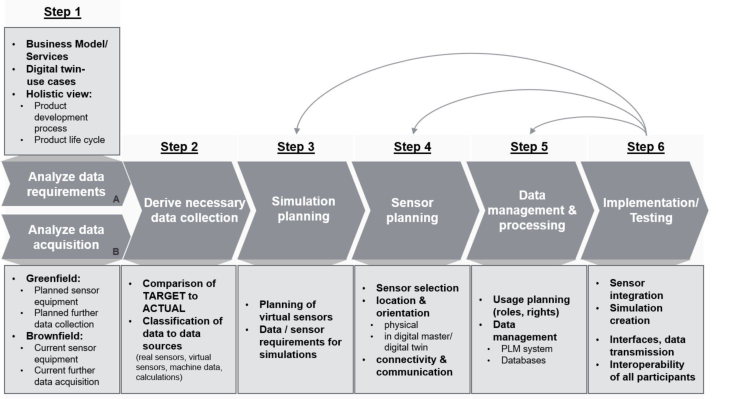
The SLP guide is based on a structured approach, as seen in Figure 1. It starts with a holistic analysis of the data requirements. Step 1A analyzes the data requirements (TARGET data collection) of the new, further development or adaptation of a product. Here, the business model and services offered as well as use cases of the Digital Twin play an essential role. All considerations are viewed holistically across all aspects of the product development process and the product life cycle.
Step 1B analyzes the current or currently possible data collection (ACTUAL data collection). The focus here is on existing or planned sensors as well as further data collection measures. A distinction is made between new and further developments.
These two analyses are compared in the second step. The result of this comparison shows the (additionally) required data collection. The required data is then assigned to its corresponding data sources, or instruments for data collection. These sources can be, for example, a real sensor, a virtual sensor from a simulation, special machine data, and (AI-based) calculations.
If data collection from simulations is planned, these simulations are plan- ned in the third step. In most cases, data is required for the simulation itself, which in turn must be considered in the data and sensor planning.
In the subsequent sensor planning step (step 4), the required sensors are selected and placed in both the physical, real product and the digital master or Digital Twin. A special focus is set on the connectivity and communication of the sensors.
Step 5 deals with the extensive topic of data management and processing. In this step, data transmission and storage as well as data usage and archiving are planned.
In step 6, the planned data collection is implemented and tested using real data sets. For this purpose, the planned sensors are connected and the planned simulations are implemented. Special attention is paid to interfaces and smo- oth data transmission during testing, and the interoperability of all instances involved is examined more closely. If gaps or errors are found at this point, the process is repeated at the corresponding steps three, four or five. This creates an iterative optimization loop until the best possible result is achieved.
In the further course of this paper, the analysis of the current or curren- tly possible data acquisition is discussed in more detail. This is part of step
Development of a Guideline for the Sensor Layout Plan 59
Figure 1: Data planning procedure.
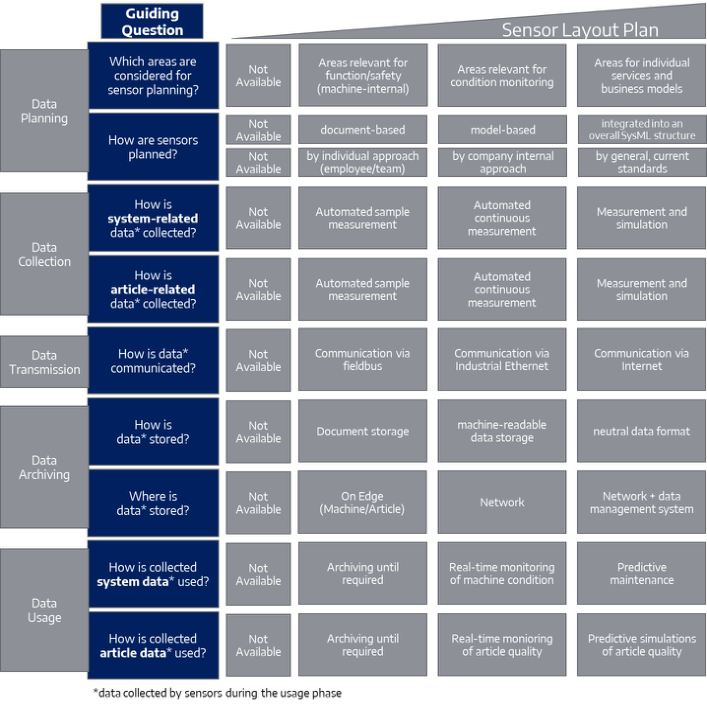
1B in Figure 1. To facilitate and structure this analysis, the Maturity Model for Data Acquisition was developed as an analysis tool, which can be seen below in Figure 2. This maturity model was developed in alignment with the Industrie 4.0 Maturity Model by Schuh et al. (Schuh et al., 2017).
The maturity model is structured chronologically from data planning, col- lection and transmission to data archiving and usage. Guiding questions make it easy to understand and categorize the individual topics. From left to right, the level of capability in relation to Industrie 4.0 and the Digital Twin increases in the classification. Since these are the main goals to be achieved with the help of the Sensor Layout Plan, this axis is named accordingly.
The first area of the maturity model for current data acquisition is data planning. The guiding questions in the area of data planning include fir- stly the purpose of data collection and secondly the type of data or sensor planning. For example, the purpose of data collection may include purely machine functional or safety aspects, condition monitoring, or other indivi- dual services and business models. The last stage mainly includes use cases of the Digital Twin. The possibility, that classification is not available, is always given. The type of sensor planning is classified twice. First, a distinction is made between document-based, model-based or in an overall SysML stru- cture integrated sensor planning. Then, the sensor planning methodology is classified into employee-specific procedures, company-internal specifications or generally applicable current standards.
In data collection, it is queried how system-related and item-related data is collected. This distinction is primarily designed for manufacturing com- panies, for which data about the production process on the one hand and data about the end product on the other may be relevant. Classified here are automated sample measurement, continuous measurements and additional simulations.
The third area “Data Transmission”deals with the type of communication. This can be via Fieldbus, Industrial Ethernet or the Internet.
Figure 2: Maturity model for data acquisition.
The area of data archiving classifies the current data acquisition in terms of the type and location of data storage. The type differs in document sto- rage, machine-readable data storage and storage in a neutral data format. The archiving location can be On Edge, for example on the machine or the article, a network or a network with an additional data management system.
The last area of the maturity model concerns the usage of the collected data. Also, a distinction is made between system-related and article-related data in this area. The classification here is possible into pure data storage until special data is required, real-time monitoring of the machine status or article quality, or predictive maintenance of the machine or predictive simulations of article quality.
The Sensor Layout Plan is intended to make it easier for small and medium-sized manufacturing companies to get started with the applications of Industrie 4.0 and the Digital Twin. The maturity model for current data collection offers a good starting point in the first step of the process presen- ted above for targeted and sustainable data collection. It provides a very good overview of the current situation in the company and shows further potential. This maturity model has already been successfully tested as part of a current research project.
Development of a Guideline for the Sensor Layout Plan 61
CONCLUSION
Structured and targeted data collection will be essential for a successful com- pany in the future. Data is necessary to optimize processes and enable services and business models. The targeted nature of data collection is of particular importance to save costs, time and resources. The described concept shows an approach to be able to plan such a data acquisition in a target-oriented way. In this paper, the maturity model for data acquisition was developed and presented. It represents one of the analysis tools in the first step of the Sensor Layout Plan guide. In subsequent papers, the Sensor Layout Plan will be further developed and presented on this basis.
ACKNOWLEDGMENT
This research and development project is funded by the German Fede- ral Ministry of Education and Research (BMBF) within the Innovations for “Tomorrow’s Production, Services, and Work” Program (02J19B012, CyberTech) and implemented by the Project Management Agency Karlsruhe (PTKA). The author is responsible for the content of this publication.
REFERENCES
Glaessgen, Edward H.; Stargel, D. S. (2012). The Digital Twin Paradigm for Future NASA and U.S.Air Force Vehicles (53rd AIAA/ASME/ASCE/AHS/ASC Structures, Structural Dynamics and Materials Conference - Special Session on the Digi- tal Twin, NF1676L-13293). Available online at https://ntrs.nasa.gov/citations/ 20120008178. Haag, Sebastian (2019). Generierung topologieinvarianter Geometrierepräsenta-
tionen für Digitale Zwillinge. Dissertation. Technsiche Universität Darmstadt, Darmstadt. Datenverarbeitung in der Konstruktion. Kagermann H, Walster W., Helbig J. (2013). Recommendations for implementing the strategic initiative INDUSTRIE 4.0. Final report of the Industrie 4.0 Working Group. Securing the future of German manufacturing indu- stry. Edited by Communication Promoters Group of the Industry-Science. acatech – National Academy of Science and Engineering. Available online at https://www.acatech.de/publikation/umsetzungsempfehlungen-fuer-das-zukun ftsprojekt-industrie-4-0-abschlussbericht-des-arbeitskreises-industrie-4-0/, che- cked on 1/14/2022. Massonet, Angela; Kiesel, Raphael; Schmitt, Robert H. (2020). Der Digitale Zwilling
über den Produktlebenszyklus. In Zeitschrift für wirtschaftlichen Fabrikbetrieb 115 (s1), pp. 97–100. DOI: 10.3139/104.112324. Ohnemus, Thomas (2020). The Digital Twin – A Critical Enabler of Industry 4.0. In Zeitschrift für wirtschaftlichen Fabrikbetrieb 115 (s1), pp. 23–25. DOI: 10.3139/104.112308. Schuh, Günther; Anderl, Reiner; Gausemeier, Jürgen; Hompel, Michael ten; Wahl-
ster, Wolfgang (2017). Industrie 4.0 Maturity Index – Managing the Digital Tran- sformation of Companies. Edited by acatech – National Academy of Science and Engineering. Available online at https://en.acatech.de/publication/industrie-4-0- maturity-index-managing-the-digital-transformation-of-companies/, checked on 2/8/2022. Zimmermann, Thomas C.; Masuhr, Christian; Stark, Rainer (2020). MBSE- Entwicklungsfähigkeit für Digitale Zwillinge. In Zeitschrift für wirtschaftlichen Fabrikbetrieb 115 (s1), pp. 51–54. DOI: 10.3139/104.112312.
LISTED IN THE AHFE DIGITAL BOOKSTORE CATALOGUE
Explore the complete digital volume
Production Management and Process Control
Read this individual research paper free through the original publisher, or explore the full digital proceedings book.
ISBN 978-1-958651-12-4
Explore this ISBN in the AHFE Bookstore ↗Listed in the July 2026 bookstore catalogue; search by ISBN to confirm current availability · Digital book purchase optional