Manami Nozaki, Kazumi Watanabe, Hiromi Ogasawara, Taeko Fukuda (2022). Formative Evaluation of Virtual Reality Materials for Inducing Cultural Awareness. In: Human Factors and Systems Interaction. AHFE Open Access, vol. 52, pp. 74–79. https://doi.org/10.54941/ahfe1002141
As Japan moves toward a multiculturally convivial society, nurses are required to have intercultural competence to recognize the diverse characteristics of their patients and to practice nursing. In order to acquire intercultural competence, it is important to take an attitudinal approach that encourages cultural awareness, which is to recognize and acknowledge differences between oneself and others. Therefore, we developed a VR teaching material that allows Japanese people to experience first-person the anxiety and difficulty that foreigners feel when they visit a Japanese hospital. As the first step from the experience, we extracted gaps between foreign patients and Japanese medical staffs by reviewing the literature; the gaps were due to lack of communication, preconceptions, and bitterness. As a second step, we set four learning objectives and created an ICE rubric. The learning objectives were as follows: 1) to try to get involved actively without feeling uncomfortable, 2) to accept others as they are, 3) to think about the reasons for their words and actions by considering their culture and customs, and 4) to be able to recognize one's own prejudices, discrimination, and assumptions. As the third step, we created a prototype of the content. We shot a 360° video of three scenes in a hospital. We embedded a video of a French actors playing a medical staff and talking to the patient. In this way, we recreated the situation of a Japanese patient visiting a hospital in a foreign country. The fourth step was to conduct alpha testing among the developers to complete the content. Four developers watched the prototype and evaluated the usability and the learning outcomes using the ICE rubric. As a result, it was pointed out that although they could experience the sense of difficulty and anxiety of not understanding the language, they could not understand the situation of what was happening, nor could they think about the other person's culture or their own preconceptions. Therefore, we completed the contents by adding guidance, explaining the situation, presenting a summary of what was said, and setting up a quiz for reflection.
In Japan, the foreign population is 2.747 million (2.2% of the total popula- tion), an increase of 835,000 (an increase of 43.6% from 2015 and an annual average increase of 7.51%) compared to 2015. Of these, 667,000 (27.8% of the total) were from China, followed by 375,000 (15.6%) from South Korea and North Korea, and 321,000 (13.4%) from Vietnam.
In fact, Japan has problems with foreign residents such as lack of com- munication, isolation in the region, and lack of communication of rules. As a result of the inability to understand the language, patients may wait until they become seriously ill to seek medical treatment, resulting in longer trea- tment periods and higher medical costs. In the worst case scenario, they may
Formative Evaluation of Virtual Reality Materials for Inducing Cultural Awareness 75
die because it is too late, even though the disease can be treated with early detection. On the other hand, the nurse said, “Since communication is diffi- cult, I don’t want to go when the nurse’s call rings.” It has been reported that it creates barriers for such foreign patients (Futami, 2020) The intercultural competence required of nurses here is seen as a path of effort to acquire the ability to engage effectively with clients while respecting their culture, and is seen as a continuous process. Including the consti- tuent concepts of “cultural awareness,” “cultural knowledge,” “cultural skills,” “cultural contact” and “cultural desire” (Campinha-Bacate, 2002) This intercultural competence development takes an attitude, knowledge and technical approach. First of all, it is important to be aware of cultural dif- ferences, that is, cultural awareness, and it is necessary to have a detailed perspective of the daily life of the target person and the family in nursing care (Ono, 2011). However, the development of intercultural competencies in the current education of nurses in-service is a low priority, and support for the development of intercultural competencies can be said to be an urgent task.
METHODS
Objectives We aim to develop VR teaching materials that allow Japanese people to expe- rience in the first person the anxiety and difficulty that foreigners feel when visiting a Japanese hospital.
Content Development Procedure The content was prototyped through three phases. Finally, the formation evaluation was performed among four developers.
In the first step, the gap between the foreign patient and the Japanese medi- cal staff was extracted through literature examination. Gap was caused by a lack of communication, preconceived notions, and a sense of incompetence.
In the second step, we set four learning goals and created an ICE rubric. A rubric is an evaluation index in a matrix format consisting of evaluation criteria (vertical axis) and aspects of learning (horizontal axis). An evaluation index based on the ICE model for learning aspects (horizontal axis) is called ICE-Rubric; in the ICE model, learning is composed of three qualitatively different aspects: I (Ideas), C (Connections), and E (Extensions).
In the third step, a content prototype was developed. Three 360-degree videos of the scenes were shot at the hospital. It also embedded a video of a French actor playing a paramedic speaking to a patient. This replicates the situation in which Japanese people visit foreign hospitals.
In the fourth step, we performed alpha testing among developers to com- plete the content. Four developers watched the prototype and evaluated the usability and learning outcomes by the ICE rubric.
This study was approved by the research ethics committee at the Faculty of Health Care and Nursing, Juntendo University (Approval Number: 2021- 67).
RESULTS AND DISCUSSION
Gap Between Foreign Patients and Japanese Medical Professionals Research Design is a literature study. Documentation on the difficulties and problems of foreign patients visiting Japanese medical facilities was analyzed. The codes in the text were extracted and treated as data. The codes were divided into the patient’s position and the medical provider’s position. In addition, difficult situations such as reception, examination, treatment and measures, hospitalization, and business procedures (including payment) were reconstructed for each situation. After that, we compared the difficulties on the patient side and on the medical staff side for each scene, and extracted the differences in thoughts as eight Gaps. Already reported in AHFE2020 (Nozaki, 2020).
It was suggested that behind this was a lack of communication (inability to communicate), a preconception (superficial understanding, characterization), and a sense of incompetence (indifference, turning a blind eye).
Learning Objectives and Rubric Four learning objectives were set to overcome these three factors.
x Try to keep an open mind y Try to accept someone as they are z Think about the other person’s culture and customs, and think about the reasons for their words and actions { Be aware of your own prejudices, discrimination and assumptions The evaluation criteria for the vertical axis in the ICE rubric are based on the perspectives that we want the students to acquire. In this case, four learning objectives were listed. On the horizontal axis were three levels of learning achievement based on the ICE model. The ICE rubric was systematized and developed by three nursing education experts.
(see Appendix Table 1)
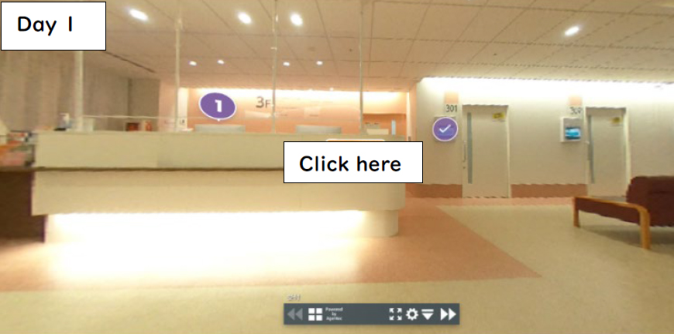
Creating Content Prototypes We set up a case of a female student visiting a hospital for abdominal pain during a trip to France. She is diagnosed with appendicitis, undergoes emer- gency surgery, and is hospitalized for a few days. It consists of outpatient procedures, examinations and scenes of inpatient life. A 360 panoramic video recreates the outpatient and ward environment of the hospital. Pop-ups show doctors, nurses and clerks spoken to by French actors in each scene. The storyline was guided by arrows to indicate the direction of travel.
Modifications Based on Formative Evaluation Among Developers The degree of attainment of the learning goals by this teaching material was answered according to the rubric. They also asked freely about learning and impressions, effectiveness (ease of learning), efficiency, satisfaction, and opinions and improvements.
Formative Evaluation of Virtual Reality Materials for Inducing Cultural Awareness 77
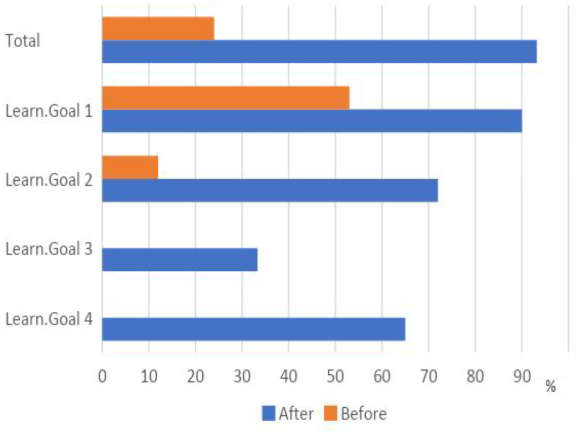
Figure 1: A scene from the finished content.Figure 2: Achievement of learning objectives.
In the light of the above, practical measures for improvement have been considered. As the first guidance, the rubric was presented as a learning goal to explain the purpose and usage of this material. Added guidance for vie- wing, such as clicking on a number to reveal additional information. The situation description of each scene, such as the display of the passage of time, was added. The presentation in French was followed by a summary in Japanese. Learning was directed to a review questionnaire to complete the content.
Revised Evaluation The evaluation points before and after modifications were compared among developers.
In terms of attainment of learning objectives, improvement was confirmed in all four learning goals.
In particular, the learning goal (1) “to keep an open mind” tended to be more attainable.
On the other hand, the learning goal (3) “to think about the other person’s culture and customs and to think about the reasons for his or her words and actions” tended to be difficult to deepen.
Achievement of learning objectives is shown in Figure 2. When asked on a 5-point satisfaction scale about the course materials, the score increased slightly from 3.6 before the revision to 3.7 after the revision.
This content was a heuristic awareness-raising textbook, and no questions were set. Therefore, it was suggested that it was difficult to obtain the effect of thinking about culture and customs by simply watching the teaching mate- rials. It was suggested that it was necessary to create a mechanism to deepen understanding, such as setting questions to raise questions and working in groups before and after viewing content.
CONCLUSION
As an attitude approach to promoting cultural awareness, we developed VR content that allows Japanese people to experience the anxiety and difficulty they feel when visiting a foreign hospital in the first person. Furthermore, it was suggested that it should be enriched as a teaching material.
ACKNOWLEDGMENT
This work was supported by JSPS KAKENHI Grant JP19K10813.
REFERENCES
Akane Futami (2020). Community Medicine in the Age of Multiculturalism. International Cultural Training Fall 2020 vol. 109, pp. 29–32 (in Japanese). Campinha-Bacate (2002): The Process of Cultural Competence in the Delivery of
Healthcare Services: A model of care. Journal of Transcultural Nursing, 13(3), pp. 181–184. Manami Nozaki, ed. (2020). The Gap Between Japanese Medical Professionals and Foreign Patients. Advances in Human Factors and Ergonomics in Healthcare and medical Devices. New Jersey: Springer. pp. 17–22. Ministry of Internal Affairs and Communications (2020). Plan for the Promotion of Multicultural Conviviality in Local Communities. https://www.soumu.go.jp/menu_news/snews/01gyosei05_02000138.html Date of access 20220214 (in Japanese). Satoko Ono, Yachiyo Yamamoto (2011). Cultural Competence in Nursing: a Litera-
ture Review. Kawasaki Medical Welfare Journal, Vol. 20, No. 2. pp. 507–512. (in Japanese).
Formative Evaluation of Virtual Reality Materials for Inducing Cultural Awareness 79
APPENDIX
Table 1. Learning goals and rubric.
Table available in the original PDF paper.
LISTED IN THE AHFE DIGITAL BOOKSTORE CATALOGUE
Explore the complete digital volume
Human Factors and Systems Interaction
Read this individual research paper free through the original publisher, or explore the full digital proceedings book.
ISBN 978-1-958651-28-5
Explore this ISBN in the AHFE Bookstore ↗Listed in the July 2026 bookstore catalogue; search by ISBN to confirm current availability · Digital book purchase optional