Irina Reznichenko, Victoriya Makarchuk, Myroslava Tkachuk, Vita Bezliudna, Alla Dobryden, Tetiana Okolnycha (2022). Monitoring the efficiency of the educational process in the conditions of distance learning. In: Training, Education, and Learning Sciences. AHFE Open Access, vol. 59, pp. 268–275. https://doi.org/10.54941/ahfe1002410
The article investigates the efficiency of the educational process in the conditions of distance learning in the Cherkasy region during the second wave of the pandemic. The results and analysis of a questionnaire survey of teachers in Uman schools, conducted in order to test the effectiveness of distance learning, are presented. The main psychological problems that arose in the conditions of distance learning mode are identified, and a number of methodological recommendations for all participants in the educational process to overcome these problems are developed.
In the pandemic situation which has developed in the world and in Ukraine in particular, the specifics of functioning of almost all spheres of life have changed, including the working conditions of the educational environment, completely switched to a distance learning format. For all participants in the educational process, distance learning is atypical, so this transition has caused a number of difficulties, not only technical and organizational, but also psychological in nature. So, it is important to provide psychological support to students, to help them adapt to the new conditions of learning, to help them form motivation and relieve psychological stress during lear- ning. Theoretical studies on distance learning are based on the research of S. Arkhangelskyi, Y. Babanskyi, S. Goncharenko, M. Makhmutov, E. Polot, V. Sagarda, L. Vygotskyi, P. Galperin, O. Matyushkin, N. Talysina and others. A significant contribution to the formation of a system of distance lear- ning was made by scientists S. Batyshev, O. Kirsanov, Ch. Kupysevych, I. Ogorodnikov, O. Piekhota, L. Romanyshyna, P. Sikorskyi, I. Kharlamov; psychologists B. Ananyev, V. Vygotskyi, M. Danylov and others. The pecu- liarities of communication in conditions of group isolation were studied by scientists I. Keielieinykov and I. Riabinin. Particular attention is attracted by
Monitoring the Efficiency of the Educational Process 269
Figure 1: the scientific work ≪Study of the state of implementation of distance lear- ning in Ukraine (March-April 2020)≫implemented by researchers of the Centre for Innovative Education ≪Pro.Svit≫M. Brovdi, I. Kogut, O. Pie- tushkova, A. Uvarova. However, the effectiveness of distance learning and highlighting the problems of psychological nature in specific regions, parti- cularly in Cherkasy region, during the second wave of the pandemic remains understudied.
The aim of the research work was to investigate the effectiveness of the educational process organised in distance learning in Cherkasy region during the second wave of the pandemic and to develop methodological advice for teachers on overcoming problems of a psychological nature.
METHODOLOGY
To check the effectiveness of distance learning, we identified the most relevant issues and conducted a questionnaire survey of teachers (November- December 2020), which was organised with the assistance of Uman City Council. An author’s questionnaire was used, which included 15 questions. A total of 150 teachers from Uman schools participated in the survey.
RESULTS
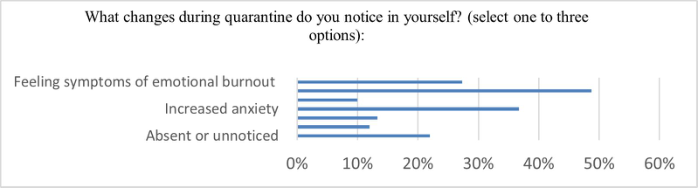
To the first question ≪What changes during quarantine do you notice in yourself?≫48.7% of teachers answered ≪anxiety about the future≫and 36.7% ≪increased anxiety≫. The lowest score was ≪irritability≫−10%. (Figure 1).
Figure 1. What changes during quarantine do you notice in yourself? (select one to three options): Absent or unnoticed - 33 (22%); Sleep disturbance - 18 (12%); Sudden changes in mood - 20 (13.3%); Increased anxiety - 55 (36.7%); Irritability - 15 (10%); Anxiety about the future - 73 (48.7%); Feeling symptoms of emotional burnout - 41 (27.3%).
Figure available in the original PDF paper.
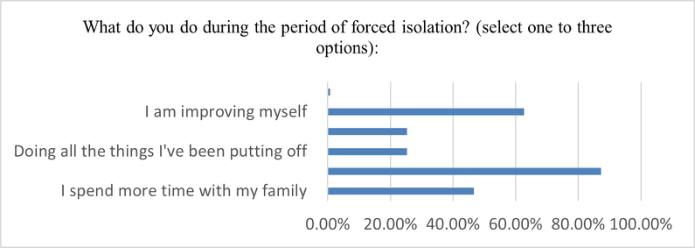
The next question was ≪What do you do during the period of forced isolation?≫. 87.3% of the respondents gave the answer – ≪work with students remotely≫, 62.7% - ≪self-improvement≫, which indicates the dedication and responsible attitude of teachers to the educational process, even during the quarantine period (Figure 2).
Figure 2. What do you do during the period of forced isolation? (select one to three options): I spend more time with my family – 70 (46.7%); I work
Figure available in the original PDF paper.
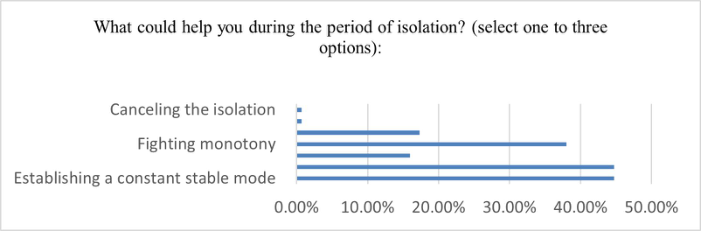
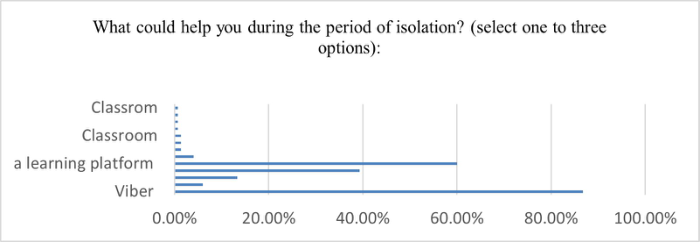
Figure 2:Figure 3: with students remotely – 131 (87.3%); Doing all the things I’ve been putting off – 38 (25.3%); I read books – 38 (25.3%); I am improving myself – 94 (62.7%); I embroider – 1 (0.7%) To the question ≪What could help you during the period of isolation?≫most of the teachers interviewed (44.7%) gave the same number of answers – ≪establishing a permanent stable daily routine≫and ≪planning the daily routine≫(Figure 3).Figure 3. What could help you during the period of isolation? (select one to three options): Establishing a constant stable mode – 67 (44.7%); Planning a daily routine – 67 (44.7%); Visiting online theaters, museums – 24 (16%); Fighting monotony – 57 (38%); Minimize time spent on - 26 (17.3%); Know- ledge of the new – 1 (0.7%);Canceling the isolation – 1 (0.7%). To the fourth question ≪What resource is used for distance learning?≫we received the fol- lowing answers: the largest number of teachers (86.7%) chose Viber, slightly less (60.0%) - a learning platform, followed by 39.3% lessons on YouTube, all other options - 0.7% (Figure 4).Figure 4. What could help you during the period of isolation? (select one to three options): Viber – 130 (86.7%); Facebook – 9 (6%); Skype – 20 (13.3%); lessons on YouTube – 59 (39.3%); a learning platform – 90 (60%); Zoom – 6 (4%); Google class – 2 (1.3%); Google meet – 2 (1.3%);Classroom – 2 (1.3%); Class room – 1 (0.7%); Video tutorials from the project– 1 (0.7%); I don’t give lessons– 1 (0.7%); Classrom– 1 (0.7%).
Figure available in the original PDF paper.
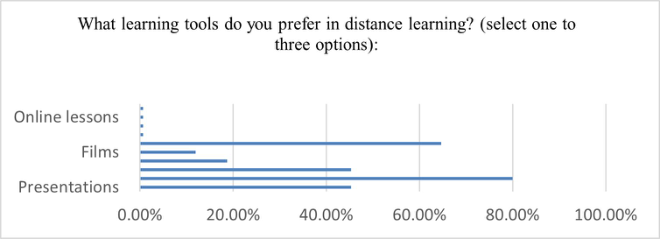
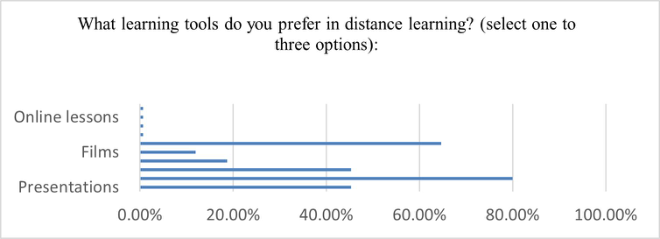
The next question was ≪What learning tools do you prefer in distance learning?≫. Most of the interviewed teachers (80%) preferred video-lessons,
Monitoring the Efficiency of the Educational Process 271
Figure 4:Figure 5:
64.7% indicated the use of simulators and tests in their practice, among the low number of answers (0.7%) were their own options: online lessons and online communication (Figure 5).
Figure 5. What learning tools do you prefer in distance learning? (select one to three options): Presentations – 68 (45.3%); Video-lessons – 120 (80%);Textbooks – 68 (45.3%); Sample pictures – 28 (18.7%); Films – 18 (12%); Exercise simulators, tests – 97 (64.7%); Tests, creative tasks – 1 (0.7%); I don’t give lessons – 1 (0.7%); Online lessons – 1 (0.7%); Online communication– 1 (0.7%).
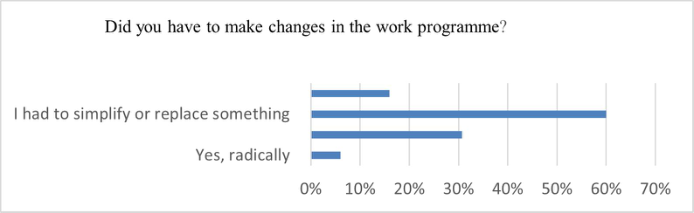
To the question ≪Did you have to make changes in the work programme?≫we received the highest number of answers - 60%, namely: ≪We had to simplify or replace something, because performance of some tasks is impossible at home in the absence of appropriate materials≫. The second place is occupied by the answer ≪partly≫- 30.7% (Figure 6).
Figure 6. Did you have to make changes in the work programme? Yes, radically – 9 (6%); Partly – 46 (30.7%); I had to simplify or replace something – 90 (60%); There was almost no need to make changes – 24 (16%).
Figure available in the original PDF paper.
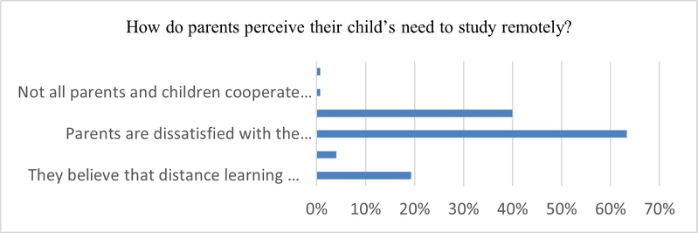
To the seventh question ≪How do parents perceive their child’s need to study remotely?≫63.3% of teachers answered that ≪parents are dissati- sfied with the introduction of distance learning, but are confident that their child should study, so if necessary, they cooperate with teachers≫and 40% - ≪parents understand the situation and are willing to meet teachers≫, which indicates the awareness of parents and their desire to cooperate (Figure 7).
Figure 6:Figure 7:Figure 8:Figure 7. How do parents perceive their child’s need to study remotely?: They believe that distance learning … - 29 (19.3%); They refuse to cooperate – 6 (4%); Parents are dissatisfied with the introduction of distance learning, but are confident that their child should study, so if necessary, they cooperate with teachers – 95 (63.3%); Parents understand the situation and are willing to meet teachers – 60 (40%); Not all parents and children cooperate with the teacher – 1 (0.7%); They went wild – 1 (0.7%).
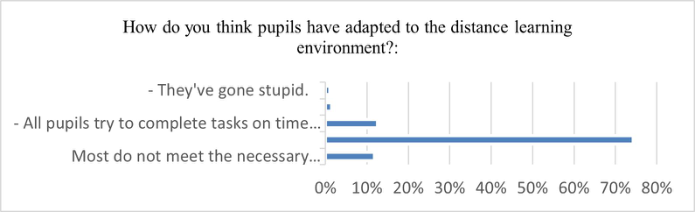
The prescribed response to the question ≪How do you think pupils have adapted to the distance learning environment?≫was ≪Pupils who studied well continue to do so, those who did not work so do not work≫was 74.7%. The answers ≪Most do not do the required minimum≫and ≪All pupils try to complete tasks on time and of good quality≫scored the same percentage −12 (Figure 8).
Monitoring the Efficiency of the Educational Process 273
Figure 9:Figure 10:Figure 8. How do you think pupils have adapted to the distance learning environment?: Most do not meet the necessary minimum. Pupils who studied well continue to do so, those who did not work so do not work. All pupils try to complete tasks on time and of good quality. Most pupils completed their assignments on time and a third. They’ve gone stupid.
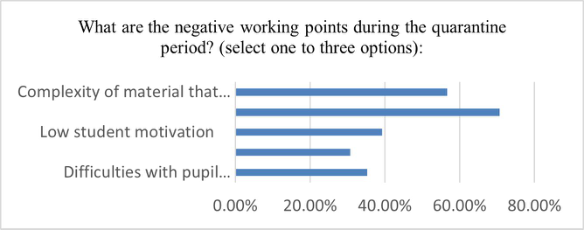
When asked about the negative working points that manifest themselves in learning during the quarantine period, we received the following results: 70.7% - ≪feedback is not always present≫and 56.7% - ≪complexity of material that cannot be perfectly learned remotely≫, indicating the need to improve distance learning (Figure 9).
Figure 9. What are the negative working points during the quarantine period? (select one to three options): Difficulties with pupil organization – 53 (35.3%); Difficulties with organisation and work – 46 (30.7%); Low stu- dent motivation – 59 (39.3%); Feedback is not always present – 106 (70.7%); Complexity of material that cannot be perfectly learned remotely 85 (56.7%).
Figure available in the original PDF paper.
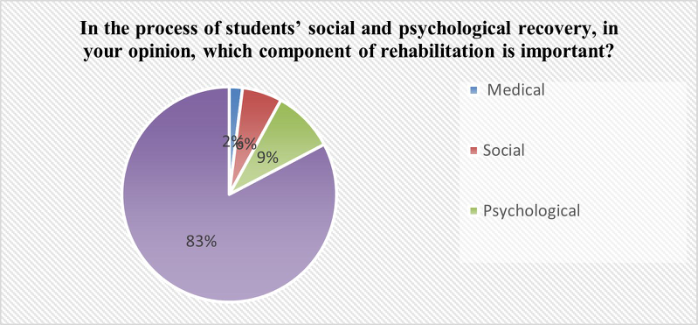
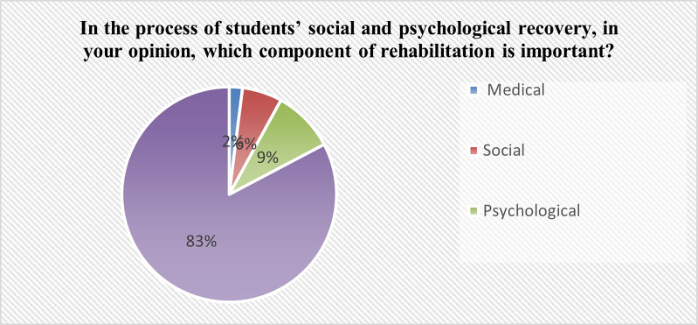
To the tenth question ≪In the process of students’ social and psychological recovery, in your opinion, which component of rehabilitation is important?≫ the high 82.7% response was ≪an integrated unity of medical, psychological and social components≫(Figure 10).
Figure 10. In the process of students’ social and psychological recovery, in your opinion, which component of rehabilitation is important?: Medi- cal; Social; Psychological; An integrated unity of medical, psychological and social components.
Figure available in the original PDF paper.
According to the results of the teacher survey, we found a number of diffi- culties and problems of a psychological nature related to the organisation of distance learning, namely: children’s lack of ability to learn independently; low motivation to learn; excessive workload for both student and teacher; lack of communication with teacher and peers; aversion to distance lear- ning; emotional burnout (for the teacher). So, we believe that psychological help and support, reducing psychological stress and ensuring conditions for motivation to work in the new realities are important.
As researcher O. Maletska notes, ≪... there are fundamental differences in the psychological state of schoolchildren during the pandemic compared with older age groups. For schoolchildren, the threat to life and health posed by the spread of the crown virus infection has less impact on their emotional state. For them the psychological discomfort is more due to forced self-isolation, changes in living and learning patterns, and restrictions on leisure and soci- alizing with peers (Maletska, 2020). Next, let’s find out how to eliminate psychological problems in students. Our analysis of contemporary research (Maletska, 2020, Doslidzhennia stanu realizatsii dystantsiinoho navchannia v Ukraini, 2020, Metodychni rekomendatsii shchodo orhanizatsii osvitnoho protsesu v zakladakh zahalnoi serednoi osvity v umovakh dystantsiinoho navchannia, 2020) has allowed us to develop a number of methodological tips for teachers to overcome such problems:
1. Communicate with pupils. ≪Experiments that were conducted to deter- mine an effective learning system (comparing audio courses, video format and live communication) showed that audio courses had a weak effect. That is, if you have the opportunity for live contact in the present circum- stances, opt for it (Navchannia vdoma: praktychni porady dlia vchyteliv vid psykholohyni Svitlany Roiz, 2020). 2. Present the material in an optimistic tone. Children are weaning them- selves off the collective and the teacher, and if you don’t try ≪to keep≫ them, after quarantine you will have to invest time and effort in ada- pting, ≪getting them back≫. The most important thing now is not to lose contact with them and to maintain trust. 3. Be interesting to the children. If the teacher now does something that doesn’t fit into the standard image, something that will initially astonish the child (say, sending a mock newsletter or wearing cat ears for video chat) - that will be fine. You have the opportunity to experiment with your image and approach. 4. Provide constant feedback. If a child has done her homework and sees that the teacher has not checked it, her motivation decreases. 5. Take into account the age range of children.
Thus, the analysis of our study revealed a number of difficulties and psych- ological problems related to distance learning (children’s lack of motivation
Monitoring the Efficiency of the Educational Process 275
to learn, learning skills; excessive workload for both pupil and teacher; lack of communication with teacher and peers; rejection of distance learning; emotional burnout (for the teacher).
CONCLUSION
We have come to the conclusion that in the conditions of quarantine and distance learning it is quite important to provide pupils with timely psych- ological support and assistance, to adapt and motivate them to work in the new conditions. The methodological recommendations developed by us can be used by teachers, psychologists, methodologists and other participants of the educational process.
Our study does not exhaust all aspects of the problem. In particular, further research is needed to develop methods for training teachers to make quality use of modern information platforms in the educational process.
REFERENCES
Doslidzhennia stanu realizatsii dystantsiinoho navchannia v Ukraini (berezen-kviten
2020) (2020): https://nus.org.ua/wp-content/uploads/2020/05/Research2020_Pr oSvit_MF1.pdf. (reference date - March 23, 2021) [in Ukrainian]. Maletska O.O. (2020). Osoblyvosti dystantsiinoi roboty psykholoha z shkoliaramy v umovakh pandemii. Dosvid perezhyvannia pandemii covid-19: dystantsiini psykholohichni doslidzhennia, dystantsiina psykholohichna pidtrymka: materi- aly onlain-seminariv, m. Kyiv, April 23, pp. 25–28: https://ispp.org.ua/wp-conte nt/uploads/Static/dosvid_onl-sem_23-04-20_and_15-05-20_ncov19.pdf. (refere- nce date – March 23, 2021) [in Ukrainian]. Metodychni rekomendatsii shchodo orhanizatsii osvitnoho protsesu v zakladakh
zahalnoi serednoi osvity v umovakh dystantsiinoho navchannia (2020), za red. Ye. M. Bachynskoi, O. V. Matushevskoi. BilaTserkva: KNZ KOR ≪Kyivskyi oblasnyiinstytutpisliadyplomnoiosvitypedahohichnykhkadriv≫[in Ukrainian]. Navchannia vdoma: praktychni porady dlia vchyteliv vid psykholohyni Svitlany Roiz. (2020): https://nus.org.ua/articles/navchannya-vdoma-praktychni-porady -dlya-vchyteliv-vid-psyhologyni-svitlany-rojz/. (reference date – March 06, 2021) [in Ukrainian].
LISTED IN THE AHFE DIGITAL BOOKSTORE CATALOGUE
Explore the complete digital volume
Training, Education, and Learning Sciences
Read this individual research paper free through the original publisher, or explore the full digital proceedings book.
ISBN 978-1-958651-35-3
Explore this ISBN in the AHFE Bookstore ↗Listed in the July 2026 bookstore catalogue; search by ISBN to confirm current availability · Digital book purchase optional