Louise Sauve, Cathia Papi, Serge Gerin Lajoie, Guillaume Desjardins (2022). Understanding dropout in distance and online learning by taking into account multiple factors. In: Training, Education, and Learning Sciences. AHFE Open Access, vol. 59, pp. 276–284. https://doi.org/10.54941/ahfe1002411
While extensive research has investigated why students drop out of university, most of this research has focused on campus-based training in the first year of university, or on some of the many elements that influence a student's life and learning pathway. Based on theoretical models of distance education dropout, we identified similar variables to those for on-campus learning but with effects that differ in importance. The objective of this research was to determine whether socio-demographic characteristics (e.g., age, gender, marital and family status), academic variables (e.g., study regime, parents’ levels of education), environmental characteristics (e.g., support from family and friends, financial and work situations), learning strategies (e.g. planning, performance, and reflection), the pedagogical organization of courses (e.g. technological tools, learning activities, and learning aids) and support for learning (e.g. interactions with tutors and peers) influenced students’ propensity to drop a course or their program of study in distance and online learning (DOL). This study used a questionnaire, a course analysis grid, and focus groups. For our sample of 791 students enrolled in a francophone DOL institution in Quebec, Canada, socio-demographic and academic variables largely explained their propensity to drop out. Learning strategies did not seem to be associated with dropping out of the course but were associated with not re-enrolling in the institution. For students who did not re-enrol after two sessions of study, the analysis of learning strategies in relation to socio-demographic, academic, and environmental variables identified thirteen predictive variables. The fewer learning strategies used by a student, as reported in the reflection phase of the study, the greater the likelihood that the student would drop out of their institution. Analyzing courses’ pedagogical organization allowed us to group the courses into five course models; the course model, when taken out of context, could not explain the propensity of students to drop out of a course, but it did contribute when we controlled for the socio-demographic and academic variables of the sample. For example, the study found that marital status and family status are two student-specific factors associated with the risk of course drop-out, but only in courses closer to course type 2 (oriented to formative assessment activities and Web site visits) and 4 (oriented to formative assessment activities and video viewing). For the other types of courses (1, 3 and 5), which are oriented towards reading text and practical exercises, these variables do not play a determining role in explaining dropout.Analyzing learning support showed that the support received is, on the whole, appropriate for the students. However, they are not fully satisfied. Some of the students would like to have more opportunities to interact with tutors in the form of individualized support and with their peers to reduce isolation and study stress. These exchanges would encourage greater perseverance, depending on the family and professional situation of certain students. For example, students who work full time and have a family have less need for interaction in their courses than those who do not work.
Distance and Online Learning (DOL), which had become an important course offering component for higher education institutions before the cur- rent pandemic, is now a crucial way for the students to complete their studies. However, research indicates that the dropout rate for DOL students is higher than for on-campus students (Fortin, Joanis and Ragued, 2019).
While research has long been conducted to better understand what leads students to drop out, most of this work has focused on campus-based trai- ning and the student’s first year of university, or on some of the many elements that influence a student’s life and learning pathway. Based on Lee and Choi’s (2011) theoretical model of distance education dropout, we identified simi- lar variables to those for on-campus learning but with effects that differ in importance. The objective of this research was to determine whether socio- demographic factors (e.g., age, gender, marital and family status), academic variables (e.g., study regime, parents’ levels of education), learning strate- gies (e.g. planning, performance, and reflection), the pedagogical design of courses (e.g. technological tools, learning activities, and learning aids) and support for learning (e.g. interactions with tutor and peers) influenced students’ propensity to drop a course or withdraw from their study in DOL.
Understanding Dropout in Distance and Online Learning 277
We begin this paper with a brief review of the DOL literature on variables found to be associated with dropping out of university courses or of school altogether. We then present the methodology and results of the study.
VARIABLES ASSOCIATED WITH DROPPING OUT Based on the literature review by Lee and Choi (2011), which takes Kem- ber’s (1989) model, inspired by the work of Tinto (1975), as a theoretical framework, we identified two main factor categories.
The initial category, student-related factors, includes three types of vari- ables that can impact dropout. First, socioeconomic variables include age (Burgos et al., 2018), gender (Vogel et al., 2018), origin/citizenship (Stoessel, 2015), marital and family status (Gündüz and Karaman, 2020), and pri- mary language (e.g., French, English) (McClelland, 2014). Second, academic variables are study regimes (Aydin et al., 2019), parents’ level of educa- tion (Yakaboski, 2010), disabilities (Verdinelli and Kutner, 2015), diploma obtained before studying via DOL (Fortin et al., 2016), and distance of the student’s residence from the place of instruction (Williging and Johnson, 2009). A third set of factors includes student learning strategies (Vogel et al., 2018), motivation, and confidence (Choi and Kim, 2018). The second category, institutional factors, brings together two types of variables First, the pedagogical design of courses (Kara et al., 2019), encom- passes study pathway flexibility, didactic material quality, program clarity, the quantity and nature of learning assessment, preparation for the course, the quantity of courses taken, and technical problems that can affect the stu- dent’s decision to drop out. Second, variables that affect learning support (Dussarps, 2015; Lafleur, 2017) include the academic and administrative sup- port that the institution must offer to promote student retention as well as the degree of communication between students, tutors, and institutions, which, if lacking, can contribute to dropout.
Lee and Choi (2011) excluded gender and age from their analysis, since the effects of these varied greatly in the literature. However, Lee and Choi concluded that students’ entry level, learning strategies and motivation, study regimes, family circumstances, the pedagogical design of the courses taken, and the support received in the course appear to play an important role in explaining distance students’ propensity to drop out or persevere. As Street (2010) pointed out, students’ behaviour is influenced by, and in turn influ- ences, both personal and institutional factors related to the course. Thus, it is understandably difficult to capture what is at play in dropout by isolating factors from each other or by attempting to study them independently of the student’s perspective. Therefore, this study has focussed on factors that seem most likely to explain why some students drop out before completing their DOL studies: student-specific factors and institutional factors.
METHODOLOGY
This exploratory study was carried out in the context of distance and online undergraduate studies in the province of Quebec, Canada. Quantitative data
were collected using: (1) an online questionnaire to collect data on students’ personal characteristics and their perception of the course organization and learning supervision offered in their DOL courses; and (2) a course analy- sis grid to determine the course models used in the DOL courses taken by respondents. This grid made it possible to quantify the technological tools, pedagogical components of the course, learning activities offered by the course sessions or modules, course navigation and learning aids, and the courses’ modes of learning support.
Sample In order to establish our population, we selected students enrolled in 19 DOL courses offered by a francophone distance education institution in Quebec, Canada. These courses were chosen based on three criteria: (1) inclusion of at least three different disciplinary fields (education, human sciences and lan- guages, and administrative sciences); (2) the number of students per course (from 312 to 900 annual enrollments); and (3) variability in the course fai- lure rates, ranging from 4.35% to 26.51%, and in dropout rates, varying between 4.3% and 26.35%, as reported by the institution’s registrar. A total of 3,578 students, over four sessions of study in 2018 and 2019, were asked to complete the survey; 791 (22.1%) responded.
Analysis Various statistical models were used, depending on their purpose in rela- tion to the study questions. All analyses used an alpha of 5% (α =.05). Analyses were carried out between categories in relation to the 20 socio- demographic and academic variables in order to identify the variables that influence drop-out. A two-step cluster analysis was used to group the vari- ables into categories that were internally consistent, yet different from each other. Analyses included independent samples t-tests and univariate ANOVA for more than two groups. Post-hoc analyses were also conducted with the Tukey test. Chi-square analysis was employed on variables for learning strategies and course types.
RESULTS
Description of the Study Sample Of the 791 students who responded to the questionnaire, 77.9% were female. Also, 46.1% of respondents were 25-34 years old, 28.4% were between 35 and 44 years old, 11.6% were over 45 years old, and 13.8% were under 25 years of age. In addition, 71.2% lived in a couple (married or common-law). French was the first language for the vast majority (91.4%) of respondents.
Academically, 82.6% of respondents were enrolled in part-time study and 56.3% were enrolled in a 30-credit certificate program. More than half of the sample (54%) were in their first year of university study. A total of 71.4% of students had earned a post-secondary diploma or degree before beginning their studies in DOL. Finally, 53.5% of the respondents’ mothers and 49% of their fathers had a high school or vocational diploma, while 23.2% of the
Understanding Dropout in Distance and Online Learning 279
students noted that their father had a university degree, compared to 19.5% for their mother.
Of the 791 respondents, 16.9% dropped out of their course during the data collection semester. Ten percent of these failed to re-enroll after two study sessions.
An analysis of the representativeness of the sample, carried out on the 20 socio-demographic and academic variables used, confirmed that our sample was representative of the student population except for two variables (gender and study regime). These were found to be minor in explaining students’ propensity to drop out.
Student-Related Factors Grouping student-related (socio-demographic and academic) variables into factors, we found that seven factors accounted for 47.58% of a student’s propensity to drop out of a course. Subsequent analyses were conducted on these seven factors to examine their effects more closely; these indicated that a student is more likely to drop a course if: 1) his or her first language is English and he or she is enrolled in a short program; 2) he or she is a common-law partner or lives with both parents; or 3) his or her mother has no schooling, and the father has a vocational diploma or the mother has only completed elementary school and the father has no schooling.
Similarly, an analysis was done to explain the tendency of students to re- enroll or not after two sessions. Seven factors explain up to 66.75% of the propensity of students to withdraw, measured by not re-enrolling after two consecutive sessions. Subsequent post-hoc analyses of these seven factors sho- wed that three of the seven variables indicate that a student is at risk of withdrawal: 1) parental education: a) the mother has a vocational training diploma and the father has no schooling, b) the mother has completed high school and the father has an undergraduate university degree, or c) the mother has no schooling and the father has completed high school; 2) the student is a permanent-resident student with an undergraduate university degree; and 3) the student’s place of residence is located 31 to 45 minutes from the place of instruction.
By grouping learning strategies according to Zimmerman’s (2000) typo- logy of self-regulation (foresight, performance, and reflection), a single- factor ANOVA analysis identified differences between certain student socio- demographic and academic variables and the likelihood of using or not using these strategies. For foresight strategies, only marital status was found to be statistically significant. For performance strategies, family status, gender, marital status, maternal education, distance, dyslexia, and physical disability were found to be statistically significant. For reflection strategies, marital status and language were found to be statistically significant.
According to Student’s t-tests, the scores obtained in the three Zimmerman phases were not statistically significantly and therefore did not affect course dropout. However, in terms of non-re-enrollment, the reflection phase made a statistically significant difference. In other words, the more that strategies are reported to be little used by students in the reflection phase, the more
likely they are not to re-enroll after two consecutive sessions. For example, the more dissatisfied students are with the quality of their courses, their academic results, and their decision to study at university, the more likely they are to drop out.
Institutional Factors In terms of pedagogical design, we used a two-step cluster analysis to inter- pret the course analysis grid data to identify the DOL course types. This method made it possible to move from disparate courses to identify course models or archetypes. Five course models (clusters) were characterized by a set of 22 variables likely to influence student attrition, such as activities for acquiring new knowledge, carrying out learning exercises, and completing summative evaluations. It is important to understand that the 22 variables must be taken as a whole, rather than individually, to characterize the course models.
To summarize, we can say that while all courses aim at knowledge acqui- sition, they differ somewhat in the means used: Course Model 1 is mainly focused on reading and practical exercises; Course Model 2 invites visits to external websites and formative evaluation activities; Course Model 3 emphasizes reading and practical exercises; Course Model 4 is focused on practical exercises and formative evaluation activities; Course Model 5 pro- poses mainly reading and viewing videos or slide shows, together with formative evaluation activities.
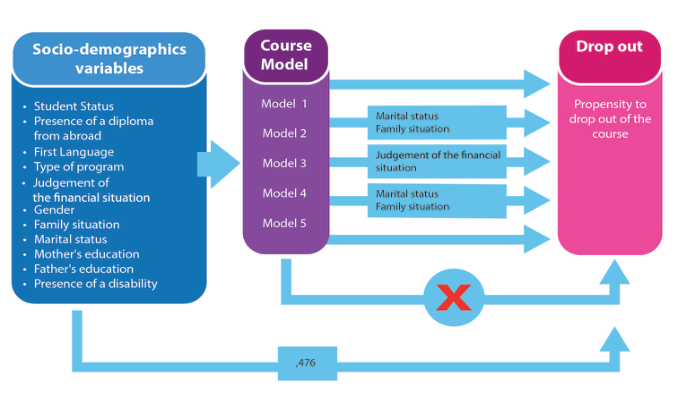
By cross-analyzing the socio-demographic and academic variables and the five course models, we were able to make certain observations regarding course dropouts: (see Figure 1). For example, the study found that marital status and family status are two student-specific factors associated with the risk of course drop-out, but only in courses closer to course type 2 (oriented to formative assessment activities and Web site visits) and type 4 (oriented to formative assessment activities and video viewing). For the other types of courses (1, 3 and 5), which are oriented towards reading text and pra- ctical exercises, these variables do not play a determining role in explaining dropout.
In short, the results of the study indicate that the design of the course taken by itself does not affect course dropout, unless it can be linked to students’ personal characteristics and appropriate interventions to promote perseverance in their studies.
Students’ assessment of the learning support provided by peers and by tutors (who in some cases are professors) showed that, overall, few inte- ractions took place in their courses. Most of these interactions took place asynchronously through email exchanges between the student and the tutor. This seems to suit the majority of students, who indicate that they would not change this arrangement, although almost a quarter would like more synch- ronous or asynchronous communication with their tutor. In fact, as noted in the study of the pedagogical design of the courses, few exchanges were planned for the courses, which are all asynchronous to allow students to pro- gress at their own pace. It was also clear that there is little-to-no exchange
Understanding Dropout in Distance and Online Learning 281
Figure 1: Modeling the analysis of sociodemographic variables in relation to course models to measure the effect on dropout.
with peers, as nearly 90% of respondents answered “does not apply” to this question.
Furthermore, while 81% were satisfied with the response time of the tutors, only a quarter of the students described themselves as satisfied with the support they received at the administrative and learning levels, and even fewer were satisfied with the support they received at the technological, methodological, metacognitive, social, and emotional levels.
However, the support that was received and students’ satisfaction with it seem to be important, since it was found that students who did not receive answers to their questions within a period of time that they considered satisfa- ctory were more likely than others to drop their courses. Similarly, Student’s t-tests revealed that students who persevered in their courses were more sati- sfied, compared to those who dropped out, with the support received by the instructors.
DISCUSSION
For our sample of 791 students, socio-demographic and academic variables largely explained their propensity to drop out, confirming the conclusions of Xavier and Meneses (2020). Learning strategies did not seem to be associa- ted with dropping out of the course but were associated with not re-enrolling. As in James et al. (2016), analysis of learning strategies in relation to socio- demographic and academic variables identified certain predictive variables in the case of students who did not re-enroll after two sessions of study: paren- tal education, marital status, and distance of residence from the educational institution.
Our study identified five types of courses with internally consistent and distinct distributions in terms of instructional organization. The design of a
course model, when taken out of context, cannot explain the propensity of students to drop out of the course, but it does contribute when we control for socio-demographic and academic variables, as outlined by Vogel et al. (2018). For example, marital status and family situation are two factors specific to the student that are at risk of causing him or her to drop out of a course, but only for two of the five course types.
Regarding the learning support received, the finding that students who are satisfied with their learning support persevere more, while those who are less satisfied are more likely to drop out, is consistent with other research results (Dussarps, 2015).
CONCLUSION
A growing number of studies have concluded that it is difficult to iden- tify predictive factors without a holistic view of the problems and obstacles encountered by those who drop out. It is in this context that our study exa- mined the interrelationships of many factors that can influence dropping out of a DOL course or not re-enrolling after two study sessions.
The study was limited in that it include only a limited number of respon- dents from one academic institution and a limited number of courses (19) at the institution that were offered only by distance and online. Howe- ver, the results provide an answer to our research question, namely that socio-demographic and academic factors that might explain dropping out cannot be analyzed in themselves but should be considered in relation to student learning strategies as well as the pedagogical design of courses and the learning support provided by the institution. In terms of further resea- rch, this study focused on courses in the social and administrative sciences; it would be interesting and useful to do a similar study on students of technical specializations.
ACKNOWLEDGMENT
This research study was funded by grants from the Ministry of Economy and Innovation and Desjardins. We would like to thank Alice Ireland for editing the manuscript.
REFERENCES
Aydin, S., Öztürk, A., Büyükköse, G.T., Er, F. and Sönmez, H. (2019), “An investigation of drop-out in open and distance education.” Educational Sciences: Theory & Practice, 19(2), 40–57. DOI:10.12738/estp.2019.2.003. Burgos, C., Campanario, M.L., de la Peña, D., Lara, J.A., Lizcano, D. and Mar-
tínez M.A. (2018), “Data mining for modelling students’ performance: A tutoring action plan to prevent academic dropout.” Computers and Electrical Engineering, 66, February, 541–556. DOI:10.1016/j.compeleceng. 2017.03.005. Choi, H.J. and Kim, B.U. (2018), “Factors affecting adult student dropout rates in the Korean Cyber-University degree programs.” The Journal of Continuing Higher Education, 66(1), 1–12. DOI:10.1080/ 07377363.2017.1400357.
Understanding Dropout in Distance and Online Learning 283
Dussarps, C. (2015), “L’abandon en formation à distance. Analyse socioaffective et motivationnelle” [Dropout in distance learning. Socio-affective and motivational analysis]. Distances et médiations des savoirs [Distance and Mediation of Know- ledge], 3(10). Available from: http://journals.openedition.org/dms/1039 [Accessed January 31, 2022]. Fortin, A., Sauvé, L., Viger, C. and Landry, F. (2016), La persévérance et la réussite
universitaires d’étudiants inscrits à des programmes de premier cycle en sciences comptables au Québec [Persistence and academic success of students enrolled in undergraduate accounting programs in Quebec]. Research report. Québec, Canada: FODAR – UQ. Fortin, B., Joanis, M. and Ragued, S. (2019), Interruption des études secondaires et postsecondaires au Canada: une analyse dynamique [High school and post- secondary school dropouts in Canada: A dynamic analysis]. Québec, Canada: Centre interuniversitaire de recherche en analyse des organisations. Gündüz, M. and Karaman, S. (2020), “Open education faculty and distance edu-
cation students’ dropout reasons: The case of a Turkish state university.” Open Praxis, 12(1), March 7. DOI:10.5944/openpraxis.12.1.970. James, S., Swan, K. and Daston, C. (2016). “Retention, progression and the taking of online courses.” Journal of Asynchronous Learning Network, 20(2), 75–96. DOI:10.2147/TACG.S78241. Kara, M., Erdo˘gdu, F., Kokoç, M. and Cagiltay, K. (2019), “Challenges faced by
adult learners in online distance education: A literature review.” Open Praxis, 11(1), January–March, 5–22. Kember, D. (1989), “A longitudinal-process model of drop-out from distance education.” Journal of Higher Education, 60(3), 278-301. Lafleur, F. (2017), Les conditions qui favorisent l’efficacité de la formation à dista-
nce: état de situation en enseignement supérieur [Conditions for effective distance learning: The state of play in higher education]. In: F. Lafleur and G. Samson (eds.), Formation à distance en enseignement supérieur: l’enjeu de la formation à l’enseignement. Québec, Canada: Presses de l’Université du Québec, 24-32. Lee, Y. and Choi, J. (2011), “A review of online course dropout research: Implications for practice and future research.” Educational Technology Research and Development, 59(5), 593–618. McClelland, T.J. (2014), Why do they leave? An exploration of situational, disposi-
tional, institutional, technological, and epistemological factors on undergraduate student withdrawal from online studies at an institute of technology in New Zea- land. [Doctoral dissertation]. Northeastern University, Boston, MA, USA. Availa- ble from: https://repository.library.northeastern.edu/files/neu:349649/fulltext.pdf [Accessed January 31, 2022]. Stoessel, I. (2015), “Sociodemographic diversity and distance education: Who drops out from academic programs and why?” Research in Higher Education, 56(3), 228–246. DOI:10.1007/s11162-014-9343-x. Street, H. (2010), “Factors influencing a learner’s decision to drop-out or persist in
higher education distance learning.” Online Journal of Distance Learning Admi- nistration, 13(4). Available from https://www.westga.edu/~distance/ojdla/winter 134/street134.htm [Accessed January 31, 2022]. Tinto, V. (1975), “Dropout from higher education: A theorical synthe- sis of recent research.” Review of Educational Research, 45(1), 89-125. DOI:10.3102/00346543045001089.
Verdinelli, S. and Kutner, D. (2015), “Persistence factors among online graduate students with disabilities.” Journal of Diversity in Higher Education, 9(4), 353–368. DOI:10.1037/a0039791. Vogel, C., Hochberg, J., Hackstein, S. and Bockshecker, A. (2018), “Dropout in
distance education and how to prevent it.” In: Proceedings of EdMedia: World Conference on Educational Media and Technology. Amsterdam, Netherlands. Available from https://www.researchgate.net/publication/328248882_Dropout_ in_Distance_Education_and_how_to_Prevent_it [Accessed January 31, 2022]. Willging, P.A. and Johnson, S.D. (2009), “Factors that influence students’ decision to dropout of online courses.” Journal of Asynchronous Learning Networks, 13(3), 115–127. Xavier, M. and Meneses, J. (2020), Dropout in online higher education: A sco-
ping review from 2014 to 2018. Barcelona: eLearn Center, Universitat Oberta de Catalunya. DOI:10.7238/uoc.dropout.factors.2020. Yakaboski, T. (2010), “Going at it alone: Single-mother undergraduate’s experiences.” Journal of Student Affairs Research and Practice, 47(4), 463–481. DOI:10.2202/1949-6605.6185. Zimmerman, B.J. (2000), “Attaining self-regulation: A social cognitive perspe-
ctive.” In: M. Boekaerts, P.R. Pintrich and M. Zeidner (eds.), Handbook of self-regulation. Cambridge, MA: Academic Press, 13-39. DOI:10.1016/B978- 012109890-2/50031-7.
LISTED IN THE AHFE DIGITAL BOOKSTORE CATALOGUE
Explore the complete digital volume
Training, Education, and Learning Sciences
Read this individual research paper free through the original publisher, or explore the full digital proceedings book.
ISBN 978-1-958651-35-3
Explore this ISBN in the AHFE Bookstore ↗Listed in the July 2026 bookstore catalogue; search by ISBN to confirm current availability · Digital book purchase optional