Zichen Zhang, Sha Liu, Weiyi Li (2022). How Does Color Matching of Web-based Courseware Affect Learners' Satisfaction. In: Training, Education, and Learning Sciences. AHFE Open Access, vol. 59, pp. 329–336. https://doi.org/10.54941/ahfe1002418
More and more network teaching activities make the visual design of multimedia courseware become more and more important. As the main means and tools of auxiliary teaching, multimedia courseware carries a large amount of information, and because of the important influence of color on the audience's attention, recognition, pleasure and other aspects, it is particularly important to choose the right color and collocation of courseware. This paper discusses the influence of different combinations of courseware background color and text color on audience satisfaction in multimedia network teaching. In this experiment, 56 undergraduates were tested by scale, and the hue, lightness, purity and text color of background color were taken as experimental variables. Firstly, taking the hue of the background color as the independent variable, the experiments are carried out when the text color is black and white respectively. Then, in accordance with the same method, the purity and brightness of background color were taken as independent variables respectively, and the experimental data were analyzed by one-way ANOVA, fitting curve, paired sample T test and other methods. The results showed that :(1) different background colors had significant influence on viewers' satisfaction (P< 0.05), and due to different text colors (black and white), audience satisfaction is different. Among them, when the text color is black, under different hue background, the audience's satisfaction is ranked from high to the bottom: orange, yellow-green, green, blue-green; When the text color is white, blue, bluish purple are preferred. In addition, the greater the difference between background color and text color, the clearer the visual presentation of content and the higher the satisfaction (P< 0.05). (2) Under the change of brightness of different background colors, viewers' satisfaction also showed significant difference (P< 0.05), the higher the brightness of background color, the higher the satisfaction degree, showing an exponential relationship basically. (3) There was no significant difference in viewer satisfaction between different background colors (P> 0.05). The result of this study, through the data, provides the basis for the color design of network multimedia courseware, which is beneficial to improve the learning experience of the audience in the network teaching.
In the teaching of universities, more and more online teaching activities make the visual design of multimedia courseware become more and more important. Unscientific color matching of courseware can directly affect the teaching effect (Liu, 2016). Li Ping argued that different colors of multime- dia courseware text background and its matching have a greater impact on the satisfaction of college students’ learning (Li, 2008), but did not clearly point out the law of color change and matching way change. Liu Gengming discussed for text color and background color matching, but the theoretical basis is not sufficient and the conclusion obtained is doubtful (Liu, 2015). Jili’s study emphasized the visual aesthetics of slides, and described the pro- blem of graphic boundaries, the hierarchical relationship between graphics and text, and the need for unity and change in color matching, but there was no further quantitative and objective discussion of the effect of color match- ing of graphic backgrounds (Ji, 2014). Berlyne, D. E. found in a study of color that warm colors can increase pleasure and excitement, while cool colors are more likely to cause a sense of loss (Berlyne, 1970). Wolfson, S., & Case, G. concluded that warm colors evoke greater arousal in viewers compared to cool colors (Wolfson&Case., 2000). Jan L. Plass showed that the use of warm colors in documents can improve the comprehension of readers (Plass et al., 2014). Wen Yayang emphasized that the negative effect of cold colors
on college students’ learning satisfaction was higher than the positive effect (Yang et al., 2021), and that warm colors could better promote college stu- dents’ learning satisfaction(Yang et al., 2021; Yuan et al., 2005) , but the research results were more limited.
It can be found that the current research content mainly focuses on color matching and contrast between warm and cold colors, and most of them lack strong support of quantitative data. The quantitative research on the influence of background and text colors and matching methods on learners’ satisfaction is still in a blank state. This paper explores the impact of dif- ferent color combinations of background and text on viewers’ subjective satisfaction in multimedia online teaching. And the following hypotheses are made.
H1a: The background color hue of multimedia courseware affects stu- dents’ satisfaction; H1b: The background color purity of multimedia cour- seware affects students’ satisfaction; H1c: The background color lightness of multimedia courseware affects students’ satisfaction; H2: The size of the difference between the hue of the background and the text of multimedia courseware affects students’ satisfaction.
PRELIMINARY PREPARATION The experiment was divided into two parts by conducting a scale test on 56 undergraduate students from China Agricultural University, using back- ground color hue, lightness, purity and text color as experimental variables. The first part of the experiment was divided into three groups, in which background hue, lightness and purity were taken Respectively as single expe- rimental variables to test hypotheses H1a, H1b and H1c, respectively. In the second part, the text color was used as a single variable to explore and verify hypothesis H2. 54 valid questionnaires were kept after removing the invalid ones.
The multimedia courseware interface was simplified to only textual infor- mation and background color (Figure 1) to exclude the influence of other factorson the experimental results during the pre-experiment.
METHOD
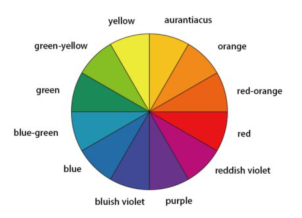
The Effect of the Background Color of Multimedia Courseware on Students’ Satisfaction in Class We chose to take one hue every 30° on the color ring, 12 in total (Figure 2). To facilitate the acquisition of more accurate data. The colors using black and white as fonts were placed on different hue backgrounds and presented in the form of a test questionnaire that was viewed and scored by the tester.
The mean scores for the black group were: red (1.86), red-orange (3.23), orange (4.32), yellow-orange (4.82), yellow (3.86), yellow-green (5.05), green (4.68), blue-green (4.73), blue (3.95), blue-violet (3.14), purple (2.82), and red-violet (2.68). The peak of satisfaction falls near the yellow-orange and yellow-green color intervals.
How Does Color Matching of Web-Based Courseware Affect Learners’ Satisfaction 331
Figure 1:Figure 2:
The mean scores for the white group were: red (3.09), red-orange (4.14), orange (4.86), yellow-orange (4.23), yellow (0.73), yellow-green (4.18), green (5.05), blue-green (5.18), blue (5.77), blue-violet (5.77), purple (5.27), and red-violet (4.77). The peak of satisfaction falls near the blue-violet phase interval.
A one-way ANOVA was performed on the data as a whole, with F = 4.535, p = 0.000003 for the black group and F = 9.681, p = 1.4213E-14 for the white group. there was a significant difference between the scores of both black and white multimedia courseware in different background color hues. The post hoc multiple comparison analysis showed significant differences between the scores of each color phase and the scores of multiple other color phases. It is thus obtained that the background color hue of multimedia courseware affects students’ satisfaction.
The Effect of Background Color Lightness and Purity of Multimedia Courseware on Students’ Satisfaction in Class Since the warm and cold tones of multimedia courseware can cause different emotions in readers (Yang et al., 2021), in order to make the experimental results more generally representative, we chose two warm and cold tones as background colors, and set five groups with lightness as a single vari- able, lightness +40, lightness +20, lightness unchanged, lightness-20, and lightness-40 (Figure 3). Five groups were set up with purity as a single variable, purity unchanged, purity-20, purity-40, purity-60, and purity-80 (Figure 4). Still in the form of a test questionnaire, the subjects were asked to rank the pictures according to the degree of visual comfort and concentration
Figure 3:
Figure available in the original PDF paper.
Figure 4:
Figure available in the original PDF paper.
Figure 5:
Figure available in the original PDF paper.
Figure 6: ranking from 1 to 5 on the degree of satisfaction of viewing that option, ran- king the degree of satisfaction of viewing that option, the higher the ranking is considered as higher satisfaction.To obtain more accurate data, black was chosen as the font color and placed in different backgrounds, and the test subjects were ranked by observation.
A one-way ANOVA was performed on the experimental data (Figure 5) as a whole.
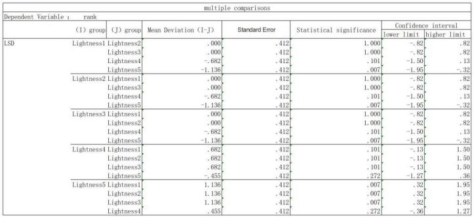
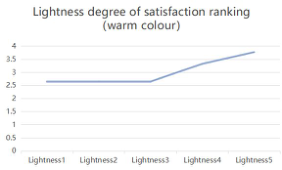
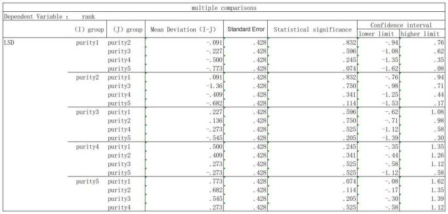
F = 3.228, p = 0.015 for the warm color group, and there was no signi- ficant difference in the ratings of the multimedia courseware at different lightness levels. Post hoc multiple comparison analysis of the fifth group was significantly different from the ratings of the first three groups (Figure 6). This yielded that the first four groups of lightness had no significant effect on satisfaction, and the satisfaction of the fifth group was low relative to the first three groups (Figure 7). A one-way ANOVA was performed on the data as a whole.
How Does Color Matching of Web-Based Courseware Affect Learners’ Satisfaction 333
Figure 7:Figure 8:Figure 9:
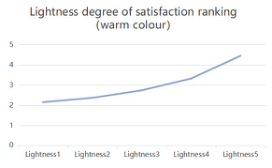
The cool color group F = 13.778, p = 4.5747E-9, and the multimedia cour- seware scores were significantly different at different lightness levels. Post hoc multiple comparison analysis showed significant differences between the sco- res of each lightness group and the scores of multiple other lightness groups. After analysis, it was found that the higher the background color lightness, the higher the satisfaction, basically in an exponential relationship (Figure 8).
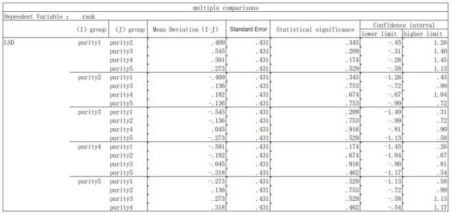
The warm color group F = 1.096, p = 0.362, and there was no significant difference in the ratings of multimedia courseware at different purity levels. Post hoc multiple comparison analysis showed no significant difference betw- een all groups (Figure 9). This yielded that the purity of the background color warm color of the multimedia courseware had no significant effect on students’ satisfaction in the class.
The cool color group F = 0.610, p = 0.656, and there was no significant difference in the ratings of multimedia courseware at different lightness levels. There was no significant difference between the groups in the post hoc multi- ple comparison analysis (Figure 10). Thus, it was obtained that the purity of
Figure 10:Figure 11: the cool background color of the multimedia courseware had no significant effect on students’ satisfaction in the class.
The Effect of the Size of the Difference Between Background Color and Text Hue on Students’ Satisfaction in Class We chose to take the colors on the color ring, one hue every 30°, 12 in total (Figure 2). Yellow-orange was chosen as the background color, and the remai- ning 11 were used as the font color to create the test multimedia courseware. Still in the form of a test questionnaire, the subjects were asked to rank the pictures according to the degree of visual comfort and attention to rank the degree of satisfaction of viewing from 1 to 11 for that option, ranking the degree of satisfaction of viewing for that option, the higher the ranking is con- sidered as higher satisfaction. The test subjects were ranked by observation. To obtain more accurate data.
A one-way ANOVA was performed on the data as a whole, F = 9.398, p = 4.7403E-13. multimedia courseware scores on the yellow-orange back- ground were significantly different under the color of the text color diffe- rence. Post hoc multiple comparison analysis showed significant differences between the scores of each group and the scores of multiple other groups. It is thus obtained that the difference in the color phase of multimedia courseware background and text affects student satisfaction.
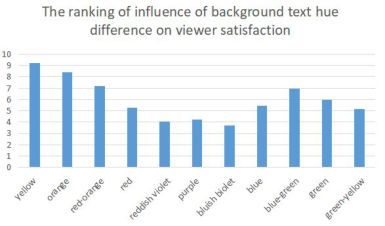
The mean scores were: yellow (9.23), orange (8.41), red-orange (7.18), red (5.27), red-violet (4.05), violet (4.23), blue-violet (3.68), blue (5.45), blue- green (6.95), green (5.95), and yellow-green (5.14) (Figure 11). The peak
How Does Color Matching of Web-Based Courseware Affect Learners’ Satisfaction 335
satisfaction falls near the complementary blue-violet phase interval of yellow- orange, when the color difference is greatest.
SUMMARY & DISCUSSION The experimental results show that color has the greatest influence on color, and different hues can bring considerable differences in visual effects.When the color of text is black, people generally prefer orange, chartreuse, green, turquoise and other colors with mild visual stimulation.Hues that are too visually stimulating can cause discomfort to the human eye. When the text color is white, the deeper and darker colors such as blue and blue-violet are more preferred. Therefore, H1a hypothesis is valid.
In the two groups of lightness and purity experiments under the condition that the text color was black, there was no significant difference between the change in lightness of the warm color group on the satisfaction as a whole. There was a significant difference in some groups, and the satisfaction was affected only when the lightness decreased significantly, and the higher the lightness the higher the satisfaction; the change in purity had no significant effect on the satisfaction. The change in lightness of the cold color group pro- duced significant difference and had a linear relationship with satisfaction, the higher the lightness the higher the satisfaction; the change in purity had no significant effect on satisfaction. Therefore, hypothesis H1b is valid and hypothesis H1c is not valid.
When the color difference between background color and text is big- ger, the visual presentation of multimedia courseware content is clearer and more satisfying; when the color difference is closer, the content is difficult to distinguish and easily causes discomfort. The color difference and sati- sfaction basically show an "inverted U-shaped" relationship. Therefore, the hypothesis H2 is valid.
In summary, the experimental results provide theoretical guidance on the use of color to improve learners’ viewing satisfaction through online teaching courseware. Through the above conclusions we can obtain that choosing con- trasting colors as text and background colors raletively strong when creating multimedia courseware can improve students’ satisfaction to some extent.
OUTLOOKS From the results of the lightness experiment, it is easy to find that the higher the background color lightness the higher the viewer satisfaction. However, black has the lowest lightness, is it possible to hypothesize that the greater the difference between the lightness of the text and the background, the higher the satisfaction of the viewers? This can be the direction of research for the next step of deeper exploration.
In addition, the experiment used a subjective feeling tests to measure viewer satisfaction, which may lead to insufficient objectivity, and future studies could resort to eye tracking and brainwave detection settings to measure the collected data for better accuracy.
REFERENCES
Berlyne, D.E. (1970), “Novelty, complexity, and hedonic value.” Perception & Psychophysics, 8, 279–286. Ji, L. (2014), “Slide design skills and specifications.” Yihai, (8), 139–140. Li, P. (2008), “Eye Movement Research of Different Font Size and Color Matching
in Web Courseware.” Shanghai: East China Normal University. Liu, G.M. (2015), “Improving the making method of multimedia courseware and enhancing the teaching effect.” Journal of Language and Literature Studies, 2, 134+138. Liu, X.Y. (2016), “Analysis of color application of multimedia courseware.” China
CIO News, (3), 157. Plass, J.L., Heidig, S., Hayward, E.O., Homer, B.D., and Um, E. (2014), “Emotional design in multimedia learning: Effects of shape and color on affect and learning.” Learning and Instruction, 29, 128–140. Wolfson, S., and Case, G. (2000), “The effects of sound and color on responses to a
computer game.” Interacting with Computers, 13(2), 183–192. Yang,W., Li, Q., and Wang, X. (2021), "The Effect of PowerPoint Theme Color on Learners’ Learning Effectiveness and Emotions." 2021 IEEE 24th Internatio- nal Conference on Computer Supported Cooperative Work in Design (CSCWD), 510–512. Yuan, F., Shen, X., and Zhang, G. (2005), “The Choice and Application of the
Color of Multimedia Presentation Courseware in Class.” Modern Educational Technology, 15(1), 47–49.
LISTED IN THE AHFE DIGITAL BOOKSTORE CATALOGUE
Explore the complete digital volume
Training, Education, and Learning Sciences
Read this individual research paper free through the original publisher, or explore the full digital proceedings book.
ISBN 978-1-958651-35-3
Explore this ISBN in the AHFE Bookstore ↗Listed in the July 2026 bookstore catalogue; search by ISBN to confirm current availability · Digital book purchase optional