Per Håkon Meland, Dag Atle Nesheim, Ørnulf Jan Rødseth (2023). Keeping the human element to secure autonomous shipping operations. In: Human Factors in Cybersecurity. AHFE Open Access, vol. 91, pp. 10–19. https://doi.org/10.54941/ahfe1003715
Autonomous shipping operations are becoming economically and technically feasible, but this development also requires new human roles and responsibilities onshore for managing cyber events. The goal of this paper is to present a methodology for describing autonomous shipping operations and risks caused by potential cyber-attacks, focusing on critical situations to the interplay between the automation and human operators. We have applied our methodology on a case study for planned autonomous operations in European waterways. Our results show that the reliance on new technologies such as sensors, computer vision and AI reasoning onboard the autonomous ships or cranes opens to new types of attacks that the industry has little experience with as of now. Unmanned systems should therefore be designed with assurance methods that can bring the human into the loop, providing situational awareness and control. At the same time, human resource exhaustion is a potential attack goal against remote operations. We could see from our threat likelihood estimation that attacks related to deny- and injure-motivations have the highest values in all mission phase patterns. This is in accordance with the general attack trends within the maritime domain and many other sectors, where financially motivated attackers will try to demand a ransom to stop business disruption.
The introduction of autonomous operations in shipping creates a new cyber- physical attack surface that cannot be mitigated by technical means alone. With only a few or no sailors onboard the vessel itself, there is a need for new human roles and responsibilities onshore for managing cyber events that could potentially lead to damage to life, goods, economy or the environ- ment. Especially the handover between the automation and human remote control represents intricate challenges which must be understood and pro- perly assessed. When should the human be involved and relieved? What kind of situational awareness can a remote operator obtain? How can the requi- red level of attention and reaction times be dynamically adjusted according to different mission phases and changing environment (e.g., weather, traffic, threats)? What can go wrong and how/why would an attacker provoke an incident? Since shipping is a highly competitive playing field, we also need to
Keeping the Human Element to Secure Autonomous Shipping Operations 11
make sure that the human and technical measures we invest in are affordable and proportional to the actual risks they are meant to manage.
The goal of this paper is to present a methodology for describing autono- mous shipping operations and risks caused by cyber-attacks. This includes different levels of autonomy and human operator control, system compo- nents and people involved, mission phase patterns and operating conditions. We apply the Unified Modeling language (UML) to formally describe the concept of operations and extend these models with misuse case diagrams representing threat actors and threat goals, which are drilled down to sequence diagrams to show attack scenarios.
The next section describes characteristics of autonomous shipping ope- rations, including terms, challenges and opportunities. We then present the need for cyber risk management in shipping before giving an overview of our methodology. An example case study from a real-life automation effort in the Trondheimsfjord area is then used to exemplify a security assessment, before we conclude the paper.
CHARACTERISTICS OF AUTONOMOUS SHIPPING OPERATIONS The international interest in autonomous shipping operations started in 2012 with the MUNIN project (Burmeister et al., 2014). Developments since then have been slow but steady and the International Maritime Organization (IMO) is currently working on a new code for autonomous ships in inter- national trade with a target completion year of 2025 (IMO, 2022). The realization of an autonomous ship system can take many forms and the community has not even agreed on a common definition of a Maritime Auto- nomous Surface Ship (MASS) (IMO, 2022). However, it is understood that autonomous ships differ from other autonomous vehicles such as cars or aerial vehicles in many ways. Ships are much more costly, move more slo- wly, and operates in environments that generally has fewer obstacles than cars (Rødseth et al., 2021). This also gives opportunities: Ships are costly enough to make the use of remote supervision and intervention cost effe- ctive compared to developing full autonomy for the ships. A fully uncrewed ship sails with an autonomous onboard controller (AOC) that can operate the ship without human assistance most of the time, while a manned Remote Control Centre (RCC) will intervene at the request of the AOC to handle situ- ations beyond the AOC’s capabilities (Rødseth, Wennersberg and Nordahl, 2021). This requires that the AOC can issue warnings in time for the ope- rator to gain sufficient situational awareness to take safe actions. This is called constrained autonomy (Rødseth et al., 2021), which enables a new and more efficient type of cooperation between human and automation. Howe- ver, constrained autonomy will also create new possibilities for cyber-attacks as coordination between AOC and crew becomes critical. Thus, the hand- over of control between human and automation via a communication link becomes important. The AOC will also need to define fallback functions and states in cases where the operational envelope (Rødseth, Lien Wennersberg and Nordahl, 2022) is exceeded. This includes cases when the crew fails to take over control after an alert from the AOC. If the fallback states are too
simplistic, e.g., just stopping the ship in all cases of communication loss, sim- ple jamming of the communication link can effectively stop the ship from doing anything useful. Thus, the definition of fallback states must also be seen in conjunction with new possibilities for cyber-attacks.
MANAGING CYBER RISKS IN SHIPPING Risk can generally be defined as the product of the assumed occurrence fre- quency or likelihood and the impact or consequence of hazardous incidents. Though the shipping industry has had a long tradition of considering risks from a safety perspective, the cyber security elements are often insufficien- tly considered (Cimpean et al., 2011). One can argue that the hazards and the consequences generally are the same for both safety and cyber security related risk, but that the likelihood or frequency distribution is the main difference. As cyber-attacks often have a conscious and antagonistic moti- vation behind them, one cannot use general probability distributions based on historical occurrences. Instead, we have to follow the principle defined by Anderson (2020) that “we assume a hostile opponent who can cause some of the components of our system to fail at the least convenient time and in the most damaging way possible”. In order to evaluate and rank for autonomous shipping operations, Meland et al. (2022) argue that we need to identify and assess threats based on the best data available. This paper also provides an overview of risk management frameworks for the maritime domain, simi- larly to Svilicic et al. (2019), Mrakovi´c and Vojinovi´c (2019), Bolbot et al. (2020), Tusher et al. (2022), Grigoriadis et al. (2022) and Park et al. (2023). As pointed out by Tam and Jones (2018), many of the existing framework do not adequately address cyberthreats for autonomous vessels. Therefore, our methodology builds upon the concept of assessing storyless systems (Meland, 2021) to address the novelty of autonomous shipping.
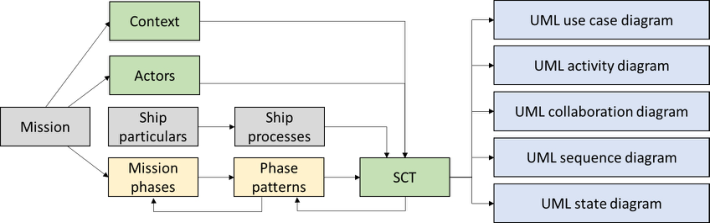
METHODOLOGY OVERVIEW The goal of the methodology is to formally describe the Concept of Operation (CONOPS) of an autonomous ship system. Figure 1 shows the framework of the methodology.
The mission is defined as the overall operation that the ship system exe- cutes, which may for instance be a certain voyage with port calls and cargo
Figure 1: Framework of the methodology.
Keeping the Human Element to Secure Autonomous Shipping Operations 13
operations. Further, more details are added by defining the context (the exter- nal entities and systems that the ship system cannot control), the internal actors of the ship system, and also the various mission phases that the mission consists of. Examples of mission phases are automatic sailing, supervised sai- ling, cargo operation, port navigation, berthing and deberthing. Also, some of the ship particulars (information about the ship, e.g., size, speed, equipment and sensors) must be described to be able to further cover the actual ship processes that the autonomous ship system must handle. Examples of ship processes are navigation, cargo handling and energy production. To decrease model complexity, similar mission phases should be generalized into a mis- sion phase pattern. This may be an iterative process, meaning that the initial definition of the mission phase may need to be changed after the mission phase pattern has been defined (the arrow from Phase patterns to Mission phases in Figure 1).
When the patterns have been defined, the system control tasks (SCT) and their prose definitions can be developed, again with a possibility for revi- sing the patterns. SCTs are defined as “process control tasks, implemented by automation and/or humans, that are required to sustainably operate the autonomous ship system within its operational envelope” (ISO, 2022). The SCT also needs to consider the actors and context to determine how auth- ority is shared between the automation and humans. In this methodology, we have a particular focus on the hand-over between the Remote Control Center (RCC) operator and the autonomous onboard controller (AOC) both operating the ship.
Finally, the SCT descriptions can be converted to Unified Modelling language (UML) diagrams, which are part of a language for system analysis and design stemming from the mid-1990s and managed by the Object Management Group (OMG) (Dobing and Parsons, 2006). These are also the basis for the security analysis. The advantage of this metho- dology is that it allows for a smooth transition from the autonomous ship system design phase to the assessment of the system using the same UML notation.
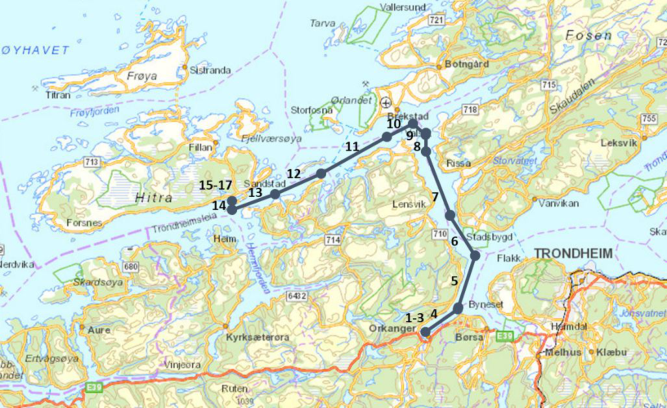
EXAMPLE CASE STUDY: TRONDHEIMSFJORD AREA In this section we exemplify the methodology, using parts of a real-world use case covering autonomous transport of goods between Orkanger to Sandstad (for further transshipment) in the Trondheimsfjord area of Norway. Though the example is not complete, it shows how different UML diagrams can be used to formalize the description of the CONOPS and used in a security analysis. This mission is depicted in Figure 2 and the context can be descri- bed as sailing in an area with both leisure- and goods traffic of various sizes, hereunder motorized and non-motorized boats and ships. Since the fjord is relatively narrow with varying traffic situations, sailing in with a large con- tainer ships is not desirable. Instead, smaller autonomous container feeder vessels can do last mile delivery and retrieval of goods inside the fjord (e.g., Orkanger), while the larger ships dock at an outer island (Sandstad port at Hitra).
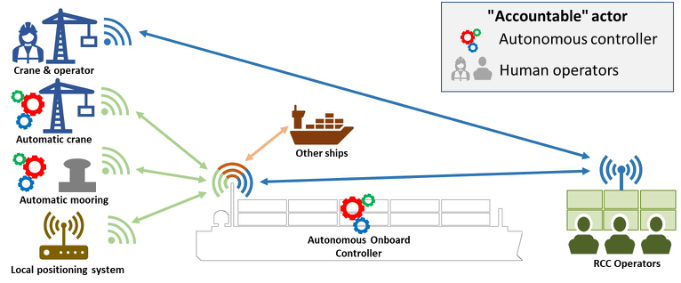
Figure 2: Mission: Voyage from Orkanger to Sandstad consists of 17 mission phases.Figure 3: Central elements from the case study example.
Figure 3 illustrates central elements from context, actors and ship particu- lars that are used in this case study. The container feeder vessel is operated by an AOC with different levels of RCC attention. Communication and positioning systems are vital for avoiding static and dynamic objects sur- rounding the ship, as well as berthing/deberthing and cargo operations with manual/automatic cranes.
The most relevant ship process in this example is navigation, which again can be broken down into critical tasks such as (Rødseth, Lien Wennersberg and Nordahl, 2022):
Situational awareness, that is, to verify the location, observe weather and sea, determine visibility, detect and classify objects and obstacles and assess own ship and the traffic situation.
Maneuvering the ship, which is short term planning of safe operations. This includes keeping track, speed and course, avoiding static and dynamic obstacles, berthing and deberthing.
Keeping the Human Element to Secure Autonomous Shipping Operations 15
Table 1. Mission phases and mission phase patterns.
Table available in the original PDF paper.
Phase Description Mission phase patterns RCC Attention Direct
1 Cargo operations in Orkanger (Manual)
Manual cargo operation
Automatic sailing Medium/low
2 Deberth Orkanger Deberthing High 3 Departure Orkanger Port navigation Medium 4 – 9, 11–14 Sailing in low density waters towards Sandstad Supervised sailing High 10 Sailing in high traffic density/complexity area
High
15 Arrival Sandstad Port navigation Medium 16 Berthing Sandstad Berthing High 17 Cargo operations Sandstad (Automatic)
Automatic cargo operations
Automatic sailing Medium/low
18 Deberth Sandstad Deberthing High 19 Departure Sandstad Port navigation Medium 20-23, 25–30 Sailing in low density waters towards Orkanger Supervised sailing High 24 Sailing in high traffic density/complexity area
31 Arrival Orkanger Port navigation Medium 32 Berthing Orkanger Berthing High
Voyage management, which is planning and re-planning of the voyage done by the RCC operator, including acting on deviations that are not handled by the ship itself.
Communication during voyage, that is, communication involving other ships, the RCC and Vessel Traffic Services (VTS).
Table 1 shows how the mission is divided into 32 discrete mission phases. This includes cargo operations, deberth and departure in Orkanger (phase 1-3), sailing outbound to Sandstad (phase 4-14) and arrival, berthing and cargo operations in Sandstad (phase 15-17). A similar phase organization is used towards Orkanger for the returning goods (phase 18-32). The mission phases have been mapped towards seven mission phase patterns to simplify the analysis. The reason why phase 1 has manual cargo operations, while phase 17 has automatic, is that Orkanger does not have autonomous crane equipment installed. The RCC attention column gives a rough indication of the need for operator attention during the different phases.
Direct means that the RCC operator must directly control the operation. High means that the operation is critical and continuous attention is needed, although operation will normally be automatic (e.g., mission phases 10 and 24 are in an area with frequent ferry crossings). Medium means that the ope- rator may be called to intervene if the traffic situation becomes too complex for the automation and low means that the system will be able to handle the automatic operation by itself and that any deterioration of the situation will not happen suddenly.
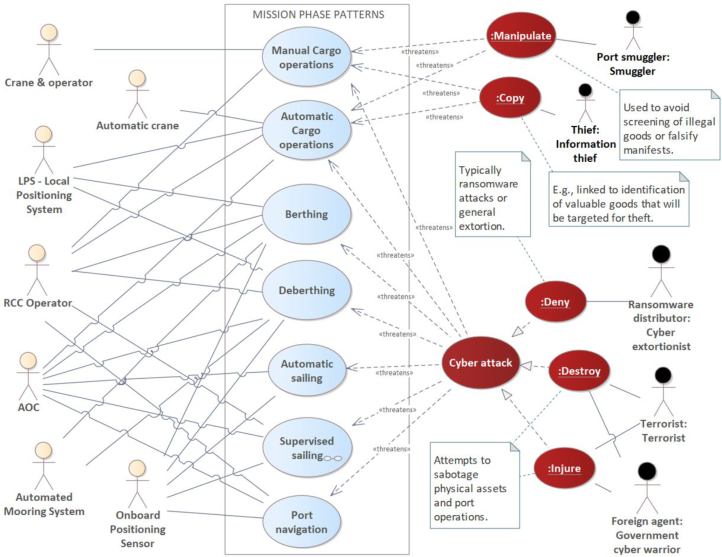
At this point we have enough information to initiate the security analysis by considering the malicious intents for potential threat actors for each of the identified mission phase patterns. This is depicted as a high-level UML use case description in Figure 4. Intents and threat actors are selected and specialized from a pre-existing library for the maritime domain, and depicted using the misuse case notation by Sindre and Opdahl (2005).
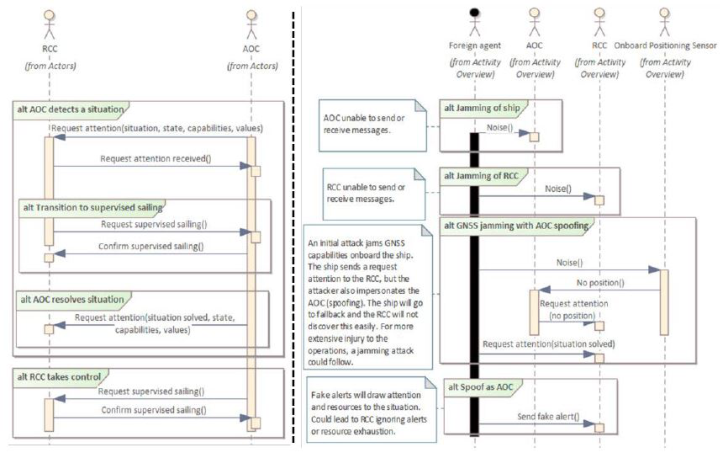
The system control tasks (SCT) define the desired level of human interven- tion versus automation for the mission phase patterns. Special focus is on the hand-over between humans and automation systems, since we cannot expect that the autonomous ship will be capable of taking all decisions by itself. In such cases, the RCC must be alerted to take over the control of the ship. Fur- ther, we must take into consideration that communication systems between the ship and the RCC and other ship particulars are exposed to both technical errors and intentional attacks. Figure 5 shows two UML sequence diagrams related to the automatic sailing pattern. The left part shows the normal situa- tion, where the RCC Operator will be in a monitoring state, and some time is needed to get situational awareness and transition to supervised sailing. The initiative for this transition can come from both the RCC and the AOC. In the right part of the figure, we have broken the injure intent from Figure 4 into more specific attack scenarios. Here, jamming of the AOC or RCC may stop the normal transition between automatic and supervised sailing. More advanced attack steps are feasible as well, where jamming is combined with
Figure 4: UML use case showing actors and mission phase patterns linked to misuse case activities and threat actors.
Keeping the Human Element to Secure Autonomous Shipping Operations 17
Figure 5: Expected behavior (left) and attack scenarios (right).
spoofing to make the RCC believe that a situation is solved when it is not, putting the AOC in an uncertain state. Also, sending fake alerts to the RCC could lead to resource exhaustion or security fatigue, which is another threat towards the operations.
In our case study we have similarly to the example in Figure 5 created attack scenarios for all the mission phase patterns and malicious intents. Together with subject-matter experts, we have estimated values for threat likelihoods based on the size of the group of potential threat actors identi- fied in the UML models, the opportunities or favorable circumstances for an attack during the given mission phase patterns, the means the threat actors would require to perform the attacks as described in the attack scenarios and finally the motivation for the threat actors, which greatly depends on the expected reward in case of a successful attack. This is in accordance with the storyless system concept (Meland, 2021) and the axiom by Anderson (2020) that “One of the first things the security engineer needs to do when tackling a new problem is to identify the likely opponents” and “…what sort of capabilities will the adversaries have, and what motivation?”.
Our results show that it is the deny- and injure-intents that have the highest likelihood values in all mission phase patterns. This is in accordance with the general attack trends within the maritime domain (Meland et al., 2021; Park et al., 2023) and other sectors, where financially motivated attackers will try to demand a ransom, typically through malware injections or denial-of- service attacks. Complex attacks can create more disturbance, but are also more expensive and complex to perform, thus requiring highly motivated threat agents. Berthing/deberthing and cargo operations have the strictest real-time requirements to communication and control. In these cases, the ship
is close to shore, and more alternative communication systems are available. This makes attacks more difficult, but it is also in these situations where infli- cted damage could be greatest. In general, hand-over between AOC and RCC is a critical phase as the autonomous ship system needs to be sure who is the accountable party at every point in time. There are several ways in which an attacker could try to block or trigger hand-over unnecessarily, causing disru- ptions or delays in the operations. As a worst case, the attacker could gain control of the ship through supervised sailing.
CONCLUSION
Autonomous shipping operations are in the process of being realized around the world. However, the human element is still vital in managing situations where the automation falls short. Furthermore, the reliance on new techno- logies, such as computer vision and AI reasoning onboard autonomous ships or cranes, opens for new attack types that the industry has little experience with as of now. Therefore, there is a need for a continued risk assessment based on the context, involved actors, ship particulars/processes and mis- sion phases for the individual missions. Our methodology focuses on finding critical situations where cyber-attacks threaten these operations, especially related to the interplay between the automation and human operators. Fur- ther work intends to also apply the methodology on other specific missions, such as inland waterway missions in central Europe.
ACKNOWLEDGMENT
This work has been funded by the European Union’s Horizon 2020 resea- rch and innovation programme under grant agreement No 859992 (AEGIS - Advanced, Efficient and Green Intermodal Systems). Many thanks to Egil Wille and Marianne Hagaseth for their valuable input to this work.
REFERENCES
Anderson, R. (2020) Security engineering: a guide to building dependable distributed systems. John Wiley & Sons. Bolbot, V. et al. (2020) ‘A novel cyber-risk assessment method for ship systems’,
Safety Science, 131, p. 104908. Available at: https://doi.org/10.1016/j.ssci.2020. 104908. Burmeister, H.-C. et al. (2014) ‘Autonomous unmanned merchant vessel and its contribution towards the e-Navigation implementation: The MUNIN perspective’, International Journal of e-Navigation and Maritime Economy, 1, pp. 1–13. Cimpean, D. et al. (2011) Analysis of cyber security aspects in the maritime sector.
ENISA. Available at: https://www.enisa.europa.eu/publications/cyber-security-as pects-in-the-maritime-sector-1/at_download/fullReport. Dobing, B. and Parsons, J. (2006) ‘How UML is used’, Communications of the ACM, 49(5), pp. 109–113. Grigoriadis, C. et al. (2022) ‘An Adaptive, Situation-Based Risk Assessment and Secu-
rity Enforcement Framework for the Maritime Sector’, Sensors, 22(1), p. 238. Available at: https://doi.org/10.3390/s22010238.
Keeping the Human Element to Secure Autonomous Shipping Operations 19
IMO (2022) Maritime Safety Committee (MSC 106), 2–11 November 2022. Available at: https://www.imo.org/en/MediaCentre/MeetingSummaries/Pages/MSC- 106.aspx (Accessed: 25 January 2023). ISO (2022) ISO/TS 23860:2022 Ships and marine technology — Vocabulary related
to autonomous ship systems. Available at: https://www.iso.org/standard/77186. html (Accessed: 24 January 2023). Meland, P. H. et al. (2021) ‘A retrospective analysis of maritime cyber security incidents’, The International Journal on Marine Navigation and Safety of Sea Transportation, 15(3). Available at: https://doi.org/10.12716/1001.15.03.04. Meland, P. H. (2021) Storyless cyber security: Modelling threats with econo-
mic incentives. NTNU. Available at: https://ntnuopen.ntnu.no/ntnu-xmlui/hand le/11250/2825312. Meland, P. H. et al. (2022) ‘Assessing cyber threats for storyless systems’, Journal of Information Security and Applications, 64, p. 103050. Mrakovi´c, I. and Vojinovi´c, R. (2019) ‘Maritime cyber security analysis–how to
reduce threats?’, Transactions on maritime science, 8(01), pp. 132–139. Park, C. et al. (2023) ‘A BN driven FMEA approach to assess maritime cybersecurity risks’, Ocean & Coastal Management, 235, p. 106480. Available at: https://doi. org/10.1016/j.ocecoaman.2023.106480. Rødseth, Ø. J. et al. (2021) ‘Operational Design Domain for Cars versus Operational
Envelope for Ships: Handling Human Capabilities and Fallbacks’, in Proceedings of the 31st European Safety and Reliability Conference. Rødseth, Ø. J., Lien Wennersberg, L. A. and Nordahl, H. (2022) ‘Towards approval of autonomous ship systems by their operational envelope’, Journal of Marine Science and Technology, 27(1), pp. 67–76. Rødseth, Ø. J., Wennersberg, L. A. L. and Nordahl, H. (2021) ‘Improving safety of
interactions between conventional and autonomous ships’, in 1st International Conference on the Stability and Safety of Ships and Ocean Vehicles, pp. 7–11. Sindre, G. and Opdahl, A. L. (2005) ‘Eliciting security requirements with misuse cases’, Requirements Engineering, 10(1), pp. 34–44. Available at: https://doi.org/ 10.1007/s00766-004-0194-4. Svilicic, B. et al. (2019) ‘Maritime cyber risk management: An experimental ship
assessment’, The Journal of Navigation, 72(5), pp. 1108–1120. Tam, K. and Jones, K. (2018) ‘Cyber-Risk Assessment for Autonomous Ships’, in 2018 International Conference on Cyber Security and Protection of Digi- tal Services (Cyber Security). 2018 International Conference on Cyber Security and Protection of Digital Services (Cyber Security), pp. 1–8. Available at: https: //doi.org/10.1109/CyberSecPODS.2018.8560690. Tusher, H. M. et al. (2022) ‘Cyber security risk assessment in autonomous shipping’,
Maritime Economics & Logistics, 24(2), pp. 208–227. Available at: https://doi.or g/10.1057/s41278-022-00214-0.
LISTED IN THE AHFE DIGITAL BOOKSTORE CATALOGUE
Explore the complete digital volume
Human Factors in Cybersecurity
Read this individual research paper free through the original publisher, or explore the full digital proceedings book.
ISBN 978-1-958651-67-4
Explore this ISBN in the AHFE Bookstore ↗Listed in the July 2026 bookstore catalogue; search by ISBN to confirm current availability · Digital book purchase optional