Pascal Bratke, Roland Zimmermann, Ralph Blum (2023). Fostering text mining with knowledge graphs: An approach to support business experts in defining domain-specific document sets. In: The Human Side of Service Engineering. AHFE Open Access, vol. 108, pp. 264–272. https://doi.org/10.54941/ahfe1003128
Text mining techniques offer an efficient approach to extract information from text-based data, such as online news, for strategic planning tasks like the scenario technique. Data selection and data preprocessing is a crucial step in this process, during which decisive search terms help to sharpen the text corpus for downstream text mining activities. The integration of business knowledge is crucial for the creation of high-quality domain-specific document sets. Manually defining search terms is a time-consuming task for managers. Knowledge graphs accelerate this vital process: Based on a few initial search terms, related domain-specific subgraphs are selected which yield additional search terms that cannot be retrieved via thesauri or mere semantic similarity comparisons. Furthermore, possible biases introduced by subjective expert assessments are avoided and a more objective data selection is realized. The concept is demonstrated in a use case on electric mobility including an online demonstrator (www.digital-scenarios.com).
PROBLEMS IN SEARCH SPACE DELIMITATION: BIASES AND SCARCE EXPERT RESOURCES Using the scenario technique for strategic and tactical planning is a com- mon approach which suffers efficiency due to time-consuming data collection (mainly from text sources) and text analysis (Backhaus et al. 2018). Consequ- ently, methods of automated text analysis are increasingly used for creating foundations for management related tasks like the creation of scenarios (Kölbl et al. 2019). In this context, data retrieval aims to provide domain- specific input documents which aid to focus downstream text analysis on topics relevant for the scenario domain, e.g. in order to ensure fine-tuning through transfer learning to adopt generalized language models to a specific domain. To sharpen the search space in the discovery phase of data mining processes the domain knowledge of experts has been widely used for many years (Anand et al. 1995). Even today, hybrid approaches integrate experts
into the foresight process supported by artificial intelligence to improve the quality of data mining results (Bakker and Budde, 2012).
In order to generate domain-specific document sets for text mining algo- rithms, one possible task of experts could be the definition of hundreds of relevant search terms (Backhaus et al. 2018). Another approach is to let humans mark documents as relevant manually (Kayser and Shala, 2016). Such selection processes which only rely on human inputs can lead to biased document sets since they are strongly influenced by the subjective assessments (and knowledge limitations) of the process participants (Mietzner, 2009). The manual definition of hundreds of search terms is not only a potential gate- way for biased document sets, but also time-consuming. This relationship is described as a quality-efficiency trade-off in machine learning for text proces- sing (Baeza-Yates and Liaghat, 2017). Scarce and expensive expert resources can therefore have a limiting effect on the quality of the domain-specific document set and thus also negatively influence the text mining results.
In this paper, we present an approach to support experts in the creation of domain-specific document sets for downstream text mining that utilizes kno- wledge graphs. We address the problem of biases and the trade-off between quality and efficiency in text data collection.
Utilizing Knowledge Graphs for Search Space Delimitation In the field of information retrieval, the importance of knowledge graphs (KG) has increased in recent years (Dietz et al. 2017). A KG allows know- ledge to be represented in a machine-processable way. The basic elements of a KG are entities. An entity can represent describable objects such as a per- son, place, technology, or company. Entities can be further characterized with attributes, such as the number of employees of a company. A KG links a large number of such entities through relationships, which themselves can have their own attributes, too. For example, a KG can map the relationships betw- een an entity Electric mobility as a super category with entities of the subtypes Electric Car, Hybrid Car and Hydrogen Car. The concept of semantic simi- larity of entities allows to select semantically related entities for information retrieval from a KG: Based on a few initially defined entities, further simi- lar, potentially relevant entities can be identified (Hliaoutakis et al. 2006), (Stankovic et al. 2011). Using the example from above, an initial search term Electric Car can be used to automatically infer the more general entity Electric Mobility via their relationship. From this super category the next relation- ship to a subordinate category can also be automatically inferred resulting in a new possible search term Hydrogen Car. Such similarity inference pro- vides new search criteria that go well beyond a thesaurus-based search: In the example, a hydrogen-based car is certainly not a typical synonym for a battery-based electric car. Employing KGs to infer additional search terms aids to more comprehensively describe the relevant domain for scenario deve- lopment. We believe that this helps to reduce biases induced by restricted individual knowledge of experts and at the same time increases the efficie- ncy in creating a more comprehensible set of search terms for a domain in question.
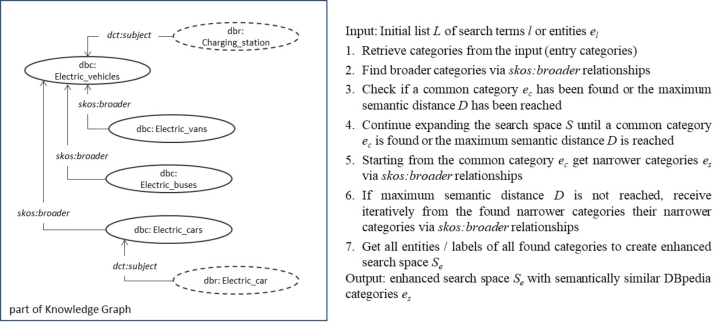
Figure 1: KG approach to retrieve entities for domain specific document set filtering.
Figure available in the original PDF paper.
Global knowledge graphs are freely available and contain very many enti- ties. Thus, they offer great potential for semantic similarity searches: For example, DBpedia describes 6,000,000 entities, including 1,500,000 peo- ple, 810,000 places, and 270,000 companies (Holze, 2016) or Wikidata that contains over 100.000.000 items (Wikidata, 2023).
The freely accessible global knowledge graph DBpedia was created auto- matically using Wikipedia as the data basis (Paulheim, 2013). Each entity of the knowledge graph is based on a Wikipedia page. The categorization of pages stored in Wikipedia was also used to classify the entities stored in DBpedia. Thus, entities can be selected based on categories. In addition, the individual categories are linked in the sense of super- and subcatego- ries. Accordingly, thematically narrower categories and their entities, as well as more general categories and their entities can be selected. Relationships between categories are described by skos:broader relationships. However, skos:broader relationships are not transitive, thus hierarchical inference can only occur between two directly related categories. If there are several hie- rarchical levels between the categories, such an inference can no longer be made. In order to be able to determine completely hierarchical relationships over several hierarchy levels, the relationship types skos:broaderTransitive and skos:narrowerTransitive are necessary. However, these relationships are not stored in DBpedia.
Alternatively, other metrics can be used when considering multi-level cate- gory relationships. For example, the path length between categories can be used to determine their semantic similarity (Rada et al. 1989). A high cor- relation with human perception of similarity was found by using distances between DBpedia categories to measure similarity (Senoussi, 2018).
Stankovic et al. used these contexts and, based on DBpedia, identified relevant topics for an open innovation process. For this purpose, initial concepts were first defined on the basis of an innovation problem. Based on these concepts, an algorithm identified further relevant concepts in the next step using skos:broader relationships. As a result, relevant topics for the innovation process could be identified (Stankovic et al. 2011).
Extract Domain-Specific Entities From a Knowledge Graph Our approach to delimit and thus enlarge the search space for documents that serve as input to downstream text-mining activities (which identify and characterize factors relevant to strategic scenario modeling) consists of five steps (Fig. 1).
Choose Knowledge Graph: As indicated, a number of globally available knowledge graphs exist which can be used to identify related keywords. The following section is based on the DBpedia graph.
Fostering Text Mining With Knowledge Graphs 267
Define initial keywords: An initial search word list L with search words s, which are available, for example, as the result of an expert workshop, is the starting point for narrowing down the search space S. This search word list is used to identify initial entities el in DBpedia that represent the search words s. In the example in section 2, the keyword “charging station” can be related to the DBpedia resource “Charging Station”.
Find suitable common category: In order to identify further DBpedia entities e, the concept of semantic similarity is used: With the help of the initial list L and the associated categories el, the search space S is exten- ded iteratively along skos:broader relationships. A maximum permissible distance D between the categories of initial entities el and their common category ec has to be defined. In the example in Figure 2, the common category dbc:Electric_vehicles can be identified based on the initial entities dbr:Charging_station and dbr:Electric_car.
Retrieve categories and entities: Once common DBpedia categories ec have been identified, it is possible in the next step to find further semantically similar DBpedia categories es by following skos:broader relationships in the opposite direction: starting from the most common category, narrower cate- gories within the maximum semantic distance are identified via skos:broader relations. The entities of all found entities and/or their labels are returned as output.
As a result, a subgraph with reference to the environment is derived from the DBpedia knowledge graph, which represents the enhanced search space Se. If necessary, this subgraph can be manually curated and further restricted, e.g., to exclude subcategories that are definitely irrelevant for a search envi- ronment from an expert’s point of view. Furthermore, certain concepts that are not very suitable for environment delimitation, e.g., because they repre- sent people or books, can be automatically excluded from the search space (Stankovic et al. 2011).
Use entities or their labels to filter documents: The entities es identi- fied from the KG are used in downstream natural language processing for
Figure 2: Identification of similar entities on the topic electric vehicles based on two initial entities. dbc = DBpedia category; dbr = DBpedia resource.
strategic planning to search and filter document sources: Either they can be used as plain keywords creating a list of search terms or in case a larger set of documents has already been pre-analyzed regarding entity types a search based on these entities can be induced.
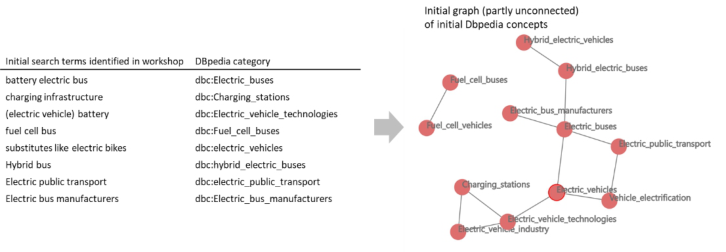
Use Case: Supporting Experts in Building a Document Set for the Electric Mobility Domain The following case study is based on results of a project of the Fraunhofer IIS Future Engineering group (Fraunhofer, 2023). The aim of the underlying project is to identify factors to support scenario modeling for the topic of e- mobility and to monitor these factors over a longer time frame for an energy provider. The company’s management aims to gain insight into the evolving market of electromobility to strategically decide on investments e.g. into char- ging infrastructure. The documents for analyzing the relevant market domain stem from RSS feeds and scientific publications vaguely related to the topic of electromobility. A detailed selection of texts from this corpus for the sce- nario development process is based on initial search terms which have been generated in a workshop with experts of the energy provider (see Figure 3). The search terms are mapped to semantically matching DBpedia categories where some of them are directly linked while the concepts fuel_cell_buses and fuel_cell_vehicles are not directly linked to any of the other concepts (see graph in Figure 3).
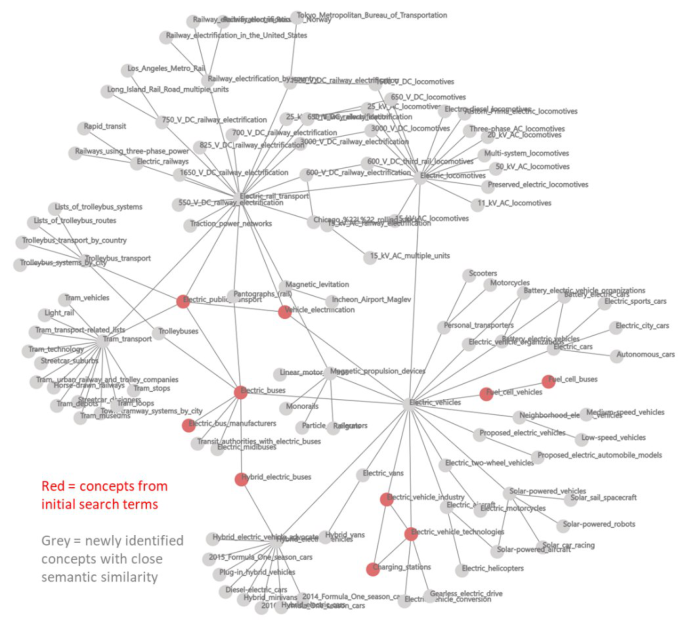
Using the semantic similarity approach defined above, more than 100 addi- tional concepts are identified that are of potential interest for the scenario process of the energy provider (see Figure 4 and https://tinyurl.com/Search-S pace-Enhancement for an interactive version).
The graph clearly depicts some central, “common” concepts in especially electric_vehicles and electric_rail_transport that enabled the search algori- thm to find relevant subordinate concepts such as solar_powered_vehicles or specific variants of railway_electrification that enlarged the search space for possibly relevant texts to be retrieved from the text sources.
Based on these newly identified entities, search word lists could have been created. In this project, however, a large document set annotated with
Figure 3: Initial search terms and their relationships based on mapped DBpedia categories.
Fostering Text Mining With Knowledge Graphs 269
Figure 4: Enlarged search space as a subgraph automatically derived from DBpedia.
DBpedia Spotlight was already available. Thus, the entity definitions were used directly to filter relevant text documents for further processing resulting in a set of more than 18,000 documents for the period from January 2019 to June 2020.
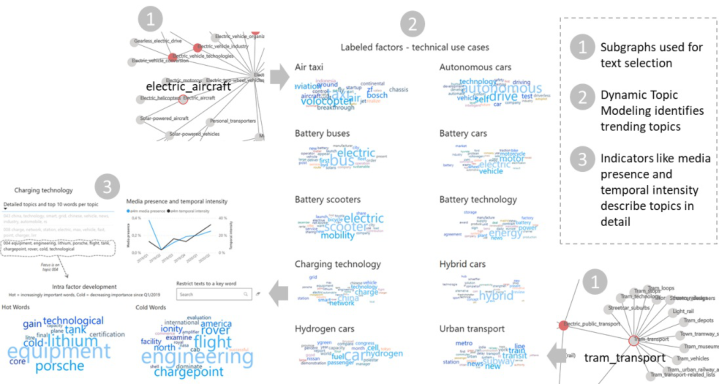
Subsequent processing of these texts consisted of natural language pro- cessing tasks based especially on the concept of Dynamic Topic Modelling which was used to automatically extract topics of relevance from the source texts (Blei and Lafferty, 2006). Further analysis of the automatically identified topics consisted of calculating indicators such as media presence or tempo- ral intensity which allow characterization of importance and developments between and within topics. Qualitative changes over time result in new pri- mary key words in these topics. These changes are identified by calculating hot and cold words (see Figure 5 bottom left).
Figure 5 additionally illustrates how some newly identified search conce- pts derived from the KG (e.g. electric_aircraft or tram_transport) align well with topics that evidently exhibit relevant developments in the analyzed text corpus. Examples are shown with word clouds on Air taxi and Urban tran- sport. The ten technological topics are subsequently used by the energy provider as potential influencing factors for scenario development. These downstream text mining results can be experienced individually by readers at www.digital-scenarios.com.
Figure 5: Connection between KG-based search term identification and downstream text mining for topic trend-detection.
CONCLUSION
The semantically enhanced search-space delimitation allowed us to iden- tify a large number of search criteria which were not present in the initial set of search strings of the use case. Even with a simple set of initial search terms, environment-specific entities such as range anxiety, vehicle-to-grid concept, or the electric vehicle network as an infrastructure system could be identified. Since there is no standard for defining sea- rch strings, the assessment of the quality of additionally identified search criteria remains subjective. Readers are invited to test the sample implemen- tation at www.digital-scenarios.com/search-space-expansion. It allows users to insert their individual key words and then try to find common concepts and semantically similar additional entities. Results are visualized in a graph visualization.
Further exploration is required regarding a viable maximum permissible distance. A higher distance will lower the average relatedness between the entry entity and the identified entity. In our tests we observed that with a maximum permissible distance greater than three the identified entities were partially not similar enough according to human judgment. Other researchers also uncovered this relationship before (Senoussi, 2018).
The procedure for search space expansion described in this paper can be characterized as a basic technical approach. Several advanced approaches for identifying similar concepts from initial search criteria have been described in the literature e.g. (Stankovic et al. 2011) or (Wenige et al. 2019). We therefore assume that the quality of the search space can be further improved by using additional methods for the selection of concepts and by implementing further filter criteria as well as automated cleansing procedures. In addition, it should be examined to what extent other Linked Open Data resources can be used for search space delimitation.
Fostering Text Mining With Knowledge Graphs 271
We have addressed that by using knowledge graphs for keyword definition, the bias can be reduced compared to a purely human keyword definition. However, since knowledge graphs such as DBpedia are also affected by human influences, we would like to mention that they are not completely free of bias either (Voit and Paulheim, 2021).
REFERENCES
Anand, S. S., Bell, D. A., Hughes, J. G.: The role of domain knowledge in data mining.
In: Pissinou, N., Silberschatz, A., Park, E. K., Makki, K., Nicholas, C. (eds.) Pro- ceedings of the fourth international conference on Information and knowledge management - CIKM ‘95, pp. 37–43. ACM Press, New York, USA (1995). Backhaus, K., Paulsen, M.: Szenarioanalyse - Verbesserungen aus der Müsteraner Effizienzwerkstatt. In: Jürgen Gausemeier, Wilhelm Bauer, Roman Dumitrescu (ed.) Vorausschau und Technologieplanung. 14. Symposium für Vorausschau und Technologieplanung, pp. 261–285 (2018). Baeza-Yates, R., Liaghat, Z.: Quality-Efficiency Trade-offs in Machine Learning for
Text Processing. arXiv (2017). Bakker, S., Budde, B.: Technological hype and disappointment: lessons from the hydrogen and fuel cell case. Technology Analysis & Strategic Management, vol. 24, 549–563 (2012). Blei, D. M., Lafferty, J. D.: Dynamic topic models. In: Cohen, W., Moore, A. (eds.)
Proceedings of the 23rd international conference on Machine learning - ICML’06, pp. 113–120. ACM Press, New York, USA (2006). Dietz, L., Kotov, A., Meij, E.: Utilizing Knowledge Graphs in Text- centricInformation Retrieval. In: Rijke, M. de, Shokouhi, M., Tomkins, A., Zhang, M. (eds.) Proceedings of the Tenth ACM International Conference on Web Search and Data Mining - WSDM ‘17, pp. 815–816. ACM Press, New York, USA (2017). Fraunhofer (2023). Fraunhofer Future Engineering Group - Website: https://www.th -nuernberg.de/en/facilities/fraunhofer-research-groups/future-engineering/ Hliaoutakis, A., Varelas, G., Voutsakis, E., Petrakis, E. G., Milios, E.: Informa-
tion Retrieval by Semantic Similarity. International Journal on Semantic Web and Information Systems (IJSWIS), vol. 2, 55–73 (2006). Holze, J.: YEAH! We did it again ;) – New 2016–04 DBpedia release (2016), https://blog.dbpedia.org/2016/10/19/yeah-we-did-it-again-new-2016-04-dbpedi a-release/ Kayser, V., Shala, E.: Generating Futures from Text—Scenario Development Using
Text Mining. In: Daim, T. U., Chiavetta, D., Porter, A. L., Saritas, O. (eds.) Anticipating Future Innovation Pathways Through Large Data Analysis. Inno- vation, Technology, and Knowledge Management, vol. 3, pp. 229–245. Springer International Publishing, Cham (2016). Kölbl, L., Mühlroth, C., Wiser, F., Grottke, M., Durst, C.: Big Data im Innovationsmanagement: Wie Machine Learning die Suche nach Trends und Technologien revolutioniert. HMD, vol. 56, 900–913 (2019). Mietzner, D.: Strategische Vorausschau und Szenarioanalysen. Methodenevalua-
tion und neue Ansätze. Gabler Verlag / GWV Fachverlage GmbH Wiesbaden, Wiesbaden (2009). Paulheim, B.: Type Inference on Noisy RDF Data. In: Alani, H., Kagal, L., Fokoue, A., Groth, P., Biemann, C., Parreira, J. X., Aroyo, L., Noy, N., Welty, C., Janowicz, K. (eds.) The Semantic Web - ISWC 2013: 12th International Semantic Web Conference, Sydney, NSW, Australia, October 21-25, 2013, Proceedings, p. 516. Springer Berlin Heidelberg (2013).
Rada, R., Mili, H., Bicknell, E., Blettner, M.: Development and application of a metric on semantic nets. IEEE Trans. Syst., Man, Cybern., vol. 19, 17–30 (1989). Senoussi, H.: Using DBpedia Categories to Evaluate and Explain Similarity in Lin-
ked Open Data. In: Fred, A., Filipe, J. (eds.) Proceedings. Volume 1, KDIR, pp. 117–127. Science and Technology Publications, [S. l.] (2018). Stankovic, M., Breitfuss, W., Laublet, P.: Discovering Relevant Topics Using DBPedia: Providing Non-obvious Recommendations. In: 2011 IEEE/WIC/ACM International Conferences on Web Intelligence and Intelligent Agent Technology, pp. 219–222. IEEE (2011). Voit, M. M., Paulheim, H.: Bias in Knowledge Graphs -- an Empirical Study with
Movie Recommendation and Different Language Editions of DBpedia. arXiv (2021). Wenige, L., Berger, G., Ruhland, J.: SKOS-Based Concept Expansion for LOD- Enabled Recommender Systems. In: Garoufallou, E., Sartori, F., Siatri, R., Zervas, M. (eds.) Metadata and Semantic Research. Communications in Computer and Information Science, vol. 846, pp. 101–112. Springer International Publishing, Cham (2019). Wikidata (2023), https://www.wikidata.org/wiki/Wikidata:Statistics.
LISTED IN THE AHFE DIGITAL BOOKSTORE CATALOGUE
Explore the complete digital volume
The Human Side of Service Engineering
Read this individual research paper free through the original publisher, or explore the full digital proceedings book.
ISBN 978-1-958651-84-1
Explore this ISBN in the AHFE Bookstore ↗Listed in the July 2026 bookstore catalogue; search by ISBN to confirm current availability · Digital book purchase optional