The rate of penetration (ROP) in drilling operations is a critical factor that can significantly affect the overall cost of drilling activities. Achieving an optimum ROP is crucial in reducing non-productive time and increasing drilling efficiency. In this study, we proposed a novel approach to predict ROP using a hybrid method Extreme Learning Machine and Grey Wolf Optimization algorithm (ELM-GWO). We use the Grey Wolf Optimization (GWO) algorithm for optimizing the weights and biases between input and hidden layers of ELM and updating the predictive model at each formation to reduce the dimension of input data and mitigate the impact of non-real-time data, such as formation properties, on the bit speed prediction. The model has been trained and tested using data collected from an Algerian field. The results of the statistical and graphical evaluation criteria showed that the ELM-GWO model exhibited higher accuracy and generalization performance compared to the ELM-PSO (Particle Swarm Optimization) and ELM-WOA (Whale Optimization Algorithm) models.
Drilling operations in the oil and gas industry are complex and challenging, and accurate modelling of the rate of penetration is crucial for optimizing drilling performance and reducing costs. In recent years, machine-learning techniques have shown promise for accurately predicting drilling parameters. However, there is still a need for more advanced modelling approaches that can handle the highly nonlinear and complex drilling dynamics. In this study, we propose a novel approach for modelling the rate of penetration during drilling operations, by combining the extreme learning machine (ELM) and the whale optimization algorithm (GWO). Our hybridization approach leve- rages the strengths of both algorithms, resulting in a more accurate and efficient model. We evaluate our approach using real-world drilling data, and show that it outperforms other modelling techniques in terms of accuracy and computational efficiency. Our findings have significant implications for the oil and gas industry, and can lead to improved drilling performance and cost savings.
Optimizing Rate of Penetration in Drilling Operations With Metaheuristic Algorithm 209
METHODOLOGIES Extreme Learning Machine (ELM)
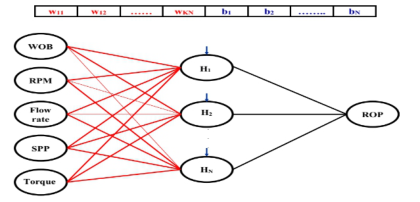
The ELM is another machine-learning tool which was introduced by (Huang et al., 2004) to avoid some obstacles encountered by BP-ANN, such as the high possibility of being trapped in a local minimum and the slow speed of the training process. Unlike MLP, ELM has a single hidden-layer and the weight and bias coefficients between the input layer and hidden layer are randomly assigned before the learning process. Once generated, the hidden layer wei- ghts do not need to be adjusted, while the output weights are analytically computed using a simple generalized inverse operation of the hidden layer output matrix. The schematic of the architecture of the proposed ELM model for ROP prediction is shown in Fig. 1. Considering that K training samples are available, the steps of ELM can be summarized as below (Huang et al., 2006): Step 1 Using the trial-and-error method, determine the number N of hidden nodes (N < K) and the transfer function f(x) Step 2 Generate randomly the weight wij and bias bj values of the hidden layer (i = 1,2, 3..., K) and (j = 1,2, 3..., N)
Step 3 Calculate the output matrix of the hidden layer H as described below: [Equation or mathematical symbol available in the original paper PDF][Equation or mathematical symbol available in the original paper PDF] f(x1 ∗w11 + b1) · · · f(x1 ∗w1N + bN) H = [Equation or mathematical symbol available in the original paper PDF][Equation or mathematical symbol available in the original paper PDF] ... ... ... f(xK ∗wk1 + b1) · · · f(xk ∗wkN + bN)
Step 4 Calculate the output weights β= [β1, β2, β3….., βK] using the following equation:
Equation reproduced from the original PDF.
Where H is the Moore-Penrose generalized inverse of the hidden-layer output matrix T.
Of note is that the input weight and bias values that are randomly gene- rated accelerate immensely the learning speed of ELM. Meanwhile, this procedure may produce possible non-optimal or unnecessary values of weight and bias, which means that the ELM requires more hidden neurons to achieve high performance. To overcomes these shortcomings which may degrade the performance and generalization ability of ELM we employed in this paper
Figure 1: ELM structure for ROP prediction.
210 Kenioua and Djebili
three naturally inspired algorithms, viz. WOA, PSO and GWO to find the optimal input weights and biases of ELM
Grey Wolf Optimizer (GWO) Grey wolf optimizer (GWO) is a metaheuristic algorithm which was proposed by Mirjalili et al. (2014). This algorithm has been inspired by the leadership hierarchy and the hunting mechanism of grey wolves. Grey wolves live in a pack and have a very strict social dominant. Leaders of the wolves are called alpha (α) as they are responsible for making decisions. The second level wolves are beta (β) that help alpha wolves in their responsibilities. The last one in this hierarchy which is known as omega (ω) that plays the role of scapegoat. If a wolf is categorized in none of the mentioned levels, it is known as a delta (δ) wolf as well. According to this well-defined leadership hierarchy, grey wolves try to encircle a prey, attack, hunt, and search for other prey ((Mirjalili et al., 2014) contains all the mathematical details).
RESULTS AND DISCUSSION
The rate of penetration is affected by several variables including bit type, bit diameter, formation properties, mud properties and drilling parameters. Thus, only the drilling parameters that change their values continuously like WOB, RPM, flow rate, stand pipe pressure and the drilling torque were employed as inputs of the developed intelligent systems to predict the rate of penetration. To conduct and evaluate the prediction of the rate of pene- tration in the present study, data was collected from an Algerian onshore field. To evaluate the performance of the models, 70% of the data have been randomly devoted to the training phase and the remained 30% have been assigned to the testing phase. As we mentioned before, we employed three metaheuristic algorithms namely, PSO, WOA and GWO to determine the optimum input weights and hidden layer biases of the ELM. After tuning the involving parameters in all the models, each model was run and its perfor- mance in terms of previously mentioned performance metrics was evaluated. Table 1 shows the obtained performance indices in the training phase for the three models, As can be seen all models have been capable to reach a satisfactory result and ELM-GWO has the best results. Table 2 illustrates the performance indices of the models in the testing phase. As can be obse- rved the ELM-GWO has the best performance indices among the two other models.
Table 1. Performance evaluation of the ML models in the training phase.
Table available in the original PDF paper.
ML Model R2 RMSE ENS WI ELM-PSO 0.9519 3.6568 0.9502 0.9876 ELM-WOA 0.9713 3.6385 0.9703 0.9845 ELM-GWO 0.9953 2.6223 0.9946 0.9937
Optimizing Rate of Penetration in Drilling Operations With Metaheuristic Algorithm 211
Table 2. Performance evaluation of the ML models in the testing phase.
Table available in the original PDF paper.
ML Model R2 RMSE ENS WI ELM-PSO 0.8714 6.1206 0.8627 0.9654 ELM-WOA 0.9534 4.5683 0.9264 0.9840 ELM-GWO 0.9832 3.7628 0.9845 0.9864
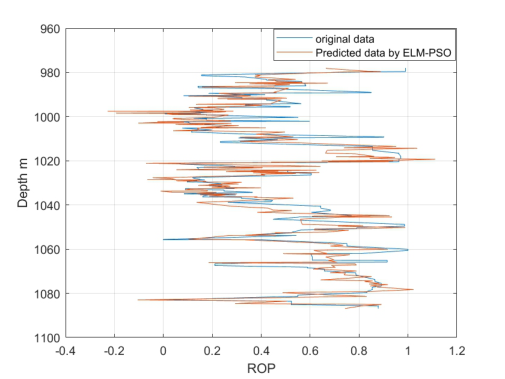
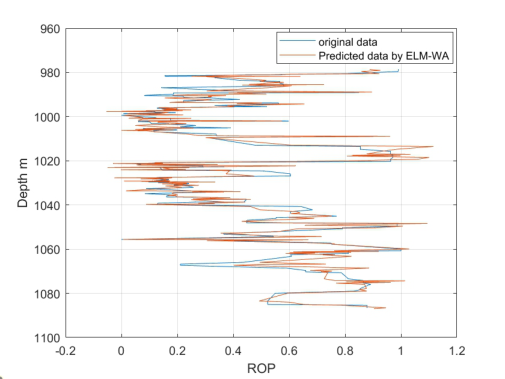
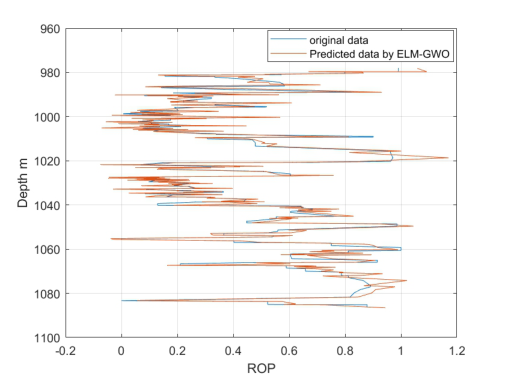
Figures 2–4 shows the predictions of three models respectively, we can see that ELM-GWO predicts real ROP data better than the two other models which also present a good prediction performance.
Figure 2: ROP prediction using ELM-PSO.Figure 3: ROP prediction using ELM-WOA.
212 Kenioua and Djebili
Figure 4: ROP prediction using ELM-GWO.
CONCLUSION
Three Intelligent systems have been developed in this work to predict the rate of penetration (ROP) in a vertical well. The model based on hybridization of ELM and some optimization techniques, among which ELM-GWO was found as the most accurate model.
REFERENCES
Huang G-B, Zhu Q-Y, Siew C-K (2004) Extreme learning machine: a new learning scheme of feedforward neural networks. In: 2004 IEEE international joint conference on neural networks (IEEE cat. No. 04CH37541). IEEE, pp. 985–990. Huang G-B, Zhu Q-Y, Siew C-K (2006) Extreme learning machine: theory and
applications. Neurocomputing 70:489–501. Mirjalili S, Mirjalili SM, Lewis A (2014) Grey wolf optimizer. Adv Eng Softw 69:46–61.
Read this individual research paper free through the original publisher, or explore the full digital proceedings book.
ISBN 978-1-958651-87-2
Explore this ISBN in the AHFE Bookstore ↗Listed in the July 2026 bookstore catalogue; search by ISBN to confirm current availability · Digital book purchase optional