With the rapid development of service robots in the senior care industry, academics have paid more attention to the study of the expression and perception of affinity for companion robots in order to reduce user barriers and mistrust. We designed an aging-in-place service robot, CareBot, and proposed six design guidelines for affinity expressions of child-like characteristics. These affinity expressions were evaluated by simulating the interaction experiment of aging in place. The results showed that participants identified three of the affinity expressions (enthusiastic, indifferent and safety) significantly more correctly than the other three (pleasant, friendly and approachable). We further found that the appearance of robots with child-like interaction characteristics such as big-eyed expressions, cute movements, and children's voices are more approachable to the elderly and are easily appreciated by them.
The continued aging of the population will pose a great challenge to heal- thcare resources, service facilities, and elderly care providers. With the application and promotion of artificial intelligence technology, intelligent elderly robots are largely helping family members, medical staff and commu- nity personnel to care for the elderly population in order to reduce the burden on medical resources and service providers (Salichs et al., 2021). In the deve- lopment of service robots, the emotional expression of robots has attracted extensive research (Takahashi et al., 2021; Hong et al., 2021; Chebotareva et al., 2019), and how to establish a good emotional connection with users through the emotional expression of robots and improve the acceptance of robots has become the key to the development of elderly service robots.
“Affinity” is a concept that originated in the field of chemistry and refers to the correlation between two atoms, and is later often used to describe human relationships. Affinity also has some initial applications in the field of affective design of robots, for example, (Lee et al., 2017) adding the concept of aesthetic experience to human-robot interaction to create social affinity of robots. The aim of companion robot design is to create products that are close
Design and Evaluation of Affinity Expressions for Child-Like Characteristics Robots 489
rather than distant to humans, and robot affinity is expressed by using emo- tional design to create an intimate connection between humans and robots (Sejima et al., 2021; Thellman et al., 2021; Andreasson et al., 2018), which can significantly affect the efficiency and quality of the human-robot inte- raction experience. The “intergenerational kinship” of the Chinese elderly is a special kind of affinity, which represents a close relationship between the elderly and their grandchildren. And a strong sense of attachment between older adults and children, which influences their judgments and preferences for similar behavioral characteristics and makes it easier to establish close bonds (Wang et al., 2019). The care of children by grandparents in modern society can ease the burden of housework on the children’s mothers. This allows them to go out and seek work opportunities to increase the family’s financial income (Chen et al., 2011). At the same time, care geared toward grandchildren can have a healing effect on the elderly. Research has shown that intergenerational caregiving leads to a greater sense of self-worth, fulfill- ment, life satisfaction, and respect from their grandchildren (Choi and Zhang, 2021). In addition, Chinese seniors usually consider a good diet as an indi- cation of a high quality of life, so they often raise children with a rounded body shape (Liu et al., 2022), which is consistent with the preference of older users for a rounded robot appearance.
In this paper, we designed an abstract anthropomorphic companion robot CareBot, which does not have body parts such as head, hands and feet exa- ctly like a human in appearance and form. However, it can mimic human actions through voice, expression and other demeanor to increase the social attributes of the robot. At the same time, we proposed six affinities with different degrees of child-like characteristics and evaluated them experimen- tally to measure older adults’ perceptions of robot affinities. In addition, we also conducted research on the elderly’s preference for children’s demeanor, movement, language and tactile perception, and applied them to the mor- phological design of the elderly companion robot, so as to bring the user a friendly, comfortable and pleasant experience when using the robot.
Experiment Affinity Expression Design CareBot is an abstract anthropomorphic design robot that was intentionally designed to not look exactly like a human because the “Valley of Terror” theory tells us that robots that look too much like humans can cause psych- ological discomfort to older people (Appel et al., 2020; Kim et al., 2022). However, it is somehow similar to human beings, where “similar” refers to abstract anthropomorphism.
Based on a meta-analysis of previous studies, this study designed six expressions of affinity (safe, friendly, pleasant, approachable, warm, and indifferent) states for the robot in terms of visual, auditory, and tactile senses (Johansson et al., 2020). We can conclude from the literature on children’s emotions and behaviors that children who are attached to their caregivers, in a happy state, like to open their eyes and gaze at other people’s faces (Broz et al., 2019). The smaller size and weight of robots that mimic children’s
images and the slower nature of their speech will reduce the psychological stress of those who come into contact with them, thus gaining a sense of security (Nakata et al., 2022). Children often make comical, exaggerated gestures and expressions as a way of expressing their closeness and enthusi- asm for the contact (Taylor and Pacini-Ketchabaw, 2017). Apathetic, autistic children have relative difficulty recognizing and expressing emotional states and often do not look others directly in the eye, as well as lack communi- cation with others (Demetriou and Fanti, 2022). In addition, children who show a happy face are approachable, and happiness with the corners of their mouths turned up creates a sense of trust and security, while an angry and expressionless face is cold and untrustworthy (Siddique et al., 2022). After analysis, we set the characteristics of the robot in different modalities: visual modality includes lighting, expression, action and movement speed, auditory modality is the change of sound tone, and tactile modality is the touch of different materials on the body (Frederiksen and Stoy, 2019). After analyzing previous studies, we also invited three PhDs who are well versed in robo- tics and user experience research to review the robot morphological features. Mark Yes for features with child-like characteristics and No for those that do not. In the end, the robot morphological features with agreed child-like characteristics were selected (as shown in Table 1).
Based on the results of the review and the robot’s own conditions, we assi- gned different degrees of child-like characteristic morphology to the robot’s affinity expression (as shown in Table 2).
Research Questions and Hypotheses -RQ1 How do participants evaluate the robot’s expression of affinity? We hypothesized that having a robot with child-like characteristics would positively influence participants’ evaluation of the robot’s expression of affinity.
-RQ2 Which child-like characteristics would give the robot better affi- nity? We hypothesized that robots that mimic child-like characteristics through visual and auditory modalities would be more likely to establish an affectionate emotional connection with participants.
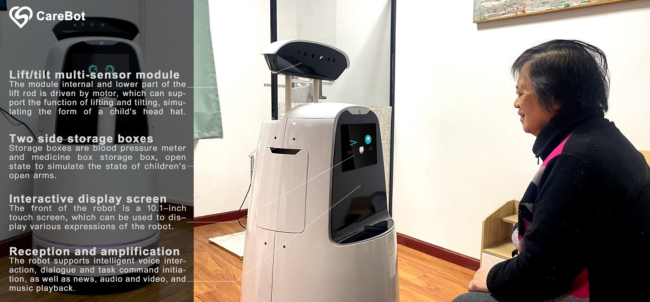
Method In this section, participants watched and evaluated the robot’s expression of six affinities. When the robot has completed all the behaviors, actions and emotions, participants selected the affinity category they thought the CareBot showed in the interaction experiments (as shown in Figure 1).
Questionnaire Questionnaire were used to collect information from participants: (1) Do you live with children? (2) How many children are there in the household? (3) How much time do you usually spend with children? (4) What characteristics do you like most in children? (5) How much do you like children with big eyes? (6) What is your preference for children’s body type?
Design and Evaluation of Affinity Expressions for Child-Like Characteristics Robots 491
Table 1. Expert review of which features have the properties of the class child, with those with marked as Yes and those without marked as No.
Table available in the original PDF paper.
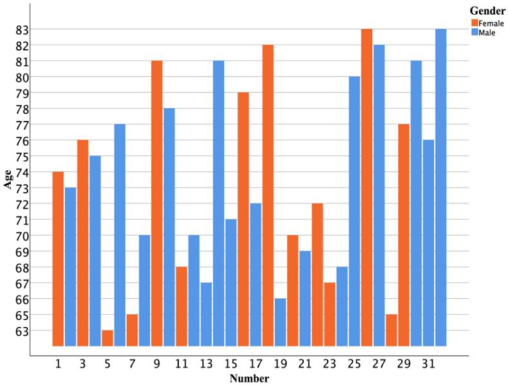
Participants Our participants (32 in total, including 18 males and 14 females, the youngest age was 63 and the oldest age was 83) were unpaid volunteers recruited from the Senior Activity Center of Huazhong University of Science and Technology (as shown in Figure 2), with the largest number from central China, followed by southwest and north China. All participants had no significant hearing or vision loss and were in good physical condition.
Table 2. Affinity expression design principles for the CareBot robot.
Enthusastic Open eyes and smile happily, rapid body twists and dances, hands to be embraced
One eye is wide open, the other blinks, mouth open to smile, the body twists from side to side, and fast approaching, children’s voices Slow rotation of the body from side to side, backing away
Indifferent Head down, eyes not open, mouth closed, body twisted and backed up
Figure 1: CareBot robot in a simulated home care service.
Design and Evaluation of Affinity Expressions for Child-Like Characteristics Robots 493
Figure 2: Participant age and gender distribution.
RESULTS
RQ1: How do participants evaluate the CareBot’s expressions of affinity?
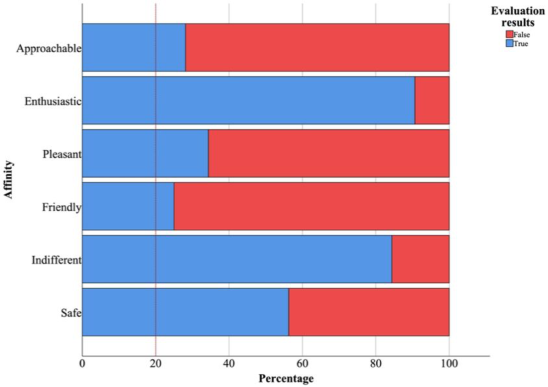
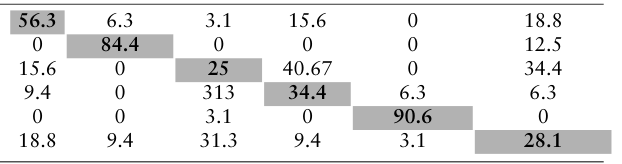
The results of the participants’ evaluation of the CareBot affinity expressi- ons showed that the rate of correct answer selection was significantly higher than other random choices (as shown in Figure 3, all p < 0.0001, using bino- mial test). Among all the expressions, “safe”, “indifferent”and “enthusiastic” had the highest recognition rate, especially “enthusiastic” and “indifferent”. But “friendly” was mostly confused with “pleasant” and “approachable” (as shown in Table 3). This might be due to the robot’s affinity for expressing design principles and the limitations in CareBot’s movements.
Figure 3: Results of participants’ evaluation of six affinity expressions, all selected correct expressions were above chance level (p < 0.0001, using binomial test).Table 3. Confusion matrix of evaluation results for robot affinity expressions.
Table 4. Participants’ interpretations and comments on the evaluation of emotional expression.
Table available in the original PDF paper.
Affinity Comments from participants Key Information “Surprised” “Safe” “Shy and copy” Safe “It is a bit shy and coy, I don’t know which one to choose.” “It seems to be frightened and needs to be protected and given a sense of security.” “It looks surprised.”
“The concerns of the mouth open” “Children’s Voice” “Round eyes” “Friendliness” “pleasure”
Friendly “I think it was friendlier, and the cap on its head rose halfway up, like it was saying hello to me.” “The children’s voices give a very friendly feeling” “I think it is pleasant, the corners of its mouth open in a smile toward me.” “I’m not quite sure exactly what kind of emotion it was, it was supposed to be pleasurable.” “Its eyes are open very round, similar to other emotional behavior, like pleasure.” “There was a smile at the corner of his mouth, alittle bit of happiness, and I picked the pleasant ones.”
“Pleasure” “Friendliness” “Eyes not fully open” “Not so happy” “Swinging/twisting body” “Happy”
Pleasant “Its eyes are not all open, it feels like it’s being naughty and should be more pleasant on its own.” “It wiggled its body at me and had a little smile that I thought belonged to a friendly one.” “I can’t tell the difference, it seems like it looks friendlier.” “It didn’t fully open its eyes and wasn’t particularly happy.” “I feel like it’s friendly.” “It was wiggling itself, and I think it was pleasurable or happy.”
“Friendly/approachable” “Indifference” “Dull eyes” “Fast movement” “The expression is a bit dull”
Approachable “I couldn’t tell which emotional behavior it fell into, as if it was cold or calm.” “It should have been friendly because it was seen with its eyes all slightly open and moving over to me relatively quickly.” “I think it’s friendly.” “The eyes are not very bright, the expression is rather dull, and I would like to choose indifference.”
Enthusastic “I think it just is enthusiastic and it moves a lot.” “Its movements are a little exaggerated, and it feels like it’s excited.” “When I heard its voice, I felt like it was like a small child, quickly coming over to ask me to hug it.” “The eyes are discharging and very naughty, I’ll go with enthusiastic.”
“Enthusiasm” “Large range of motion” “Exaggerated movements” “Like a child” “Fast movement” “Eye Discharge” “No spirit” “Indifference” “Backward movement”
Indifferent “Its eyes and mouth were not open and it looked unhinged.” “I thought it was cold and it didn’t look like it wanted to communicate with me.” “I felt like it was in shock and kept backing up.”
Design and Evaluation of Affinity Expressions for Child-Like Characteristics Robots 495
RQ2: Which child-like characteristics will make robots have better affinity?
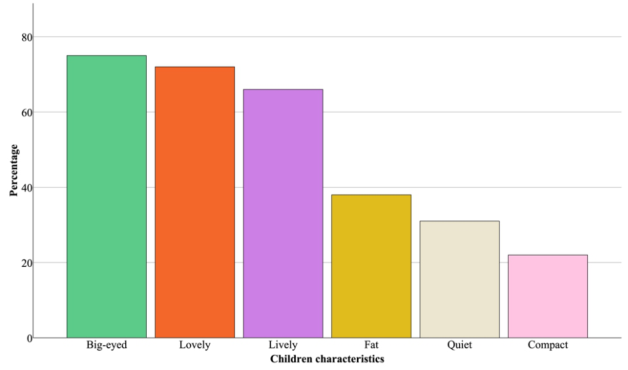
In order to investigate which child-like characteristics make the robot have better affinity, we compared the participants’ interpretations and com- ments(as shown in Table 4) of the evaluation with the results of a survey of participants’ preferences for child-like characteristics. The results of statisti- cal analysis of the data showed that the main characteristics of the robot’s child-like are reflected in the similar movements, sounds and expressions of children (as shown in Figure 4).
Figure 4: The most child-like characteristics in terms of robot movements, sounds and expressions (at least half of the total).
CONCLUSION
The purpose of this study is to investigate how child-like characteristics affect the evaluation results of robot affinity and to examine users’ morphologi- cal preferences for robot affinity. As emotional methods of communication and building become increasingly important in improving the acceptance of intelligent products, we propose six design principles for the expression of affinity with child-like characteristics, and the results show that child-like characteristics of robots facilitate the evaluation of affinity. Unlike traditi- onal anthropomorphic robots, these findings can improve user acceptance of robots. Furthermore, although many affinity expressions could be cor- rectly identified, especially positive and negative affinities, the limitations of the CareBot’s functionality and the participants’ age, experience with children, and familiarity with electronics resulted in poor recognition of neutral affinities. The results also showed that the design features of wide- eyed expressions, cute movements, and children’s voice interactions are easily preferred by older adults.
Our proposed design principles can be used as a reference paradigm for affinity expression of companion robots, which enriches the design theory
of emotional expression of anthropomorphic robots. This approach of affi- nity expression not only solves the psychological discomfort of the elderly in using the robot, but also improves the efficiency and experience of the users. The paradigm can be promoted more and expanded in the field of AI pro- ducts (robots, smart home devices, smart wearable devices, etc.). Of course, the limitations of our experimental study also provide good suggestions for improvements in the iteration of the CareBot and clear directions for future research. All in all, we hope that our research will provide an important step in the enhancement of smart devices in the senior care industry, so that companion robots can truly become intelligent assistants in the lives of users.
ACKNOWLEDGMENT
We are genuinely pleased to extend ourgratitude to the editor and the reviewers for their valuable comments.
REFERENCES
Andreasson, R., Alenljung, B., Billing, E., & Lowe, R. (2018). Affective touch in human–robot interaction: conveying emotion to the Nao robot. International Journal of Social Robotics, 10(4), 473–491. https://link.springer.com/article/10. 1007/s12369-017-0446-3 Appel, M., Izydorczyk, D., Weber, S., Mara, M., & Lischetzke, T. (2020). The
uncanny of mind in a machine: Humanoid robots as tools, agents, and experi- encers. Computers in Human Behavior, 102, 274–286. https://www.sciencedirect. com/science/article/pii/S0747563219302742 Broz, F., Nehaniv, C. L., Kose, H., & Dautenhahn, K. (2019). Interaction histories and short-term memory: Enactive development of turn-taking behaviours in a childlike humanoid robot. Philosophies, 4(2), 26. https://www.mdpi.com/2409- 9287/4/2/26 Chebotareva, E., Safin, R., Shafikov, A., Masaev, D., Shaposhnikov, A., Shayakh-
metov, I.,... & Talanov, M. (2019, October). Emotional social robot” Emotico”. In 2019 12th international conference on developments in esystems engineering (dese) (pp.247–252). IEEE. https://www.elibrary.ru/item.asp?id=43283597 Chen, F., Liu, G., & Mair, C. A. (2011). Intergenerational ties in context: Grandparents caring for grandchildren in China. Social forces, 90(2), 571–594. https: //academic.oup.com/sf/article-abstract/90/2/571/2235805 Choi, S. W. E., & Zhang, Z. (2021). Caring as curing: Grandparenting and depressive
symptoms in China. Social Science & Medicine, 289, 114452. https://www.scienc edirect.com/science/article/pii/S027795362100784X Demetriou, C. A., & Fanti, K. A. (2022). Are children high on callous-unemotional traits emotionally blind? Testing eye-gaze differences. Child Psychiatry & Human Development, 53(4), 623–634. https://link.springer.com/article/10.1007/s10578- 021-01152-3 Frederiksen, M. R., & Stoy, K. (2019, November). A systematic comparison of
affective robot expression modalities. In 2019 IEEE/RSJ International Confe- rence on Intelligent Robots and Systems (IROS) (pp. 1385-1392). IEEE. https: //ieeexplore.ieee.org/abstract/document/8967846/ Hong, A., Lunscher, N., Hu, T., Tsuboi, Y., Zhang, X., dos Reis Alves, S. F.,... & Benhabib, B. (2020). A multimodal emotional human-robot interaction archi- tecture for social robots engaged in bidirectional communication\vspace* 7pt. IEEE transactions on cybernetics. https://ieeexplore.ieee.org/abstract/document/ 9027136
Design and Evaluation of Affinity Expressions for Child-Like Characteristics Robots 497
Johansson, B., Tjøstheim, T. A., & Balkenius, C. (2020). Epi: An open humanoid platform for developmental robotics. International Journal of Advanced Robo- tic Systems, 17(2), 1729881420911498. https://journals.sagepub.com/doi/full/10. 1177/1729881420911498 Kim, B., de Visser, E., & Phillips, E. (2022). Two uncanny valleys: Re-evaluating the
uncanny valley across the full spectrum of real-world human-like robots. Com- puters in Human Behavior, 107340. https://www.sciencedirect.com/science/articl e/pii/S0747563222001625 Lee, J. J., Kim, D. W., & Kang, B. Y. (2017). Esthetic interaction model of robot with human to develop social affinity. International Journal of Advanced Robo- tic Systems, 14(4), 1729881417722721. https://journals.sagepub.com/doi/full/10. 1177/1729881417722721 Liu, Y., Zhao, J., & Zhong, H. (2022). Grandparental care and childhood obesity in
(2022). Development of ‘ibuki’an electrically actuated childlike android with mobility and its potential in the future society. Robotica, 40(4), 933–950. https://www.cambridge.org/core/journals/robotica/article/development-of-ibuki- an-electrically-actuated-childlike-android-with-mobility-and-its-potential-in-th e-future-society/95D6E2AF4D09ECEDC4D710E85758BDD3 Salichs, M. A., Castro-González, Á., Salichs, E., Fernández-Rodicio, E., Maroto- Gómez, M., Gamboa-Montero, J. J.,... & Malfaz, M. (2020). Mini: a new social robot for the elderly. International Journal of Social Robotics, 12(6), 1231–1249. https://link.springer.com/article/10.1007/s12369-020-00687-0 Sejima, Y., Sato, Y., & Watanabe, T. (2021). A body contact-driven pupil response
pet-robot for enhancing affinity. Journal of Advanced Mechanical Design, Systems, and Manufacturing, 15(5), JAMDSM0061-JAMDSM0061. https://ww w.jstage.jst.go.jp/article/jamdsm/15/5/15_2021jamdsm0061/_article/-char/ja/ Siddique, S., Sutherland, C. A., Palermo, R., Foo, Y. Z., Swe, D. C., & Jeffery, L.
(2022). Development of face-based trustworthiness impressions in childhood: A systematic review and metaanalysis. Cognitive Development, 61, 101131. https: //www.sciencedirect.com/science/article/pii/S088520142100126X Takahashi, Y., Kayukawa, Y., Terada, K., & Inoue, H. (2021). Emotional Expressions of Real Humanoid Robots and Their Influence on Human Decision-Making in a Finite Iterated Prisoner’s Dilemma Game. International Journal of Social Robo- tics, 13(7), 1777–1786. https://link.springer.com/article/10.1007/s12369-021 -00758-w Taylor, A., & Pacini-Ketchabaw, V. (2017). Kids, raccoons, and roos: Awkward
encounters and mixed affects. Children’s Geographies, 15(2), 131-145. https: //www.tandfonline.com/doi/full/10.1080/14733285.2016.1199849 Thellman, S., Thunberg, S., & Ziemke, T. (2021, March). Does Emotional State Affect How People Perceive Robots?. In Companion of the 2021 ACM/IEEE International Conference on Human-Robot Interaction (pp. 113-115). https: //dl.acm.org/doi/abs/10.1145/3434074.3447140 Wang, C. D., Hayslip Jr, B., Sun, Q., & Zhu, W. (2019). Grandparents as the primary
care providers for their grandchildren: a cross-cultural comparison of Chinese and US samples. The International Journal of Aging and Human Development, 89(4), 331–355. https://journals.sagepub.com/doi/abs/10.1177/0091415018824722
Read this individual research paper free through the original publisher, or explore the full digital proceedings book.
ISBN 978-1-958651-87-2
Explore this ISBN in the AHFE Bookstore ↗Listed in the July 2026 bookstore catalogue; search by ISBN to confirm current availability · Digital book purchase optional