Joerg Kleine-gung, Elizabeth Koumpan (2023). Pay-per-use models, the backbone of a sharing economy: How to stimulate a sustainable human-centered ecosystem success to achieve a faster Society 5.0. In: Human Interaction & Emerging Technologies (IHIET 2023): Artificial Intelligence & Future Applications. AHFE Open Access, vol. 111, pp. 620–628. https://doi.org/10.54941/ahfe1004069
In Society 5.0 humans aim to leverage advanced technologies to create innovative solutions for social and environmental issues. Public awareness of the need to act now to shape a liveable future for the next generations and to set the course for a climate-friendly and sustainable future has reached its peak. This societal and political pressure is currently changing and will change industries, corporate strategies, buying behaviors, and society dramatically and lastingly in the coming years. Strengthening the concept of the sharing economy is essential to achieving the sustainability goals of Society 5.0. Effective and mature implementation of pay-per-use models is the heart of the sharing economy and essential to drive that concept to the next level. Due to their cost-effectiveness, flexibility, scalability, and predictability pay-per-use models are attractive to both businesses and consumers and offer several benefits. Pay-per-use is nowadays established as the standard for payment processes of native cloud services, electric vehicles, and many others, but the full potential is not exhausted, and currently serves as a payment model rather in niche areas. We will discuss how this can be changed, and what possible implementations could look like enabled with micropayments, cryptocurrencies, and distributed ledgers. We will provide the architecture overview and explain how it fits future (should we change for the future or leave current?) banking architecture. The implementation of frictionless payment models is a significant opportunity to improve customer perception and increase revenue by providing a more convenient, secure, and efficient payment experience and is, therefore, a win for the industry, consumers, and the environment. Finally, we describe what obstacles there have been so far in implementing, and what a roadmap to strengthen pay-per-use models and sharing economies might look like.
The term “sharing economy” refers to economic activities involving sharing of underused assets via an online platform. The key features of the sharing economy include underused assets, suppliers, customers, and online plat- forms that can match suppliers and customers (Huang, 2020). There are
Pay-Per-Use Models, the Backbone of a Sharing Economy 621
several sharing economy models available. In the following, the use cases and examples refer to peer-to-peer sharing and business-to-peer sharing models. The success of those models depends heavily on the success and acceptance of pay-per-use models and the quality of digital payment implementations.
Sharing economy provides a pathway to sustainable human-centered soci- eties (Heinrichs, 2013) that balance economic advancement with the reso- lution of social problems by a system that highly integrates cyberspace and physical space as described in Society 5.0 (Cabinet Office, 2016). Society 5.0 was introduced by the government of Japan to improve the quality of life of society with the aim to be sustainable and environmentally friendly by leve- raging hyper-modern technology, like IoT, AI, and big data (Cabinet Office, 2016). Human-made problems like greenhouse gas emissions, deforestation, and transportation needs are the result of today’s society’s hunger for con- sumption which is the main reason why sustainability and environmental objectives will not be achieved in short term.
The global economy is shifting from physical to digital currency and the demand for frictionless payment grows, tiering the physical and digital world even more together. Payment is no longer a payment, but an integrated offering of processing money movement along with services to optimize the user experience (Stax, 2023). Payments modernization and its move towards Society 5.0 will be defined by automation and data-driven tran- sactions that will be at the center of collaborative ecosystems (PAYMNTS, 2020). As frictionless payments become more ubiquitous due to the instrumen- tation of our environments at home, while traveling, and at work, IoT- initiated micropayments will require significant innovation and new business models.
PAY-PER-USE BUSINESS MODELS Market opportunities, technology advancements, and new business models have caused the evolution of the payments ecosystem to include new players that add value in domain-specific verticals in response to market changes and consumer needs, supporting the sharing economy aspect and the pay-per-use business model.
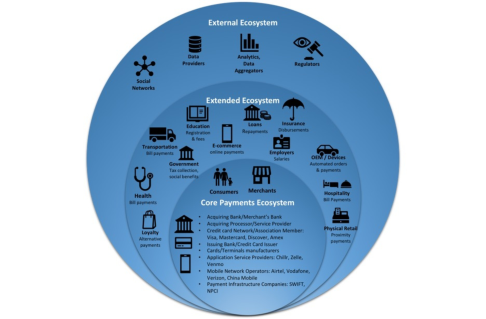
The payment Ecosystem is a collaboration of core, extended, and external ecosystems, as defined in Figure 1.
The Core Payments Ecosystem includes entities involved in making and processing a payment, such as Acquirers, Aggregator, Payment Service Provi- ders, Payment Facilitators, and other Companies that provide special services to either merchants or acquirers like fraud detection, hardware terminals, or software.
The Extended Ecosystem stands for linkages between ecosystem initiatives in different verticals across industries.
The External Ecosystem includes any company that does not directly par- ticipate in the value transfer transactions but acts as an influencer in the transactions themselves. Examples include companies that provide insights into the reputation of a given merchant/vendor or consumer.
622 Kleine-Gung and Koumpan
Figure 1: Value-add perspective on the payment ecosystem (IBM original from IBM Academy of Technology).
Payments continue to evolve by becoming more social and mobile-enabled, with new services emerging to meet customer demands. The payment netw- orks and the banks leverage mobile smartphones and apps that provide financial services directly in the connected ecosystem. Consumers now can manage their payments through new applications that are tailored to their specific needs while paying or being paid both in the physical and digital worlds.
The most advanced use of mobile payment wallets today is integra- ted within converged platforms for social media, commerce, and financial services (e.g., Tencent Wechat Pay, AntFinancial/Alibaba AliPay).
Unlike traditional business models, ecosystems allow users to both create and consume value. At the business layer, users (producers) can create value on the platform for other users (consumers) to consume.
The cloud enables a global infrastructure for production, allowing anyone to create content and applications for a global audience. Social networks connect people globally and maintain their identity online. Mobiles allow connection to this global infrastructure anytime, anywhere. The result is a globally accessible connected ecosystem of entrepreneurs, workers, and consumers who are available to create businesses, contribute, and purchase goods and services in real-time.
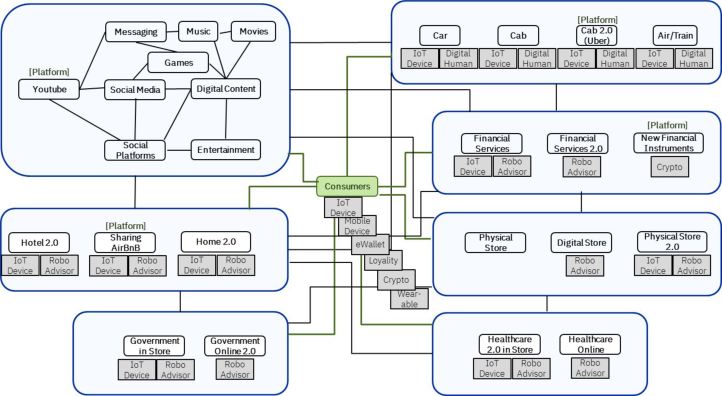
The diagram in Figure 2 represents the micropayments and pay-per-use business model, covering the following use cases:
Frictionless Payments leveraging IoT, Digital Humans, AR/VR
Machine to Machine Micropayments leveraging zero transaction fees
Smart vehicle to grid (V2G)
Micropayments for in-game purchases of virtual goods
Smart clothes - collecting points as you use the product towards consumer loyalty rewards.
Pay-Per-Use Models, the Backbone of a Sharing Economy 623
Figure 2: Micropayments and “pay per use” business model (IBM original from IBM Academy of Technology).
This new fine-granular sharing economy has profound implications for business models and ownership itself. It gets rid of the cumbersome and wasteful subscription models or trust-dependent pay before/after by moving the economy to the present. Individuals and machines pay for exactly what they consume when they consume it.
USE CASES Society 5 ecosystem - human-centric model, can be expanded to a large num- ber of use cases and gains the most value as these use cases are layered on top of each other to provide services and values that span across traditional industry lines.
By layering different value chains and linking them as business needs develop the system gains depth, insight, and resilience, breaking down the tra- ditional barriers, we create a path for digital disruption and organic growth in unforeseen directions. There are multiple use cases for the ‘sharing eco- nomy’ and ‘pay per use’ business models, and we focus on a few of them – to describe the use case scenarios, data flows, and architecture that is required to support it.
Micropayments Collecting payment for services delivered as soon as possible after comple- ting work is especially important to the people who work the lower-end kinds of temporary work, through services like CrowdFlower, Clickworker, Toluna, and Amazon’s Mechanical Turk. Largely unregulated, these sites allow businesses and individuals to post short tasks and pay workers—in cash or, sometimes, gift cards—to complete them. A recent Mechanical Turk listing, for example, offered workers 80 cents to read a restaurant review and then answer a survey about their impressions of it (Semuels 2018).
624 Kleine-Gung and Koumpan
The use of a mobile to effect payment for goods and services represents a paradigm shift towards digital-only payments and has been driven by consu- mers who wish to make purchases at retail stores or to transfer funds using their mobile as a digital wallet.
Payments now are being integrated into the Internet of Things and the ope- ration of physical devices. An example is a vehicle that pays autonomously for parking, fueling or charging, and tolls.
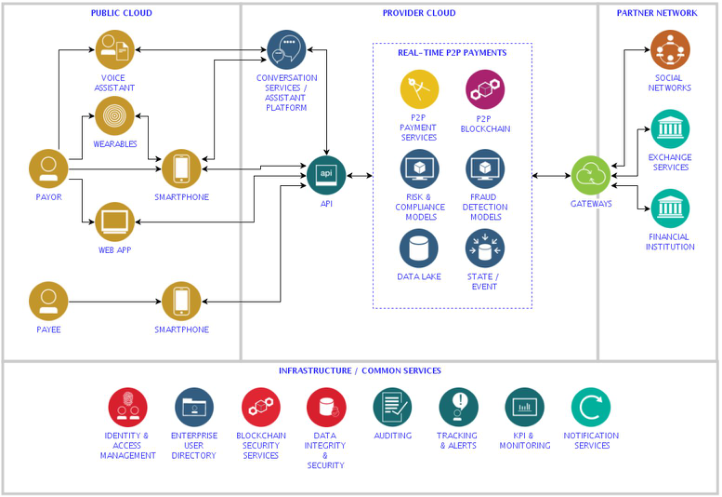
The payor initiates a payment to the payee through a web application, smartphone, wearable, or others. The P2P payment platform executes the standard risk, compliance, and fraud detection models. Upon successful com- pletion, any required services like currency conversion, social network, and real-time funds transfer are invoked. The payee gets notified of the real-time payment and verifies the details using his smartphone app.
Figure 3: Typical solution architecture – real-time payments P2P architecture (IBM original from IBM Academy of Technology).
The diagram depicted in Figure 3 shows a high-level real-time payments P2P solution architecture. It consists of the following components:
Conversation Services/Assistant Platform to enable conversation compu- ting services. It allows end users to interact with the solution over voice, understands the intent, context, and entities, and translates the interaction into API calls.
Secure Connection enables the connectivity between end-user device- s/applications and the solution. Secure APIs deliver a standard method of integration between components. Security is managed via standard encryption protocols and authentication methods.
Pay-Per-Use Models, the Backbone of a Sharing Economy 625
P2P Payment Services are implemented via APIs that support real-time (RTP) P2P payment transactions in any cashless payment system through any channel. The services orchestrate checks for real-time fraud detection, risk, and compliance models, and call external services such as currency exchange and RTP transfers to payees’ financial institutions.
P2P Blockchain is used as a hyper-ledger for recording transactions in the P2P payment ecosystem.
Fraud Detection Models are continuously trained to learn patterns in datasets to determine transactions that are most likely to be fraudulent.
Risk & Compliance Models validate transactions for the risk and compliance criteria set by national and international regulatory authorities.
Data Lake serves as the data repository for transactions and analytics.
State/Event Repository for state and event data related to platform operations.
Frictionless Payments With the offer of frictionless payment, the industry’s objective was to opti- mize the consumer buying experience. With the elimination of any hurdles in the payment process like confirming, clicking, showing legitimation, etc., not only the consumer benefit from the smoothest possible payment expe- rience - but also the provider will achieve higher revenue. We need to enhance further frictionless payment use cases to strengthen the sharing economy:
Vehicle-initiated payments –the use of public infrastructure (tolls, roads, bridges) or for vehicle-initiated payment at the gas station
IoT – OEM (connected appliances, like washing machines), devices sen- ding diagnostic information to the IoT platform. This may result in service to replace a part or ordering supplies. The user will be automatically char- ged a service fee, according to the weight of the laundry, duration, type of wash cycle, or other criteria.
V2G (vehicle to grid) – as an example, a user parks their vehicle in the par- king lot of a restaurant and connects the vehicle to the charging station. The user provides setting preferences, such as selecting whether to charge or discharge the battery, and the duration of time the user expects to be at the restaurant. The system ensures that the necessary information exch- ange and related task processing among the user, the vehicle, the charging station, the payment management company, and the utility take place in a secure manner.
Mobile point-of-time request/value-added services. The integrated digi- tal experience backend pulls business services based on relevant data points such as user preferences, location, time of day, traffic, weather, etc. Based on the user’s needs, the services such as guidance to the next rental car, the best parking options, and the location of the next florist, etc will be provided. The payment process will be triggered directly from the car.
626 Kleine-Gung and Koumpan
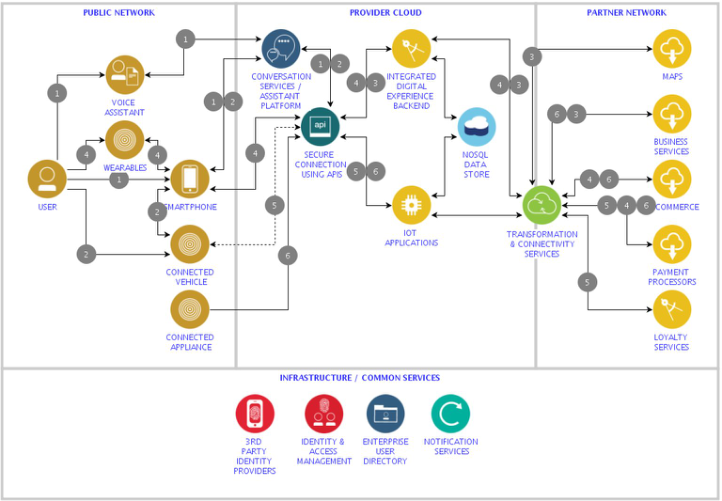
Figure 4: Typical solution architecture - frictionless payments – consumer convenience architecture (IBM original from IBM Academy of Technology).
In Figure 4 a typical frictionless payments solution architecture is depicted. It consists of the following components:
Conversation Services/Assistant Platform enables conversation computing services for end-users to interact with the solution over voice, understan- ding the intent and context, and translating into API calls.
Secure Connection - managed and secured using APIs and delivers a standard method of integration between components over different cloud- s/networks, connecting end-user devices and the platform.
Integrated Digital Experience Backend orchestrates a consumer-centric digital experience that pulls data from various sources to enable a signifi- cantly friendly and improved end-user experience.
IoT Applications are extensions of the IoT Platform to enable headless transactions on behalf of the end user. Examples include frictionless pay- ment through wearables, connected vehicles, and connected applications.
NoSQL Data Store for a repository for end-user preferences, context, etc.
Partner Services include value-added services, orchestrated in the context of connected events which improve end-user experience. Services include but are not limited to maps and directions, business and e-commerce services, payment processing, and loyalty services.
CONCLUSION
While conventional ecosystems focus on specific areas and value chains the nature of the projected ecosystems requires the integration and coordination
Pay-Per-Use Models, the Backbone of a Sharing Economy 627
of many use cases, industries, and participants. In order to support this shift, the world is moving towards connected ecosystems to get the most value for society. Covid-19 has forced society to rethink faster how we can move to a more digital world. Cashless and digital payment models have been part of this change, accelerating dramatically now, with new types of payment channels emerging.
Today, data and artificial intelligence represent a unique opportunity for creating unimaginable value. Cross-industry information sharing, adopting the common use of shared infrastructures and platforms, and expanding areas for cooperation, are necessary to foster the development of advanced technologies to solve social challenges, promote competitiveness and esta- blish new industry structures. This new economic model in which resources are shared across connected ecosystems in a collaborative way, connecting the physical and digital world through data sharing will produce a tremendous number of use cases.
Consumers take up new business models if they are economically more attractive and easier to use than conventional models and imply no negative side effects. The sharing of data across industry and company boundaries leads to legal or regulatory, but also to ethical considerations and will not work if the consumers do not trust the participants.
As deduced above, the number of service offerings needs to be expanded. Large quantities and excellent quality will lead to broad acceptance of those use cases in society. To enlarge the number of service offerings, strengthening and promoting incumbents and startups that implement innovative aggrega- tor business models and take them to market needs to be better supported by the governments. (Dubolazov et al. 2020) discusses various tax models that make it easier for providers to set up and operate appropriate platforms. Regulatory frameworks should also be created within which business models can develop and cooperation between service providers can be facilitated.
ACKNOWLEDGMENT
The authors would like to acknowledge Andreas Kind, Adrian Papacica, Marcelo Martins, Paul Lucas, Tadas Peciulis, Bradford D Leigh, Sanu- jit Senapati, who developed architecture blueprints, and IBM Academy of Technology for their support.
REFERENCES
Cabinet Office (2016). What is Society 5.0? Website: https://www8.cao.go.jp/cstp/e nglish/society5_0/index.html Chasin, Friedrich; Hoffen, Moritz von; Hoffmeister, Benedikt; and Becker, Jorg
(2018) “Reasons for Failures of Sharing Economy Businesses,” MIS Quarterly Executive: Vol. 17: Iss. 3, Article 4. Dubolazov, V. A., Kolesnikov, A. M., Dubolazova, Y. A., & Malevskay-Malevich, E. D. (2020). International Organizational And Legal Problems Of Shared Economy. In I. V. Kovalev, A. A. Voroshilova, G. Herwig, U. Umbetov, A. S. Budagov, & Y. Y. Bocharova (Eds.), Economic and Social Trends for Sustainability of Modern Society (ICEST 2020), vol 90. European
628 Kleine-Gung and Koumpan
Proceedings of Social and Behavioural Sciences (pp. 506–516). European Publi- sher. https://doi.org/10.15405/epsbs.2020.10.03.57 Heinrichs, Harald. (2013). Sharing Economy: A Potential New Pathway to Sustainability. GAIA - Ecological Perspectives for Science and Society. 22. 10.14512/gaia.22.4.5. Huang, SL., Kuo, MY. (2020). Critical success factors in the sharing economy: a customer perspective. Serv Bus 14, 553–576 https://doi.org/10.1007/s11628-020- 00426-5 PYMNTS (2020). Digesting The Payments Modernization ‘Elephant’ — Bite By
Byte. Website: https://www.pymnts.com/digital-payments/2020/digesting-the-pa yments-modernization-elephant-bite-by-byte/ Semuels, Alana (2018). The Internet Is Enabling a New Kind of Poorly Paid Hell.
The Atlantik Website: https://www.theatlantic.com/business/archive/2018/01/am azon-mechanical-turk/551192/ Stax (2023). 6 Ways Integrated Payment Systems Can Help Your Business. Website: https://fattmerchant.com/blog/what-is-an-integrated-payment-system-and-h ow-it-helps-your-business/
Read this individual research paper free through the original publisher, or explore the full digital proceedings book.
ISBN 978-1-958651-87-2
Explore this ISBN in the AHFE Bookstore ↗Listed in the July 2026 bookstore catalogue; search by ISBN to confirm current availability · Digital book purchase optional