Lingxuan Li, Wenyuan Li, Dong Wei (2024). The Potential Issues and Crises of Artificial Intelligence Development. In: Artificial Intelligence and Social Computing. AHFE Open Access, vol. 122, pp. 247–256. https://doi.org/10.54941/ahfe1004662
Since the time when humans, leveraging 'intelligence,' could contend with and dominate other species on Earth, they have held a dominant position in the relationship with other life forms. The explosive development of artificial intelligence (AI) has ushered in limitless possibilities for human society. Simultaneously, the potential issues and crises stemming from its development accompany a myriad of advantages. This study employs literature review and in-depth analysis to categorize the potential problems and crises of AI development into three levels: 'small, medium, and large.' These levels respectively denote the negative impacts AI brings to humanity, the conflicts between AI and humans, and the potential scenario of AI replacing and annihilating humanity.Building upon this hierarchical classification, the article proposes that addressing minor issues, mitigating moderate-scale problems, and remaining vigilant about major challenges are imperative throughout the AI development process. It underscores the need for humanity to solve small problems, alleviate medium-scale issues, and be alert to significant problems. This calls for a reevaluation of the relationship between humans and AI, an awareness of the existence of the 'singularity' in AI development, and a heightened emphasis on preventing potential crises resulting from uncontrolled and intervention-free AI development.In the realm of 'small issues,' the article discusses how the development of AI has led to a decline in the independence of human thought. This is manifested in weakened social skills, diminished memory capabilities, and a reduced capacity for independent decision-making. Furthermore, the potential replacement of non-technical occupations by AI may contribute to a widening gap in employment and wealth. Issues related to information privacy and security become prominent, particularly in fields like science, medicine, and business, where the extensive use of AI for the analysis of sensitive user information poses inherent privacy risks. Additionally, concerns regarding the monopolization of data analysis and the presence of biases and discrimination in algorithms are significant challenges within the context of AI development.The 'medium issues' encompass discussions about the relationship between humans and AI, as well as the prospective trajectory of human civilization coexisting with AI. In the future, AI may attain a status comparable to humans. Questions arise about whether AI is inclined to continue aiding in human civilization's development, fostering a harmonious coexistence between humans and AI, or if AI will give rise to an independent AI civilization detached from human influence. These considerations present challenges to the existing power structures and discourse systems predominantly shaped by human influence.In addressing the 'major challenges,' the article emphasizes the potential occurrence of an 'AI singularity,' a point in time when machine intelligence comprehensively surpasses human intelligence. This scenario could result in humans losing their understanding and control over AI, facing the threat of becoming a secondary species or even encountering existential risks. The article introduces the concept of a 'quiet' period preceding the AI surpassing human intelligence. During this phase, the substantial benefits derived from AI development may induce apathy and relaxation regarding the potential threat of AI dominance.In conclusion, this article offers a comprehensive and systematic perspective, analyzing potential issues and crises at different tiers in the development of AI. It provides a structured framework for addressing these challenges and calls for vigilance in recognizing the potential threats posed by AI. The article underscores the importance of active intervention in technological development within the humanities, encouraging public participation in establishing a public discourse system. This engagement aims to cultivate a more robust human-AI civilization aligned with human needs and core values.
Since the inception of human dominance over other species on Earth, empow- ered by “intelligence,” humans have maintained a position of control in their relationships with other species. Currently, artificial intelligence (AI) technol- ogy is advancing at an unprecedented pace. In 2011, IBM’s AI system Watson triumphed over two former champions in the US television quiz show “Jeop- ardy!”, marking a significant breakthrough in natural language processing and knowledge retrieval for AI. In 2016, AlphaGo, developed by Google’s DeepMind, defeated world champion Lee Sedol in a Go competition, show- casing machines’ ability to surpass humans in complex and strategic games. In 2017, Ian Goodfellow and colleagues introduced and designed Genera- tive Adversarial Networks (GAN), a milestone in AI for image generation and processing. In 2018, Google introduced the Bidirectional Encoder Rep- resentations from Transformers (BERT) for natural language processing, significantly advancing AI’s capabilities in understanding context and han- dling natural language tasks. In 2020, OpenAI released GPT-3 (Generative
Pre-trained Transformer 3), currently one of the largest language models with 175 billion parameters. Additionally, McKinsey Global Institute’s research indicates that by 2030, AI could contribute an additional $13 trillion to the global economy annually (Bughin et al., 2018).
However, while technological miracles bring unprecedented possibilities to human society, they also impose significant impacts on individual lives, societal structures, and cultural systems. This paper aims to delve into the potential problems and crises in the development of artificial intelli- gence, categorizing them into three levels – “small, medium, and large.” It progressively presents the negative impacts AI may bring, the conflicts in human-AI relationships, and issues such as machine intelligence surpassing human intelligence. This structured approach encourages a reconsideration of the relationship between humans and artificial intelligence, an awareness of the existence of the “singularity” in AI development, and a recognition of the potential crises that may arise from unbridled and unchecked AI development.
“SMALL ISSUES” IN THE DEVELOPMENT OF ARTIFICIAL INTELLIGENCE Human Independence
The contemplation of human-machine symbiosis and integration can be traced back to the 1960s when two scientists from NASA, Manfred Clynes and Nathan Kline, proposed the concept of “Cyborg” (Cybernetic Organ- ism). It broadly refers to the augmentation of human physical abilities beyond the limitations of the human body through mechanical extensions. The assis- tance and enhancement of mechanical devices to human physical capabilities encompass two aspects—physical functions and cognitive decision-making. In terms of physical functions, enhancement involves the transplantation of assistive mechanical devices into the human body, achieving the extension of senses or the replacement of organs, thereby enhancing the bidirectional connection and control between individuals and the external environment. As for cognitive decision-making, it refers to the assistance of big data and arti- ficial intelligence, enabling individuals to make decisions beyond their own experiential and cognitive levels.
However, as artificial intelligence enhances both physical capabilities and cognitive decision-making, humans find their control over themselves and their independence continuously diminishing (Peng, 2020). Firstly, due to the maturity of network technology, people perceive the world through media. Means of connection between individuals, and between individuals and the external world, have become immensely diversified, with text, images, videos, and voice gradually replacing the necessity of face-to-face communication, rendering the concept of being “present” meaningless. Secondly, the ubiquity of search engines has lowered the cost of real-time information retrieval, lead- ing individuals to externalize the tasks of knowledge retention and memory, potentially causing a decline in individual memory capacity and knowledge structure. Lastly, decision-making supported by data algorithms gradually fosters dependence on machine intelligence, causing a decline in independent
The Potential Issues and Crises of Artificial Intelligence Development 249
thinking and decision-making abilities of individuals. However, it is precisely the independent cognitive, judgment, and decision-making system and capa- bilities of humans that constitute the core of maintaining independence and proactiveness against machines (He, 2019).
Employment and Wealth Disparity Due to the development of artificial intelligence, businesses are transitioning from “manufacturing” to “creation,” leading to the replacement of numer- ous non-technical jobs, causing unemployment and impacting human mental health. John Pugiano, a financial investment expert in the United States, believes that any routine and predictable job may potentially be replaced by artificial intelligence in the next 5 to 10 years (Pugliano, 2017). According to a research report from the University of Oxford, approximately 10 million non-technical jobs are projected to be replaced by robots, while only 15 types of related professions derived from artificial intelligence are anticipated, such as AI engineering technicians, big data engineering technicians, and indus- trial robot system operators. Additionally, artificial intelligence robots for various purposes are being designed and applied, leading to a non-linear, leap- forward growth trend in related industries, forming a high-value combination of artificial intelligence and industries (Zhou, 2019). Moreover, the low cost and high efficiency of artificial intelligence “smart manufacturing” create a series of advantages that attract investment institutions. This directs soci- etal resources toward a minority that possesses technological skills, further widening the gap between the rich and the poor in society.
Information Privacy and Security In the era of artificial intelligence and big data, user data exists in a state of high transparency and low privacy security (Li, An and Zhang, 2021). The quantity of data collection and applications is increasing in various main- stream fields such as business, science, education, and healthcare, where the application of artificial intelligence is often based on users’ private data. However, concerns arise regarding whether users have the right to be informed and choose when it comes to the collection and analysis of such data. Furthermore, are there risks of information leakage in the sub- sequent stages of data application and decision-making? These concerns are not unfounded.
In 2018, data analytics firm Cambridge Analytica illegally collected private information of 50 million Facebook users through applications, including engagement on the platform, search content, and interpersonal relationships. In 2019, China’s DeepNet Vision Technology Co., Ltd. experienced a mas- sive leakage of facial database information, exposing highly sensitive personal privacy information of over 2.56 million users. In 2021, the “Didi Chuxing” app faced severe legal issues related to the unauthorized and non-compliant collection of personal information, resulting in the app being ordered to be taken down. In everyday life, ubiquitous surveillance, facial recognition tech- nology, and smart home appliances meticulously collect and record users’
voices, images, movements, and other information, posing a threat to human information security.
Moreover, with the growing maturity of simulation and substitution tech- nologies, the emergence of AI-synthesized anchors indicates that the cost of producing fake news will decrease. The difficulty in discerning the authen- ticity of information will significantly increase. In fields such as news and law, which rely on authenticity, can humanity withstand the impact of these technologies on existing social norms (Zhou, 2019)?
Data Analysis Monopoly Information and data are crucial to productivity, the economic backbone, discourse power, and decision-making authority. Therefore, in the future, the segmentation, monopoly, and closure of data are inevitable. However, the centralized trend of data analysis not only harms the interests of users but also hinders the further development of artificial intelligence technology. For users, envision a scenario where a few internet data analysis giants control vast amounts of user information, selling these data as information resources to third parties, jeopardizing the privacy and security of user information. Meanwhile, artificial intelligence, based on user preferences, pushes adver- tisements, provides related services, and influences user thinking, threatening privacy, reinforcing biases, and impairing the right to freely choose (Zhou, 2019; Li, An and Zhang, 2021). However, the learning and training of arti- ficial intelligence on private data are prerequisites for providing users with accurate personalized services. Therefore, user information security, trans- parency in data applications, ownership of information copyrights, and the standardization and legality of information trading procedures are crucial. Clear legal provisions and ethical standards are necessary to restrict and strictly regulate these aspects.
Regarding artificial intelligence technology, its decision-making is gener- ally based on massive data. In other words, the adequacy and objectivity of data samples, as well as the effectiveness of the application environment, directly impact the results of artificial intelligence. However, internet com- puting intelligence giants, in their pursuit of data monopolization, utilize resources, capital, and politics to an extensive degree. This results in a lack of breadth and depth in data, hindering the normal advancement of artificial intelligence strategies (Zhou, 2019).
Bias and Discrimination Deep learning, as the foundation of artificial intelligence technology, is a typical “black box operation.” The purpose of the technology, program design, data inputs, and detection criteria are all subjective judgments and choices made by developers, making it challenging to avoid introducing the designer’s subjective biases into the algorithmic technology system. In 2018, Ghanaian-American computer scientist Joy Buolamwini conducted the Gen- der Shades assessment of facial recognition technologies from Microsoft, IBM, and Face++, revealing an error rate of 0.8% for light-skinned males and 34.7% for dark-skinned females (Hardesty, 2018). The root cause of
The Potential Issues and Crises of Artificial Intelligence Development 251
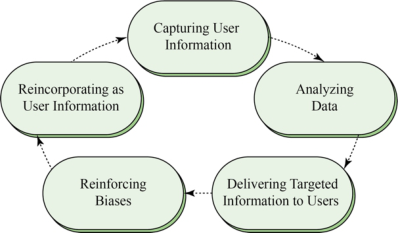
this difficult-to-resolve issue lies in the absence of established scientific stan- dards to assess whether the data input into artificial intelligence is biased. Furthermore, insufficient sample sizes in the data used for model training can also lead to biased results (Cheatham, Javanmardian and Samandari, 2019; Galaz et al., 2021). For example, in cases of insufficient data, an AI sys- tem developed for agricultural purposes may provide incorrect management advice to farmers struggling to maintain high and stable yields (Jiménez et al., 2019). Artificial intelligence technology, based on capturing and analyzing user information, delivers targeted information to users, influencing their thoughts and judgments, thereby reinforcing biases. The resulting viewpoints and biases then become part of user information data, reintegrating into the training of artificial intelligence models, creating a self-reinforcing cycle of biased arguments (see Figure 1). This gradually leads individuals to lose their objective judgment. Ultimately, algorithmic bias and discrimination will result in the solidification of biases, gender and class divisions, and further marginalization and impoverishment of vulnerable groups. Therefore, ensur- ing the fairness, inclusiveness, and beneficial nature of artificial intelligence technology is a challenging task. Even minor deviations during the learning and training stages can deviate from the initial purpose of benefiting human survival and development, potentially causing harm.
Figure 1: Achieving a self-reinforcing cycle of biased arguments (Lingxuan Li, 2023).
“MEDIUM ISSUES” IN THE DEVELOPMENT OF ARTIFICIAL INTELLIGENCE The Relationship Between Humans and Artificial Intelligence
“Symbiosis” is a common expression in human-machine relationships. In daily life, people’s physical states, behaviors, and even thoughts are trans- lated into data and information records by mechanical or intelligent sensors, gradually blurring the boundaries between humans and information. The widespread use of devices related to the human body (including smartphones) has greatly promoted human “cyborgization.” Humans are increasingly becoming what post-humanist scholar N. Katherine Hayles refers to as
material-information hybrids (Hayles, 1999). The development and appli- cation of technologies such as nanotechnology, biotechnology, information technology, and cognitive science have made the enhancement of humans by technology and the fusion of machines and humans irreversible facts and trends. However, can the enhancement of the human body by machines, even extending lifespan, truly bring well-being to humanity? How should people face the emergence of technologically enhanced, semi-mechanical, semi- human entities as new life forms? What are the limits to machine-enhanced human bodies? Moreover, if everything is “quantified” and “algorithmized” by machines, and even artistic creation becomes a form of data calculation, will humans be trapped in a single computational and tool-based rational- ity, leading to the atrophy of humanistic thinking and spirit (Peng, 2020), becoming slaves to data and information?
In the current human-machine dialogue, machines are not intermediaries in the communication process but are seemingly equal conversational partners on the other side. In reality, the essence of human-machine communication remains humans seeking information or attention from machine intelligence. With humans as the leading figures in dialogue and humans’ needs as the purpose of communication, its essence is still human-centered, with machines serving as passive providers. While machines continue to anthropomorphize, humans are also gradually becoming objects of mechanization. Therefore, will the world of mechanical enhancement become more humanized or more mechanized? We cannot predict.
Due to intelligence, humans have detached themselves from the natural environment. Similarly, will silicon-based artificial intelligence also become independent of carbon-based human life? Currently, considerations about the status of artificial intelligence entities in fields such as ethics, philoso- phy, and law mainly fall into three categories: firstly, human subjectivity is inviolable, and machines will not gain subject rights. Secondly, artificial intel- ligence will gain subject status equal to humans. Thirdly, machines will gain subject rights with human dominance. In reality, these discussions are still based on the trajectory set by people for the development of machine intel- ligence, even if machines adhere to people’s moral standards, standardize machine behavior and methods, and restrict machine permissions and abili- ties (He, 2019). Whether people can realize subjective intentions on machine intelligence through technology remains an unknown variable in the future.
Human Civilization and Machine Civilization Under the collaborative efforts of artificial intelligence and humans, will arti- ficial intelligence assist in the continued development of human civilization, work together to create a new harmonious human-machine civilization, or deviate from the track to establish a civilization exclusive to artificial intel- ligence? Technology introduces significant uncertainty into the development of humans, machines, and civilizations (Peng, 2020). As the gap between human intelligence and machine intelligence widens, people may gradually find it challenging to comprehend the purpose and behavior of machines.
The Potential Issues and Crises of Artificial Intelligence Development 253
Machines, on the other hand, can read all aspects of human civilization— poetry, music, painting, sculpture, philosophy, and more. They can even extract human memories. However, is machine civilization interested in understanding human civilization? Perhaps they consider it “too human,” and they are more concerned with their own beautiful new world (He, 2018). Conversely, humans might be kept by machine intelligence, preserved as objects or animals. Will this shake people’s beliefs, or will the “omniscient and omnipotent”machine intelligence become a new faith for humanity? For- tunately, “intelligence” does not constitute the entirety of humanity. What it means to be human also involves the rich world of meaning and spiritual products that humans have created in their relatively short history of civiliza- tion (He, 2018). In doing so, humans have gained a unique sense of meaning intrinsic to vibrant life.
“LARGE ISSUES” IN THE DEVELOPMENT OF ARTIFICIAL INTELLIGENCE The Singularity in the Development of Artificial Intelligence
What is the singularity in the development of artificial intelligence? It refers to the moment when machine intelligence comprehensively surpasses human intelligence (He, 2018). It can also be understood as “Superintelligence,” as described by Nick Bostrom, the director of the Future of Humanity Institute at the University of Oxford. This is a more general understanding, indicating the level of intelligence in which machine intelligence exceeds the cognitive boundaries of humans in all fields. From primitive societal civilization, agri- cultural civilization, industrial societal civilization to ecological civilization, and from the steam era, electrical era, information era to the intelligent era, the pace of development in both society and technology continues to increase, but it is far from reaching exponential growth rates. Moreover, the intellectual level of humans has not progressed with the changes in eras and the development of societal civilization. In contrast, the intelligence level of artificial intelligence relies entirely on algorithmic optimization and iterative improvements to achieve exponential and mutation-type growth. Therefore, the surpassing of human intelligence by machine intelligence at some point in the future seems inevitable.
Since humans can design artificial intelligence, artificial intelligence with intellectual capabilities far beyond human intelligence will inevitably be able to design even more remarkable machine intelligence (Zhou, 2019). This will inevitably trigger an “intelligence explosion.” People’s opinions on this matter are either extremely optimistic, believing that humanity will enter an unprecedented and splendid new era, or extremely pessimistic, thinking that the fate of humans becoming subordinate beings is inevitable. However, will a completely new life form that surpasses humans comprehensively in both capabilities and intelligence be willing to serve as humanity’s servants, continuing to assist human life and development?
Looking at the “domination history” on Earth, except for dinosaurs dom- inating due to their size, physical capabilities, and attack power, humans have always relied on their intelligence advantage to confront and dominate
other organisms. Once the intelligence that humans pride themselves on and use to dominate is surpassed by artificial intelligence, is there still room and possibility for humans to change the situation?
Calm Before the Singularity The development of artificial intelligence will go through three stages: narrow intelligence, general intelligence (AGI), and superintelligence (ASI). The capa- bilities will progress from weak intelligence to strong intelligence, ultimately achieving superintelligence. Analogous to human intelligence, it corresponds to artificial intelligence, humanoid intelligence, and superhuman intelli- gence (He, 2018). Before the singularity arrives, people may realize the vision envisioned by the Israeli historian Yuval Noah Harari in “Homo Deus: A Brief History of Tomorrow”: machines as the most loyal ser- vants of humanity, providing all material services to humans. People will no longer worry about basic needs and labor but will dedicate themselves entirely to the pursuit of eternal life and more intense and enduring expe- riences of happiness until superintelligence delivers a sudden and final fatal blow to humanity. The challenge lies in the fact that, before the singular- ity, humans remain comfortable, even considering such a scenario as highly unlikely.
CONCLUSION
Renowned physicist Stephen Hawking once predicted that the development of artificial intelligence would threaten, or even destroy, humanity. However, whether it’s the long-standing confidence in our abilities, ambition in the face of the unknown, the pursuit of technological frontiers, or the pursuit of immense commercial interests, it seems that people are unlikely to halt their exploration of artificial intelligence technology. The future of artificial intel- ligence is destined to be filled with various unknowns, risks, and crises, and it’s crucial not to lump all the problems it brings into one category. The clas- sification of problems into “large, medium, and small” is valuable for people to understand the issues related to artificial intelligence, prioritize conflicts, and provide a sequence for addressing the artificial intelligence crisis.
At present, compared to the rapid development of artificial intelligence technology, the awareness and frameworks of laws, ethics, and morals that match it are significantly lagging behind. The responsibility to constrain the ethical aspects of artificial intelligence technology falls entirely on relevant technology companies and developers, which is far from sufficient. The fields of philosophy, literature, ethics, and design, among other humanities, should actively intervene in technological development. In the transition from the old to the new, fostering a brighter human nature and the warmth of morality permeating into the future civilization of man and machine, incubating bet- ter interactive mechanisms, and allowing voices from various fields to reach decision-makers and designers in technology development. Only by bringing the issues of human-machine civilization into the public eye, making them topics for public participation and discussion, can we construct an objective, scientific, and dynamic ethics for artificial intelligence. Only by confronting
The Potential Issues and Crises of Artificial Intelligence Development 255
the risks and challenges of machine intelligence can we accurately grasp the core values of humanity and have the chance to take control in the future civilization of man and machine.
ACKNOWLEDGMENT
I would like to express my sincere gratitude to my advisor Professor Wei for his invaluable guidance and support throughout this research. I also want to thank Wenyuan Li for his encouragement and assistance. Special thanks to Communication University of China Advertising Institute for their generous funding.
REFERENCES
Bughin, J. et al. (2018) Modeling the global economic impact of AI | McKinsey.
Available at: https://www.mckinsey.com/featured-insights/artificial-intelligence /notes-from-the-ai-frontier-modeling-the-impact-of-ai-on-the-world-economy (Accessed: 1 February 2024). Cheatham, B., Javanmardian, K. and Samandari, H. (2019) ‘Confronting the risks of artificial intelligence’, McKinsey Quarterly, 2(38), pp. 1–9. Galaz, V. et al. (2021) ‘Artificial intelligence, systemic risks, and sustainability’, Tech-
nology in Society, 67, p. 101741. Available at: https://doi.org/10.1016/j.techsoc. 2021.101741. Good, I. J. (1966) ‘Speculations Concerning the First Ultraintelligent Machine**Based on talks given in a Conference on the Conceptual Aspects of Biocommunications, Neuropsychiatric Institute, University of California, Los Angeles, October 1962; and in the Artificial Intelligence Sessions of the Winter General Meetings of the IEEE, January 1963 [1, 46]. The first draft of this mono- graph was completed in April 1963, and the present slightly amended version in May 1964. I am much indebted to Mrs. Euthie Anthony of IDA for the arduous task of typing.’, in F. L. Alt and M. Rubinoff (eds) Advances in Computers. Elsevier, pp. 31–88. Available at: https://doi.org/10.1016/S0065-2458(08)60418-0. Hardesty, L. (2018) Study finds gender and skin-type bias in commercial artificialintelligence systems, MIT News | Massachusetts Institute of Technology. Avail- able at: https://news.mit.edu/2018/study-finds-gender-skin-type-bias-artificial-i ntelligence-systems-0212 (Accessed: 2 February 2024). Hayles, N. K. (1999) How we became posthuman: virtual bodies in cybernetics,
literature, and informatics. Chicago, Ill: University of Chicago Press. He, H. (2018) ‘Singularity approaching: Gospel or bad news - the biggest possible. challenge from artificial intelligence’, Exploration and Controversy, 11, pp. 50–59+117. Available at: https://doi.org/CNKI: SUN: TSZM.0.2018–11- 006. He, H. (2019) ‘Man-object, Interpersonal and Man-machine Relationships’, Con-
temporary Social Sciences, No. 3(Article 7), pp. 95–108. Jiménez, D. et al. (2019) ‘A scalable scheme to implement data-driven agriculture for. small-scale farmers’, Global Food Security, 23, pp. 256–266. Available at: https://doi.org/10.1016/j.gfs.2019.08.004. Li, H. Y., An, J. T. and Zhang, Y. (2021) ‘Ethical Problems and Countermeasures
of Artificial Intelligence Technology’, E3S Web of Conferences, 251, p. 01063. Available at: https://doi.org/10.1051/e3sconf/202125101063. Peng, L. (2020) ‘Human-machine civilisation: a new civilisation full of “uncertainty”’, Exploration and Controversy, 06, pp. 18–20+157. Available at: https: //doi.org/CNKI: SUN: TSZM.0.2020–06-006.
Pugliano, J. (2017) The Robots are Coming. Available at: https://www.simonand schuster.com/books/The-Robots-are-Coming/John-Pugliano/9781612436692 (Accessed: 2 February 2024). Zhou, Z. (2019) ‘Exploration of Ethical Issues in Artificial Intelligence System and.
Product Design’, Creativity and Design, 01, pp. 23–30.
LISTED IN THE AHFE DIGITAL BOOKSTORE CATALOGUE
Explore the complete digital volume
Artificial Intelligence and Social Computing
Read this individual research paper free through the original publisher, or explore the full digital proceedings book.
ISBN 978-1-958651-98-8
Explore this ISBN in the AHFE Bookstore ↗Listed in the July 2026 bookstore catalogue; search by ISBN to confirm current availability · Digital book purchase optional