Patrick Rupprecht, Walter Mayrhofer (2024). Hybrid Intelligence - An Approach towards the Symbiosis of Artificial and Human Creativity and Interaction in the Design and Innovation Process in SMEs. In: Creativity, Innovation and Entrepreneurship. AHFE Open Access, vol. 125, pp. 34–42. https://doi.org/10.54941/ahfe1004718
Publisher statistics will load when you open Metrics.
AHFE OPEN ACCESS OPEN ACCESS CONFERENCE PROCEEDINGS PAPER
Hybrid Intelligence - An Approach towards the Symbiosis of Artificial and Human Creativity and Interaction in the Design and Innovation Process in SMEs
Institute for Digital Transformation and Strategy (IDS), University of Applied Sciences, for Management & Communication (FHWien der WKW), 1180 Vienna, Austria ↗
In a world where Artificial Intelligence (AI) is accelerating technological change, small and medium-sized enterprises (SMEs) are challenged to remain competitive and innovative. SMEs, which often are faced with having only limited time and financial resources. particularly struggle to test emerging technologies and develop innovations. In this context, recent studies suggest that the combination of artificial intelligence and the creativity of SME employees may provide a viable solution. According to latest findings, the combination of human and artificial intelligence, also referred to as “Hybrid Intelligence”, has significant potential to enhance innovation processes and increase productivity and creativity. The primary objective of this paper is to investigate how Generative Artificial Intelligence (Generative AI) can enhance creativity and efficiency in established design and innovation processes, such as Design Thinking. In addition, the paper aims to explore the possible symbiotic interaction between humans and artificial intelligence during the different phases of the innovation process in general and within innovation workshops in particular.In a first approach, an overview of human and AI capabilities and the use of Generative AI throughout the innovation process is explored. In addition, several perspectives on the use of symbiotic Human-AI interaction in creative innovation workshops are presented. Finally, the importance of interdisciplinary collaboration and the integration of Hybrid Intelligence in SMEs to enhance creativity and efficiency in the innovation process are highlighted.
The current technological transformation triggered by AI is changing indus- tries, businesses, processes, and the way companies generate innovation. In November 2022, the potential of Generative AI was clearly highlighted, par- ticularly through the introduction of ChatGPT (OpenAI, 2024; OpenAI et al., 2023). Generative AI offers the chance to learn from large amounts of data, to integrate daily updated data and to generate creative results such as tables, texts, images and program code or to support research, analysis and problem- solving tasks (Akata et al., 2020; Google DeepMind, 2023; OpenAI et al.,
Hybrid Intelligence - An Approach Towards the Symbiosis of Artificial 35
2023). For the first time, current developments offer the possibility of secure and low-threshold access for enterprises through customizable Generative Pre-Trained Transformers (GPTs); a type of large language models that form the framework for Generative AI. These GPTs make it possible to integrate company-specific knowledge sources into the knowledge base and to cus- tomize interactions for the respective use cases (e.g. for idea generation), while the company retains control over the data (OpenAI, 2023).
However, how will the use of Generative AI affect productivity and effi- ciency? One Harvard Business School study shows the positive impact on the productivity and quality of knowledge workers. The study found that the use of Generative AI increased the number of tasks completed by an aver- age of 12.2% compared to a control group with no AI use. Moreover, the group using AI completed the tasks on average 25.1% faster and with 40% higher quality. The study provides empirical evidence of the positive role of AI integration in companies, especially in areas based on knowledge work (Dell’Acqua et al., 2023).
Small and medium-sized enterprises (SMEs) often struggle with the chal- lenge of integrating digital technologies quickly and sustainably. This is attributed to limited financial and human resources (Ates & Bititci, 2011; Gray et al., 2003) as well as a lack of qualified specialists and digital skills (Rupprecht & Schulz, 2023). Generative AI as an assistance system can enhance capabilities and expand the creativity of humans (Eapen et al., 2023) while increasing the efficiency in daily work tasks (Akata et al., 2020). Humans, with their ability to understand context, solve problems and make sustainable decisions, will continue to play an important role in innovation (Amershi et al., 2014). Hence, a symbiosis of human and artificial intelli- gence in the sense of Hybrid Intelligence is a suitable way to drive innovation in organizations (Dellermann, Calma et al., 2019; Dellermann, Ebel et al., 2019; Jarrahi et al., 2022). Since the 2000s, agile innovation methods, e.g. Design Thinking, have been proposed for the sustainable generation of innovations in business (Brown, 2008). Agile methods promote an iterative design approach and involve users early in the process, resulting in innovations that meet customer needs more closely and reduce the involved risks and costs of product development. Design Thinking combines the innovation phases “analysis” and “solu- tion finding” in iterative cycles, which are divided into several sub-phases, i.e. including customer needs, context and data analysis, idea generation, prototyping and testing (Hasso Plattner Institute (d.school) - Stanford Uni- versity, 2023). Accordingly, different analytical, creative, problem-solving, and decision-making skills are required in the phases of the innovation pro- cess and Generative AI as analytical and creative assistance is particularly suited to make meaningful use of the power of both types of intelligence (Jarrahi et al., 2022).
This paper focuses on the capabilities of Generative AI and humans during the different phases of the innovation process and the integration of Hybrid Intelligence into this process, as well as on Human-AI interaction in the creative context of product development in SMEs. A first overview of the application of Generative AI in the innovation phases of Design Thinking is
36 Rupprecht and Mayrhofer
provided by a taxonomy of human and AI capabilities. In addition, a prac- tical suggestion is made in terms of deploying Hybrid Intelligence and how Human-AI interaction can take place in typical innovation workshops set- tings in SMEs. Thus, the research question of this paper is “How to apply human and AI capabilities to the phases of the Design Thinking innovation process?” and “How to achieve a symbiotic Human-AI interaction in the context of creative innovation workshops?”.
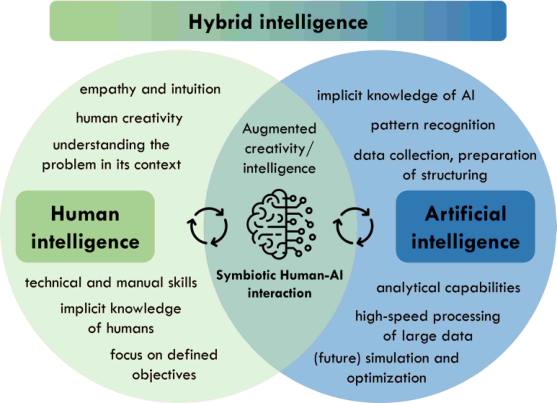
HYBRID INTELLIGENCE AND SYMBIOTIC HUMAN-AI INTERACTION To exploit the strengths of Generative AI for innovation management in SMEs in combination with the experience and creativity of humans, the use of Hybrid Intelligence in the different phases of the innovation process is proposed. Hybrid Intelligence refers to the symbiosis of human and AI for bi-directional augmentation of intelligence and creativity (see Figure 1) (Jarrahi et al., 2022). The goal is not to replace the human component but to combine the respective strengths of humans and AI to implement research and analysis more efficiently, solve complex problems more sustainably, and generate more creative solutions (Dellermann, Calma et al., 2019). The result- ing symbiosis aims to behave more intelligently than either could on its own (Kamar, 2016).
Figure 1: Hybrid intelligence and symbiotic human-AI interaction (adapted from Jarrahi et al., 2022).
Human Intelligence contributes skills like ethics, critical thinking, emo- tional intelligence, creativity, contextual understanding, and implicit knowl- edge from experience and context (Amershi et al., 2014). Artificial intel- ligence can analyze and generate creative content from large amounts of data, recognize patterns and perform repetitive or complex computations with high speed and accuracy (Akata et al., 2020; Dellermann, Calma et al.,
Hybrid Intelligence - An Approach Towards the Symbiosis of Artificial 37
2019; Jarrahi et al., 2022). The concept of Hybrid Intelligence envisions humans and AI systems interactively working together, creating a symbiotic Human-AI interaction (Jarrahi et al., 2022). The result of such symbiotic Human-AI interaction is enhanced overall creativity and intelligence. AI sys- tems are therefore socio-technical systems that improve their performance when humans and AI interact and complement each other (Østerlund et al., 2021). An important challenge is to communicate the implicit knowledge of humans and machines, as this knowledge is often difficult to articulate. The “black box” of neural networks is usually inscrutable to users of AI sys- tems (Felzmann et al., 2019). For a symbiotic application, machines need to better understand how humans think and work (AI alignment) while time, humans need to develop a better awareness of AI decision logic (AI literacy) (Jarrahi et al., 2022).
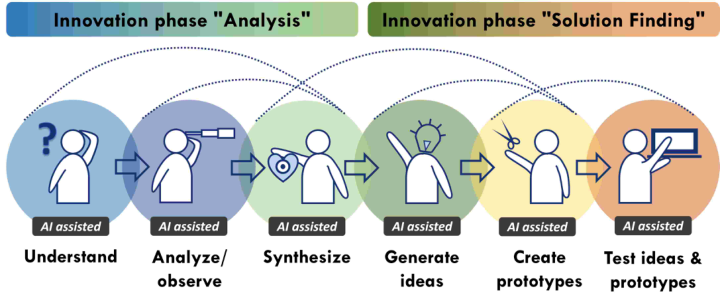
GENERATIVE AI IN INNOVATION PROCESS DESIGN THINKING One of the challenges is the sustainable integration and application of dif- ferent types of AI systems in companies and processes to enable efficient collaboration and interaction (Oeste-Reiß et al., 2021). For this purpose, the agile innovation process of Design Thinking (see Figure 2) will be adopted and enhanced with AI. Further, an overview of human and AI capabilities (see Table 1) aims for a better understanding of the benefits and limitations of an AI assisted innovation process (for a generic approach see Samid, 2021).
Figure 2: AI assistance in the design thinking innovation process (adapted from Hasso Plattner Institute (d.school) - Stanford University, 2023).
The innovations phase “Analysis”consists of the “Understanding”, “Anal- ysis/ Observation” and “Synthesis” sub-phases, in which the context, the problem, the available data, and user needs are analyzed/synthesized, and the team’s or company’s point of view is defined. In the innovation phase “Solution Finding”, which consists of the sub-phases “Idea Generation”, “Prototyping” and “Testing”, creative ideas and solutions for the previously defined context should be developed or built and tested. In SMEs, this is usually done iteratively and interactively in several internal and external
38 Rupprecht and Mayrhofer
innovation workshops with experts, users and stakeholders (Hasso Plattner Institute (d.school) - Stanford University, 2023).
Generative AI tools have the potential to enhance human creativity and promote innovation, especially in the idea and solution generation phases, as well as in analyzing and synthesizing large and complex datasets (Jarrahi et al., 2022). The challenge is to apply appropriate Generative AI tools and define the tasks in the innovation phases where AI can positively contribute, as well as to design practice-oriented Human-AI interaction for innovation workshops and group settings.
TAXONOMY OF HUMAN AND AI CAPABILITIES IN INNOVATION PROCESS DESIGN THINKING The following taxonomy is intended to provide an overview of which human and AI capabilities can be applied to the phases of the Design Thinking inno- vation process. It should be a first response to the questions: What is AI better at? and What are humans better at? in the setting of the innovation process. Those questions are an extension of the original Fitt’s list (Fitts, 1951); a list derived almost 75 years ago comparing the capabilities of humans and machines.
Table 1. Taxonomy of human and AI capabilities in innovation process.
Table available in the original PDF paper.
Phases of Innovation Process Human Capabilities AI Capabilities “Analysis” Understand Empathy: The ability to feel the needs and problems of the target audience. Contextual understanding: Awareness of the broader context of the innovation. Intuition: Using your “sixth sense”.
Data collection and compilation: Collect and compile relevant data from multiple sources within a defined context. Data structuring and preparation: Systemize data to enable it to be analyzed. Analyze/ observe
Data analysis: Advanced investigation of complex data sets, images, tables and texts to extract relevant data. Recognizing patterns and trends: Especially in large amounts of data. Anomaly detection: Identify unusual patterns or data points.
Critical analysis: Reflection, evaluation and questioning of data and information. Observation skills: Attention to weak patterns of behavior and interaction. Detail orientation: Focusing on specifics important to understanding the problem.
Synthesis Creative thinking: Innovative results by abstract and creative thinking. Problem solving skills: Ability to deconstruct complex problems and identify potential solutions. Interdisciplinary integration: Combination of knowledge and insights from multiple disciplines. Define a potential objective and hypotheses: For further phases, it is important to focus on one aspect and one goal and generate various hypotheses.
Aggregation/synthesizing of data and information: The analyzed data and extracted information needs to be aggregated in order to make deci- sions. Predictive modelling and simulation: Create models and simulations to predict future trends, make recommendations, and build potential scenarios. Definition of objectives, hypotheses for potential scenarios: Objectives, hypotheses, and options should be defined for the solution phase.
(Continued)
Hybrid Intelligence - An Approach Towards the Symbiosis of Artificial 39
Table 1. Continued Phases of Innovation Process Human Capabilities AI Capabilities
Table available in the original PDF paper.
“Solution Finding”
Assistance with idea generation and creative brainstorming: Extend, sum- marize, structure and narrow ideas. Inspiration mining: Gain inspiration with additional examples and sug- gestions.
Generate ideas Creativity: Originating ideas with a focus on the defined goal and context. Divergent thinking: Generating a variety of solutions to a given issue. Collaboration: Leverage collective intelligence and diverse perspectives. Integration of tacit human know-ledge: Integrate human experience.
Integration of tacit AI knowledge: Integrate hidden knowledge from the huge dataset of AI. Create protoypes
Manual skills: Ability to create physical models or prototypes. Technical understanding: Applying technical knowledge to prototype development. Iterative thinking: Incrementally improve prototypes based on feedback.
Algorithm-based optimization: To optimize design and functionality. Software prototyping: AI assisted programming of software mockups. Simulations: Conduct virtual testing to evaluate prototype performance. 3D models: Create complex 3D models. Test ideas & prototypes
Critical evaluation: Evaluate prototypes against defined objectives and hypotheses. Interviews with users: Incorporate user feedback from interviews.
Multi-criteria AI-supported analysis: Analyzing time, paths, ergonomics, heat maps, etc. from user studies AI-based evaluation of user feedback: AI-based evaluation of user feedback from surveys or interviews. User behavior analysis: Evaluate user behavior by interacting with proto- type. Predictive analysis: Predict potential market success based on test data.
Observing the interaction with the prototype: Gain valuable hidden knowledge from test users. Adaptability: Flexible adaption of ideas and prototypes based on test results.
The capabilities presented are intended to provide guidance on how Gen- erative AI can assist the Design Thinking innovation process. It highlights human capabilities that should be leveraged in combination with artificial intelligence to gain creativity and productivity. Furthermore, the question remains as to how these capabilities can be applied in a sensible way and how a symbiotic interaction with artificial intelligence can take place in the setting of innovation workshops.
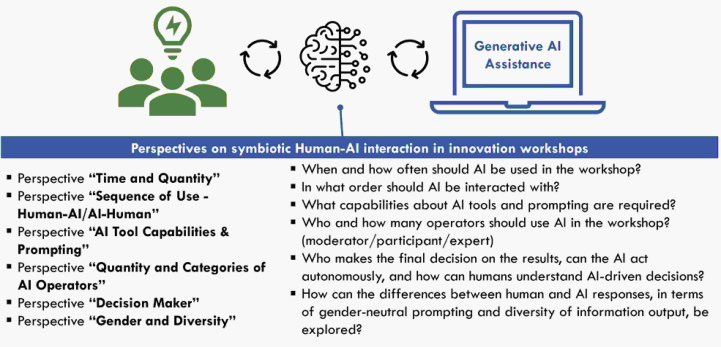
SYMBIOTIC HUMAN-AI INTERACTION IN THE SETTING OF CREATIVE INNOVATIONS WORKSHOPS The aspect of how symbiotic human-AI interaction can be applied and designed in creative innovation workshops is discussed below. The overview of the perspectives and the associated questions (see Figure 3) provides an ini- tial indication of the design of the interaction and the answer to the research question.
40 Rupprecht and Mayrhofer
Figure 3: Perspectives on symbiotic human-AI interaction in innovation workshops.
The different perspectives on the symbiotic interaction between humans and AI in innovation workshops provide an insight into the dynamics of the interaction in a creative workshop setting. The Time and Quantity per- spective sheds light on how the temporal aspect and quantity of interaction influence the efficiency and creativity of symbiotic Human-AI interactions and how it can facilitate or hinder innovation. The Sequence of Use - Human-AI/AI-Human perspective focuses on the succession of interactions in a workshop and examines whether the initiative comes from the human side and is supported by AI, or whether AI-generated ideas are the start- ing point, or how this goes back and forth in an interactive manner. The AI Tool Capabilities & Prompting perspective focuses on technical capabil- ities of AI tools and humans, and how prompting affects the quality and accuracy of AI results. The Quantity and Categories of AI Operators per- spective addresses the role and number of people operating and controlling AI in workshops, and whether it should be conducted by the facilitator, by individual or multiple participants, or by a specialized third-party AI expert. The Decision Maker perspective addresses the question of who decides and to what extent AI can act autonomously in making decisions. It also encom- passes the level of human involvement and understanding of the decisions made by AI. The Gender and Diversity perspective is intended to examine the differences between humans and the differences of AI tools applied, focusing both on the gender-neutral input of prompts as well as diversity aspect of information output.
These perspectives provide a framework for understanding and designing the symbiotic interactions between human operators and AI systems in cre- ative innovation workshops. The evaluation of these claims is still open and will be evaluated in future research through several experiments.
CONCLUSION
In the taxonomy presented above, a first approach examines the capabili- ties of AI and humans in different phases of the Design Thinking innovation
Hybrid Intelligence - An Approach Towards the Symbiosis of Artificial 41
process and offers a preliminary assessment of where AI and humans have their complementary strengths. The contribution on Hybrid Intelligence in the context of innovation workshops provides an overview of different per- spectives on the application and design of the Human-AI interaction and identifies questions that remain to be answered in an experimental setting. In order to investigate this approach scientifically, an experimental framework in the context of an innovation workshop with professionals and experts is needed. The objectives of this future research are to find out (1) whether AI and humans are better at the capabilities listed in the taxonomy above, and (2) how to design interaction and collaboration in a way that allows both humans and AI to maximize their individual strengths and understand each other’s processes and decisions. Another question that needs further investigation is: How can humans and AIs learn from each other during the interaction? Future research also needs to explore which Generative AI tools are appropriate for the specific capabilities at each stage of the innovation process.
This paper provides a first insight into the potential of Hybrid Intelligence and the support of Generative AI in innovation generation. It also highlights the open questions in the field of symbiotic interaction, especially for the application in innovation workshops. Hybrid Intelligence and a proper appli- cation within a company’s innovation process look promising in bringing benefits to SMEs, especially in terms of generating radical innovations and enhancing creativity.
ACKNOWLEDGEMENTS
We would like to thank Anna Ilaria Mayrhofer for editing this article.
REFERENCES
Akata, Z., Balliet, D., Rijke, M. de, Dignum, F., Dignum, V., Eiben, G., Fokkens, A., Grossi, D., Hindriks, K., Hoos, H., Hung, H., Jonker, C., Monz, C., Neer- incx, M., Oliehoek, F., Prakken, H., Schlobach, S., van der Gaag, L., van Harmelen, F., Welling, M. (2020). A Research Agenda for Hybrid Intelligence: Augmenting Human Intellect With Collaborative, Adaptive, Responsible, and Explainable Artificial Intelligence. Computer, 53(8), 18–28. https://doi.org/10. 1109/MC.2020.2996587 Amershi, S., Cakmak, M., Knox, W. B. & Kulesza, T. (2014). Power to the Peo-
ple: The Role of Humans in Interactive Machine Learning. AI Magazine, 35(4), 105–120. https://doi.org/10.1609/aimag.v35i4.2513 Ates, A. & Bititci, U. (2011). Change process: a key enabler for building resilient SMEs. International Journal of Production Research, 49(18), 5601–5618. https: //doi.org/10.1080/00207543.2011.563825 Brown, T. (2008). Design Thinking: Thinking like a designer can transform the way
you develop products, services, processes-and even strategy. Harvard business review. https://hbr.org/2008/06/design-thinking Dell’Acqua, F., McFowland III, E., Mollick, E., Lifshitz-Assaf, H., Kellogg, K. C., Rajendran, S., Krayer, L., Candelon, F. & Lakhani, K. R. (2023). Navigating the Jagged Technological Frontier: Field Experimental Evidence of the Effects of AI on Knowledge Worker Productivity and Quality. Working Paper (24-013). Harvard Business School.
42 Rupprecht and Mayrhofer
Dellermann, D., Calma, A., Lipusch, N., Weber, T., Weigel, S. & Ebel, P. (2019). The future of human-ai collaboration: A taxonomy of design knowledge for hybrid intelligence systems. In T. X. Bui (Hrsg.), Proceedings of the 52nd Annual Hawaii International Conference on System Sciences: January 8-11, 2019, Maui, Hawaii. University of Hawaii at Manoa Hamilton Library ScholarSpace. Dellermann, D., Ebel, P., Söllner, M. & Leimeister, J. (2019). Hybrid Intelligence.
Business & Information Systems Engineering, 61(5), 637–643. https://doi.org/10. 1007/s12599-019-00595-2 Eapen, T. T., Finkenstadt, D. J., Folk, J. & Venkataswamy, L. (July 2023). How generative AI can augment human creativity. Harvard Business Review. https://hb r.org/2023/07/how-generative-ai-can-augment-human-creativity Fitts, P. M. (1951). Human engineering for an effective air-navigation and traffic-
control system. Washington, DC: National Research Council. Felzmann, H., Villaronga, E. F., Lutz, C. & Tamò-Larrieux, A. (2019). Transparency you can trust: Transparency requirements for artificial intelligence between legal norms and contextual concerns. Big Data & Society, 6(1), 205395171986054. https://doi.org/10.1177/2053951719860542 Google DeepMind. (2023). Google DeepMind - Gemini. https://deepmind.google/technologies/gemini/#introduction Gray, J. H., Densten, I. L. & Sarros, J. C. (2003). Size Matters: Organisational Cul-
ture in Small, Medium, and Large Australian Organisations. Journal of Small Business & Entrepreneurship, 17(1), 31–46. https://doi.org/10.1080/08276331. 2003.10593311 Hasso Plattner Institute (d.school) - Stanford University. (2023). Design Thinking Process. dschool.stanford.edu Jarrahi, M. H., Lutz, C. & Newlands, G. (2022). Artificial intelligence, human intelli-
gence and hybrid intelligence based on mutual augmentation. Big Data & Society, 9(2), 205395172211428. https://doi.org/10.1177/20539517221142824 Kamar, E. (2016). Directions in Hybrid Intelligence: Complementing AI Systems with Human Intelligence. In IJCAI’16, Proceedings of the Twenty-Fifth International Joint Conference on Artificial Intelligence (S. 4070–4073). AAAI Press. Oeste-Reiß, S., Bittner, E., Cvetkovic, I., Günther, A., Leimeister, J. M., Memmert,
L., Ott, A., Sick, B. & Wolter, K. (2021). Hybride Wissensarbeit. Informatik Spektrum, 44(3), 148–152. https://doi.org/10.1007/s00287-021-01352-0 OpenAI. (2023). Introducing GPTs. https://openai.com/blog/introducing-gpts OpenAI. (2024). OpenAI. https://openai.com OpenAI, Achiam, J., Adler, S., Agarwal, S., Ahmad, L., Akkaya, I., Aleman, F. L., Almeida, D., Altenschmidt, J., Altman, S., Anadkat, S., Avila, R., Babuschkin, I., Balaji, S., Balcom, V., Baltescu, P., Bao, H., Bavarian, M., Zoph, B. (2023). GPT-4 Technical Report. https://arxiv.org/pdf/2303.08774v4 Østerlund, C., Jarrahi, M. H., Willis, M., Boyd, K. & T. Wolf, C. (2021). Artificial
intelligence and the world of work, a co-constitutive relationship. Journal of the Association for Information Science and Technology, 72(1), 128–135. https://doi. org/10.1002/asi.24388 Rupprecht, P. & Schulz, A.-C. (2023). Organisationale Ambidextrie in österreichischen KMU: Durch Exploration und Exploitation die digitale Transformation bewältigen (Praxisstudie). Institute for Digital Transformation & Strategy (IDS), FHWien der WKW. Samid, G. (2021). Artificial Intelligence Assisted Innovation. In https://doi.org/10.
5772/intechopen.96112
LISTED IN THE AHFE DIGITAL BOOKSTORE CATALOGUE
Explore the complete digital volume
Creativity, Innovation and Entrepreneurship
Read this individual research paper free through the original publisher, or explore the full digital proceedings book.
ISBN 978-1-964867-01-4
Explore this ISBN in the AHFE Bookstore ↗Listed in the July 2026 bookstore catalogue; search by ISBN to confirm current availability · Digital book purchase optional