Katherine Mollenhauer, Cala Del Rio, Javiera Rodriguez, Kay Bergamini, Vanessa Rugiero, José Ignacio Medina (2024). Multilevel Information Delivery Strategy (MIDS): A strategic design based model and method for equitable access to environmental information. In: Human Systems Engineering and Design (IHSED2024): Future Trends and Applications. AHFE Open Access, vol. 158, pp. 325–343. https://doi.org/10.54941/ahfe1005556
Faced with the climate crisis scenario, it is crucial to take collaborative action that involves multiple actors from civil society, the private and public sectors. However, often in the process of integrating environmental information and designing tools to disseminate it, the unique requirements of each user group are overlooked. This raises the question: how can we develop an environmental information delivery strategy that caters to the diverse needs of its users? To address this issue, strategic design and co-creation methodologies were employed in the "Environmental Observatory of Mining Projects", an applied research project aimed at improving the equitable delivery of information in four communes in Chile. Through this project, a Multilevel Information Delivery Strategy (MIDS) model was developed that outlines the various levels of environmental information delivery required for sustainable and resilient local community development adaptable to multiple contexts.
Currently, it can be stated that the climate crisis is unquestionable and affects all corners of life on earth, from the most remote territories to the most populated cities (IPCC, 2022). In this context, people are in an urgent position to take action, to relate differently with natural and artificial spaces and among peers, generating adaptive capacities that allow them to respond to those conditions of risk and environmental emergency. This call to action must transcend socio-political dimensions, making actors from multiple spheres of influence an essential part of the change: civil society, members of the private industry and of the public management and legislative spectrum; all of them being crucial participants in the processes of territorial and environmental management.
To reach this, empowering actors who are directly affected and inviting them to contribute from their knowledge, experience and expertise in the solution that is sought to be developed is imperative (Blomkamp, 2018).
The participation of all stakeholders is essential for survival. Thereupon, and according to Law 19,300, Article 4, it is the duty of the State to facilitate participation, allow access to environmental information and promote educational campaigns aimed at environmental protection (Approves Law on General Bases of the Environment, 1994), which, in the long term, allow interaction between the different sectors of society in order to take action against crisis scenarios through the management of territories and economic activities that are developed in it.
Thus, participation has been seen as a means to reduce vulnerability and increase resilience (Graveline & Germain, 2022; Jeans et al., 2016; Pelling, 2003; Cutter et al., 2000,). Resilience is the ability to adapt to difficult situations and provides a conceptual framework for assessing the community’s ability to cope with emergencies (Bonanno et al., 2015 in Shahpari Sani et al., 2022), such as environmental degradation. Likewise, by observing individuals who relate to each other in the territories, adaptive capacities feed back and strengthen each other, allowing individuals to respond to the impacts of environmental conditions (Adger et al., 2001, Downing, 2003), in a collaborative and committed manner among all those involved with a common interest, ensuring the survival and sustainability of the territories in which they develop (Jeans et al., 2016).
In the search for climate change resilient actions, environmental impact information is essential to support the decisions that are made, the direction they take and the timeframe in which they are carried out. However, although the distribution of this knowledge must be transversal to the different actors involved in the transformation towards sustainable development, the way in which it is delivered cannot be unique. This is because the context, motivation, capacities, levels of action, and uses of this information differ among these actors, despite sharing the ultimate goal of change. So far, the integration of environmental impact information has neglected this dimension, singularizing the way it is delivered and thus excluding key actors in the active participation towards sustainable and resilient local community development.
The following questions arise: What are the needs and expectations of the users that interact with environmental information and the factors that influence them? What requirements should be considered in the design of an environmental information delivery strategy according to the characterization of users? What are the attributes and components for the design of an environmental information delivery strategy that considers the requirements of each user type?
The present article seeks to report the methodological contribution developed within the framework of an applied research that aims to integrate civil society, private and public sector actors in the visualization and understanding of information in an equitable manner, for its use in pursuit of sustainable community development, achieving greater resilience through a design strategy. This process is carried out as a result of the applied research project “Environmental Observatory of Mining Projects: System for the Analysis of Public Information on Environmental Management’ (www.observatorioambientaluc.cl), which aims to integrate environmental
Multilevel Information Delivery Strategy (MIDS): A Strategic Design 327
impact information from the mining industry in Chile into a publicly accessible platform. This research was funded by the Promotion of Scientific and Technological Development Fund (Fondo Para El Fomento Del Desarrollo Científico y Tecnológico) FONDEF ID20I10084 and the Technological Research (Investigación Técnológica IT23I0066 organism dependent on the National Commission of Science and Technology (CONICYT).
This study focused on four municipalities that have a diversity of mining projects from different company scales and -logically- the presence of environmental conflicts. These territories are Alhué, San José de Maipo, Los Andes and Puchuncaví, communes where the provision of equitable information becomes fundamental for environmental compliance, coexistence within the territory and sustainable community development. As a result of the user research conducted for this applied research, a strategy for the delivery of the information is created, which helped define: i) the building blocks for the Environmental Observatory platform (from now on OA Platform), ii) the visualizing parameters of the information and iii) the complementary components or touchpoints for a systemic interaction with the users.
THEORETICAL FRAMEWORK: CHILE’S MINING INDUSTRY AND INFORMATION DELIVERY SYSTEMIC STRATEGIES Environmental Information in Chile’s Mining Industry
Information democratization has gained importance as part of the ongoing debate on the repositioning of the role of science in society (Zulkafli et al., 2017) and around the undeniable environmental crisis and its relation to environmental management process improvement. In that sense, other initiatives around the world such as the OA Platform facilitate access through the collection, processing, publication and visualization of information providing an increasing opportunity to create and exchange knowledge for decision support in environmental management (Beven et al., 2012; Cohen & Santhakumar, 2007).
Facilitating access makes it possible to generate a common knowledge base among organizations with potential and active initiatives in pursuit of sustainable development, regardless of whether they come from the public, private or organized civil society sectors. Arts et al. (2015) identified two obstacles to accessing online environmental information from public authorities: liability concerns related to the accuracy and quality of the information provided, and difficulties in interpretation. While previous research has mainly focused on addressing the first barrier of ensuring data consistency and quality, the presentation of information and the public’s ability to understand it has been relatively understudied. Thus, this study considers it crucial to gain a deeper understanding of this second aspect.
Establishing a “current situation” that can be understood by all these stakeholders facilitates collaboration and increases resilience towards the ultimate goal of sustainable development. The level of technicality and specificity of the information requires an understanding scheme by and for
the different sectors of society, enabling the delivery of information that is understandable, useful, manageable, comparable and interoperable and can therefore be used for decision making and management.
Since the 1990s, Latin America has registered a strong growth in the mining sector, a context where Chile has established itself as the largest producer of copper, iodine, rhenium and lithium in the world, accounting for 63.2%, 50% and 39% of world production respectively (OECD-UN, 2018). However, mining corresponds to an economic sector with inherent environmental impacts (Gudynas, 2009; Alimonda, 2011; Bebbington, 2012; Göbel and Ulloa, 2014; Dietz and Engels, 2016; Barton, Bustos and Prieto, 2015; Bergamini and Dextre, 2022). According to Schorr (2018), with the increase in investments and the number of mining megaprojects, social conflicts over mining have also multiplied, often fueled by gaps in access to environmental information.
Regarding environmental information in the Chilean mining industry, there are public institutions that seek to regulate the environmental and social performance of each project, including the Ministry of the Environment (MMA), the Environmental Assessment Service (SEA), the Environmental Superintendency and the Environmental Courts (TA). Each of these institutions, within their attributions, carry out activities related to the evaluation, inspection and sanction, respectively, generating information that allows analyzing and evaluating the socio-environmental impact of a mining project and of the general economic sector. This information is obtained mainly from environmental monitoring networks, and is translated in a simpler and more synthetic form into environmental indicators (Perevochtchikova, 2013). Access to these indicators helps to avoid conflicts among stakeholders, who tend to take a stance on each mining project, supporting or opposing it. In this sense, a scarce interaction with environmental information, together with the lack of reliable information and its ambiguity can even lead to the simultaneous existence of hostile or exaggeratedly positive beliefs (Sabatini, 2020) within the territory. In this way, accessing information from different positions within society makes it possible to adequately analyze environmental impact and performance studies in order to support or oppose mining work in a reasoned and justified manner.
Therefore, the need arises to empower individuals and collectives to action in the context of climate change, through the increase of available information, and therefore, participation, growing generation of multidisciplinary knowledge, increased awareness of a locality, globality, networks and communities (Salvatierra, 2017). In addition, the effect of the availability of information in communities provides certainty about the territory they inhabit and their way of life. When human groups face changing conditions, insecurities are generated in relation to their future, raising the imperative need to overcome this state of affairs (Sabatini, 2000) in search of stability and the welfare of their community.
For the effective integration of the public, private and civil society sectors, in search of sustainable community and local development, it is necessary to provide equitable access to information, guaranteeing the understanding of each of them. In this way, we seek to respond to the needs of each interest
Multilevel Information Delivery Strategy (MIDS): A Strategic Design 329
group, so that, from the different roles they play within the mining sector, they can make use of the information.
Chile’s Mining Environmental Information Ecology Since the late 1990s, the concept of information ecology has been recognized as “a system of people, practices, technologies, and values in a local environment; it is diverse, complex, and continually evolving” (Naiwi & O’Day, 1999). Integrating technological products within an information flow system rather than just describing them as tools or separate systems. Since then, the growing need for access to information has proliferated the construction of technologies, platforms and software that incorporate within these information ecologies, improving information access, delivery and understanding.
Within the context of environmental impact, platforms have been built around the world for monitoring the effects of various economic activities, activism, availability of public information, monitoring of governmental environmental management processes, and others. In the case of the mining sector in Chile, public, private and civil society self-led organizations have generated information platforms that have injected enormous amounts of data into the information ecology they are part of. The aforementioned MMA, the SEA, the SMA and the TA are all public organisms that relate to the mining industry and its operation in the context of environmental impact. Each of these agencies has made available multiple platforms that provide metrics on their area of interaction with the mining industry and environmental impact. However, these are dispersed and are not interoperable, making it difficult to access, understand and use the information.
Along the same lines, in the private sector, mining companies and consulting firms use and generate environmental information about the activity of each company and its mining operations or facilities, in order to comply with environmental regulations and control processes, as well as to innovate within the company itself in order to obtain greater efficiency and less impact on the environment. The environmental information they contribute to information ecology includes figures on productivity levels, economic contribution to the national GDP and tax revenues, participation in the country’s employment and strategic planning in terms of contribution to socio-environmental impact, among others. However, this information is often kept private, being used for the internal work of the mining project or directly provided to the public sector in monitoring contexts. In some cases, the information is materialized in annual reports which are published in order to make known what is happening within the company. However, these are often difficult to understand or are a strategic selection of available information, commonly perceived as corporate greenwashing.
Finally, civil society has mainly been related to environmental impact information through organization and activism in order to watch over, encourage and mobilize for the sustainable management of the territory they inhabit. Civil society contributes to information ecology through the
raising of concerns about the impact of mining companies based on their personal experiences, as well as the dissemination of what they witness in their respective communities and/or regions. This information is translated into collective demonstrations in the public space, dissemination through social networks and generation of social organizations that give rise to citizen oversight. In this way, self-managed information is generated, but it is often delegitimized by the lack of official sources to support the information and bounded data sets.
Inserting the type of technologies targeted by the OA platform, within the information ecology to which it seeks to contribute, can certainly help groups trying to address inequalities as well as improve services in a wide variety of areas (Harrell, 2020), such as the management of their territories or of the mining service itself. However, “It has been shown that more information does not necessarily lead to better decisions” (Han, 2012) so just populating the system with information is not the answer to better use of information. Thinking about how these technological tools are being designed and inserted in this system is the key to ensure the co-evolution of the technical and social dimensions of the system in which they are inserted. (Nardi, & O’Day, 1999).
Systemic Strategies for Information Delivery Based on Nardi and O’Day’s information ecologies approach, almost 5 years later Raya Fidel and Annelise Mark Pejtersen state that the literature has already established the importance of examining the human-information behavior of an objective user to support the design of new information systems, and how these would be more effective if this occurred (Fidel, & Pejtersen, 2004). Therefore, the methodology used in the processes of development and deployment of the technology that surrounds us, must be focused and act locally in the integration of human-information behavior of potential users and the design parameters that then shape the technological solution that is integrated into the system (August, 2013). At the same time, within an information ecology “Understanding how people relate to other people is just as important as understanding how they relate to information” (Jones et al., 2006, p. 68) so design decisions should not only inform the design of the technological product itself but also the information delivery strategy with a systemic view, considering the direct flow with and between users.
Strategic design is a branch of the design discipline that focuses on solving complex problems through creativity, strategy and the generation of long- term value for organizations and society. (Buchanan, 2015). According to Bentz and Franzato (2017, p. 138) “strategic design considers the characteristic creative processes of design from an ecosystemic perspective, in other words, conceiving them among the multiple and intricate processes elaborated by creative ecosystems (...) Strategic design resignifies the values of the social groups, the organizational structures and the social- cultural contexts, besides re-signifying technologies and networks”. From the perspective of strategic design practice and, specifically from the perspective of the UK based consultancy Rival Strategy (2017) led by Marta Ferreira
Multilevel Information Delivery Strategy (MIDS): A Strategic Design 331
de Sá and Benedict Singleton, strategies can be seen as designed objects “in the sense that they’re not just the sum of the words that are in them, but deliberately designed, with their form following their function”. These authors invite practitioners to design strategies following the logic of the platform, and not in the technological realm. But, referring to the scenic platform, where they become “a set of elements that can support a given activity” leaving aside the linear perspective of planning services or designed experiences, to build strategic models that can develop over time in response to their environment in a systematic way.
From the intersection of these concepts, it can be inferred that the design of new elements that contribute to an existing ecosystem must be fed by a multidimensional study of it “one has to understand: the work actors do, their info behavior, the context in which they work, and the reasons for their actions” (Fidel & Pejtersen, 2004). Doing this will result in the creation of a strategy and its derived components that transform the current information ecology into a preferable one (Simon, 1969), according to the conducted study. As Niki Wallace states in her multilevel perspective (MLP), problems should be explored from “multiple perspectives, co-creating with communities, and interfaces with local government; the latter is argued by Zivkovic (2013) as crucial for transitions” (Wallace, 2021). However, this is not only a method that should feed the investigation of problems, but also the applied output of the designed product, especially in diverse and complex contexts such as the mining environmental information ecosystem in which this project is contextualized, which is composed of multiple actors with dissimilar motivations. Thus “Engaging with plurality reveals how complex design approaches can use multiple leverage points that act like needles, performing a kind of ‘systems acupuncture”’ (Ceschin and Gaziulusoy, 2016; Manzini and Rizzo, 2011).
METHODOLOGY
The present FONDEF project was undertaken using an applied research scope (Bickman & Rog, 2009), which aims to generate knowledge for its use and application in cultural, scientific and productive contexts (Lozada, 2014, p. 34; Vargas, 2009). The used methodology has a multi-method research approach (Muratovsky, 2022) integrating techniques from strategic design, public service design (LIP, 2017), earth sciences, social sciences, data science and programming, defining 5 stages for its development (Figure 1): (1) Study of the perception of access to public environmental management information, (2) Definition and validation of indicators, (3) Technological development: data capture and normalization, (4) Automatic calculation and visualization of indicators, and (5) Comparative evaluation of the change in the gap of access to environmental information.
As stated in the Platform Design principles of Rival Strategy (2019), design creates scenarios in which conditions and components that allow the development of specific interactions are defined (Rival Strategy, 2019). If we are looking for these people to interact equitably with environmental information then a scenario must be generated for that to occur, considering its digital and analog components. Therefore, stage 1, associated with the
needfinding of the project, seeks to identify the particularities of each type of stakeholder according to their needs, desires and expectations in the context of information delivery and comprehension. With this input, the technical requirements to be considered for the development of the web platform and its service delivery are synthesized according to the particular characteristics of each type of user.
In the context of this project, the needfinding stage concerning the strategy to be presented, contemplated the following phases:
1. Information gathering
In this first phase we sought to investigate the perception of each user regarding the access and use of environmental information as well as the level of understanding and incentives to use it. This, in order to understand the interaction that each type of user has with the environmental information within the information ecosystem to which the project belongs. A survey responded by 278 people and 30 interviews were used in the first instance, which allowed the generation of certain hypotheses of motivations of use and relationship of the diversity of users with the environmental information of mining projects.
2. User characterization
In this second phase and based on the results of the previous one, 2 user workshops were designed and implemented with a total of 127 participants. The objective of both workshops was to validate and deepen the information gathered to characterize the 3 types of users from a needfinding point of view. Based on the results, the findings were analyzed and systematized around the variables and factors that are critical for the interaction with environmental information, according to i) the motivation to review environmental information, ii) the level of training and capabilities to deal with the information, iii) the level of action in the mining sector and iv) the opportunities or outputs that each user has with respect to the use of this information.
3. Requirements definition
In the third phase, based on the characterization of the user’s needs, desires and expectations, requirements were defined to generate a strategy that would guarantee the equitable delivery of information. This strategy lays
Multilevel Information Delivery Strategy (MIDS): A Strategic Design 333
the foundations for the generation of a systemic solution where each type of user can understand and make use of the information according to their level of interaction with the information. We will call this strategy Multilevel Information Delivery Strategy.
4. Materialization
Finally, in the fourth phase, the Multilevel Information Delivery Strategy was generated, which considers the requirements of each type of user to generate a systemic solution. This solution addresses the variables and factors that affect the effective and equitable reception of environmental information by the different types of users, considering their characteristics and the different levels at which they interact with the information for resilient environmental management. This Multilevel Delivery Strategy not only feeds the development of the web platform itself, but also the whole experience surrounding it, guiding the development of its main and secondary components.
FINDINGS During the needfinding stage, it was identified that the interactions of civil society, industry and public sector actors with environmental information are extremely different as shown in Table 1, which summarizes the findings. These specificities also describe the relationship between the types of actors, which provides guidelines to achieve greater involvement at all levels of action, not only in the direct experience with the information but also considering these actors as information channels.
Civil society mainly encounters environmental information in connection with the territory it recognizes as its own, making use of it in contexts of activism or community organization. The motivation to access this information lies in the interest of knowing what is happening in their surroundings and the socio-environmental impact that mining projects have on it. However, there is less accessibility and capacity to understand the information due to the high level of technicalities and complexity of the information, which is aggravated by the lack of training of civil society in environmental terms. This causes that only certain groups of the civil society have real access to information and participate in these activities. All of the above directly affects the motivation to visit and trust official sources of information, which further extends the asymmetry in access to significant information for the evaluation and monitoring and inspection of projects located affecting them.
On the other hand, the private sector relates to environmental information at the producer level, using it as a method for benchmarking within the industry and driving it in terms of business pivots and innovation. Mining companies constantly face uncertainty about environmental resolutions in the development of their projects, so they need to be aware of the ongoing and future environmental management processes and the performance of their projects. The private sphere can be a very broad group, but most of these organizations have the capacity and need to count with a group of highly technical professionals, capable of understanding information at its most crude and complex levels, which allows a high level of understanding
and analysis that can then be leveraged for decision making. However, there is a trust barrier, especially with civil society, reflected in the collective demonstrations in opposition to the projects.
Finally, the public sector is located at a mediating level between these two other groups of users, relating to environmental information on a daily basis with respect to public policy decision making in local and national management. Likewise, based on this kind of information, they can supervise the environmental compliance of mining projects and demand parameters when appropriate. Within this group of users there are different levels of knowledge regarding the understanding of the information, however, they have the possibility of distributing the knowledge to the civil society, since they have the tools and networks to reach the civil society, especially when we focus on local governments.
The results above guide the definition of requirements for the overall delivery strategy. In the case of civil society, the information delivery should be as simple and accessible as possible, both in terms of shape and distribution formats. This possesses a visualization requirement in parallel to the generation of a system that allows accessible formats and possible guided processes to enhance the understanding of the information. The private sector requires access to “raw” information of a highly technical and specialized nature. This allows for internal interpretation, using private data analysis systems. There is a technical requirement to generate a way to download or connect to the data source of the OA platform for this type of user. Finally, the public sector requires information for daily use to support decision making. However, there is a diversity of technical management levels in this user group, so the above requirements of simplicity and technical offloading apply in this sphere as well. A requirement that is unique to this type of user is the possibility of disseminating and connecting information within the ecosystem, which makes necessary the creation of a sub-component that allows the transfer of this information to the community.
Through this process, the characterization of each type of user made it possible to understand the needs and expectations of each one of them, and thus elucidate the requirements that need to be considered in the design of a strategy to deliver environmental information and develop the appropriate components to support it.
DISCUSSION AND RESULTS The characterization resulting from the needfinding process, shown in Table 1, evidences the existence of diverse user profiles with specific requirements for a delivery of information that improves access and understanding for and by each of them in a single platform. Using these findings as input, a Multilevel Information Delivery Strategy is proposed, which considers the specificities of each of the actors involved. This strategy integrates the heterogeneous requirements for each type of stakeholder in a single system-solution of transversal use, having as a unifying element the OA Platform, but also involving other components that add value and complete the user’s experience.
Multilevel Information Delivery Strategy (MIDS): A Strategic Design 335
Table 1. Determining factors of information interaction by user type and derived requirements for the strategy (Own Elaboration, 2024).
Table available in the original PDF paper.
User’s level of action in the mining sector
Information delivery strategy design requirements
Motivation to review environmental information
Opportunities/ outputs with respect to the use of environmental information
Level of training and capabilities to deal with environmental information
They require simplicity in the visualization of the information, support and guidance in its reading.
They participate in community organizing to demand change (activism) and participate in the mining industry.
Low level of technical specialization in the management of environmental information and therefore less capacity to understand the information.
Civil Society To know what is happening within my territory and how it influences my health, work, environment, etc. Backup the reasoning for social manifestation.
Improvement in management of the community organization, contributing to the quantity and quality of information and local knowledge that they connect to their own experiences.
Private Sector Innovate within the company, in terms of efficiency and socio- environmental impact, and communicating that to the public.
They require the possibility of technical download and connection to the mathematical model via API in order to be able to make use of the information.
High level of specialization in the technical management of environmental information and therefore greater understanding and processing capacity.
They participate in the environmental or sustainability areas of companies, establishing community relations and accountability strategies.
Improvement of innovation processes in the industry based on the comparison of environmental performance with its competitors.Generation of trust with the inhabitants of the territories where they operate, by including them in decision making processes in those areas that are within their competence.
They participate in decision making, regulation of companies performance and the generation of public policies.
Improvement in processes of knowledge distribution and mediation of the company-civil society relationship.
They require the possibility of technical downloading of the information as well as simplicity in visualization in order to guide the community in reading the information.
Public Sector Fulfill the guidelines conferred by their institutions and public commitment towards the dissemination of environmental information based on international commitments acquired, such as the Escazú Treaty.
Different levels of knowledge and specialization in the socio-technical management of environmental information, since they must deal with everything from data analysis to the dissemination of information to the community.
Based on these results, 3 levels of information delivery are established: uncooked, mixed cooking and cooked (see summary in Table 2), making a metaphor from gastronomy in the sense of the degree of preparation of a dish that is going to be served to diners. Uncooked information refers to raw information that is not processed or prepared before being served. Mixed cooking information refers to information with different degrees of preparation, depending on the requirements that need to be covered. And finally, cooked information refers to information that has been specially processed and prepared according to the taste of the diner to whom it will be presented with.
It is important to emphasize that the proposed Multilevel Information Delivery Strategy, although based and aimed at each of the different users analyzed, does not delimit the use of a specific level as something exclusive
to the user type in question. In other words, the information browsing experience in any of these levels depends only on the needs of the person at the time of accessing it. Therefore, any individual could access the three levels if required without depending on the structures previously established by the system.
Table 2. Requirements and attributes for the solution according to the MIDS in the context of the environmental observatory for mining projects (Own Elaboration, 2024).
Table available in the original PDF paper.
Information Delivery Level
Solution requirements according to MIDS
Solution attributes according to MIDS Technical: in the sense that organizations can make use of the information at a specialized level. Interoperable: in the sense that organizations can make use of the information from their own systems.
Uncooked The solution must consider components for downloading information in technical format. The solution must consider a connection to the database via an API that is compatible with the data analysis means of the organizations that request it, guaranteeing its interoperability.
Mixed cooking The solution must consider components for downloading information in technical format. The solution must consider components to facilitate the transfer of information to the community.
Technical: in the sense that specialized users can make use of the information in decision making processes, inspection and public policy design. organizations can make use of the information at a specialized level. Comprehensible: in the sense that the less specialized users can make use of the information in relation to decision making processes, inspection and public policy design. organizations can make use of the information at a specialized level. Cooked The solution should consider instances of reading guidance to promote the comprehension of information within the community.
Understandable: in the sense that civil society can know what is happening within the territory it inhabits or in which it develops.
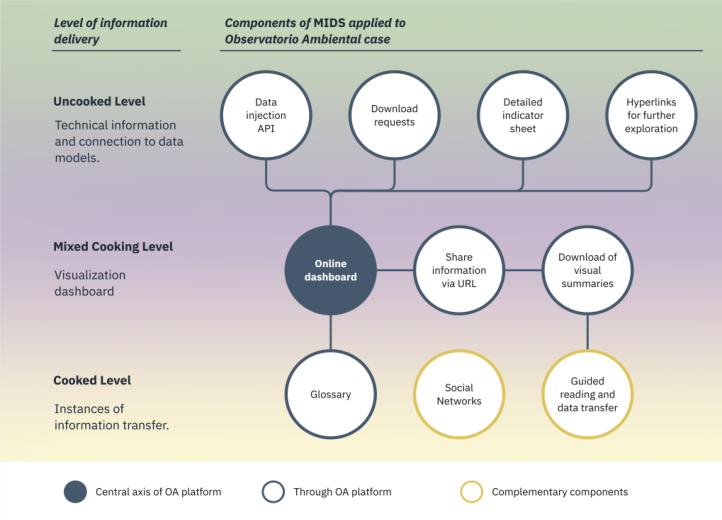
In the case of OA, the particularities of each of these levels of the MIDS are described below as presented in Figure 2.
Uncooked Level This level allows the design of a web platform that meets the needs of an actor with a high level of specialization in the management of environmental information and therefore a greater capacity to use complex terminology. This level seeks to present information in a technical or disaggregated state, thus enabling internal analysis by different agencies according to the technologies handled by each one of them. This level is completely mediated through the OA Platform, where organizations may request the download of databases or the connection to a specialized API designed for this purpose. At the same time, this level of information delivery allows access to data sheets detailing the construction of the indicators available on the platform and hyperlinks to data sources and other websites that can provide complementary content to those displayed on the dashboard.
Multilevel Information Delivery Strategy (MIDS): A Strategic Design 337
Mixed Cooking Level This level seeks to present information to users with different levels of specialization in technical management, whose responsibilities vary between the technical analysis of the data and the community support in the reading of the information, guaranteeing the understanding of the local communities. This, through the central axis of the OA Platform; a filterable visualization dashboard that uses different graphic elements to generate greater proximity and legibility to the data. This seeks to improve the understanding of the information displayed and the creation of a space that can be easily disseminated among people through a URL address. In addition, this level of delivery allows the download of communal reports that use the same visual media as the dashboard. These can be used to reach sectors where there is a greater digital divide, printing the reports as documents for community dissemination through ambassadors who can interpret and explain them.
Cooked Level This level focuses on presenting information to actors with a low level of technical specialization in environmental information and, therefore, less capacity to understand it. The delivery of information is done through mediated instances, where there may be an explanation of the information being presented by people or entities with greater knowledge. In these instances, downloadable communal summaries or the online visualization dashboard can be used as input. In addition, the platform offers a glossary to familiarize users with the language used in the mining environmental information ecosystem in Chile. Finally, social networks such as instagram, are available as a direct means of communication with the project and also as a complementary means of socializing information.
All of these components, their connection to the OA Platform’s functionalities and other elements complementary to the platform itself, operate together through the levels of this MIDS. This enables the creation of an informed and diverse core of people in pursuit of sustainable and resilient community development. Where “These interconnected approaches generate constellations of activity or ‘solution ecosystems’ that span multiple levels in the system using strategic and tactical approaches” (Eggers and Muoio, 2015). Getting closer to the goal of an equitable information delivery system.
Implementation of the MIDS in the Environmental Observatory Context As a result of the Environmental Observatory for mining projects, it is possible to conclude that the way in which environmental information is delivered cannot be unique since the actors in the system - private sector, public sector and civil society- have diverse purposes and characteristics. Although they all share the ultimate purpose of contributing to systemic resilience to climate change and sustainable community development, the context, motivations, capacities, levels of action, and use of this information differ from one to another. Therefore, the integration of civil society, private sector and public sector actors in the delivery, visualization and understanding of information is critical.
Figure 2: Components of MIDS applied to environmental observatory for mining projects (Own Elaboration, 2024).
The combined application of a methodological approach such as Platform Strategies from an information ecology perspective was key in the design of the MIDS applied to the Environmental Observatory delivery strategy. As part of the strategy, the needs, expectations and factors affecting information delivery were determined. Based on this, the requirements, attributes and components were defined to meet the particularities of the various stakeholders, integrating everything into a single interface and its operating system to achieve equity in the delivery and subsequent use of environmental information.
Methodological Contribution of Strategic Design to Environmental Management for Community and Resilient Development The results of the research project in the present case study highlight the importance of characterizing the information ecosystem in which intervention is sought. From this perspective, modeling the process of characterizing the users’ interaction with environmental information and how these characteristics determine the requirements for an intervention is key when designing an information delivery strategy. Moreover, the application of systemic strategies that address the determinants of user interaction with environmental information as well as the characteristics and requirements of civil society, private industry and the public sector allows the entire system to thrive, achieving greater resilience and equity.
Multilevel Information Delivery Strategy (MIDS): A Strategic Design 339
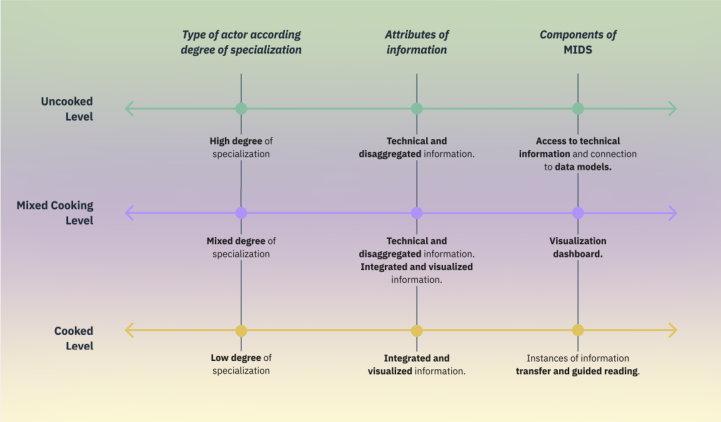
The Multilevel Information Delivery Strategy (MIDS) has graduation components according to the level of information delivery the user inhabits. In this way, the model is made up of the correlation between the level of information delivery with specific attributes translated into specific components associated with the delivery of information. Within those parameters, users will move, depending on the degree of specialization and the objectives associated with their information review.
Figure 3: Multilevel delivery strategy model (Own Elaboration, 2024).
This model and its method can be applied to other information systems where an analysis is needed to enhance the information ecology as a whole. To do this, one must begin by analyzing the different stakeholders or types of users of the system, with respect to the following variables: a) motivation for the use of information, b) level of specialization and capabilities, c) levels of action in the system under study, and d) opportunities in relation to the information ecology of the system under study. This will make it possible to characterize and identify the requirements for each of the actors in the system in question. These variables can be driven by the following questions: a. Motivation for information review: in what contexts does the user seek information of this type? With what objectives does the user seek this information? b. Capacities and level of training: How does the user deal with an information delivery platform? What are his main challenges when searching for information? c. Levels of action: What activities or tasks can trigger the use of this information by the user? In what contexts does the user make use of the information consulted?
d. Opportunities or output: What opportunities does access to information provide for this actor within the organization to which they belong or their personal character?
Once the actors of the system have been characterized, the requirements (e) can be extracted to generate an optimal and equitable information strategy, according to the answers obtained from the users belonging to the information ecology in question (Table 3).
Table 3. MIDS model instrumental template n1 (Own elaboration, 2024).
User type Motivation to review information
User’s level of action in system
Opportunities/ outputs in relation to the system
Level of training and capabilities to deal with information
Information delivery strategy design requirements User 1 a) b) c) d) e) User 2 a) b) c) d) e) User 3 a) b) c) d) e) User X… a) b) c) d) e)
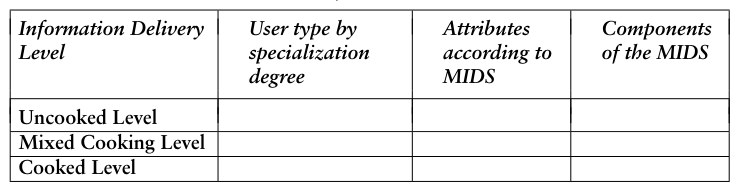
The systematization of determining factors for each type of stakeholder (Table 3), makes it possible to determine their degree of specialization in the subject matter and, therefore, the level of delivery required for each stakeholder to be able to make use of the information (Table 4). For each level, specific attributes are established to guide the definition of the specific MIDS components for the scope of application.
Table 4. MIDS model instrumental template n2 (Own elaboration, 2024).
Table available in the original PDF paper.
CONCLUSION
The MIDS Model guides the information delivery process when facing a given information ecology, specifying the graduation components according to the level of specialization of each user, based on the characterization factors associated with their interaction with information. From that process, the delivery levels are established, which have a specific objective and are associated to certain attributes that apply to the information ecology analyzed. All the above is materialized in components directed to each type of information delivery level, allowing it to respond to different needs, providing equity within the strategy. It is important to emphasize that although the application of this model allows the delimitation of different levels, these are not closed. The MIDS model allows the actors to move through these levels,
Multilevel Information Delivery Strategy (MIDS): A Strategic Design 341
taking into account the specificities of the people who make up the different types of users on which the strategy itself is based, thus guaranteeing equity of access to information and making it possible to approach sustainable and resilient community development.
Finally, through the results obtained in the context of the Environmental Observatory of Mining Projects it is possible to perform a systematization that results in a Multilevel Information Delivery Strategy (MIDS) model. So, from a methodological approach this paper presents a model, method and tool to implement the design strategic role and apply a systems oriented design (SOD) approach in complex contexts (Sevaldson, 2022). Based on Bentz and Franzato (2017) the MIDS model could be an expression of the meta-meta-meta level of production of knowledge, and, according to López- León & Macias (2020) this MIDS can contribute to an “epistemological design level background that will allow flexible, adaptable and holistic practices when working with it”.
LIMITATIONS Due to the characteristics of the scope of FONDEF, only 4 communes in two different regions of Chile are addressed, from which this model is systematized. However, due to the replicability and scalability characteristics of the model, its applicability to other communities and regions where there are socio-environmental conflicts is estimated.
Many of the elements proposed in the strategy have not yet been incorporated into the development of the OA Platform in question, because they are part of the development of a long-term strategy and the proposal for continuous improvement of the project.
REFERENCES
Adger, N. (2000). Social and ecological resilience: Are they related? Prog. Hum. Geogr. 2000, 24, 347–364. In: https://journals.sagepub.com/doi/10.1191/ 030913200701540465 Agosto, Denise E. Understanding reference transactions: Transforming an art into a science. Journal of the American Society for Information Science and Technology, Vol. 55(4), pp. 365–366;02/15/2004; doi: https://doi.org/10.1002/asi.10393 Alimonda, 2011. La naturaleza colonizada. Ecología política y minería en América
Latina. Ediciones CICCUS-CLACSO. Buenos Aires. Aprueba Ley Sobre Bases Generales Del Medio Ambiente, Ley no. 19300 (1994, 9 de marzo) (Chile). Boletín de Leyes y Decretos de Gobierno, (34810). https://www.leychile.cl/Navegar?idNorma=30667 Arts, K., Ioris, A. A. R., MacLeod, C. J. A., Han, X., Sripada, S., Braga, J. R. Z., &
van der Wal, R. (2015). Supply of Online Environmental Information to Unknown Demand: The Importance of Interpretation and Liability Related to a National Network of River Level Data. Scottish Geographical Journal, 131(3–4), 245–252. https://doi.org/10.1080/14702541.2014.978809 Barton, Bustos y Prieto, 2015; Ecología Política en Chile: naturaleza, propiedad, conocimiento y poder. Santiago de Chile: Editorial Universitaria, 2015. 275 p. ISBN: 9561124653. Bebbington, A. (ed.). Minería, movimientos sociales y respuestas campesinas. Una
ecología política de transformaciones territoriales. Lima: IEP-CEPES, 2007, p. 349.
Bergamini y Dextre, 2022. Exportación de la contaminación en Chile: Análisis de procedimientos sancionatorios de la Superintendencia del Medio Ambiente, 2013–2019. EURE (Santiago) vol. 48, no. 145 Santiago set. 2022. Recuperado de http://dx.doi.org/10.7764/eure.48.145.06 Beven, K., Smith P., Wood, A. (2012). Environmental modelling: An uncertain
future? Tipping towards a brighter future? Advances in Environmental Research, 18, 185–211. Bickman, L., & Rog, D. J. (2009). Applied Research Design a Practical Approach Planning Applied Social Research. In J.; Maxwell, L.; Bickman, & D. J.; Rog (Eds.), Handbook of applied social research methods (Vol. 2, pp. 3–43). SAGE Publications, Inc. Blomkamp, E. (2018). The promise of co-design for Public Sector, Australian Journal
of Public Administration, vol. 77, no. 4, 729–743. Bonnie A. Naiwi and Vicki L. O’day. Information Ecologies: Using Technologies with Heart. Cambridge, Mass.: MIT Press, 1999. pp. 232. $27.50 (cloth). ISBN 0-262-14066–7. Buchanan, R. (2015). Wicked problems in design thinking. Design Issues, 31(4), 3–9. Ceschin, F. and Gaziulusoy, I. (2016) ‘Evolution of design for sustainability: from
product design to design for system innovations and transitions’, Design Studies, Vol. 47, pp. 118–163. Cohen, M. A., & Santhakumar, V. (2007). Information disclosure as environmental regulation: A theoretical analysis. Environmental and Resource Economics, 37(3), 599–620. Cutter, S. L., Mitchell, J, T., Scott, M. S. (2000). Revealing the vulnerability of people
and places: a case study of Georgetown Country, Soth Carolina. Annals of the Association of American Geographers 90, pp. 713–737. Dietz T., and Engels, A. (2016) Extractive industries and social conflicts: A review of conceptual and strategic literature. Global Enviromental Change, 36, 47–59. Eggers, W. and Muoio, E. (2015), “Wicked Opportunities”, in Business ecosystems
come of age, Deloitte University Press, Westlake, TX, pp. 31–42. Fidel, R & Pejtersen, A. M (2004) From information behavior research to the design of information systems: the Cognitive Work Analysis framework. Göbel, B. y A. Ulloa (Eds.). 2014. Extractivismo minero en Colombia y América
Latina. Bogotá: Universidad Nacional de Colombia-Ibero-Amerikanisches Institut-DesiguALdades.net. Graveline, M. H., & Germain, D. Disaster Risk Resilience: Conceptual Evolution, Key Issues, and Opportunities. International Journal of Disaster Risk Science. 2022, 13 (3), 330–341. Gudynas, E. (2009) El mandato ecológico. Derechos de la Naturaleza y políticas
ambientales en la nueva Constitución (Quito: Abya Yala). Han, B.-C. (2012). La sociedad de la transparencia. Madrid, España. Editorial Herder. IPCC, 2022: Summary for Policymakers [H.-O. Pörtner, D. C. Roberts, E. S. Poloczanska, K. Mintenbeck, M. Tignor, A. Alegría, M. Craig, S. Langsdorf, S. Löschke, V. Möller, A. Okem (eds.)]. In: Climate Change 2022: Impacts, Adaptation and Vulnerability. Contribution of Working Group II to the Sixth Assessment Report of the Intergovernmental Panel on Climate Change [H.-O. Pörtner, D. C. Roberts, M. Tignor, E. S. Poloczanska, K. Mintenbeck, A. Alegría, M. Craig, S. Langsdorf, S. Löschke, V. Möller, A. Okem, B. Rama (eds.)]. Cambridge University Press, Cambridge, UK and New York, NY, USA, pp. 3–33, doi: 10.1017/9781009325844.001.
Multilevel Information Delivery Strategy (MIDS): A Strategic Design 343
Jeans, H., S. Thomas and G. Castillo. The future is a choice: The Oxfam framework and guidance for resilient development. Oxford. Routeldge. 2016. https://oxfamilibrary.openrepository.com/bitstream/handle/10546/604990/ml- resilience-framework-guide-120416-en.pdf?sequence=1. Jones, W., et al.... “It’s about the information stupid!”: Why we need a separate field
of human-information interaction. Ext. Abstracts CHI2006, ACM Press (2006), 65–68. Laboratorio de Innovación Pública. (2017). La co-producción del usuario en los servicios públicos. Documento de Trabajo No. 1. [en línea] https://www.lipuc.cl/publicaciones/coproduccion Lozada, J. (2014). Investigación Aplicada: Definición, Propiedad Intelectual e Industria. CIENCIAMÉRICA, 3, 34–39. Muratovski, G. (2022). Research for designers: A guide to methods and practice.
SAGE Publications Ltd, London EC1Y 1SP. Nardi, B. A., & O’Day, V. L. (1999). Information ecologies: Using technology with heart. Cambridge, MA: MIT Press. OECD-UN. (2018). Mineral resource governance in 21st century: Gearing up for a
globalided future. Recuperado de https://doi.org/10.1787/9789264309592-en. Pelling, M. (2003). The vulnerability of cities. Natural Disasters and Social Resilience. Earthscan Publications LTD, London, Sterling, VA. ISBN: 1853838306. Perevochtchikova, M. (2013). La evaluación ambiental y la importancia de los
indicadores ambientales. Gestión y Política Pública, vol. XXII, núm. 2. Rival Strategy. (2017). Contemporary Strategy. Recuperado de: https://medium.com/rival-strategy/introduction-to-rival-strategy-125e50529175. Rival Strategy. (2019). Platform Design: Introduction. Recuperado de: https://medium.com/rival-strategy/platform-design-part-i-db26d08a947d. Rodríguez, J, (2022). Comunidades para el desarrollo local en minería. Participación activa en los procesos de participación ciudadana. Santiago, Chile. Sabatini, D. (2000). Participación ciudadana para enfrentar conflictos ambientales:
desafíos para el sistema de evaluación de impacto ambiental. CIPMA, Santiago, Chile. Salvatierra, R. (2017). Desencriptar, formalizar y sistematizar la co-creación: Propuesta exploratoria del Diseño Participativo entendido como escala y estrategia metodológica. Santiago, Chile. Schorr (2018). Oportunidades desiguales: empresas y Estado en conflictos sobre la
minería en Chile. Estud. atacam. no. 57 San Pedro de Atacama 2018. Recuperado de http://dx.doi.org/10.4067/S0718-10432018005000601 Sevaldson, B. (2022). Designing Complexity: The Methodology and Practice of Systems Oriented Design. Champaign, IL: Common Ground Research Networks. Simon, H. A. (1969). The sciences of the artificial. The MIT Press. Vargas, Z. (2009). La investigación aplicada: una forma de conocer las realidades
con evidencia científica. Revista Educación, 33(1), 155–165. Wallace, Niki: Using the multi-level perspective for problem articulation, leverage point identification, and systems storytelling in design. https://ualresearchonline. arts.ac.uk/id/eprint/17863/1/MLP_author%27s%20copy.pdf Zulkafli, Z., Perez, K., Vitolo, C., Buytaert, W., Karpouzoglou, T., Dewulf, A.,
Clark, J., Hannah, D., Shaheed, S. (2016). User-driven design of decision support system for polycentric environmental resources management. Recuperado de https://www.sciencedirect.com/science/article/pii/S1364815216308799
LISTED IN THE AHFE DIGITAL BOOKSTORE CATALOGUE
Explore the complete digital volume
Human Systems Engineering and Design (IHSED2024): Future Trends and Applications
Read this individual research paper free through the original publisher, or explore the full digital proceedings book.
ISBN 978-1-964867-34-2
Explore this ISBN in the AHFE Bookstore ↗Listed in the July 2026 bookstore catalogue; search by ISBN to confirm current availability · Digital book purchase optional