Aravind Kumar Saride, Mrigank Sharad (2025). Behavioural Intentions of Natural Farming Farmers to Adopt Digital Platforms for Purchasing Inputs: A Structural Equation Modeling-Based Multi-Group Analysis. In: Artificial Intelligence and Social Computing. AHFE Open Access, vol. 163, pp. 59–66. https://doi.org/10.54941/ahfe1006036
Publisher statistics will load when you open Metrics.
AHFE OPEN ACCESS OPEN ACCESS CONFERENCE PROCEEDINGS PAPER
Behavioural Intentions of Natural Farming Farmers to Adopt Digital Platforms for Purchasing Inputs: A Structural Equation Modeling-Based Multi-Group Analysis
Natural Farming (NF) is a non-chemical agricultural practice that has gained traction in India since 2016. However, its expansion remains limited due to various challenges. This research investigates the determinants affecting Natural Farming (NF) farmers intention to use digital platforms for purchasing agricultural inputs based on gender by employing an extended framework of the Unified Theory of Acceptance and Use of Technology (UTAUT) with Performance Expectancy (PE), Effort Expectancy (EE), Facilitating Conditions (FC), Social Influence (SI), Personal Innovativeness (PI), Perceived Cost (PC), and Perceived Risk (PR) as constructs. 795 valid responses were collected from the NF farmers in the state of Andhra Pradesh, India, and analysed using Measurement Invariance of Composite Models (MICOM) and Partial Least Squares-Structural Equation-based Multi-Group Analysis (MGA). The MICOM procedure confirmed partial measurement invariance, allowing for MGA based on gender. Results indicate that PE and PI significantly impact adoption for both genders, while FC influences only males. These findings highlight the need for gender-specific digital adoption strategies, emphasizing performance benefits, innovation readiness, and access to technological services to enhance digital adoption among NF farmers.
Agriculture plays a crucial role in India’s economy, contributing more than 18% to the nation’s Gross Domestic Product (GDP) (Reddy et al., 2024). The advent of Green Revolution technology transformed agricultural landscape in India. The Green Revolution encouraged Chemical Farming (CF) i.e., the use of agro-chemicals in agriculture, placing India 3rd in Asia and 12th in the global pesticide use (Nayak & Solanki, 2021). Only in agriculture, 3.39 million tons of pesticides were used worldwide, out of which 61,702 tons are from India in 2020 (FAO, 2022). The excessive use of agro-chemicals
has reduced soil productivity, impacted natural resources, posed a threat to human health, and increased cost of cultivation (Saride & Sharad, 2024). To address these challenges, adopting alternative sustainable agricultural practices is essential. One such approach is Natural Farming (NF), a chemical less farming practice that relies on inputs made from livestock derivatives and other locally available materials (Niti, n.d.). NF has many benefits over CF, it reduces the cost of cultivation and has a positive impact on the natural resources (Mastiholi et al., 2023).
Despite its benefits over CF, NF covers only 952313 ha in India in 2023 (Niti, 2023). The scarcity of bio inputs, increase in labour cost, limited availability of ready-to-use bio inputs are few constraints for the slow adoption of NF (Balla & Goswami, 2022). These challenges emphasize the importance of digital interventions in the supply chain of NF inputs. Digital technologies provide favourable opportunities to address the issues in agriculture sector (Cimino et al., 2024). Even the Government of India has launched various programs through Digital India Initiative to scaleup the internet connectivity to rural and remote areas. As of March 2024, there are 398.35 million internet subscribers in rural areas. As of April 2024, 95.15% of villages across the country have access to internet (PIB, 2024). The rapid expansion of internet access in rural areas will facilitate the adoption of digital technologies to address the challenges in scaling up NF across India. The significance of digital technologies in enhancing value and nurturing business ecosystems is widely acknowledged (Cimino et al., 2024).
Considering the challenges encountered by Natural Farming (NF) farmers, the significance of NF, the increasing availability of internet services in rural regions, and the advantages that digital technologies offer for business growth, it is essential to explore the factors influencing their adoption. This research utilized PLS-SEM based MGA to assess the impact of gender on the Behavioural Intention (BI) of NF farmers in adopting digital platforms for procuring NF inputs, based on the UTAUT framework.
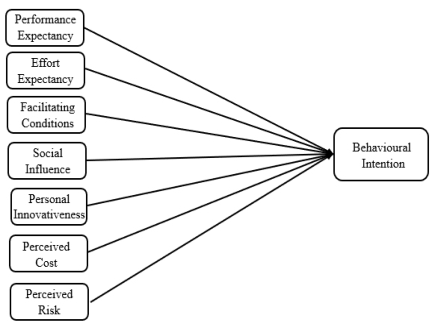
HYPOTHESIS DEVELOPMENT This study utilized an extended UTAUT to analyse the factors influencing the behavioural intention of NF farmers. In addition to Performance Expectancy (PE), Effort Expectancy (EE), Social Influence (SI), and Facilitating Conditions (FC), the study also incorporated Personal Innovativeness (PI), Perceived Cost (PC), and Perceived Risk (PR) to gain a comprehensive understanding of behavioural intention of NF farmers in adoption of digital technologies for purchasing inputs.
Performance Expectancy (PE): It refers to a person’s perception that utilizing a specific technology will improve their efficiency or effectiveness (Venkatesh et al., 2003). In the context of NF farmers, it reflects their perception of how digital technologies can improve efficiency in purchasing inputs.
H1: PE positively impact the BI of NF farmers to adopt digital technologies for purchasing inputs.
Behavioural Intentions of Natural Farming Farmers to Adopt Digital Platforms 61
Effort Expectancy (EE): The level of effort required to operate a technology efficiently (Venkatesh et al., 2003). It reflects how simple or complicated farmers find digital platforms for purchasing agricultural inputs.
H2: EE positively affects the BI of NF farmers to adopt digital technologies for purchasing inputs.
Facilitating Conditions (FC): It refers to the external resources and infrastructure that support an individual to adopt a new technology. (Venkatesh et al., 2003). This includes internet access, mobile devices, and technical assistance available to NF farmers.
H3: FC positively impact the BI in adoption of digital technologies by NF farmers.
Social Influence (SI): The extent of an individual’s willingness to embrace and implement a technology is affected by the opinions, recommendations, and behaviours of important people such as family, friends, or community leaders (Venkatesh et al., 2003). In the context of NF farmers, social influence refers to the impact of fellow farmers, agricultural advisors, and government employees on their willingness to adopt digital technologies for purchasing inputs.
H4: SI positively influences the BI of NF farmers to adopt digital technologies for purchasing inputs.
Personal Innovativeness (PI): A person’s openness and inclination to embrace and explore emerging technologies (Shi et al., 2022).
H5: PI positively impact the BI of NF farmers to adopt digital technologies. Perceived Cost (PC): The financial and non-financial expenses associated with adopting a technology (Al-Saedi et al., 2020). This includes the cost of devices, internet connectivity, and transaction fees that may influence NF farmers’ willingness to use digital platforms.
H6: PC negatively affects the BI of NF farmers to adopt digital technologies for purchasing inputs.
Perceived Risk (PR): The level of uncertainty and potential negative outcomes that individuals associate with using a technology (Al-Saedi et al., 2020). For NF farmers, this may include concerns about data security, or the reliability of online platforms for purchasing inputs.
H7: PR negatively influences the BI of NF farmers to adopt digital technologies for purchasing inputs.
METHODOLOGY
This research was conducted in Andhra Pradesh (AP), a southeastern state of India from July to November, 2024. The government of AP, launched the Andhra Pradesh Community Managed Natural Farming (APCNF) program to encourage the NF in the state. This initiative is implemented through Rythu Sadhikara Samstha (RySS), a non-profit organization supported by the government (Balla & Goswami, 2022).
Data for this study was collected from NF farmers with the support of RySS using a structured questionnaire. The questionnaire was designed with three sections, with items assessed using a Likert scale ranging from 1 (“Strongly Disagree”) to 5 (“Strongly Agree”). The first section provided an overview of
62 Saride and Sharad
the survey’s purpose and introduced the proposed digital platform to ensure farmers had a clear understanding of its concept. The second section captured demographic details of the respondents, while the final section focused on questions related to UTAUT constructs to assess factors influencing digital technology adoption among NF farmers.
This study analysed 795 valid responses to identify the factors influencing NF farmer’s BI to adopt digital platforms for purchasing NF inputs based on gender. Fig. 1 illustrates the research model utilized in this study.
Figure 1: Research model.
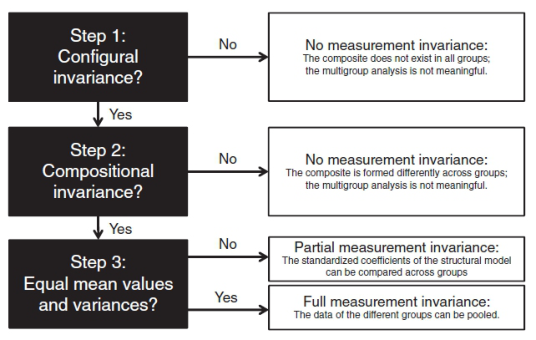
The MICOM procedure was utilized to evaluate measurement invariance in PLS-SEM. MICOM is widely used in research to account for observed heterogeneity (Kaur & Kaur, 2022; Sepasgozar, 2023; Tan et al., 2025). MICOM is a three-step process, the first step is to ensure that the model measures construct equivalently across different groups (Henseler et al., 2016). The second step involves assessing compositional invariance, which determines whether composite scores show significant differences between groups (Kaur & Kaur, 2022). Achieving the first two steps is sufficient to establish partial measurement invariance. The last step examines whether composite mean values and variances are equal, and achieving this confirms full measurement invariance (Kaur & Kaur, 2022). Establishing full invariance is essential for conducting pooled data analysis (Henseler et al., 2016). The Fig 2, outlines the MICOM procedure adopted from (Henseler et al., 2016).
After conducting the MICOM analysis, Multi-Group Analysis (MGA) was carried out with 5,000 sub-samples, using bias-corrected bootstrapping to assess the impact of gender (Kaur & Kaur, 2022). The dataset was divided into two groups: males (n = 523), comprising 65.78% of the total sample, and females (n = 272), making up 34.21%. According to Henseler et al. (2009), a path coefficient p-value less than 0.05 or greater than 0.95 represent a significant variation between the groups.
Behavioural Intentions of Natural Farming Farmers to Adopt Digital Platforms 63
Figure 2: MICOM procedure (Henseler et al., 2016).
RESULTS AND DISCUSSION
The Table 1. shows the configural invariance and compositional invariance. All constructs (BI, EE, FC, PC, PE, PI, PR, and SI) satisfy the configural invariance (step 1) as the measurement models for each group are conceptually and structurally equivalent. For all constructs (BI, EE, FC, PC, PE, PI, PR, SI), the original correlation is very close to 1 (≥0.999) and the p-values are greater than 0.05, confirming compositional invariance (step 2). This indicates a high level of similarity in composite scores between groups. Since both configural and compositional invariance are satisfied, partial measurement invariance is established, confirming that MGA is feasible.
Table 1: Configural invariance and compositional invariance (source: author).
Table available in the original PDF paper.
Construct Step 1 Step 2 Configural Invariance Original Correlation p Value Compositional Invariance
BI Yes 1.000 0.617 Yes EE Yes 1.000 0.328 Yes FC Yes 1.000 0.826 Yes PC Yes 0.999 0.724 Yes PE Yes 0.999 0.459 Yes PI Yes 0.999 0.181 Yes PR Yes 0.999 0.935 Yes SI Yes 0.851 0.464 Yes The Table 2 show the step 3 of MICOM analysis. It examines the equality of means and variances across groups. It consists of two sub-steps: Step 3(a): equality of mean values examines whether the mean values of composite scores differ significantly between groups. Step 3(b): equality of variances checks whether the variances of composite scores differ significantly between groups. Constructs BI, PC, PE, PI, PR, and SI have p-values greater than 0.05, indicating no significant difference in mean values across groups, indicating
64 Saride and Sharad
mean invariance is established. However, EE (p = 0.012) and FC (p = 0.003) have p-values less than 0.05, indicating significant differences in mean values, so mean invariance is not established for these constructs. Constructs BI, EE, FC, PE, PI, PR, and SI have p-values greater than 0.05, meaning their variance is equal across groups. However, PC (p = 0.018) has a p-value less than 0.05, indicating a significant difference in variance, so equality of variance is not established for PC. As EE, FC, PC constructs failed Step 3, full measurement invariance is not established confirming the partial measurement invariance but, MGA can still be feasible.
Table 2: Equal means and equal variance of MICOM analysis (source: author).
Table available in the original PDF paper.
Construct Step 3 (a) Step 3 (b) Original Difference
p Value Equal Mean
Original Difference
p Value Equal Variance BI −0.004 0.961 Yes 0.129 0.335 Yes EE 0.183 0.012 No −0.092 0.465 Yes FC 0.221 0.003 No −0.112 0.405 Yes PC 0.037 0.620 Yes 0.396 0.018 No PE 0.040 0.590 Yes 0.261 0.115 Yes PI 0.136 0.065 Yes −0.047 0.725 Yes PR 0.085 0.249 Yes −0.011 0.903 Yes SI 0.040 0.586 Yes −0.012 0.926 Yes
The Table 3 presents the results of MGA comparing the influence of different constructs on BI between female and male groups. Among the constructs, PE and PI emerge as the strongest determinants of digital adoption, as they are statistically significant for both genders. However, FC play a crucial role only for males, suggesting that access to better resources may enhance adoption within this group. To effectively promote digital adoption, strategies should prioritize strengthening PE and PI, as these factors influence adoption behaviour across both male and female users.
Table 3: Multi group analysis between males and females (source: author).
Table available in the original PDF paper.
Original
t Value
p Value
Construct Original (Female) (Male)
t Value (Female) (Male)
p Value (Female) (Male) EE 0.115 0.093 1.667 1.656 0.095 0.098 FC 0.099 0.134 1.499 3.366 0.134 0.001∗∗∗
PC −0.021 0.062 0.306 1.762 0.759 0.078 PE 0.211 0.143 3.013 2.970 0.003∗∗ 0.003∗∗ PI 0.483 0.491 6.953 8.787 0.000∗∗∗ 0.000∗∗∗ PR −0.037 −0.017 0.861 0.562 0.389 0.574 SI 0.080 −0.032 1.316 0.633 0.188 0.527
Note: ∗Significance level less than 0.05, ∗∗Significance level less than 0.01, ∗∗∗Significance level less than 0.001 .
Behavioural Intentions of Natural Farming Farmers to Adopt Digital Platforms 65
CONCLUSION
This study employed an extended UTAUT model to examine the factors influencing NF farmer’s adoption of digital platforms for purchasing NF inputs, based on gender. This research effectively implemented the MICOM and MGA methodologies. The MICOM analysis confirmed partial measurement invariance, allowing for meaningful Multi-Group Analysis (MGA). The results revealed that Performance Expectancy (PE) and Personal Innovativeness (PI) significantly drive adoption for both genders. However, Facilitating Conditions (FC) were significant only for males, suggesting that better access to training and technological services could further enhance their adoption. These findings emphasize the need for targeted digital adoption strategies that address gender-specific barriers, ensuring a more inclusive and effective transition to digital platforms in Natural Farming.
ACKNOWLEDGMENT
We would like to acknowledge gratitude to IIT Kharagpur for providing the academic and research support that made this study possible. We extend our heartfelt appreciation to Rythu Sadhikara Samstha (RySS) for their invaluable assistance in facilitating data collection and connecting with Natural Farming (NF) farmers. Their support was instrumental in ensuring the success of this research. Finally, we are thankful to all the respondents for participating in this study.
REFERENCES
Al-Saedi, K., Al-Emran, M., Ramayah, T., & Abusham, E. (2020). Developing a general extended UTAUT model for M-payment adoption. Technology in Society, 62, 101293. https://doi.org/10.1016/J. TECHSOC.2020.101293 Balla, J., & Goswami, K. (2022). Understanding the constraints and reasons to adopt
natural farming - a study on rice growing farmers of Andhra Pradesh, India. International Journal of Agricultural Sustainability, 20(6), 1209–1224. https:// doi.org/10.1080/14735903.2022.2070340 Cimino, A., Coniglio, I. M., Corvello, V., Longo, F., Sagawa, J. K., & Solina, V.
(2024). Exploring small farmers behavioral intention to adopt digital platforms for sustainable and successful agricultural ecosystems. Technological Forecasting and Social Change, 204. https://doi.org/10.1016/j.techfore.2024.123436 FAO. (2022). Pesticides use, pesticides trade and pesticides indicators. Henseler, J., Ringle, C. M., & Sarstedt, M. (2016). Testing measurement invariance of composites using partial least squares. International Marketing Review, 33(3), 405–431. https://doi.org/10.1108/IMR-09-2014-0304 Henseler, J., Ringle, C. M., & Sinkovics, R. R. (2009). The use of partial least squares
path modeling in international marketing. Advances in International Marketing, 20, 277–319. https://doi.org/10.1108/S1474-7979(2009)0000020014 Kaur, D., & Kaur, R. (2022). Elucidating the role of gender differences via TAM in e-recruitment adoption in India: A multi-group analysis using MICOM. Bottom Line, 35(2–3), 115–136. https://doi.org/10.1108/BL-11-2021-0104
66 Saride and Sharad
Mastiholi, A. B., Sowmya, B., Maheswarappa, H. P., Gondi, S. P., Shantappa, T., Rudresh, D. L., & Gopali, J. B. (2023). Organic and natural farming improve microbial diversity and dehydrogenase activity in clusterbean-tomato cropping sequence. Archives of Agronomy and Soil Science, 69(15), 3705–3716. Nayak, P., & Solanki, H. (2021). Pesticides and indian agriculture-a review.
International Journal of Research-Granthaalayah, 9(5), 250–263. https://doi.org/ 10.29121/granthaalayah.v9.i5.2021.3930 Niti Aayog. (n.d.). Natural Farming – Natural Farming: NITI Initiative | NITI Aayog. Retrieved February 10, 2025, from https://naturalfarming.niti.gov.in/ natural-farming/. Niti Ayog. (2023). ImplementationProgrss. https://naturalfarming.dac.gov.in/ NaturalFarming/ImplementationProcess PIB. (2024). Press Release: Press Information Bureau. https://pib.gov.in/ PressReleaseIframePage.aspx?PRID=2040566 Reddy, A. A., Reddy, M., & Mathur, V. (2024). Pesticide Use, Regulation, and
Policies in Indian Agriculture. Sustainability 2024, Vol. 16, Page 7839, 16(17), 7839. https://doi.org/10.3390/SU16177839 Saride, A. K., & Sharad, M. (2024). Augmentation of Farmer’s Income through Non Pesticidal Management (NPM) Input Production: An Economic Analysis. 2024 9th International Conference on Energy Efficiency and Agricultural Engineering, EE and AE 2024 - Proceedings. https://doi.org/10.1109/ EEAE60309.2024.10600518 Sepasgozar, S. M. E. (2023). Construction Digital Technology Assimilation and Absorption Capability Using Measurement Invariance of Composite Modeling. Journal of Construction Engineering and Management, 149(7). https://doi.org/ 10.1061/jcemd4.coeng-12912 Shi, Y., Siddik, A. B., Masukujjaman, M., Zheng, G., Hamayun, M., & Ibrahim,
A. M. (2022). The Antecedents of Willingness to Adopt and Pay for the IoT in the Agricultural Industry: An Application of the UTAUT 2 Theory. Sustainability (Switzerland), 14(11). https://doi.org/10.3390/su14116640 Tan, T. L., Lu, M. P., & Kosim, Z. (2025). The mediating effect of digital financial inclusion on gender differences in digital financial literacy and financial well-being: Evidence from Malaysian households. Investment Management and Financial Innovations, 22(1), 11–24. https://doi.org/10.21511/imfi.22(1).2025.02 Venkatesh, V., Morris, M. G., Davis, G. B., & Davis, F. D. (2003). User acceptance
of information technology: Toward a unified view. MIS Quarterly: Management Information Systems, 27(3), 425–478. https://doi.org/10.2307/30036540
LISTED IN THE AHFE DIGITAL BOOKSTORE CATALOGUE
Explore the complete digital volume
Artificial Intelligence and Social Computing
Read this individual research paper free through the original publisher, or explore the full digital proceedings book.
ISBN 978-1-964867-39-7
Explore this ISBN in the AHFE Bookstore ↗Listed in the July 2026 bookstore catalogue; search by ISBN to confirm current availability · Digital book purchase optional