Tae-eun Kim, Gesa Praetorius, Ziaul Haque Munim (2025). Customized maritime education and training path (C-path) for aspiring and current ship navigators. In: Advances in Human Factors of Transportation. AHFE Open Access, vol. 186, pp. 574–580. https://doi.org/10.54941/ahfe1006547
This study investigates the design and implementation of a Customized Maritime Education and Training Path (C-Path) for aspiring and current ship navigators by focusing on defining strategies to tailor learning paths to individual needs. Six customization strategies are compared and explored including 1) experience-based approaches that adapt training to students’ self-reported prior knowledge and 2) assessment-driven methods that use diagnostic tools to identify skill gaps and guide targeted instruction, 3) Interest-based customization allows students to align their training with personal career aspirations, while 4) pace-based strategies assumes all learners begin with the same foundational content but progress adaptively according to their individual learning speed. Additional two methods include 5) dynamic-performance customization, which uses real-time monitoring and adaptive algorithms to adjust training content based on learner ongoing performance, and 6) scenario-based customization which tailors learning through simulated real-world challenges. This study evaluates these approaches in terms of their effectiveness, feasibility and alignment with STCW and maritime industry standards, and we hope to present a customized learning path for modernizing maritime education to optimize skill acquisition, enhance safety and support professional growth in an evolving industry.
Advances in computational models and adaptive algorithms have evolved the educational strategies and environment across various disciplines (Zawacki-Richter et al., 2019). The integration of real time performance monitoring with diagnostic assessment tools now permits a detailed analysis of individual learning profiles and facilitate tailored educational experiences, replacing the one-size-fits-all approach to education (Csapó & Molnár,
Customized Maritime Education and Training Path (C-Path) for Aspiring 575
2019). Theoretical frameworks, rooted in constructivism, situated cognition and the principles underlying Bloom’s taxonomy (Bloom et al., 1956) provide a scientific basis for such adaptive systems, emphasizing that prior experience and contextual relevance are key to effective learning.
When we look into the maritime education context, Maritime Education and Training (MET) programs have historically followed standardized training framework designed to meet the regulatory requirements established by international bodies, such as the Standards of Training, Certification, and Watchkeeping for Seafarers (STCW) (IMO, 2010). Even when training programs are built on the same standardized guidelines and certification system, how they are actually put into practice can vary greatly across different institutions, countries and regions. This variation stems from a mix of historical, social, economic, cultural and regulatory influences that shape how a curriculum is adapted locally. For instance, the availability and quality of educational infrastructure, how resources are distributed, and teaching traditions can all play a role in determining how training is delivered. Some educational contexts have pedagogical emphasis on experiential and simulation-based learning modalities, contributed by institutional access to advanced technological infrastructure and digital tools. Alternative regional frameworks may prioritize more on didactic and theory-centric instruction over practice oriented competencies.
Variations in regulatory enforcement and the interpretation of international guidelines contribute to the heterogeneity observed in training provisions. This not only challenges the uniformity of skill acquisition across global maritime professionals but also inform the necessity for international collaborations and empirical research to harmonize training methodologies and ensure that the intended benefits of standardized frameworks are consistently realized.
MET programs worldwide are currently at crossroads where task- based vocational training approaches rooted in knowledge, proficiency and understanding items as defined in the Code are contrasted with more traditional academic approaches (Manuel, 2017; Karahalil et al., 2024). As a result, challenges as such the limited available time for training of both academic and vocational skills, adequate qualification of instructional staff, defining training and assessment methods as well as balancing learning activities and teaching methods have arisen. Further, many training programs lack robust diagnostic tools necessary to identify and remediate specific skill gaps. Without precise performance metrics and ability to generate objective individualized feedback, instructors are limited in their capacity to tailor instruction to address diverse learner needs effectively. As global maritime operations become more technologically sophisticated and operational risks more diversified, there is a compelling need to re-evaluate and modernize MET methodologies through the lens of advanced educational theories and adaptive technologies (Kim et al., 2023).
ADAPTIVE LEARNING PATHS In the realm of general education, foundational research has long recognized the limitations of uniform teaching practices. Bloom’s (1956) seminal work on educational objectives already emphasized that instruction aligned with learner prior knowledge and pace can significantly enhance the learning process. Complementing this perspective, Vygotsky’s (1978) sociocultural theory has introduced the concept of the zone of proximal development, advocated for instructional scaffolding that bridges the gap between current ability and potential achievement (Lantolf & Pavlenko, 1995). These theoretical underpinnings highlighted that adaptive learning is not just a technological innovation but a natural progression in the evolution of effective pedagogy. By dynamically adjusting the difficulty, sequence, and presentation of content based on the trainee’s current performance, adaptive learning paths can potentially enable that each trainee receives an optimized learning experience tailored to individual strengths and areas for improvement. Nevertheless, adaptive learning is easy in planning but hard to be implemented. The teacher can delineate objectives, map learning outcomes and design theoretical frameworks that promise to tailor education to individual needs. However, transitioning from theory to practice involves implementing a complex data analysis structure, integrating sophisticated data analytics and advanced algorithmic models that are capable of dynamically providing feedback and adjusting to each trainee’s evolving performance. This implementation requires a robust digital infrastructure, high-quality granular data and as in some cases, there is the need to be able to integrate with existing learning management systems, which can be difficult to achieve in heterogeneous educational environments. These challenges are compounded by the need for interdisciplinary collaborations among educators, technologists, and policymakers to ensure that adaptive learning systems not only function as intended, but also align with established curricular standards and operational demands.
In practice, adaptation can be achieved through a variety of ways and methodologies, as proposed in Table 1, that leverage both established pedagogical principles and available technological tools.
Table 1: C-paths alternatives for ship navigation training.
Table available in the original PDF paper.
Customization Paths Description Experience-based Adapts training to individual trainee by incorporating their self-reported prior knowledge. Assessment-driven Utilizes diagnostic tools to identify skill gaps, guiding
targeted instruction for individualized learning interventions. Interest-based Aligns training content with trainee personal career aspirations, enhancing motivation and engagement. Pace-based Provides a uniform foundational content while
allowing trainees to progress at an adaptive pace tailored to their individual speed of mastery.
Continued
Customized Maritime Education and Training Path (C-Path) for Aspiring 577
Table 1: Continued Customization Paths Description
Table available in the original PDF paper.
Dynamic-performance Employs real-time monitoring and adaptive algorithms to adjust training content dynamically based on ongoing trainee performance. Scenario-based Tailors learning through simulated real-world
challenges, immersing trainees in practical context-rich scenarios to enhance decision-making and skill transfer.
Each of these six maritime customization paths requires distinct data and technical infrastructure, implementation further demands standardized data collection, substantial computational resources, scenario realism, data privacy safeguards and high system responsiveness.
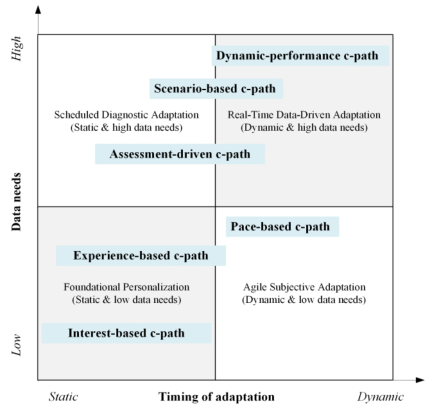
MARITIME ADAPTIVE LEARNING STRATEGIES CLASSIFICATION AND ASSESSMENT Considering both the dimensionality of data requirements (i.e., the number of data parameters involved/needed) and the timing of adaptation (i.e., point in time when adaptive mechanisms are initiated), these six strategies can be positioned within a two-dimensional conceptual framework, as presented in Figure 1.
Experience-based customization is grounded in constructivist principles. It relies on the self-reported prior knowledge and experience to adjust the learning path. This approach can be simple matching algorithms to optimize the cognitive load by tailoring content to existing cognitive frameworks. Yet its reliance on subjective data may induce inaccuracies that undermine
its effectiveness. Similarly, assessment-driven methods utilize diagnostic evaluations to pinpoint specific skill deficits, aligning with formative assessment theory (Black & Wiliam, 1998). While providing objectivity and clarity, these methods remain static, since their interval-based assessments may fail to capture the trainee’s evolving performance dynamics, which could result in missed opportunities for timely intervention. Interest-based strategies further personalize the learning path by aligning content with individual career goals, rooted in self-determination theory (Deci & Ryan, 1985), yet it risks causing misalignment between preferences and necessary skillsets, potentially jeopardizing achievement of required competencies.
On the other end of the spectrum, dynamic performance C-path offers real-time adaptability through continuous performance feedback and algorithm-based adjustments. This would be a hallmark of modern adaptive learning systems. This real-time adaptation, informed by data-heavy inputs, aligns with cognitive neuroscience principles, wherein immediate feedback strengthens neural pathways for optimal retention. Furthermore, scenario- based learning environments, which immerse learners in complex, real-world simulations, build on situated learning theory (Lave & Wenger, 1991) to bridge theoretical knowledge with practical competency. Although such immersion offers extensive benefits for decision-making under pressure, it demands high-fidelity simulations and significant technological investment. Pace-based strategies further enhance the adaptability of maritime training by providing individualized speed of progression, informed by differentiated instruction frameworks (Tomlinson, 2001). Both dynamic-performance and pace-based methods require simulator infrastructure that is capable of extracting data and applying analytical algorithms, which presents significant logistical and technical challenges for implementation.
Adaptive maritime education can integrate all spectrum of customization strategies that extend from subjective learner inputs to objective data- driven adjustments. Approaches such as experience-based and interest- based adaptations leverage self-reported prior knowledge and individual career aspirations, rooted in constructivist theories that emphasize the activation of pre-existing cognitive schemata (Vygotsky, 1978; Bloom, 1956). Assessment-driven methods employ periodic diagnostic evaluations to objectively pinpoint knowledge gaps that facilitate targeted instructional interventions (Black & Wiliam, 1998; Kumar et al., 2021). This dual reliance on both qualitative insights and quantitative benchmarks establishes a foundation for tailored maritime training, so that initial learning pathways are closely aligned with each trainee’s unique background and their evolving needs.
In parallel, dynamic customization strategies such as pace-based, dynamic- performance and scenario-based adaptations harness continuous and real- time data to adjust learning trajectories. Pace-based methods allow learners to progress at an individualized speed, prevent both cognitive overload and disengagement by synchronizing content delivery with each trainee’s learning rhythm. Dynamic performance techniques utilize real-time monitoring and adaptive algorithms to fine-tune instructional difficulty instantaneously, echoing cognitive neuroscience findings on the importance of immediate
Customized Maritime Education and Training Path (C-Path) for Aspiring 579
feedback in reinforcing neural pathways (Anderson & Crawford, 1995). Scenario-based customization further elevates this paradigm by embedding learners in high-fidelity, simulated maritime environments that mirror real- world challenges, thereby promoting situational awareness and critical decision-making under operational pressures (Lave & Wenger, 1991; Salas et al., 2008). Scenario and assessment driven c-path is currently being explored in ongoing research initiatives (e.g., i-MASTER project). The volume of data required for assessment remains disproportionately high even under comparatively simple training scenarios. Scalability and ease of implementation requires further research exploration.
As maritime education and training are at a crossroads between traditional vocational approaches focused on practical skills and academic requirements focused on critical thinking and analytical skills, adaptive learning paths could offer an opportunity to increase effectiveness, efficiency and trainee satisfaction through tailoring exercises and teaching to specific needs and requirements. The different adaptive c-paths show the potential to cater to the increasingly diverse student population as both the perspective on maritime professions and skill sets required are under development. While this study has outlined and discussed strengths and limitations of the different paths, there is the need for empirical studies to explore how students and instructors perceive the gain of dynamic and tailored educational solutions.
CONCLUSION
Adaptive learning enabled by advanced technological integration represents a significant advancement in maritime training methodologies. This paper introduced six adaptive C-paths and categorized according to their timing (static vs dynamic) and data intensity (low vs high) required for implementing their adaptive strategies. The next phase of the study involves conducting experiments and empirical research to validate the framework, refine their application and analyse their implementation constraints and practical effectiveness in improving maritime training outcomes.
REFERENCES
Anderson, J. R., & Crawford, J. (1995). Cognitive psychology and its implications. Black, P., & Wiliam, D. (1998). Assessment and classroom learning. Assessment in Education: Principles, policy & practice, 5(1), 7–74. Bloom, B. S., Engelhart, M. D., Furst, E. J., Hill, W. H., & Krathwohl, D. R. (1956).
Handbook I: Cognitive domain. New York: David McKay, 483–498. Csapó, B., & Molnár, G. (2019). Online diagnostic assessment in support of personalized teaching and learning: The eDia system. Frontiers in psychology, 10, 1522 Deci, E. L., & Ryan, R. M. (2013). Intrinsic motivation and self-determination in
human behavior. Springer Science & Business Media. IMO (2010). International Convention on Standards of Training, Certification and Watchkeeping for Seafarers (STCW). International Maritime Organization. Karahalil, M., Lützhöft, M., & Scanlan, J. (2024). Factors impacting curricula in
maritime simulator-based education. WMU Journal of Maritime Affairs, 1–29.
Kim, T. E., Munim, Z. H., & Schramm, H. J. (2023). Exploring alternative performance evaluation method in nautical simulations. Training, Education, and Learning Sciences, 109(109). Kumar, A., Krishnamurthi, R., Bhatia, S., Kaushik, K., Ahuja, N. J., Nayyar, A.,
& Masud, M. (2021). Blended learning tools and practices: A comprehensive analysis. Ieee Access, 9, 85151–85197. Lantolf, J. P., & Pavlenko, A. (1995). Sociocultural theory and second language acquisition. Annual review of applied linguistics, 15, 108–124. Lave, J., & Wenger, E. (1991). Situated learning: Legitimate peripheral participation.
Cambridge university press. Manuel, M. E. Vocational and academic approaches to maritime education and training (MET): Trends, challenges and opportunities. WMU J Marit Affairs 16, 473–483 (2017). Salas, E., DiazGranados, D., Klein, C., Burke, C. S., Stagl, K. C., Goodwin, G. F.,
& Halpin, S. M. (2008). Does team training improve team performance? A meta- analysis. Human factors, 50(6), 903–933. Tomlinson, C. A. (2001). How to differentiate instruction in mixed-ability classrooms. Ascd. Zawacki-Richter, O., Marín, V. I., Bond, M., & Gouverneur, F. (2019). Systematic review of research on artificial intelligence applications in higher education– where are the educators? International journal of educational technology in higher education, 16(1), 1–27.
LISTED IN THE AHFE DIGITAL BOOKSTORE CATALOGUE
Explore the complete digital volume
Advances in Human Factors of Transportation
Read this individual research paper free through the original publisher, or explore the full digital proceedings book.
ISBN 978-1-964867-62-5
Explore this ISBN in the AHFE Bookstore ↗Listed in the July 2026 bookstore catalogue; search by ISBN to confirm current availability · Digital book purchase optional