Abdiaziz Omar Hassan, Cheng Yao, Peter Walusimbi, Saandi Youssouf, Amir Ubed, Said Youssouf Kadafi (2025). Smart Backpack System: A Wearable Educational Technology for Enhancing Student Organization and Academic Performance. In: Human Factors in Design, Engineering, and Computing. AHFE Open Access, vol. 199, pp. 261–270. https://doi.org/10.54941/ahfe1006838
Educational challenges in underdeveloped regions are often worsened by limited access to organizational tools and technological resources, making it hard for students to manage their academic responsibilities effectively. This study presents the Smart Backpack System, a fully developed wearable solution designed to improve student organization, encourage academic discipline, and support daily learning through integrated technology.The system was created through three iterative design phases. The initial RFID-based prototype aimed to reduce forgetfulness but faced issues with multi-tag detection and feedback. A second version introduced more reliable RFID, ergonomic improvements, and touch-based interaction. The final prototype included a detachable digital display, dual power sources (solar and rechargeable battery), and software applications for homework reminders, personal schedules, gamified learning, and item-tracking features.Evaluation involved 40 Somali students from elementary, middle, and high school levels, supported by four teachers. Mixed methods, including hands-on trials, structured surveys, and interviews, were used. Results were very promising: 95.7% of students said they would recommend the backpack, while 85% reported that notifications helped them avoid forgetting important items. Younger students appreciated reminder features and visual cues, while older students preferred customization options that matched their existing digital routines. Teachers noticed improvements in preparedness, punctuality, and responsibility, noting the backpack’s potential to reduce missed assignments and encourage proactive learning habits.This study shows how user-centered, technology-enhanced design can meet real-world educational needs. The Smart Backpack provides a scalable, culturally adaptable tool that can boost academic performance in resource-limited environments, while also setting an example for wearable educational technologies that smoothly integrate into daily student life.
The Smart Backpack System is an innovative answer to the increasing challenges students face in managing their daily academic duties. As schools adopt more technology to enhance learning, the pressure on students to stay organized and ready for classes also increases. Traditional ways of managing school materials, keeping track of schedules, and monitoring assignments often leave students feeling overwhelmed, especially when they have to juggle multiple subjects and tasks at once (Baker, 2012; Strom et al., 2022). This issue is especially evident in regions where learners face unique sociocultural and logistical challenges. For example, in Somalia, many students follow a dual education schedule, attending religious studies in the morning before going to regular classes. Such overlapping commitments can lead to stressful situations where important study materials are forgotten or homework is skipped, which harms academic performance (World Bank, 2017).
Educational technologies have emerged as a promising means of addressing these difficulties, with solutions such as mobile applications for assignment tracking, reminder systems, and RFID-based tools for monitoring school materials (Al Januszewski and Molenda, 2013; Antony et al., 2023; Haleem et al., 2022). However, existing approaches often depend on external devices, particularly smartphones, which are not always permitted or practical in school contexts. While some smart school bags exist, most focus narrowly on item tracking or parental notifications, rather than providing a fully integrated, student-centered solution (Ajayakumar et al., 2019).
The Smart Backpack System aims to fill this gap by combining multiple features into a single, wearable platform. It integrates RFID technology, a detachable digital display, and voice feedback, enabling students to confirm that required materials are packed before leaving home. Beyond item tracking, the system supports personal schedules, homework reminders, and extracurricular activities, providing a holistic tool that promotes discipline, preparedness, and responsibility (Colley et al., 2016; Qu et al., 2021).
This study makes several important contributions. First, it introduces the Smart Backpack System as a wearable device that seamlessly fits into students’ daily routines, offering a practical and culturally adaptive tool for academic organization. Second, it presents a unique detachable digital component that students can remove and use independently in classrooms or study spaces, encouraging flexibility and convenience. By integrating these features, the Smart Backpack System offers a novel, user- centered approach to helping students manage their academic responsibilities, ultimately enhancing organization, reducing stress, and improving academic performance.
SYSTEM DEVELOPMENT AND METHODS The Smart Backpack System was developed through an iterative, user- centered design process. Each prototype addressed issues found in the previous version, with feedback from students and instructors guiding improvements. This section summarizes the system’s development and describes the methodology used to assess its effectiveness.
Smart Backpack System: A Wearable Educational Technology 263
Prototype Evolution The first prototype employed radio-frequency identification (RFID) technology to detect missing school items. While effective in principle, the system struggled with multi-tag detection and offered limited feedback to students, consistent with earlier challenges reported in RFID-based inventory and tracking systems (Abu Shehab et al., 2015; Mahajan et al., 2010; Sachan et al., 2016).
The second prototype addressed these issues by using a more reliable RFID module and adding simple touch-based controls. Ergonomic updates, like better straps and lighter materials, also made the backpack more comfortable. Even with these changes, students expressed the need for more interactive and supportive features beyond just item detection.
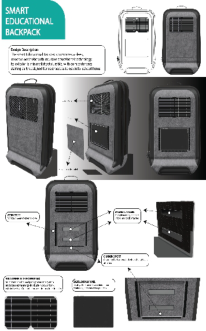
Final Prototype: Smart Backpack with Digital Display and Dual Power Sources The third prototype is the most advanced version of the Smart Backpack System. It combines hardware and software features to offer a complete academic support tool. Key components include:
Detachable Digital Display: Enables students to independently access personal schedules, homework reminders, and educational apps from their backpacks.
Dual Power Sources: Combines solar panels with a rechargeable battery to ensure dependable operation in areas with unreliable electricity supply (Arduino, n.d.; Shenzhen Taojingchi Electronics Co., n.d.).
RFID Integration: Ensures dependable item detection to prevent forgotten school materials (Antony et al., 2023).
Interactive Features: Offers alerts, gamified learning components, and customizable reminders to promote responsibility and engagement (Ajayakumar et al., 2019).
This final prototype transforms the system from just an item-tracking device into a comprehensive educational tool aimed at improving student organization, preparedness, and academic success (Qu et al., 2021).
Figure 1: Final implemented smart backpack prototype.
User-Centered Design Process The development process used a user-centered approach, actively involving students and teachers in giving feedback. Early prototypes were tested with small groups to find usability issues, while the final version was adjusted to consider cultural factors, such as making sure students wearing traditional clothing are comfortable. This participatory process made sure that the Smart Backpack stayed functional and culturally appropriate (Marinagi et al., 2013).
Evaluation Methodology The system was tested with 40 Somali students from various grade levels. Twenty students took part in hands-on testing and interviews, while another twenty completed structured online surveys. Additionally, four instructors provided qualitative feedback on student behavior and readiness.
The evaluation focused on three criteria:
1. Usability – ease of interacting with RFID, digital display, and reminders. 2. Effectiveness – reduction in forgotten items and improved academic readiness. 3. User Experience – student satisfaction, stress reduction, and teacher observations.
RESULTS AND DISCUSSION
A structured questionnaire was administered to 40 students from six schools in Mogadishu, including IQRA Model, Al-Risaala Primary and Secondary School (Dharkeynley), ALFAJRI (Yaqshid), Maxmuud Xarbi (Wadajir), Godey (Karaan), and Ainu Shamsi (Kaxda). The participants consisted of 30% elementary-level, 40% middle-level, and 30% high school students, with feedback provided by four instructors. The responses and organizational habits are summarized in Table 1.
Table 1: All user interview response.
Table available in the original PDF paper.
No Question Options Sample Responses
1. Section 1: Demographic Information
What is your grade? - Elementary (Grades 1–5) Elementary: 30%, Middle School: 40%, High School: 30%
- Middle School (Grades 6–8) - High School (Grades 9–12) 2. What is your age? - 6–8 years 6–8 years: 15%, 9–11 years: 35%, 12–14 years: 30%, 15–18 years: 20%
- 9–11 years
- 12–14 years
- 15–18 years
3. What is your gender? - Male Male: 50%, Female: 48%, Prefer not to say: 2%
- Female
- Prefer not to say
Section 2: Scheduling Habits and Preferences
Continued
Smart Backpack System: A Wearable Educational Technology 265
Table 1: Continued No Question Options Sample Responses
Table available in the original PDF paper.
4. Do you currently use a schedule to organize your schoolwork and activities?
- Reduces stress by keeping me organized - Helps me balance school, extracurriculars, and personal time - Makes me feel prepared and responsible - Other:
9. What challenges do you face with using a schedule regularly?
- I forget to check or update it Forget to check: 30%, Takes time: 25%, Not helpful: 15%, Feels restrictive: 10%
- It takes too much time to set up or use - I don’t find it helpful
- I feel restricted by a fixed schedule
- Other: Section 4: Interest in Enhanced Scheduling Support 10. If there were a smart scheduling tool or feature that could help remind you of your tasks and items, would you find it helpful?
- Yes, very helpful Very helpful: 55%, Somewhat helpful: 25%, Neutral: 10%, Not very helpful: 5%, Not helpful: 5% Continued
Table 1: Continued No Question Options Sample Responses
Table available in the original PDF paper.
- Somewhat helpful
- Neutral
- Not very helpful
- Not helpful at all
11. What features would you find most useful in a scheduling tool or system?
- Reminders for tasks and deadlines Task reminders: 70%, Notifications for items: 50%, Weekly overview: 45%, To-do lists: 35%
- Notifications to bring specific items to school - Weekly overview of my classes and activities - Customizable to-do lists
- Other:
12. Would you recommend a scheduling system to other students?
- Yes Yes: 70%, Maybe: 25%, No: 5%
- Maybe
- No
Half of the respondents (50%) considered a scheduling system “very important” for managing academic tasks, while 30% found it “somewhat important.” Regarding current practices, 45% of students reported using digital tools such as Google Calendar, especially in high schools like IQRA Model and ALFAJRI. Meanwhile, 25% preferred traditional paper planners, common among younger students in Al-Risaala and Maxmuud Xarbi, and 20% relied on school-provided timetables, particularly at Godey and Ainu Shamsi. Despite these habits, 30% of students admitted forgetting to check or update their schedules, while 25% found maintaining them time-consuming. An additional 15% indicated that scheduling was not helpful.
Forgetting school items was also a common issue: 20% of respondents reported frequently forgetting, especially among middle school students at Al-Risaala and IQRA Model, while 45% sometimes forgot them. These findings highlight the need for helpful organizational tools.
Interest in the Smart Backpack System was high. A majority (55%) believed it would be “very helpful” if equipped with reminders for tasks and items, while 25% found it “somewhat helpful.” Among these students, 70% preferred task reminders and 50% wanted item notifications. Teachers confirmed these results, noting that organizational challenges reduce preparedness and punctuality, and strongly supported tools that could help students develop consistent routines.
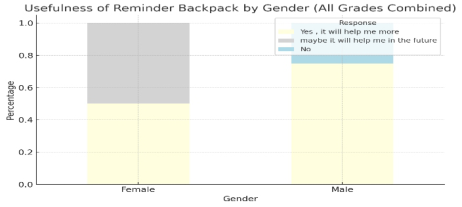
As shown in Figure 2, students had different perceptions of a reminder- enabled Smart Backpack when responses were broken down by gender. Most female respondents said the backpack might be helpful in the future, while fewer saw it as immediately useful. In contrast, male respondents showed stronger immediate interest, with most rating the backpack as helpful and only a small number choosing “maybe” or “no.” This pattern suggests that
Smart Backpack System: A Wearable Educational Technology 267
males across grade levels are more likely to adopt reminder features right away, while females tend to be more cautious, often thinking about the backpack’s usefulness over the longer term.
Figure 2: Usefulness of reminder backpack all grades combined.
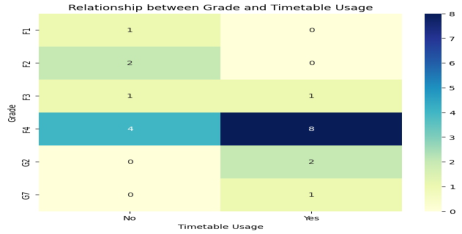
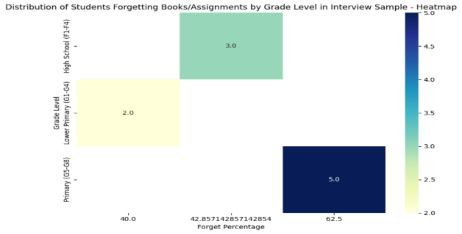
The heatmap analysis offers deeper insights into student organizational habits and their interest in supportive tools. As shown in Figure 3, a clear trend appears where higher-grade students show greater consistency in using weekly timetables compared to younger peers, reflecting the stronger academic demands and maturity associated with higher levels of schooling. Complementing this, Figure 4 reveals that middle school students are most likely to forget essential items such as books or assignments, with many reporting moderate to frequent forgetfulness. This emphasizes the need for early interventions to help younger learners develop reliable organizational routines before moving on to higher grades.
Figure 3: Timetable usage by grade.
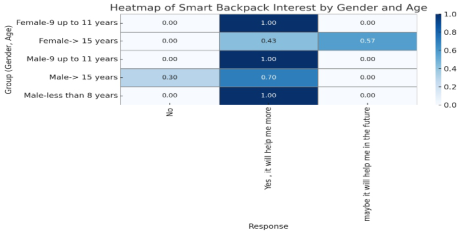
Interest in the Smart Backpack System, broken down by gender and age, is shown in Figure 5. Younger students of both genders expressed strong enthusiasm for reminder features, especially males under 12 years, while older female students had a more balanced response, with some saying the backpack would be useful in the future rather than right away. Among males over 15 years, 30% showed disinterest, indicating that older students are less likely to adopt the system unless it includes customization and integration with their current organizational methods.
Figure 4: Forgetting items by grade level.Figure 5: Heatmap of smart backpack by gender and age.
These findings show that the Smart Backpack can quickly help younger learners by tackling forgetfulness and encouraging organization, while also needing flexible features to attract older students with more routines.
DISCUSSION
The discussion further emphasizes age-specific needs. Younger students in primary grades often struggled with forgetfulness and relied on parents or teachers for reminders. For this group, structured features like visual cues, digital checklists, and reminders could encourage better habits and decrease stress. Older students, on the other hand, showed more consistent organizational methods and preferred customizable features that matched their existing strategies, such as syncing with digital calendars.
Teachers also stressed the importance of adaptability, noting that tools like the Smart Backpack can support diverse learners by providing both visual and auditory reminders. By combining structured support for younger students with flexible customization for older ones, the Smart Backpack can serve as a versatile tool that improves organization, lowers stress, and supports academic outcomes in underdeveloped settings.
CONCLUSION
The Smart Backpack System successfully met its goals by blending organizational support with innovative technology in a form familiar to
Smart Backpack System: A Wearable Educational Technology 269
every student: the school bag. Created to simplify daily routines, the system helps middle and high school students manage schedules, assignments, and materials within a single, easy-to-use platform. By combining UHF RFID readers, an intuitive digital display, and pressure sensors, the Smart Backpack allows students to monitor their readiness without needing external devices. This project shows how educational technology can be built directly into everyday objects to tackle real academic issues like forgetfulness, disorganization, and stress.
The innovation of this study is its holistic approach. Unlike traditional school bags or other “smart” backpacks, the system features an embedded application accessible through a built-in screen, offering schedules, reminders, and item checklists. The RFID reader confirms that all necessary materials are present, while pressure sensors ensure the system activates only when the student is moving. Voice and visual alerts further improve usability by providing instant feedback. The ergonomic and durable design also enhances comfort and durability, making the system both practical and sustainable for daily school use.
While the system has proven effective in enhancing preparedness and organizational habits among students, some limitations still exist. The current evaluation involved only 40 students and four teachers, and testing was done over a relatively short period. Future studies should include larger and more diverse groups, as well as long-term assessments, to better understand the impact on academic performance and well-being. Further development could focus on lighter materials, multilingual interfaces, and integration with existing digital platforms to improve accessibility and user engagement.
In conclusion, the Smart Backpack System marks a significant advancement in wearable educational technology. By integrating organizational tools into students’ daily routines, it has the potential to encourage responsibility, lower stress, and enhance learning outcomes, especially in underdeveloped educational settings.
ACKNOWLEDGMENT
The authors would like to thank all the participants who took part in this study and shared their valuable opinions.
REFERENCES
Abu Shehab, W., Al Shabaan, G., Al-sawalmeh, W. H., Al-Shabaan, G., Al-Sawalmeh, W., 2015. RFID-Based Inventory and Security System 6. Ajayakumar, J., Abdi, H., Anna, N. V. D. S., 2019. An IOT Enabled Smart School Bag to Help Kids, Parents and Schools. 2019 International Conference on Internet of Things Research and Practice (iCIOTRP) 1–6. Al Januszewski, Michael Molenda, 2013. Educational Technology. Routledge.
https://doi.org/10.4324/9780203054000 Antony, F., Vaz, J., AnusuyaDevi, G., Mohana, A., Priya, I., Rajam, R. Y., Kumar, K.,
2023. Smart Attendance System using RFID and Raspberry Pi. 2023 Second International Conference on Electronics and Renewable Systems (ICEARS) 1450– 1455.
Arduino, n.d. Arduino® Nano. Baker, C. E., 2012. Bridging the Gaps: A Case Study on the Implementation of Educational Technologies in High Schools. Colley, A., Pakanen, M., Koskinen, S., Mikkonen, K. S., Häkkilä, J., 2016. Smart
Handbag as a Wearable Public Display - Exploring Concepts and User Perceptions. Proceedings of the 7th Augmented Human International Conference 2016. Haleem, A., Javaid, M., Qadri, M. A., Suman, R., 2022. Understanding the role of digital technologies in education: A review. Sustainable Operations and Computers 3, 275–285. https://doi.org/10.1016/j.susoc.2022.05.004 Mahajan, K. D., Pandey, P. K., Pandher, B. K., 2010. Application of RFID Technology
in Libraries and Role of Librarian. Marinagi, C., Skourlas, C., Belsis, P., 2013. Employing Ubiquitous Computing Devices and Technologies in the Higher Education Classroom of the Future. Procedia Soc Behav Sci 73, 487–494. https://doi.org/10.1016/ j.sbspro.2013.02.081 Qu, X., Wang, J., Miao, R., 2021. Application of Wearable Technology in Education.
OAlib 08, 1–11. https://doi.org/10.4236/oalib.1107630 Sachan, D. K., Raju, K. V. V, Biswas, S., 2016. Application of RFID for Tracking Metallic Items Packed in Wooden Boxes. international journal of engineering trends and technology 33, 288–294. Shenzhen Taojingchi Electronics Co., Ltd., n.d. TJC8048X270_011R. Strom, P. S., Hendon, K. L., Strom, R. D., Wang, C., 2022. High School Student Stress
Human Factors in Design, Engineering, and Computing
Read this individual research paper free through the original publisher, or explore the full digital proceedings book.
ISBN 978-1-964867-75-5
Explore this ISBN in the AHFE Bookstore ↗Listed in the July 2026 bookstore catalogue; search by ISBN to confirm current availability · Digital book purchase optional