ANIL KUMAR, Sarah Glanville, Manasa Hegde, Carmen Roberts, Tanay Arora (2026). Usability of Respirators for Wildland (W) and Wildland Urban Interface (WUI). In: Usability and User Experience. AHFE Open Access, vol. 232, pp. 308–318. https://doi.org/10.54941/ahfe1008059
This pilot study compared the design influences of three Powered Air Purifying Respirators (PAPRs) and one no-respirator condition. A repeated measures test was employed to collect qualitative and quantitative data on firefighters who performed three exercises (confidence course, sledgehammer, and tower climb with hose) during an exercise evolution. To assess the fit, form, and function of PAPRs during simulated work activities, both qualitative (Survey, focus group “debriefs”, BORG RPE) and quantitative measures (physiological measurements including but not limited to HR, HRV, breathing rate) were collected prior to the testing session, during the testing session and at the end of the data collection session. Overall, the participants generally expressed openness to respiratory protection; however, dissatisfaction with specific aspects of the fit, form, comfort, and function of each respirator model was evident. The findings underscore the need for design improvements focusing on functionality, fit, comfort, and form factor, particularly regarding system integration with existing wildland firefighting gear and operational practices. These results provide a framework for prioritizing the approval of universal and modular components in future respiratory protection designs. This framework also supports a holistic approach to the design and integration of respiratory gear that addresses specific requirements of wildland and wildland-urban interface firefighting across individual roles, specific processes, and variable conditions. Devices B-C and B-D demonstrated advantages in breathing under exertion and seal integrity, whereas Device F demonstrated advantages in communication clarity. Durability-related features showed minimal differentiation. Findings are exploratory and require confirmation in larger samples.
Firefighters in Wildland and Wildland Urban Interface (WUI) settings face physically and psychologically demanding tasks that involve significant skill and risk. Recent research has established that occupational exposure as a firefighter is carcinogenic to humans, with sufficient evidence for mesothelioma and bladder cancer (International Agency for Research on Cancer, 2023). An extensive health surveillance initiative, the National Firefighter Registry for Cancer (NFR), continues
Usability of Respirators for Wildland (W) and Wildland Urban Interface (WUI) 309 to track emerging cancer cases among firefighters, including those with wildland exposure histories. Growing awareness of acute respiratory hazards within the profession has led to increased efforts by health agencies and firefighting stakeholders to address the need for effective respiratory protection.
Wildland operations—often remote, multi-day, and physically taxing— involve a set of conditions that are dynamic and complex; and in the absence of suitable respiratory protection, workers are forced to rely on heat shrouds, or bandanas whose function is more palliative than protective Still, to our knowledge, no currently available APR or PAPR meets NFPA 1984, though the addition of an addendum in 2024 reflects an active process to align the standard to consider an integrated approach to the appropriate use of APRs and PAPRs based on the operational levels of firefighting operations in the Wildland/WUI. These recommendations underscore the ongoing need for wearable respiratory protection strategies that incorporate modular, integrated, and situationally appropriate material design.
While sociological and occupational studies reveal that wildland firefighters have recognized the need for respirators for decades, Granberg et al. (2022) provided evidence that user knowledge, beliefs, and the perceived acceptability of respirators influence adoption and the efficacy of their use. The 1997 survey of state and federal wildland firefighters, in which 82.2% shared the belief that smoke hazards warranted respirator bears an uncanny similarity to Pelletier and colleagues 2002 study, in which 89% of WFF surveyed expressed the need to mitigate smoke inhalation and a strong desire for feasible, functional respiratory equipment. (Pelletier & Ross, 2002) While participants in several studies expressed the desire to protect themselves from respiratory exposures, they also noted the practical difficulties of wearing a mask in the field while fighting fire for long hours, and issues with fit, comfort, and integration persist. The overall goal of the study was twofold: 1) assess the efficacy of PAPR prototypes in controlled conditions. Specifically, assess user experience with the PAPR through focus groups and in controlled fire settings, and 2) assess the effectiveness of PAPR prototypes under actual conditions. Specifically, assess the user experience, including physiological burden. The study was intended to be conducted in three phases: pilot operational field testing, continued with an expanded operational field test, and culminated in a natural terrain field test. This paper presents the results of the first phase, i.e., the pilot testing. The findings of this pilot study build on this body of knowledge by capturing physiological, survey, and qualitative data that would be helpful to inform design specifications and policy refinements tailored to WFF and WUI firefighters’ actual tasks and equipment configurations.
METHOD
Design and Participants A fully crossed repeated measures design was used to evaluate three powered air-purifying respirators (PAPR) configurations alongside a no-respirator control. Both qualitative (Survey, focus group “debriefs”, BORG RPE) and quantitative measures (physiological measurements including but not limited to HR, HRV, breathing rate) were collected prior to the testing session, during the testing session and at the end of the data collection session. The participants were recruited from a local fire department. Eligibility was based on significant time spent performing wildland firefighting duties across a range of positions. The mean age was 41.0 years (SD = 12.6), and mean years served in professional firefighting was 10.1 (SD = 5.9).
Each firefighter completed a randomized sequence of two physically demanding tasks (sledgehammer swings - 20 each for dominant and non- dominant side) and a 6-story tower climb while carrying a 2.5” hose bundle weighing 40 lbs), and completion of a confidence course, which involved crawling with the gear in a dark confined space requiring navigating 90 degree bends, and movement both horizontally and vertically. These tasks were selected to simulate realistic firefighting movements and level of exertion. This testing session included an additional APR comparison using participants’ own fit-tested masks to benchmark physiological data. This device was not included in the randomization or survey questions, but it formed an integral part of the debrief discussions and informed the decision to formally include the APR in subsequent phases of the study.
MATERIALS
PAPRs In this study, participants tested three PAPR models (respirators B-C, B-D, and F), and one half-mask elastomeric APR model (respirator A). Table 1 provides details of the devices used in this study. Respirators B-C and B-D shared a blower model, but had different facepieces, and the same facepiece model was used in respirators A and B-C. To support the interpretation of configuration- level findings, each condition is described briefly here. The APR condition used an elastomeric half-mask facepiece with a filter cartridge attached directly to the facepiece (no blower assistance). PAPR B functioned as a belt-mounted blower and served as the shared powered air unit for Configurations C and D. It supplied airflow via dual hoses to Configuration C (which used the same half- mask facepiece and strap design as the APR condition) and via a single hose to Configuration D (a full-face configuration providing integrated facial and eye protection). PAPR F combined a fabric half-mask with a dedicated PAPR worn with a shoulder/chest harness, featuring front-mounted air controls for user access. PAPR F uniquely drew air into the mask from the back, at the nape. All respirators tested are NIOSH-certified and were purchased from vendors
Table 1: Respirators evaluated in the pilot testing.
Table available in the original PDF paper.
Label Illustration Description A NIOSH-certified half-mask elastomeric facepiece fitted with a P100 cartridge
B-C
NIOSH-certified PAPR with belt-mounted blower fitted with P100 filters that supplies air to a half-mask elastomeric respirator via two hoses.1
Blower (B)
B-D
NIOSH-certified PAPR with belt-mounted blower fitted with P100 filters that supplies air to a full-face mask via one hose.2
Blower (B)
F NIOSH-certified fabric half-mask PAPR with a blower integrated into a shoulder harness and worn on the back or chest. Airflow controls are front-mounted.
Control No respirator or face covering worn 1The half-mask facepiece was the same as respirator A 2Respirators B-C and B-D have the same model of belt-mounted blower
Pre- and Post-Exercise Surveys The pre-exercise survey consisted of ten questions intended to capture the participants’ initial impressions of the PAPR models, with a particular focus on assessing the participants’ prior experience with respirators, their ability to integrate the various respirator models into their existing gear during the donning exercise, and their initial impressions of the respirator model assigned for each evolution. The post-exercise survey consisted of thirteen questions designed to capture participants’ subjective perceptions and evaluations of the respirators following the series of training exercises. Questions focused primarily on participant perceptions of fit, form, comfort, and function for each unit. The post- exercise survey gathered individual firefighter feedback on respirator usability immediately after field exercises and prior to group debrief discussions. Survey items included Likert-scaled questions aligned with the study’s deductive framework (fit, form, function, and comfort), categorical multiple-choice items related to donning and gear integration, and short-answer responses. Following the full rotation of exercises in each field-testing phase, participants gathered for a semi-structured debrief, during which they expanded on feedback submitted in the survey. A set of scripted questions guided the discussion moderator, but, as the participants
were considered collaborative subject-matter experts, they were encouraged to expand on salient topics as they emerged. The research team used audio recordings and supplemental notes to capture data.
RESULTS
Pre-Survey All participants had prior SCBA or APR experience but limited PAPR familiarity. Table 1 presents the summarized inferential and statistics results for the three PAPRS. Friedman tests identified a significant difference for ‘allows tight facial seal’ (χ² = 6.86, p = 0.032), with higher median ratings for B-C and B-D compared to F. No other items reached statistical significance. Large effect sizes were observed for facial seal. facepiece fit, and donning time. These effect results (in relation to the sample size) could be indicative of substantial systematic differences in device rankings across participants: however, these results for effect sizes should be interpreted as preliminary pilot estimates rather than definitive evidence of magnitude. Open-ended feedback cited tubing interference, gear incompatibility, and belt adjustments as primary concerns. Overall, firefighters adapted well after donning, indicating reliable fit and comfort but underscoring the need for improved donning procedures and gear integration.
Table 1: Descriptive statistics (Median [IQR]) and Friedman for the 3 PAPRs.
Table available in the original PDF paper.
Device Test Results
Category Question
B-C B-D F χ² p Kendall’s W
5.5 [5.0, 6.0]
5.5 [4.0, 6.0]
5.5 [4.0, 6.5] 0.2 0.91 0.03
Adjustable without bunching clothing Fit and Seal Allows tight facial seal 6.0 [6.0, 6.5]
6.0 [6.0, 6.5]
3.5 [2.5, 4.5] 6.86 0.03 0.86
Facepiece fit properly
6.0 [6.0, 6.5]
6.0 [6.0, 6.5]
4.5 [3.5, 5.5] 4.91 0.09 0.61
5.5 [4.0, 6.0]
6.0 [5.5, 6.0]
5.5 [4.5, 6.0] 0.5 0.78 0.06
Strap / Helmet Comfort
Straps adjustable / comfortable Donning time Time to don acceptable 3.0 [2.0, 3.0]
2.5 [2.0, 3.0]
4.5 [3.0, 5.5] 5.69 0.06 0.71
Donning Ease
Overall PAPR rating
2.5 [2.0, 3.5]
2.5 [2.0, 3.5]
3.0 [2.0, 3.5] 1.08 0.58 0.13
Usability of Respirators for Wildland (W) and Wildland Urban Interface (WUI) 313 Post-Survey
Table 2 presents the summarized post-survey inferential and statistics results of the 22 questions for the three PAPRS by the categories used to create the survey. Following the pilot operational field test, firefighters rated their overall experience with each PAPR as generally positive, with mean satisfaction scores ranging from 5.0 to 6.0 on a 7-point scale. Across the 22 individual items, most comparisons did not reach statistical significance at α = .05, reflecting the limited power associated with n = 4. However, several items (Breathing under strenuous conditions, Seal stability and leak integrity, and Communication clarity (hearing others and voice effort) demonstrated moderate-to-large effect sizes (Kendall’s W ≥ .50), indicating systematic differences in device rankings across participants.
Table 2: Post survey descriptive statistics (Median [IQR]) and Friedman for the 3 PAPRs.
Table available in the original PDF paper.
Category Item B-C B-D F χ² p Kendall’s W
1.50 0.519 0.19
6.0 [6.0, 6.0]
5.0 [5.0, 5.5]
4.5 [2.5, 6.0]
Comfort Comfortable to wear (duration)
0.88 0.741 0.11
6.0 [5.8, 6.2]
5.5 [4.8, 6.0]
6.0 [5.8, 6.2]
Did not cause excessive irritation
1.62 0.519 0.20
5.5 [5.0, 6.2]
5.0 [4.8, 5.2]
5.5 [5.0, 6.0]
Overall comfort excellent
0.38 1.000 0.05
Breathing Easy to breathe (rest)
7.0 [6.8, 7.0]
7.0 [6.8, 7.0]
6.5 [6.0, 7.0]
0.38 1.000 0.05
7.0 [6.8, 7.0]
7.0 [6.8, 7.0]
6.5 [6.0, 7.0]
Easy to breathe (walking)
3.50 0.194 0.44
6.0 [6.0, 6.2]
6.5 [6.0, 7.0]
2.0 [1.0, 3.8]
Easy to breathe (strenuous)
6.00 0.037 0.75
Seal/Leak/ Airflow
Easy to adjust airflow
1.0 [1.0, 1.5]
1.0 [1.0, 1.5]
5.5 [4.8, 6.0]
0.38 1.000 0.05
6.0 [6.0, 6.2]
6.5 [5.8, 7.0]
6.0 [5.2, 6.2]
No readjustment needed for seal
4.88 0.074 0.61
6.5 [6.0, 7.0]
6.5 [5.8, 7.0]
5.0 [4.5, 5.2]
No apparent leaks while moving
3.38 0.111 0.42
6.0 [6.0, 6.0]
6.0 [5.0, 6.2]
4.0 [2.5, 5.2]
Breathing Worn without affecting ease of breathing
(Continued)
Table 2: Continued.
Table available in the original PDF paper.
Category Item B-C B-D F χ² p Kendall’s W
2.62 0.278 0.33
Equipment compatibility
3.5 [1.8, 5.2]
2.5 [2.0, 3.0]
6.0 [4.5, 7.0]
Did not interfere with other gear
0.88 0.667 0.11
6.0 [4.5, 7.0]
7.0 [7.0, 7.0]
7.0 [6.2, 7.0]
Could wear preferred eyewear comfortably
1.50 0.500 0.19
5.0 [3.2, 6.2]
6.5 [5.2, 7.0]
6.5 [6.0, 7.0]
Communication Hear others clearly (face- to-face)
0.50 0.778 0.06
7.0 [5.5, 7.0]
7.0 [6.0, 7.0]
6.5 [6.0, 7.0]
Hear others clearly (PTT radios)
1.62 0.444 0.20
Did not need to raise voice
5.0 [3.5, 6.0]
5.5 [4.8, 6.2]
6.0 [6.0, 6.2]
3.50 0.111 0.44
7.0 [6.8, 7.0]
5.5 [4.5, 6.2]
7.0 [7.0, 7.0]
Vision Did not obstruct near/ intermediate sight
3.50 0.111 0.44
7.0 [6.8, 7.0]
6.0 [5.5, 6.2]
7.0 [7.0, 7.0]
Did not obstruct far sight
2.62 0.278 0.33
Mobility / Performance
5.0 [4.5, 5.5]
4.0 [3.8, 4.2]
6.5 [5.5, 7.0]
Did not inhibit range of motion
0.88 0.741 0.11
4.5 [2.8, 6.2]
4.5 [3.5, 5.2]
5.5 [5.0, 6.2]
Did not interfere with job performance
2.00 0.222 0.25
Durability / Straps
5.5 [4.0, 6.0]
6.0 [5.8, 6.0]
3.5 [3.0, 4.5]
Facepiece / straps / components durable
0.12 1.000 0.02
5.5 [4.5, 6.0]
5.5 [4.8, 6.0]
5.5 [4.5, 6.0]
PAPR assembly / straps/ components durable
2.62 0.296 0.33
6.0 [6.0, 6.0]
5.5 [4.2, 6.0]
5.0 [4.5, 5.2]
Straps easy to adjust; did not loosen
Usability of Respirators for Wildland (W) and Wildland Urban Interface (WUI) 315 BORG RPE Rating
The Borg ratings also included the no respirator as a device option, thus providing a comparison with the PAPRs conditions. The statistical tests revealed no statistically significant differences in perceived exertion among the four devices. Baseline (Pre-Borg), post-exercise (Post-Borg), and change in exertion from pre to post session (ΔBorg) were comparable across devices. Although not statistically significant, B-C demonstrated the lowest mean increase in perceived exertion while the other three devices exhibited similar change scores. The moderate Kendall’s W for ΔBorg (W = 0.35) suggests a potential device-related effect that may not have reached statistical significance due to limited power.
Table 3: Summary of borg ratings ((mean ± SD) across 4 devices.
Table available in the original PDF paper.
Equation reproduced from the original PDF.
Kendall’s W
Pre-Borg 10.0 ± 3.7
11.5 ± 4.5
10.3 ± 2.9
10.3 ± 3.0 0.75 0.861 0.063
Post-Borg 15.5 ± 3.0
14.3 ± 2.2
15.5 ± 1.9
15.3 ± 1.7 1.35 0.717 0.113
ΔBorg 5.5 ± 5.4
2.8 ± 3.9
5.3 ± 3.5
5.0 ± 3.4 4.2 0.241 0.35
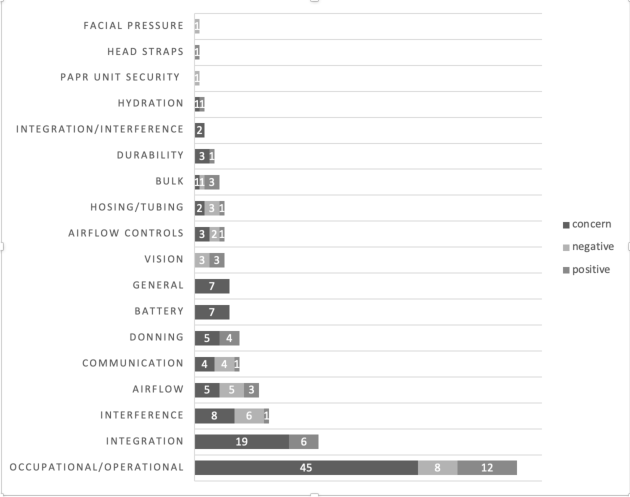
Post Study Debrief Analysis of the semi-structured debrief transcripts followed a mixed deductive–inductive (adductive) framework. The team used the study’s conceptual focus on fit, form, function, and comfort as an initial deductive coding structure throughout the survey and debrief analysis. The team applied many of the Inductive codes defined through initial analysis of the open-ended field survey responses. A research team member imported the complete transcript, notes. and initial codes into Excel for further review, analysis, and refinement. To ensure internal consistency and the ability to identify recurrent and shifting patterns across study stages, the researchers mapped the coding schema, including the relationship between the deductive codes and inductive codes, using a codebook. Deductive parent categories were fit, form, function, and comfort (FFFC). Inductive codes were airflow, airflow controls, hose/tubing, PAPR unit security, integration, interference, bulk, durability, vision, communication, noise, seal, facial pressure, donning/ doffing, head straps, heat, occupational/operational, and general. General and occupational discussion also included comparative references to SCBAs and device integration with helmets and hydration systems.
Figure 1: Pilot debriefs: inductive codes by sentiment.
The results of the analysis (Figure 1) indicate that participants emphasized adoption conditions, cultural barriers, and integration with gear and occupational tasks more than the specific usability of the devices tested. The extensive use of the “Occupational operational” code reflects this (n = 65. Specifically, participants converged on five needs throughout the discussion: (1) airflow that is user-controlled and unobstructed, (2) universal power, (3) modular mounting that integrates with wildland web gear, (4) fast don/doff with glove-friendly hosing quick-disconnects, and (5) workable communication.
Physiological Outcomes The statistical tests revealed no statistically significant differences in perceived exertion for Heart Rate, Breathing Rate and Heart Rate Variability for the four devices (all 5 device options were included in this analysis).
DISCUSSION
This mixed-methods pilot study evaluated the usability of four devices using a repeated-measures design that integrated physiological burden (Borg scale), structured pre- and post-use surveys, and thematic analysis of participant feedback. While quantitative exertion measures did not demonstrate statistically significant differences between devices, survey responses and qualitative findings revealed meaningful variability in perceived usability, particularly in operational performance and equipment integration. Collectively, these findings seem to suggest that device usability is driven
Usability of Respirators for Wildland (W) and Wildland Urban Interface (WUI) 317 less by physiological strain and more by workflow compatibility and human factors design.
From a physiological perspective, no significant differences were observed in baseline exertion (Pre-Borg), post-use exertion (Post-Borg), or change in exertion (ΔBorg) between devices. Although device B-C demonstrated a numerically smaller increase in perceived exertion, the differences did not reach statistical significance, possibly due to the high variability. These results indicate that, under the tested conditions, the devices imposed comparable levels of perceived physical effort. Importantly, this suggests that basic respiratory or exertional burden may not be the primary determinant of user preference or perceived performance. Also, the fitness level of the participants (average 8 out of 10 for self-reported fitness level) might be another reason for the observed results.
However, usability extends beyond physiological demand. Pre-use survey responses indicated that participants anticipated challenges related to integration, bulk, and communication, highlighting the importance of first impressions and design expectations. Post-use surveys further differentiated devices, particularly for workflow interference, ease of donning, compatibility with concurrent equipment, and communication clarity. The usability ratings for devices perceived as more cumbersome or less integrated were observed to receive lower usability ratings, despite similar Borg scores. These results could indicate that perceived exertion does not necessarily imply good usability. The thematic analysis reinforced this interpretation wherein the dominant theme was occupational/operational impact, with participants frequently citing workflow disruption, mobility restriction, and interference during task execution. Integration with other equipment emerged as the second most prominent theme, reflecting concerns about compatibility with helmets, shields, or additional protective gear. Interference (specifically with communication and situational awareness) was also frequently noted. In contrast, comfort concerns such as facial pressure or head strap discomfort were mentioned less often.
These findings suggest that users prioritize functional performance over minor ergonomic discomfort. A device that maintains workflow efficiency and integrates seamlessly with existing systems may be perceived as usable even if minor comfort limitations exist. With that said, it appears that even small degrees of operational concerns (e.g., obstructed communication or movement constraints) may significantly degrade perceived usability. The moderate effect size observed for ΔBorg indicates that small physiological differences could exist but were not detectable in this small sample. Nonetheless, the qualitative data suggest that improving usability may require focusing less on reducing perceived exertion and more on optimizing integration, minimizing interference, and enhancing communication compatibility.
LIMITATIONS This study has limitations such as the small sample size that limits generalizability and statistical power. Survey and thematic findings reflect subjective perceptions, but the intensity of concern may not be fully captured by analysis of the frequency counts only. Additionally, for this paper, some
quantitative analyses collapsed across exercise conditions, which may have obscured context-specific usability differences. Finally, the environment was set up to simulate the working requirements but the surrounding environmental conditions (exposure to fire, smoke etc.) were not manipulated, which could impact the results as well.
CONCLUSION
The results from this pilot study seem to indicate that there were some differences in perceived usability although there were no significant differences in the physiological burden devices demonstrated comparable. Nevertheless, it appears that operational compatibility, equipment integration, and interference with workflow appear to be central determinants of device acceptability. These findings highlight the importance of incorporating usability-focused, mixed-methods evaluation into device assessment and development. Future research with larger samples and objective performance metrics is warranted to further define how human factors influence device adoption and sustained use. It is be noted that as of the writing of this paper, data collected for other phases is being analyzed.
ACKNOWLEDGMENT
This work is funded by the UCOP Climate Action SEED Award R02CP733. We express our deep gratitude to the Santa Rosa Fire Department for their support and participation in this research. We also acknowledge the contributions of Abigail Williams and Yi-Lin Chen for data collection.
REFERENCES
Granberg, R. M., Shen, T., Pearson, S. W., & Verble, R. M. (2023). Occupational and environmental factors influencing morale of United States federal wildland firefighters. International Journal of Wildland Fire, 32(12), 1663–1676. https:// doi.org/10.1071/WF22098. International Agency for Research on Cancer. (2023). Occupational exposure as a
firefighter (IARC Monographs, Vol. 132). Pelletier, C., Ross, C., Bailey, K., Fyfe, T. M., Cornish, K., & Koopmans, E. (2022).
Health research priorities for wildland firefighters: A modified Delphi study with stakeholder interviews. BMJ Open, 12(2), e051227.
LISTED IN THE AHFE DIGITAL BOOKSTORE CATALOGUE
Explore the complete digital volume
Usability and User Experience
Read this individual research paper free through the original publisher, or explore the full digital proceedings book.
ISBN 979-8-950676-08-6
Explore this ISBN in the AHFE Bookstore ↗Listed in the July 2026 bookstore catalogue; search by ISBN to confirm current availability · Digital book purchase optional