Dylan Jurski, Thomas Ulrich, Ronald Boring, Justin Watson, Emma Hone (2026). Intra-Crew Dynamics of Multi-Unit Operations in a Nuclear Power Plant Simulator. In: Human Factors in Design, Engineering, and Computing. AHFE Open Access, vol. 238, pp. 1285–1295. https://doi.org/10.54941/ahfe1008357
Although multi-unit operation has long been standard practice in non-nuclear facilities, its application in the nuclear industry remains relatively immature, with NuScale bringing the concept to prominence in 2016. To prepare for a larger study on multi-unit crew dynamics, a pilot study was conducted using a nuclear power plant simulator. The initial goal of the pilot was to assess the research infrastructure, identify simulator bugs, and refine the study plan. The pilot revealed a different critical and unexpected finding: a significant gap in intra-crew communication capabilities introduced by the multi-unit environment. Research (e.g., Park et al., 2023) demonstrated that data from student participants can be a useful proxy for professional operators in single-unit single-operator operations. To test multi-unit operations, our pilot involved simulator sessions utilizing two groups of two student Reactor Operators (ROs), with a single confederate researcher acting as the Senior Reactor Operator (SRO) across all sessions to maintain consistency. The sessions revealed that the multi-unit environment exacerbates the differences between students and trained professionals. Professional operators are highly trained in specific, formalized communication protocols, whereas the student ROs frequently failed to communicate their actions or announce specific milestones in the expected manner during reactor startups and shutdowns, leaving the SRO under-informed. This paper documents this communication gap, highlighting the possibility that the relationship between data ascertained from student operators and qualified professionals may fundamentally change in a multi-unit, multi-operator context.
Advanced reactor concepts increasingly envision the centralized operation of multiple reactor modules or units as a single integrated facility. One operating crew, and possibly one operator, may be responsible for more than one reactor at the same time. This multi-reactor concept has been identified as a primary human-factors challenge for advanced reactors (Boring, 2023). Although multi-unit operation is established in some non-nuclear industries, its application to nuclear power remains comparatively immature and raises
distinct questions concerning workload, attention allocation, supervisory control, crew coordination, and shared situation awareness. These demands become particularly significant when units are in different operating states, such as when one unit is operating at power while another is starting up or shutting down. They are further compounded by proposals for leaner crew sizes and specialized operator qualifications that may depart from current regulatory staffing standards (O’Hara et al., 2012). Safe multi-unit operation must therefore account not only for advanced human-system interface designs and the monitoring of passive safety systems, but also for the communication and coordination practices needed to maintain a common understanding of plant status across the crew.
To explore and resolve these operational complexities, the nuclear industry relies heavily on simulator-based research. For example, NuScale Power used full-scope simulators (GSE Systems, 2017), following the performance-based logic of NUREG-1791 (Perensky et al., 2005), to validate that a minimum crew could safely manage multiple modules during high- workload events (NuScale Power, LLC., 2022; U.S. Nuclear Regulatory Commission, 2021). Building on this, extensive research by the Halden Project with licensed professional operators has demonstrated that while multi-unit operations are feasible, they impose a continuous communication burden on the crew. Their findings emphasize that successful multi-unit oversight depends intricately on explicit communication expectations, rigorous peer checking, and well-defined supervisory roles (Blackett et al., 2022; Eitrheim et al., 2025). Similar multi-unit simulator studies have been conducted by academic institutions, such as UC Berkeley’s investigation into multi-site operations (Alivisatos, 2023) and the Korea Atomic Energy Research Institute (KAERI) framework evaluating multi-module human reliability (Park et al., 2026; Salim et al., 2024). Across these studies, safe and effective performance appears to depend substantially on intra-crew coordination, communication structure, and shift-supervisor leadership, particularly when operators must detect and recover from errors across multiple units.
The broader study motivating the present work was designed to examine how operators allocate responsibilities and coordinate their activities while managing multiple reactor units, with particular emphasis on the communication practices needed to support shared situation awareness. This paper reports the pilot phase of that study, conducted using a nuclear power plant simulator with crews consisting of two student Reactor Operators (ROs) and a confederate researcher serving as the Senior Reactor Operator (SRO). The same researcher performed the SRO role across all sessions to maintain consistency. The pilot implemented a reduced version of the planned experimental protocol to evaluate the research infrastructure, identify simulator and procedural issues, and refine the design of the larger study.
In addition to fulfilling these objectives, the pilot revealed a potentially important methodological consideration concerning participant selection. Prior research suggests that student participants may serve as useful proxies for professional operators in some single-unit, single-operator contexts
Intra-Crew Dynamics of Multi-Unit Operations in a Nuclear Power Plant Simulator 1287 (Park et al., 2023). The pilot findings, however, indicate that this relationship may not extend directly to multi-unit, multi-operator environments, where performance depends heavily on communication among crew members. During reactor startups and shutdowns, student ROs frequently did not announce their actions, changes in plant state, or the completion of operational milestones, leaving the SRO without information needed to maintain shared situation awareness across the units. Qualified nuclear operators, by contrast, receive extensive training in formalized communication protocols and crew-coordination practices. Communication competence may therefore moderate the validity of student-based findings in multi-unit research. This paper documents the communication gap observed during the pilot and considers its implications for the design of the larger crew-dynamics study and for the interpretation of research involving nonprofessional participants in communication-dependent operational settings.
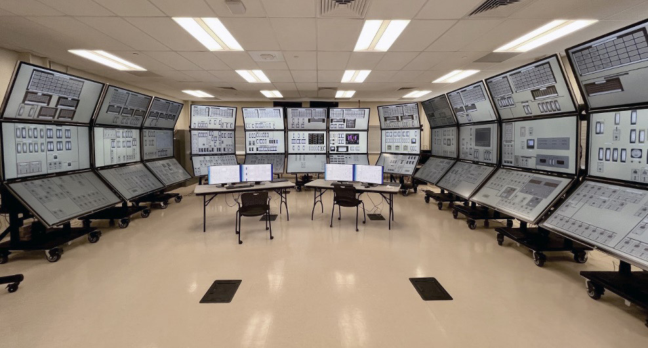
Figure 1: The original human systems simulation laboratory (HSSL-1).
CONTROL ROOM SIMULATOR FACILITY The Human Systems Simulation Laboratory (HSSL) has been established by Idaho National Laboratory (INL) as a domestic, plant-agnostic nuclear control room simulator for human factors research (Boring, 2021). Figure 1 depicts the original facility, now referred to as the HSSL-1, aimed at representing legacy light water reactor control rooms. It achieves full-scope simulation via the use of glasstop control room bays that have been employed in support of control room upgrades, HSI prototyping, operator-in-the-loop evaluation, and validation of digital control room concepts for the current fleet.
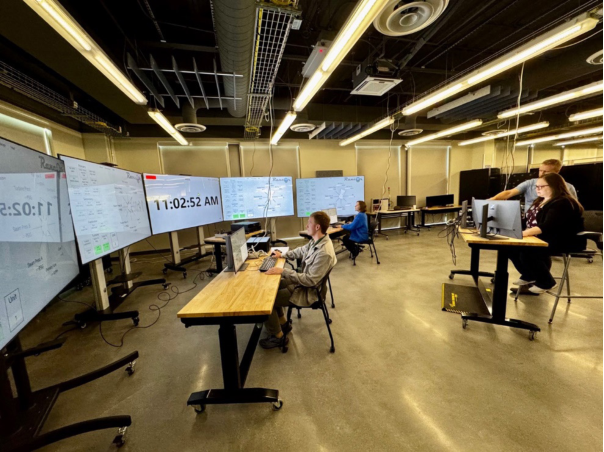
To stay at the forefront of control room modeling, INL created the HSSL-2. The HSSL-2, shown in Figure 2, addresses the move from the legacy control bays to more modern digital control rooms similar to those seen in NuScale’s control room (Flamand, 2022; NuScale Power, LLC, 2026; U.S. Department of Energy, 2021), U.S. Nuclear Regulatory Commission’s Human Performance Test Facility (HPTF) (Morrow &
Green, 2026), and the Halden Man-Machine Laboratory (HAMMLAB) (Jokstad et al., 2026).
Figure 2: The human systems simulation laboratory for advanced reactors (HSSL-2).
Within the HSSL-2, for the purposes of this study, the Rancor Microworld Simulator (Rancor) was used. This was chosen in lieu of a full-scope simulator due to a full-scope simulator’s complex configuration necessitating the use of licensed operator crews. Rancor was jointly developed by INL and the University of Idaho to evaluate operator attention and situational awareness within process control environments while avoiding the prohibitive expenses associated with full-scale simulators (Ulrich, 2017; Ulrich et al., 2017).
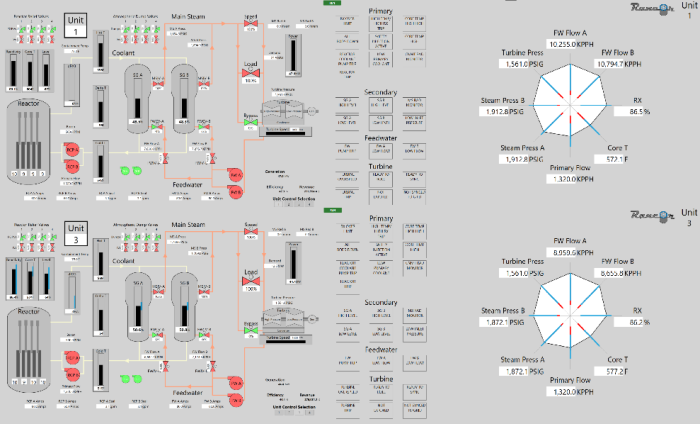
Designed as a simplified 30 MW pressurized water reactor (Lew et al., 2017), Rancor is developed in C# and leverages the Windows Presentation Foundation (WPF) framework (Ulrich, 2017; Ulrich et al., 2017). Because the simulator is intended for usability by non-experts, the plant design deliberately simplifies pump and heat transfer dynamics and excludes peripheral systems, such as main steam reheaters, chemical and volume control systems (CVCS), pressurizers, electrical distribution, and containment (Lew et al., 2017; Ulrich, 2017). Despite these simplifications, the simulator retains robust, realistic safety interlocks (e.g., reactor scram, turbine trip logic, and emergency core cooling) and enforces an authentic operational flow. For example, a standard start-up sequence requires operators to activate reactor coolant pumps, manipulate control rods, align steam generator valves, initiate turbine operation, and finally synchronize to the grid (Ulrich, 2017; Ulrich et al., 2017).
Rancor supports rigorous experimentation through automated data logging of key performance indicators, including execution times, error frequencies, and control inputs. The platform supports embedded scenario faults, such as masked indicators, across start-up, abnormal, and emergency evolutions.
Intra-Crew Dynamics of Multi-Unit Operations in a Nuclear Power Plant Simulator 1289 Furthermore, the inclusion of gamified feedback, using a revenue-based performance score, encourages optimization and participant engagement (Ulrich, 2017; Ulrich et al., 2017). As a result, novice undergraduate psychology students can achieve competent operational performance after approximately 40 minutes of training, enabling meaningful performance comparisons between student surrogates and licensed operators (Park et al., 2023).
Several coding improvements and changes were implemented to the simulator to achieve multi-unit operations that are beyond the scope of this paper; however, the largest change was the implementation of server-client protocol, which permits several stations to communicate and interact with the server hosting the simulator. Changes to the displays were also made to facilitate the multi-unit operation, specifically, four units in this study.
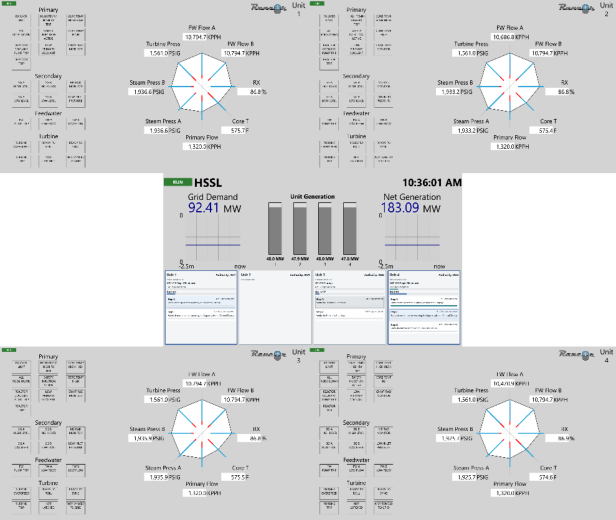
The most obvious change is the introduction of a set of overview displays. These allow the ROs, SRO, and other staff to rapidly view a summary of the state of all four units. This consists of the common overview display that indicates grid demand and site net-generation as line graphs, each individual unit’s generation as a bar graph, and current procedure status for each unit along with the current time and simulation status (Run/Pause), as seen in Figure 3. Procedure-tracking functionality was added after the pilot study to provide the SRO with a rapid indication of each unit’s procedural status. By making procedural progress visible across units, this functionality is intended to support the SRO’s formation and maintenance of an accurate mental model of the multi-unit plant state and to reduce reliance on verbal status reports. Because the functionality was added after the pilot, its effectiveness was not evaluated in the present study. Future research should determine whether it improves multi-unit monitoring, coordination, and situation awareness as the number and complexity of concurrent procedures increase.
Figure 3: Overview displays depicting four units flanking a common display centrally located.
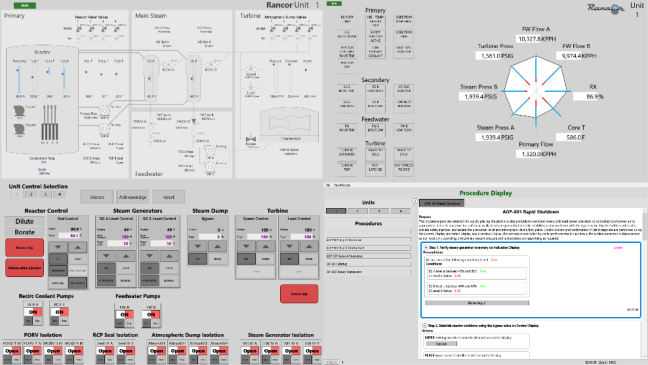
The RO workstation, shown in Figure 4, was designed to facilitate a flow path from procedure step to manipulated component. This was done by situating the Rancor Integrated Procedure System (RIPS) (Boring et al., 2025), a computer-based procedure system, in the bottom-right quadrant, with the control panel in the bottom left. This control panel is paired directly with the piping and instrumentation diagram (P&ID) of the actively controlled unit, and the corresponding unit overview is displayed in the top-right quadrant. Importantly, all three interface elements are conspicuously labeled to ensure personnel remain continuously aware of which plant system their actions will affect. The unit control selection is available in the top left corner of the control panel.
Figure 4: Reactor operator workstation with active unit p&id in the top left, active unit overview in the top right, control panel with the active unit selector in the bottom left, and digital procedure system in the bottom right.
Since the SRO is primarily tasked with supervisory oversight, the SRO workstation does not incorporate the direct control panels utilized at the RO station. Instead, as demonstrated in Figure 5, the SRO setup encompasses P&ID interfaces and unit overviews. While these P&ID displays are shared between both operators, the SRO workstation specifically features an active unit selector; this functionality enables the SRO to seamlessly transition between and observe different units. Furthermore, to facilitate the proper tracking of operations executed by the RO, a secondary screen dedicated to RIPS for procedural oversight is included in the SRO operating environment (not pictured).
As stated in the introduction, this pilot study was done as a means to test the simulator after the aforementioned code changes in support of future studies. This pilot study included a standardized course on basic reactor physics, covering the neutron life cycle, reactivity balance equation, and a simple reactor point kinetics example to provide the participants some understanding of how rod movements would affect the reactor. There was also a discussion on integrated plant operations to inform participants how
Intra-Crew Dynamics of Multi-Unit Operations in a Nuclear Power Plant Simulator 1291 actions in the secondary can translate to the primary and ultimately affect reactor power.
Figure 5: Senior reactor operator workstation active unit overviews in the top and bottom right and active unit P&ID with the active unit selector in the top and bottom left.
The pilot study consisted of two groups of two interns at INL to serve as the ROs, and a confederate SRO with previous licensed SRO experience. The first RO was responsible for units 1 and 2, while the other RO was responsible for units 3 and 4. Both groups performed power maneuvers to follow grid demand, with the first group performing a concurrent reactor startup on units 1 and 3 and the second group performing concurrent reactor shutdown on units 2 and 4.
QUALITATIVE RESULTS Given the initial scoping objectives of the pilot study, quantitative data was not collected. However, the confederate SRO was able to provide qualitative information on their experience and evaluated the simulator sessions against their extensive prior experience in professional supervisory roles within nuclear operations.
The SRO reported difficulty in simultaneously tracking two independent reactor states, an issue they felt would not be a challenge due to their experience tracking multiple simultaneous maintenance items across several systems. When asked to reflect on the discrepancy between their expected and actual situational awareness, the SRO attributed the challenge directly to significant deficiencies in crew communications. They noted that while they were capable of successfully forming and maintaining the necessary mental models for both plants simultaneously, routine status checks of the units frequently revealed that items had been altered by the student ROs without any verbal report.
This breakdown in shared situational awareness was corroborated by the SRO’s need to issue repeated reminders to the student ROs throughout the sessions. Specifically, the operators had to be continuously prompted to report their intent to perform a task, acknowledge the completion of actions, and announce the achievement of specific milestones related to the reactors’ states. Furthermore, the SRO observed that this communication gap was highly context-dependent; the issue did not manifest during the load-following portion of the pilot studies, a phase that requires significantly fewer control interventions and routine communications from the operating crew.
CONCLUSION
Although it has been demonstrated that students can be used as a proxy for licensed operators for the purposes of human factors studies (Park et al., 2023), there may be limitations when leaving the single-unit, single- operator format. In single-unit studies, intra-crew communication is not a primary factor. However, transitioning to a multi-unit format that requires coordination between two ROs and an SRO introduces the need for precise communications. When multiple independent operators are taking actions without reporting them, it creates a compounding effect on the SRO, who is left trying to build an accurate mental model of the facility with incomplete, delayed, or outdated information. The nuclear industry and other safety- critical applications employ formalized, three-way communications (Gonzalez, 2016; Matthew, 2024) to avoid such miscommunications. These communications are done in a precise way to convey necessary information to what some may be consider porous communication (Carvalho et al., 2006). Without this formalized training, student ROs default to naturalistic, informal communication, which fails to support the SRO’s situational awareness.
While no malfunctions were introduced during these pilot studies, their inclusion in future studies would inherently increase the cognitive load and stress experienced by student ROs. Based on the communication breakdowns observed during routine operations, it is highly probable that communication gaps would severely degrade during off-normal events. High-stress scenarios would likely lead to an increase in missed reports and instances of student operators talking over one another to relay information to the single SRO. Furthermore, unlike professional operators, students lack the innate industry experience required to understand which alarms or system degradations take precedence. In the event of overlapping issues across different units, this lack of built-in prioritization would likely result in the SRO receiving disorganized or low-priority information at critical moments.
Despite these challenges, student proxies can likely still be utilized in multi- unit simulator research, provided the methodological design accounts for this communication gap. Previous studies have demonstrated that students possess the ability to learn and employ formal communications within a two-person operating team with dedicated training (Reinerman-Jones et al., 2016). The necessity of rigorous, specific communication training prior to simulator data collection cannot be overstated. However, it remains an
Intra-Crew Dynamics of Multi-Unit Operations in a Nuclear Power Plant Simulator 1293 open research question how effectively students can scale this formalized communication training to accommodate three or more operators in a multi- unit environment.
Future research should directly evaluate the effectiveness of the common overview displays and their procedure-tracking functionality. Display-viewing frequency, dwell time, and the timing of display use could be measured through eye tracking, interaction logs, or both. These measures could then be related to task performance, communication behavior, and situation-awareness assessments to determine whether operators merely view the displays or use them effectively to monitor and coordinate concurrent activities across units. Such work is also needed to determine whether procedure tracking remains beneficial as the number of simultaneous procedures, abnormal conditions, and competing operator demands increases.
ACKNOWLEDGMENT
The authors acknowledge INL’s Kirk Fitzgerald for his assistance in setting up the HSSL-2, and to Heather Watkins, Dalton Sparks, and Stephanie Morrow of the U.S. NRC for their support of this research.
This work of authorship was prepared as an account of work sponsored by Idaho National Laboratory, an agency of the United States Government. Neither the United States Government, nor any agency thereof, nor any of their employees makes any warranty, express or implied, or assumes any legal liability or responsibility for the accuracy, completeness, or usefulness of any information, apparatus, product, or process disclosed, or represents that its use would not infringe privately-owned rights. Idaho National Laboratory is a multi-program laboratory operated by Battelle Energy Alliance LLC, for the United States Department of Energy under Contract DE-AC07-05ID14517.
REFERENCES
Alivisatos, C. (2023). Evaluating remote operations for advanced nuclear reactor control: Feasibility, benefits, and implementation criteria [University of California, Berkeley]. https://escholarship.org/content/qt1wt929p1/qt1wt929p1_ noSplash_988e46bdaad7bcd74df63a5d5e2689ad.pdf#:~:text=This%20 dissertation%20provides%20a%20comprehensive,strategy%20for%20 advanced%20nuclear%20reactors. Blackett, C., Eitrheim, M. H., McDonald, R., & Bloch, M. (2022, June). Human
Performance in Operation of Small Modular Reactors. Boring, R. L. (2021). The First Decade of the Human Systems Simulation Laboratory: A Brief History of Human Factors Research in Support of Nuclear Power Plants. In T. Ahram (Ed.), Advances in Artificial Intelligence, Software and Systems Engineering (Vol. 1213, pp. 528–535). Springer International Publishing. https:// doi.org/10.1007/978-3-030-51328-3_72 Boring, R. L. (2023). Human Factors for Advanced Reactors. 14th International
Conference on Applied Human Factors and Ergonomics (AHFE 2023). https:// doi.org/10.54941/ahfe1003781 Boring, R. L., Lew, R., & Ulrich, T. A. (2025, June). Rancor Integrated Procedure System (RIPS): A Computer-Based Procedure Platform for Advanced Reactor Research. https://www.osti.gov/biblio/3024546
Carvalho, P., Vidal, M., & Carvalho, E. (2006). Nuclear power plant communications in normative and actual practice: A field study of control room operators’ communications. Human Factors and Ergonomics in Manufacturing & Service Industries, 17, 43–78. https://doi.org/10.1002/hfm.20062 Eitrheim, M. H. R., Arigi, A. M., McDonald, R., & Jamieson, G. A. (2025). Multi-
unit operation of small modular reactors: Impacts of two staffing configurations on human performance (HTOR-096). OECD Nuclear Energy Agency Halden Human-Technology-Organisation Project. Flamand, R. (2022, December 16). Rethinking operations through digital control room design. Nuclear News. https://www.ans.org/news/article-4531/rethinking- operations-through-digital-control-room-design/ Gonzalez, R. (2016, May 20). Three-Way Communication for Utility Workers.
Incident Prevention. https://incident-prevention.com/blog/three-way-communi cation-for-utility-workers/ GSE Systems. (2017). NuScale simulator: An integral part of design certification application (DCA). GSE Systems. https://gses.com/wp-content/uploads/GSE- NuScale-Design-Cert-CS.pdf Jokstad, H., McDonald, R., & Lunde-Hanssen, L. S. (2026). HAMMLAB. Institute
for Energy Technology (IFE). https://ife.no/en/laboratory/hammlab/ Lew, R., Ulrich, T. A., Boring, R. L., & Werner, S. (2017). Applications of the rancor microworld nuclear power plant simulator. 2017 Resilience Week (RWS), 143–149. https://doi.org/10.1109/RWEEK.2017.8088663 Matthew, M. (2024, September 17). Three-Way Communication: An Essential
Tool for Safety and Clarity in the Workplace. Safety, Inc. https://www.safety.inc/ post/three-way-communication-an-essential-tool-for-safety-and-clarity-in-the- workplace Morrow, S., & Green, N. H. (2026, July). The Human Factor in Licensing and Operating the Next Generation of Nuclear Plants. Nuclear News, 69(8), 32–39. NuScale Power, LLC. (2022). Human Factors Engineering Staffing and Qualification
Results Summary Report (TR-130412-NP). U.S. Nuclear Regulatory Commission. https://www.nrc.gov/docs/ML2330/ML23304A378.pdf NuScale Power, LLC. (2026). Energy Exploration (E2) Centers. https://www.
nuscalepower.com/products/e2-centers O’Hara, J., Higgins, J., & Pena, M. (2012). Human-performance issues related to the design and operation of small modular reactors (NUREG/CR-7126). U.S. Nuclear Regulatory Commission. https://www.nrc.gov/docs/ML1217/ML12179A170.pdf Park, J., Kim, Y., Rø Eitrheim, M. H., Arigi, A., Dickerson, K., Green, N., Boring,
R. L., Park, J., & Bye, A. (2026). Human performance data collection for small modular reactors: Needs, limitations, and coordinated research approaches [Unpublished Manuscript] [Unpublished manuscript]. Park, J., Yang, T., Boring, R. L., Ulrich, T. A., & Kim, J. (2023). Analysis of human performance differences between students and operators when using the Rancor Microworld simulator. Annals of Nuclear Energy, 180, 109502. https://doi.org/ https://doi.org/10.1016/j.anucene.2022.109502 Perensky, J., Szabo, A., Plott, C., Engh, T., & Barnes, V. (2005). Guidance for
Assessing Exemption Requests from the Nuclear Power Plant Licensed Operator Staffing Requirements Specified in 10 CFR 50.54(m) (NUREG-1791). U.S. Nuclear Regulatory Commission. https://www.nrc.gov/docs/ML0520/ ML052080125.pdf
Intra-Crew Dynamics of Multi-Unit Operations in a Nuclear Power Plant Simulator 1295 Reinerman-Jones, L., Matthews, G., & Mercado, J. E. (2016). Detection tasks in
nuclear power plant operation: Vigilance decrement and physiological workload monitoring. Safety Science, 88, 97–107. https://doi.org/https://doi.org/10.1016/j. ssci.2016.05.002 Salim, S., Yeom, S.-Y., & Ham, D.-H. (2024). Collecting and Organizing the Influencing Factors of Team Communications to Handle Nuclear Power Plant Emergencies. Applied Sciences, 14(4). https://doi.org/10.3390/app14041407 Ulrich, T. A. (2017). The Development and Evaluation of Attention and Situation
Awareness Measures in Nuclear Process Control Using the Rancor Microworld Environment [University of Idaho]. https://verso.uidaho.edu/esploro/outputs/ doctoral/The-Development-and-Evaluation-of-Attention/996637919601851 Ulrich, T. A., Lew, R., Werner, S., & Boring, R. L. (2017). Rancor: A Gamified Microworld Nuclear Power Plant Simulation for Engineering Psychology Research and Process Control Applications. Proceedings of the Human Factors and Ergonomics Society Annual Meeting, 61(1), 398–402. https://doi. org/10.1177/1541931213601582 U.S. Department of Energy. (2021, September 22). NuScale SMR Simulation Lab
Opens in Idaho. https://www.energy.gov/ne/articles/nuscale-smr-simulation-lab- opens-idaho U.S. Nuclear Regulatory Commission. (2021). Safety evaluation for NuScale Power, LLC control room staffing plan topical report (TR-0420-69456, Rev. 1). U.S. Nuclear Regulatory Commission.
SEARCH THE AHFE DIGITAL BOOKSTORE BY ISBN
Explore the complete digital volume
Human Factors in Design, Engineering, and Computing
Read this individual research paper free through the original publisher, or explore the full digital proceedings book.