Bryan Croft, Seana Rothman, Tai Nguyen (2026). IMAGES-AI: Generative AI to Improve Products for the US Navy Warfighter. In: Human Factors in Design, Engineering, and Computing. AHFE Open Access, vol. 238, pp. 1789–1797. https://doi.org/10.54941/ahfe1008407
Project IMAGES-AI uses generative AI (GenAI) to improve products for the US Navy warfighter. Recent advances in GenAI, and the ability to adapt it to a specific domain, have made it a useful tool for enhancing the interfaces that display information used by the warfighter. The overarching goal is to improve situational awareness and strengthen the decision-making process, primarily through visual GenAI image generation. GenAI image generation has become a fast-growing capability and has overcome many of the early errors and mistakes seen in the technology's early days. Much of this has been made possible with improvements to Large Language Models (LLMs). LLMs can be very large and cover a wide range of data to support correct image generation. However, for very specific domains, much of the data required, such as for the US Navy warfighter and related topics, can be very limited, which can impact the results of GenAI-generated imagery for this specific topic. Low-Rank Adaptation (LoRA) is a parameter-efficient fine-tuning technique that is used to customize pre-trained models (LLMs). It does this by training a small set of extra weights instead of altering the massive LLM model. The concept is to freeze the base weights of the original pre-trained model to preserve its coverage and capability. A domain-specific lightweight companion matrix or adapter layers can be added to inject domain-specific data into specific parts of the model with attention mechanisms. No retraining of the LLM is required; instead, a smaller add-on portion is used, where gradient updates modify only the much smaller set of adapter parameters. This produces a LoRA file, essentially a plug-in that adjusts the final output to better match the desired characteristics. In this case, applicable to US Navy applications. This technique is cost- and resource-efficient, small in file size compared to LLM data, and easy to swap out for different adapters to align with the desired output. IMAGES-AI has leveraged this technique to generate imagery that better illustrates Navy missions and courses of action. IMAGES-AI has been applied to applications to test and verify whether improvements are seen in warfighters through improved situational awareness and rapid decision-making. Domain and environmental information become embedded in the imagery. This has been examined through integration into applications and used in storyboarding workflows and scenario development. Initial prototype results indicate a valid return on investment.
The use of storyboarding is common technique best known for its used in the film and media entertainment business but has existed in many forms throughout history (Lefevre, 2016). Commonly it is used by artists to create
visual outlines of a story using a series of images or shots to plan for the film, animation, or other end uses. It is a visual roadmap for the production team to know how to create the film or product. The storyboard serves as means to pre-visualize the essence of the narrative in the story. Often short clips with descriptive text are included. This provides the outline to be used by various craftsman in the media industry to align everyone with the same vision. It acts as a visual script, a planning tool, and a communication tool, and in the case for the Navy warfighter, a planning tool, a course of action COA, or a as workflow layout. A storyboard is a medium which allows for collaborative teaming in production but also to identify potential issues prior to execution of a scene in a film or animation sequence, or across the entire production. Features common to storyboards include an image of each scene, notes on any dialog, actions to take place, placement in the scene including background which defines camera angles and positioning to better visualize the concepts behind the story. The images represent key moments or shots in a story or animation that often the chain of action or events is sufficiently understood. Notes are supplied to either add needed information the scene or to clarify what the visual image cannot do by itself. For films it includes how the camera is to view the scene such as a long shot, close-up, movement, angle of view, and so on which can relate to additional information found in closeups or far away scenes which depict elements of the environment. A storyboard benefits the production team to provide a plan on the visuals of the scene, to improve efficiency in modifications which can be done via the storyboard instead of during actual filming or animation creation. Additional benefits include clarification on the storyline which supports the identification of gaps, pacing of the story, and making sure the intent of the story is being told. This also support the production team by planning so the shots can be more efficient in time and budget.
Generative AI (GenAI) has improved in its quality to provide the means to impact the methodology and production used in the creation and use of storyboarding especially in film making (Uddin et al., 2025). It currently allows improvement in speed and efficiency for those typically involved with storyboarding. For Subject Matter Experts (SMEs) with knowledge and skills in particular areas but are not artistically oriented it becomes a great support to get across their ideas. GenAI can create entire storyboards in minutes which is dramatically faster than traditional methods. It becomes more accessible by removing the need for artistic skill and allowing other skilled members of the production team to create visual representation of their ideas. GenAI can provide cost-effective means to the process while more importantly allowing for rapid iteration on multiple versions of the storyboard to explore different visual approaches. This iterative process can allow for changes on the fly, when needed. Collaboration when using storyboarding generated by GenAI is enhanced by providing a variety of team-based AI tools to allow sharing of content, real-time editing, feedback, and improved communication. The technique for GenAI image generation has found significant place in the process by creating the means for automatic interpretation of scripts and then generate corresponding visuals. There do exist limitations and challenge with the use of GenAI in general but applies
IMAGES-AI: Generative AI to Improve Products for the US Navy Warfighter 1791 to storyboarding as well. Visual consistency is a must to be maintained. Characters, style, and composition across the storyboard require consistency otherwise misinterpretations occur from viewers of the storyboard. Not long ago GenAI content creation tools often created differing content even with much of the same prompt text being the same or even re-running the content generation with the same prompt. GenAI currently lack the ability to fully capture an artist’s intent which includes a nuanced control over composition, pose, and other content features which a professional artist provides but with added costs. Currently GenAI can be unpredictable in image generation leading to potential nonsensical, misaligned, or inconsistent content which might require a significant rework.
RELATED WORKS Historically, storyboarding (Lefevre, 2016) illustrates the impetus in understanding its utility in creating a narrative of an idea or concept which then must be created in some fashion. It outlines its necessity and benefits to providing products especially in the media and entertainment business. Early on, storyboarding when applied to various businesses in areas such as layout design, keyframe animation, inbetweening, and colorization, which created substantial manual effort, the demand for technical expertise, and a significant time investment in product creation (Tang et al., 2025). These types of challenges often impeded the efficiency and scalability of the storyboarding concepts as seen in areas of comics, graphic novels and other learning tools (Uddin et al., 2025; Abram, 2008). Many storyboard designs (Rasool, Molka-Danielson, & Smith, 2020) were also considered unstructured or would require techniques like learner-centered-design (Paracha & Yoshie, 2011), adaptive behaviours in serious games (Aronld, Fujima, Karsten, & Simeit, 2013), and transmedia-based methodology (Rasool, Molka-Danielson, & Smith, 2020) or other technics to improve upon the efficiency, scalability and even in the quality. Modern and digital- based techniques such as data driven systems (Asgari & Hurtut, 2024) or creating software with the intent to storyboard such concepts as planning (Wang et al., 2024) were also utilized. Recently GenAI has entered the arena of storyboarding (Liang et al., 2024) in such areas as film making (Palmer & Palmer, 2025), Cel-animation (Tang et al., 2025), and to support artistic fusion to provide improved artistry in storyboarding (Bhuvaneshwaran, 2024). Current works explore the improvement in efficiency, scalability and improvement of storyboarding have utilized GenAI techniques to achieve this. Beyond storyboarding it has applied to other areas such as the medical industry (Lin, Feng, & Liu, 2025; Birtwell, Morris, & Armitage, 2022) and in the defence industry as provided in this work. Storyboarding using GenAI has also specialized the generation of content by using sketches (Jo, Yuan, & Kim, 2022), creating 3D poses from 2D images (Mouaijah & Plessiet, 2021), improving prompt/query entries to improve visual quality and consistency (Kim, Eun, Oh, & Lee, 2025), as well as incorporating it into a storyboarding Virtual Reality Systems (Manuri, Sanna, & De Pace, 2023). This works tends toward the ability to support an entire creative process and workflow into
a single pipeline for the generation of storyboards, while making it a useful tool for all stakeholders involved in the process. This is also a challenge taken on by this body of work for applying storyboarding capability to use in various projects within the Department of War (DoW) such as COA and planning.
PROPOSED METHODOLOGY The methodology for this work is based upon the following process: 1) determine the information necessary for a project to be storyboarded, 2) use Large Language Models (LLMs) to generate a story draft, 3) develop a shot list based upon previous process steps, 4) generate images via AI tools, 5) provide a structure within an application to assemble the storyboard. The IMAGES-AI tool was successfully used in image generation. This coming year the concentration focuses on COA development as storyboards, workflows, and concepts to be examined prior to investment.
Within the DoW there exists many different projects which pertain to a variety of applications. The unique feature of storyboarding is that it can be applied to any project within the DoW with support of Subject Matter Experts (SMEs) and the variety of jobs required within any given project. The concept is to get the entire team involved so that all aspects get covered in the storyboarding process. Use of UX/UI or User-Centered Design (UCD) personnel can provide the structure needed throughout the storyboarding process.
GenAI has improved in the generation of text, imagery and video content along with Agents. It is a creative based software technology when structured correctly can provide the required results. Much of the ability of GenAI comes from the integration of LLMs. LLMs provide the generated structure of the data necessary for the GenAI algorithms to understand and then utilize in the formulation of the content. This work utilities ComfyUI which is an open-source, node-based interface for running GenAI workflows based on Stable Diffusion. ComfyUI allows the integration of several LLMs which can be used, and which are based upon data from a variety of sources. Many different and usable LLMs exist that can be integrated into the ComfyUI structure. This work has examined many LLMs and has determined several the meet desirable outcomes for given projects and for general use. It has been determined that often a balance between the quality of the output and the size of the LLM, which relates to generative runtime, is required to meet project expectations but provide the required speed of use expected by end users. This work utilizes LLMs for both text generation like ChatGPT as well as for the generation of imagery and videos.
A shot list is used in the film industry and provides a detailed document created by the director or cinematographer which outlines every camera shot which is needed for the scene in the film. The content of the document typically uses a shot type, camera angle, camera movement, and a list of required equipment. In essence it is a blueprint for capturing each shot. A storyboard provides the visual representation from the shot list and GenAI can support a Project team member support in the creation of the shot list.
IMAGES-AI: Generative AI to Improve Products for the US Navy Warfighter 1793 Critical to the storyboard content is the visual representation at the various points of interest in the shot list. GenAI is now well known for the creation/ generation of imagery which can be based on text prompts and or other visual images that are representative of the desired output. ChatGPT, Midjourney and many other GenAI applications are currently known to provide such desired output. ComfyUI can provide access to such applications within its workflow structure. This work has utilized and examined several of the more extensive and well known GenAI-based image generators. Some key factor which has been examined are image/content consistency, avoidance of non-correct imagery (adding features which are not normal or natural), can generate futuristic but realistic imagery in projecting newer concepts of project, and the ability to stylize the imagery. Consistency is often a problem in GenAI, and a method used call Low-Rank Adaptation (LoRA) has been applied in this work. This allows for fine-tuning large, pre-trained models by modifying the model weights in Stable Diffusion and LLMs. This provides efficiency, resource savings, small-adapted files to use, and more flexibility in swapping out different LoRA adapters for different tasks and styles and not having to retain the entire model. The majority of GenAI image generators have recently provided changes to avoid non-correct imagery but is still a factor to consider and better solutions are being sought in this work. The output from this work has proven the ability to generate future based imagery for use in the US Navy, however, much of the success has been to prompt manipulation and adjustments. Stylizing content has become a feature in many GenAI image generators and has proven to provide styles of interest.
The AI application ComfyUI, provides the visual representation of its workflow. This helps support the necessary work to assemble a storyboard. This work has also provided an application which has been vetted by UI/ UX/UCD experts that it does create the necessary interface and backend structure to assemble the storyboard in the desired format with the content provided for the US Navy application. This format not only provides the GenAI generation of content but the cell-based sequential element of the storyboard which include the generated imagery along with summarized text-based explanation regarding most cells within the storyboard. This is still an effort in progress but has provided example storyboards of up to 10 or 12 cells for more simple based scenarios while improving the generated content for COA creation.
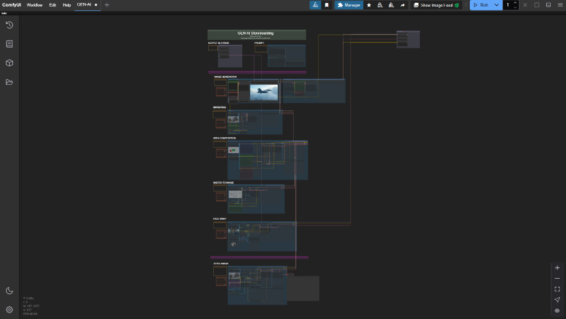
The use of ComfyUI has provided the means to logically and visually piece together the various components necessary to make a storyboard generator work as outlined. ComfyUI provides a visual representation of modules which perform certain workflow features and the necessary inputs and outputs for those features. Besides the integration of GenAI techniques it provides the following capabilities within exiting add-on modules or modules which can be created. These modules are now discussed. Output Settings module provides just what it states, the desired output and control of that output via specified settings. Prompts allow for GenAI prompting entry points by the user to then to be fed to GenAI applications like ChatGPT. An Image Generation
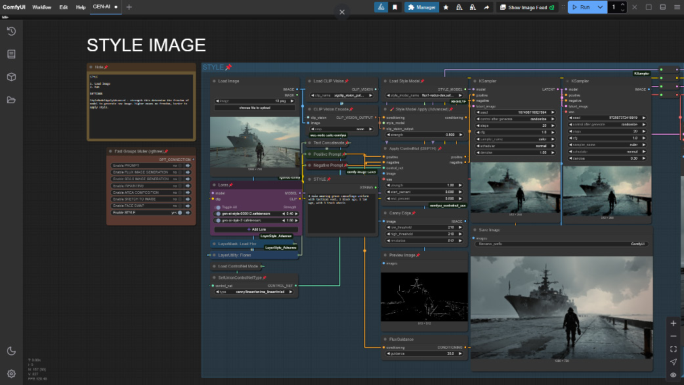
module is very similar and takes in and outputs what is expected form the embedded GenAI image generator. The Inpainting module reconstructs or fills in missing or damaged portions of a generated AI image. It supports the user in allowing to select areas an image and allow the GenAI to more closely match the surrounding area. The Area Composition module is a workflow technique which allows the user to apply different prompts to specific regions of an image to better control the final output. This is beneficial in complex scenes or in avoiding non-desired items in the scene. The Sketch to Image module takes the input of a simple drawing or sketch as a starting point and uses it to generate a more detailed and realistic AI image. This is often beneficial when used in collaborations. The Face Swap module allows the desired face of a given individual to be swapped for the face provided by the GenAI image generator. The last but not final module currently in the version of this work’s storyboard application is the Style Image module. This module allows for the ability to transfer visual characteristics from a reference image. Such style characteristics include artistic style, colour palette, and textures from other images.
This work has examined several technical papers that utilize GenAI or other techniques for storyboarding as illustrated in the related works section. This work has also examined current commercial and open-source applications such as Storyboarder.ai, StoryboardHero, LXT Studio, Adobe Firefly, Krea. ai, Canva and others that are specially built for the storyboarding process. This has helped to understand various GenAI and related capabilities for storyboarding. This would have DoW requirements which require it to be a standalone or off the general internet to perform its work. ComfyUI was selected along with other LLMs and GenAI tools which allow the services to be integrated into a standalone (off general network/internet) AI-based workstation. This requirement has limited the use of several valued GenAI tools but has been able to match other storyboarding applications in its current state.
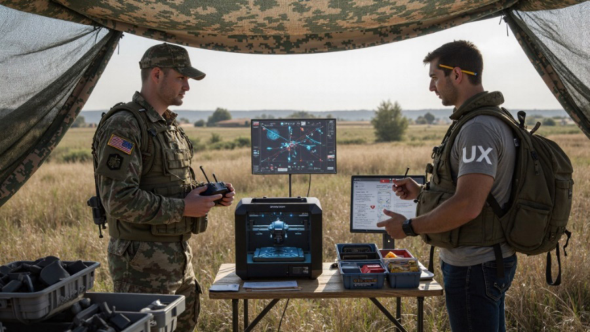
EXPECTED RESULTS This work has been successful and have gained interest from several Navy related projects that have shown interest in its use. A second-year effort is currently underway with a new approach to apply it to storyboarding and image generation for COA development and deployment. This work is funded by a Naval Innovation for Science and Engineering (NISE) internal Research and Development effort for NIWC Pacific. Internal marketing is currently being utilized which allows co-workers to login and supply prompts to generate Navy-based imagery under a variety project-based condition. An example is shown if Figure 1.
Figure 1: Example image result from end user.
A prototype application is currently functional as described. It is still in development and expansion of capabilities but has successfully shown how it can be used and direction it undertakes to become a more fully integrated storyboard and scenario generation tool within the domain of the US Navy and DoW.
Below are a few images which illustrate a portion of the work that is currently functional and expected to become more functional over iterative design and development cycles. The current style images interface is shown in Figure 2 and Figure 3. This is but one of the following ComfyUI workflow modules. The include in sequential order: Output Settings, Prompt, Image Generation, Inpainting, Area Output, Sketch to Image, Face Swap, and Style Image module.
Figure 2: Current ComfyUI module for visual styling in storyboarding.Figure 3: ComfyUI module used in application.
Another example from the IMGENS-AI work shows more detail on the Style Image module for the ComfyUI workflow. The nature of this application does allow for future expansion and development to improve upon current capabilities for storyboarding as well as integrate new storyboarding features as they become apparent from project requirements.
CONCLUSION AND FUTURE WORK Current results and interest are indications that this work’s progress in the right direction. The second year of the effort will continue to improve upon the existing and new features deem necessary by projects which use the application. Future work also includes the integration of the capability into the NIWC Pacific High-Performance Computing Centre (HPCC) which will provide a certain level of the application to personnel across the Centre. Further design and development efforts will continue as well as examination of Generative AI tools, LLMs, and new techniques in storyboarding.
ACKNOWLEDGMENT
The authors would like to acknowledge Naval Information Warfare Centre Pacific for its Naval Innovation for Science and Engineering support to explore the concepts of GenAI-based storyboarding.
REFERENCES
Abram, S. (2008). “Storyboarding: Comics, Graphic Novels, and Engaging Learners”.
Published in Multimedia & Internet @ Schools, May/June 2008, 15,3, pp. 25–27. Arnold, S., Fujima, J., Karsten, A., & Simeit, H. (2013). “Adaptive Behaviour with User Modelling and Storyboarding in Serious Games”. 2013 International Conference on Signal-Image Technology & Internet-Based Systems. pp. 345–350. Doi: 10.1109.SITIS.2013.63. Asgari, M. & Hurtut, T. (2024). “A Design Language for Prototyping and
IMAGES-AI: Generative AI to Improve Products for the US Navy Warfighter 1797 Bhuvaneshwaran, A., et al., (2024). “Artistic Fusion: AI Powered Artistry for Story
Boarding”. Proceedings of the International Conference on Sustainable Expert Systems (ICSES’24). Doi: 10.1109.ICSES63445.2024.10763187. Birtwell, K., Morris, R., & Armitage, C. J. (2022). “Combining Timelining and Storyboarding to Create a Novel Method for Intervention DesIGn with StakehOlders: INDIGO”. International Journal of Qualitative Methods, 21, 1–10. Doi: 10.1177.16094069221127147. Jo, S., Yuan, Z., & Kim, S. (2022). “Interactive Storyboarding for Rapid Visual Story
Generation”. 2022 IEEE International Conference on Consumer Electronics – Asia (ICCE-Asia), doi: 10.1109/ICCE-ASIA7006.2022.9954679. Kim, S., Eun, J., Oh, C. & Lee, J. (2025). “Journey of Finding the Best Query: Understanding the User Experience and AI Image Generation System”. International Journal of Human-Computer Interaction, 41-2, pp. 951–969. Doi: 10.1080.10447318.2024.2307670. Lefevre, P. (2016) “Storyboarding: A Critical History”, Historical Journal
of Film, Radio & Television, December 2016, 36-4, pp. 712–713. Doi: 10.1080/01439685.1248068. Liang, Z., et al., (2024). “StoryDiffusion: How to Support UX Storyboarding With Generative-AI”. arXiv:2407.07672v1, 10 July 2024. http://arxiv.org/ abs/2407.07672. Lin, H., Feng, C., & Liu, Y. (2025). Generative AI-enhanced UX Storyboarding:
Transforming Novice Designers’ Engagement and Reflective Thinking for IoMT Product Design”. International Journal of Technology and Design Education, May 2025, pp. 1–26. Manuri, F., Sanna, A., & De Pace, F. (2023). “Storytelling in the Metaverse: From Desktop to Immersive Virtual Reality Storyboarding”. 2023 IEEE International Conference on Meteorology for eXtended Reality, Artificial Intelligence and Neural Engineering (MetroXRAINE). Doi: 10.1109. METROXRAINE58569.2023.10405763. Mouaijah, S. & Plessiet, C. (2021). “3D Character Posing for 2D Sketches for
Storyboarding”. 2021 IEEE International HCI and UX Conference in Indonesia (CHIuXiD), doi: 10.1109/CHIuXiD54398.2021.9650611. Palmer, R., & Palmer, A. (2025). “Intention is All You Need to Create Your Own Hollywood Blockbuster Movies”. Published by the IEEE Computer Society, April 2025, Editor Michael Zyda. pp. 79–82. doi: 10.1109.MC.2025.35342663. Paracha, S. & Yoshie, O. (2011). “Exploring the Role of Drama and Storyboarding
in Learner-Cantered Scenario Generation”. Published in Intelligent Decision Technologies, 201l, 5, 3, pp. 237–252. Doi: 10.3222.IDT.2011.0109. Rasool, J., Molka-Danielsen, J., & Smith, C. H. (2020). “Designing Interfaces for Cre ative Learning Environments Using the Transreality Storyboarding Framework”. BDE 2020, May 29-31, 2020, Shanghai, China. Doi: 10.1145.3404512.3404530. Tang, Y. et al., (2025). “Generative AI for Cel-Animation: A Survey”.
ArXiv:2501.06250v4, 8 Oct 2025, https://github.com/yunlong10/Awesome- AI4Animation. Uddin, S., et al., (2025). “Innovations and Challenges of AI in Film: A Methodological Framework for Future Exploration”. ACM Transactions on Multimedia Computing, Communications, & Application, July 2025, 21-7, pp. 1–55. Doi: 10.1145/3736725. Wang, W., et al., (2024). “Idea Builder: Motivating Idea Generation and Planning for
Open-Ended Programming Projects through Storyboarding”. Proceedings of the 55th ACM Technical Symposium on Computer Science Education V.1 (SIGCSE 2024), March 2024, pp. 1402–1408. Doi: 10.1145.3626252.3630872.
SEARCH THE AHFE DIGITAL BOOKSTORE BY ISBN
Explore the complete digital volume
Human Factors in Design, Engineering, and Computing
Read this individual research paper free through the original publisher, or explore the full digital proceedings book.