Steven J. Doehler (2026). I’ve Got an Idea: A Study on the Decision to Share. In: Human Factors in Design, Engineering, and Computing. AHFE Open Access, vol. 238, pp. 2802–2810. https://doi.org/10.54941/ahfe1008504
The decision to share an idea is a fundamentally human factors challenge — requiring an individual to assess cognitive risk, calibrate social trust, evaluate available protections, and make a behavioral choice under uncertainty. Yet design education has largely treated idea sharing as a given, embedding critique and collaboration into studio culture without addressing the factors that cause students to withhold their best thinking. When ideas stay locked inside the person who conceived them, they never live. This study applies a human factors lens to examine why professionals are reluctant to share ideas and proposes pedagogical mechanisms that design educators can integrate. A survey instrument was distributed via LinkedIn for its broad, cross-industry professional user base. A total of 71 responses were collected, with 52 completed surveys informing the analysis. Respondents ranged from 18 to 65+, with the largest cohorts in the 25–34 (37%) and 35–44 (25%) ranges. The survey examined willingness to share ideas with trusted friends, strangers, and on social media, and assessed relative trust in four protection mechanisms: patent protection, non-disclosure agreements, members-only access controls, and tracking systems. Findings reveal a pronounced trust gradient across sharing contexts. Patent protection earned the highest trust level but, notably, 29% agreed that no safeguard would make sharing feel secure. These findings inform four pedagogical interventions: structured critique formats with the startup community; IP literacy programming; founder lecture series; and team-building through disclosure. Together, these practices build the conditions under which sharing becomes the more rational choice.
Every idea begins the same way—as a private thought, held by a single person, not yet tested, not yet proven, not yet shared. What happens next determines whether that idea ever becomes anything at all. For some people, the next step is to talk about it. For many others, the next step is to hold it— to file it away for a future moment of motivation that, for too many ideas, never arrives.
Idea sharing is not simply a communication behavior. It is an act of interpersonal risk, requiring an individual to simultaneously assess cognitive risk, calibrate social trust, evaluate available protections, and make a behavioral choice under conditions of uncertainty. For designers, entrepreneurs, and creative professionals, this decision determines whether
I’ve Got an Idea: A Study on the Decision to Share 2803 early-stage ideas receive the feedback needed to survive, whether collaborators are recruited at the right moment, and whether the energy behind a nascent concept is channeled into development or dissipated in protective silence.
Design education has a particular stake in this challenge. The design studio cultivates a culture of sharing—critique is foundational, collaboration is expected, and the willingness to present unfinished work is a professional norm. Yet that culture is context-specific. When students graduate and enter professional contexts where the studio’s social contract no longer applies, many default to the behavior that feels safest—they stop sharing. The portfolio becomes a vault. Ideas developed through years of studio training are filed away, waiting for a security that the outside world does not automatically provide.
This paper addresses that gap. Drawing on a mixed-methods survey of 71 professionals distributed via LinkedIn, it examines the conditions under which professionals are willing to share ideas, the protection mechanisms they trust, and the reasoning behind their choices. It then proposes four pedagogical interventions that design educators can integrate into studio practice to build the conditions under which students approach the sharing decision with informed judgment rather than fear.
LITERATURE REVEW The decision to share an idea sits at the intersection of four bodies of research: psychological safety, psychological ownership, knowledge hiding, and design studio culture.
Psychological Safety and Interpersonal Risk Edmondson (1999) introduced team psychological safety—defined as a shared belief that the team is safe for interpersonal risk taking—and demonstrated its direct relationship to learning behavior and performance. Crucially, Edmondson’s model involves a tacit calculus at behavioral decision points: individuals ask, if I share this here, with these people, will I be hurt, embarrassed, or ignored? This maps directly onto the idea-sharing decision. Moffett et al. (2023) found psychological safety can be facilitated within design thinking environments, with key indicators including sharing ideas and taking risks. When psychological safety is present in project-based learning, students demonstrate higher creativity and willingness to let ideas circulate freely (Han et al., 2022).
Psychological Ownership and Knowledge Hiding Psychological ownership theory explains why individuals are reluctant to share personal ideas. When creators invest cognitive and creative effort in developing an idea, it becomes psychologically fused with their sense of self. The prospect of sharing—and potentially losing control of—something experienced as ‘mine’ produces psychological tension and protective behavior (Pierce et al., 2003). Research linking knowledge hiding to individual creative performance extends this framework: when individuals conceal knowledge,
2804 Doehler it restricts the exchange of ideas essential for creative insights and reduces capacity for innovative outcomes (Kurniawanti et al., 2023).
The Psychology of Idea Theft Ellis and Lucas (2024) examined the psychology of idea theft, finding that fear is widespread: more than 80% of employees believed a boss had stolen one of their ideas, and nearly a third reported a colleague had done so. Their most striking finding is a systematic mismatch: creators protect polished ideas most vigilantly, but idea thieves prefer early-stage ideas, which are easier to claim as inspiration. This creativity-protection paradox—behaviors most necessary for innovation are those most suppressed by fear—is a central human factors challenge this paper addresses.
The Studio Boundary Problem Design studio pedagogy positions critique and open sharing as foundational. Within the studio, students share ideas, present work in progress, and participate in collective critique—creating a high-trust environment in which the social contract around idea sharing is explicit and enforced (Brandt et al., 2013). The problem is what happens at the boundary between the studio and the world beyond it. Students trained to share in a controlled, peer- rich environment graduate into professional contexts where none of those conditions exist. They stop sharing. The portfolio becomes a vault. Mills and Watson (2021) argue that a key factor suppressing creativity is the lack of psychological safety within the social system surrounding education—not just within it. The pedagogical interventions proposed here are designed to close that gap.
METHODOLOGY
Research Design This study employed a mixed-methods survey design combining quantitative Likert-scale and ranking instruments with open-ended qualitative responses.
Survey Instrument The 18-question survey was organized across three thematic sections preceded by a demographic profile. The opening statement framed its purpose: ‘This survey aims to understand the circumstances surrounding sharing ideas. There are many reasons why we share or keep ideas secret. We are attempting to determine those reasons and what we can do to make people feel more secure about the idea-sharing process, whether face-to-face, through text, or online.’ The Idea Sharing section assessed willingness to share a million- dollar idea with friends, strangers, and on social media using five-point Likert scales with open-ended follow-up questions. The Idea Security section assessed trust in four protection mechanisms—patent protection, NDAs, members-only access, and tracking—through trust scales and a ranking task. The Idea Theft section examined whether any safeguard would make sharing feel sufficiently secure.
I’ve Got an Idea: A Study on the Decision to Share 2805 Sample and Distribution
The survey was distributed via LinkedIn over approximately one month. LinkedIn was selected deliberately for its broad, cross-industry professional user base—reflecting that idea-sharing reluctance is not domain-specific. A total of 71 responses were collected, with 52 fully completed. Respondents ranged from 18 to 65+; the largest cohorts were 25–34 (37%) and 35–44 (25%). Sixty percent identified as men, 36% as women, and 4% as non- binary or preferred not to say.
Data Analysis Quantitative data were analyzed using descriptive statistics including frequency distributions and mean trust scores. Qualitative open-ended responses were analyzed using inductive thematic clustering: responses were grouped by shared meaning and each cluster assigned a descriptive title, allowing patterns to surface from the data rather than being imposed by a predetermined coding scheme.
FINDINGS The Trust Gradient
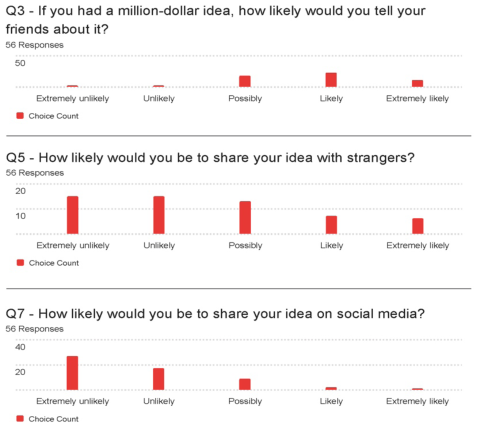
Fifty-six respondents completed the sharing likelihood questions. When asked about sharing a million-dollar idea with trusted friends, 61% were Likely or Extremely Likely, with only 8% indicating reluctance. Willingness dropped sharply with strangers: 54% were Unlikely or Extremely Unlikely to share, with only 23% willing. Social media produced the strongest reluctance: 78% were Unlikely or Extremely Unlikely, with only 6% willing. This trust gradient maps directly onto the degree of relational control available in each context—friends offer accountability; strangers offer uncertain intent; social media offers no relational control.
Figure 1: Willingness to share across social contexts—Friends (top), Strangers (middle), Social Media (bottom).
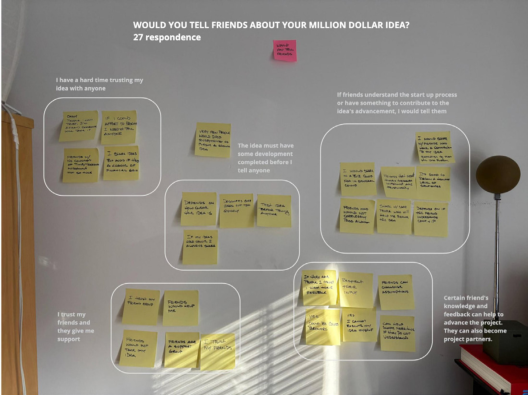
Friends (27 responses, 5 clusters): Willing respondents emphasized trust, feedback, and collaborative potential. One captured the dominant rationale: ‘Ideas are a dime a dozen. Follow through is rare.’ Reluctant respondents conditioned sharing on idea readiness or the friend’s relevant capacity.
I’ve Got an Idea: A Study on the Decision to Share 2807 Strangers (23 responses, 5 clusters): The dominant theme was fear and zero trust. A striking counterpoint emerged: ‘Friends will encourage you. Strangers will tell you the truth.’ Conditional willingness appeared when strangers were framed as potential consumers or IP protection was in place.
Social Media (23 responses, 5 clusters): Dominant themes were indiscriminate distribution and the one-year patent novelty clock. Conditional willingness framed social media as a marketing tool only once IP was secured.
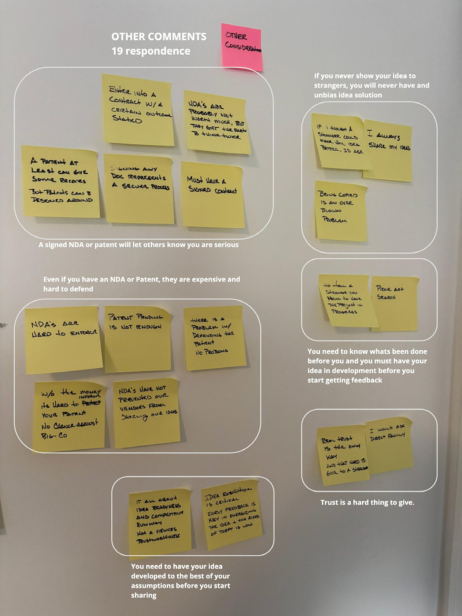
Other Considerations (19 responses, 6 clusters): NDAs and patents signal seriousness but are expensive and hard to enforce. One respondent articulated the dilemma precisely: ‘NDAs have not prevented vendors from stealing our ideas... A patent at least gives you some recourse, but those are often easy to design around. Real trust is the only way, and that is hard to give to a stranger.’
Protection Mechanism Preferences Patent protection earned the highest mean trust score (4.27/5), followed by NDAs (3.88), members-only access (3.79), and tracking (2.98). Despite ranking first in trust, patent protection drew significant open-ended scepticism regarding cost and enforceability—revealing a gap between rated trust and practical confidence with direct implications for IP education.
The No-Safeguard Cohort Twenty-nine percent of respondents (16/56) agreed no safeguard would make sharing feel secure. Legal sceptics cited inaccessibility of IP enforcement. Philosophical respondents went further: ‘Owning an idea is an illusion. You can shepherd it, but at the end of the day people can still do whatever they want.’ Notably, 39% of completions voluntarily provided contact information for future research—signalling strong engagement with the topic.
PEDAGOGICAL RESPONSE The findings suggest idea-sharing reluctance is not primarily a confidence problem—it is a condition shaped by trust, relational context, and perceived control. Four interventions address the human factors at different levels.
Structured Community Critique Inviting startup founders, investors, and practitioners into studio critique formats replicates trusted-stranger disclosure in a low-risk context, giving students direct experience with unfamiliar audiences. Repeated exposure builds capacity for sharing outside the studio—not because fear disappears, but because the experience of surviving it accumulates.
IP Literacy Programming IP literacy programming distinguishes two separate questions: what protects an idea legally, and what enables an idea to become a business. When students
2808 Doehler understand that early-stage sharing rarely constitutes meaningful legal risk —and that value lies primarily in execution—the calculus of disclosure shifts.
Founder Lecture Series Practitioners who have brought ideas to market with and without formal IP protection provide real-world context for the sharing decision. The goal is not to convince students sharing is safe—it is to equip them to develop a personal strategy grounded in informed judgment rather than vague fear.
Team-Building Through Disclosure When students understand that sharing an idea is often how a development team is assembled, the calculus of disclosure changes fundamentally. Structured exercises that require sharing nascent ideas as the entry point for collaboration make disclosure the first step in building rather than the last step before launch.
DISCUSSION
Confirming the Theory The trust gradient is consistent with psychological ownership theory (Pierce et al., 2003)—the perceived risk of relinquishing something experienced as ‘mine’ scales directly with the degree of relational control available. The gradient is not irrational; it is a coherent response to a real and variable risk landscape.
The Probability of Theft Ellis and Lucas (2024) found a mismatch between when creators believe ideas are most vulnerable and when theft occurs. The more fundamental question is whether early-stage idea theft results in a competing commercializable product. The cognitive investment, domain expertise, manufacturing access, distribution channels, and commitment required to take someone else’s nascent idea to market are enormous. The realistic probability that a stranger possesses both the motivation and resources to execute an idea ahead of the originator is significantly lower than the fear of sharing suggests. The greater risk is not theft—it is that the idea dies quietly, filed away and forgotten.
Studio Boundary: Empirical Validation The findings validate the studio boundary problem. If idea-sharing reluctance is structural rather than individual, the pedagogical response must be environmental—not motivational. Students need structured experience navigating the sharing decision in contexts that approximate professional reality before graduation.
I’ve Got an Idea: A Study on the Decision to Share 2809 Limitations and Future Research
The sample is self-selected and skewed toward younger professionals (61% under 35). The survey does not capture disciplinary background, industry sector, or prior entrepreneurial experience. Future research should examine whether the trust gradient differs across disciplines, career stages, and cultures. The 39% future research opt-in rate suggests strong appetite for longitudinal work tracking how targeted pedagogical interventions change students’ sharing behavior over time.
CONCLUSION
The decision to share an idea is a human factors challenge shaped by trust, perceived risk, psychological ownership, and the conditions that make disclosure feel rational. The trust gradient documented here—from openness with friends to near-total resistance on social media—reveals a coherent risk calculus beneath what might be dismissed as simple fear. The 29% who believe no safeguard makes sharing feel secure may be responding to a perception of vulnerability that overstates the realistic probability of successful idea theft—and that design education is uniquely positioned to recalibrate.
Design studios are environments of structured trust. What they have not consistently done is prepare students for the moment they cross the studio threshold into a world where none of those conditions are guaranteed. The portfolio becomes a vault. The four interventions proposed here—structured community critique, IP literacy, founder lectures, and team-building through disclosure—are designed to close that gap. They do not eliminate the challenge of idea sharing. They build the conditions under which sharing becomes, for students entering professional life, the more rational and more practiced choice.
Ideas that are never shared never live. Design education has a responsibility not only to teach students how to generate ideas, but to equip them for the decision that determines whether those ideas ever reach the world.
REFERENCES
Brandt, C.B., Cennamo, K., Douglas, S., Vernon, M., McGrath, M., & Reimer, Y. (2013). A theoretical framework for the studio as a learning environment. International Journal of Technology and Design Education, 23(2), 329. https:// doi.org/10.1007/s10798-011-9181-5 Edmondson, A.C. (1999). Psychological Safety and Learning Behavior in
Work Teams. Administrative Science Quarterly, 44(2), 350–383. https://doi. org/10.2307/2666999 Ellis, L.M. (2022). The Interpersonal Consequences of Stealing Ideas: Worse Character Judgments and Less Co-Worker Support for an Idea (vs. Money) Thief. Organizational Behavior and Human Decision Processes. https://doi. org/10.1016/j.obhdp.2022.104165 Ellis, L.M., & Lucas, B.J. (2024). Before the ink dries? Creators misjudge idea thieves’
preferences for early-stage ideas. Social and Personality Psychology Compass. https://doi.org/10.1111/spc3.70008
Creativity in Project-Based Learning: The Mediating Role of Psychological Empowerment. Frontiers in Psychology, 13, 865123. https://doi.org/10.3389/ fpsyg.2022.865123 Kurniawanti, I.A., Zain, D., Thoyib, A., & Rahayu, M. (2023). Knowledge hiding and individual task performance: The role of individual creativity as mediator. Heliyon, 9(11), e21035. https://doi.org/10.1016/j.heliyon.2023.e21035 Mills, M.S., & Watson, J.H. (2021). Breaking Free: The Role of Psychological Safety
and Productive Failure in Creative Pathmaking. TechTrends, 65(4), 668–676. https://doi.org/10.1007/s11528-021-00620-w Moffett, J., Little, R., Illing, J., de Carvalho Filho, M.A., & Bok, H. (2023). Establishing psychological safety in online design-thinking education: A qualitative study. Learning Environments Research, 1–19. https://doi.org/10.1007/s10984-023- 09474-w Pierce, J.L., Kostova, T., & Dirks, K.T. (2003). The state of psychological ownership:
Integrating and extending a century of research. Review of General Psychology, 7(1), 84–107. https://doi.org/10.1037/1089-2680.7.1.84e
SEARCH THE AHFE DIGITAL BOOKSTORE BY ISBN
Explore the complete digital volume
Human Factors in Design, Engineering, and Computing
Read this individual research paper free through the original publisher, or explore the full digital proceedings book.