Hisayuki Kunigita (2026). Visualizing Pay-What-You-Want Donation Bursts Using Bubble Charts and LLM- Based Conversation Analysis: Evidence From Twitch Subscription Gifting. In: Human Factors in Design, Engineering, and Computing. AHFE Open Access, vol. 238, pp. 394–401. https://doi.org/10.54941/ahfe1008272
Pay-What-You-Want (PWYW) donations, such as social tipping and subscription gifting on live-streaming platforms, such as Twitch, have become important monetization mechanisms for online services. Although streamers and viewers interact continuously through voice, text chats, and emojis, previous studies have not systematically examined how these interactions induce PWYW donations or characterized their temporal dynamics. This study proposes a framework for analyzing streamer–viewer interactions and PWYW donations by combining bubble chart visualization with a Large Language Model (LLM). Bubble charts plot the timing and scale of subscription gifting along the livestream timeline to identify "donation bursts," defined as periods during which multiple viewers donate consecutively. The LLM analyzes the streamer's voice during these bursts. A case study of a top Twitch streamer examined three streams from different genres: chatting, IRL', and gaming. The bubble charts reveal that gifting patterns vary by genre, with one genre exhibiting markedly distinct dynamics. The LLM analysis further suggests that donation bursts emerge from several distinct types of streamer–viewer interactions. These findings offer new insights into the relationship between live streamer–viewer interactions and viewers' donation behaviors. The framework contributes to research on live streaming, human-computer interaction, and digital monetization.
Since the COVID-19 pandemic, virtual community activities have expanded rapidly, and pay-what-you-want (PWYW) donations have become an important monetization mechanism for online service providers. On platforms, such as Twitch (Twitch, 2026), viewers voluntarily support streamers through social tipping and subscription gifting, both regarded as PWYW donations, because viewers can repeatedly donate varying amounts without an upper limit. These donations occur in highly interactive environments, where streamers and viewers continuously communicate through voice, text chat, and emojis.
Visualizing Pay-What-You-Want Donation Bursts Using Bubble Charts 395 Although previous studies have investigated streamer-viewer interactions, limited attention has been paid to how such multimodal interactions induce PWYW donation behavior (e.g., Hilvert-Bruce et al., 2018).
This study proposes a framework that combines Bubble Chart visualization with a Large Language Model (LLM) to investigate PWYW donation behavior. Bubble Charts visualize the timing and value of tipping and subscription gifting on a time series, identifying “donation bursts”—periods when several viewers donate consecutively—a pattern rarely analyzed in prior work. The LLM analyzes the streamers’ voice conversations during these bursts, identifying patterns, emotional expressions, and engagement strategies associated with increased donation activities.
A case study involving a top Twitch streamer and their viewer community focused on subscription gifting as a representative form of PWYW donation. Streaming data, including voice, chat messages, gifting records, and concurrent viewer counts, were analyzed to examine the relationship between multimodal interactions and PWYW donation behavior. By integrating Bubble Chart visualization with an LLM-based analysis, this study identified the types of streamer conversations and actions that coincided with donation bursts in the analyzed streams.
The proposed framework contributes to the literature on live streaming, human-computer interaction, and digital monetization by introducing a multimodal method that combines interactive visualization with LLM-based semantic analysis.
THEORETICAL BACKGROUND Previous studies on PWYW donation behavior in live streaming have largely examined viewers’ engagement with streamers using qualitative approaches, such as surveys. For example, drawing on Uses and Gratifications Theory, Hilvert-Bruce et al. (2018) find that social interaction and a sense of community are significant motivators for becoming subscribers and making donations. However, these studies did not analyze direct interactions between streamers and viewers, including voice conversations and text chats. Although certain studies have analyzed such interactions in relation to PWYW donations (e.g., Yao et al., 2024), none has systematically visualized their temporal dynamics, including periods during which many viewers make PWYW donations within a short time frame.
Recent studies employed LLMs to analyze streamer–viewer interactions. For instance, Hämäläinen et al. (2024) used an LLM to cluster chat messages, including text and emojis, from three streams, and classified the types of viewers who posted them. However, these studies did not address PWYW donation behavior.
The present study differs from these prior studies in that it focuses on streamer–viewer interactions related to PWYW donation behavior. To this end, it employs a bubble chart, a graph that uses three elements—the X-axis, Y-axis, and bubble size—to simultaneously visualize the relationships among multiple datasets within a single graph. Bubble charts are widely used in the analysis of online services and other applications (e.g., Huang et al., 2023). Specifically, the author proposes a framework that combines bubble charts
396 Kunigita with an LLM. The bubble charts visualize the timing and scale of PWYW donation behavior along the livestream timeline to identify “donation bursts,” while the LLM analyzes the streamer’s voice during these periods.
METHOD
TwitchTracker.com (TwitchTracker, 2026), a ranking site based on Twitch Streamers’ current active subscriber counts, continuously updates each streamer’s active subscriber and gifted subscription number daily. An active gifted subscription refers to the number of subscription gifts sent by viewers within a month, serving as an indicator of PWYW donations. This study first focused on a single streamer to validate a method for analyzing the complex interactions between streamers and viewers related to PWYW donation behavior, using time-series bubble charts and an LLM.
Two selection criteria were applied:
1. English-language streamer 2. Streamers with the highest ratio of active gifted subscriptions to current active subscribers among the top 20 streamers.
Selecting an English language streamer enhances the comprehension accuracy of the LLM. Focusing on the top 20 streamers by subscriber count is reasonable because streamers with large subscriber bases are likely to have a correspondingly high number of active gifted subscriptions, while a pool of 20 offers a broader range of candidates than a pool of ten. Additionally, the streamer with the highest ratio of active gifted subscriptions was selected because this provides greater visibility into gifting behavior.
Based on the ranking data observed from September 2025 to August 2026 (the selection period), the streamer who met the above conditions was designated as Streamer A, whose profile is shown below.
Streamer A:
Language: English
A ratio of active gifted subscriptions to current active subscribers: 92.98% (as of August 31, 2026, within the selection period)
The top three livestream genres by total hours are shown in Table 1
Table 1: Streamer A’s top three livestream genres.
Table available in the original PDF paper.
Livestream Genre Stream Time Distribution (as of September 18, 2026) Just Chatting 79.9%
IRL (In Real Life) 18.2% Others such as Game 1.9%
Stream durations ranged from several tens of minutes to over 20 h, with most lasting approximately two–four hours.
Table 2: Streamer A’s archived videos collected by genre.
Table available in the original PDF paper.
Stream Name Livestream Genre Duration Month Livestreamed September, 2026 Stream A Just Chatting 3 hours, 1 minute, and 41 seconds (3:01:41)
September, 2026
Stream B IRL 5 hours, 13 minutes, and 45 seconds (5:13:45) August, 2026 Stream C Game 4 hours, 29 minutes, and 19 seconds(4:29:19)
The analysis method was validated as follows.
1. A review of Streamer A’s archived videos revealed that, from late August to early September 2026, stream genres alternated every other day among “Game,” “IRL,” and “Just Chatting.” The data for the three streams analyzed in this study were collected during this period (late August to early September 2026). Because streams broadcast closer together in time are likely to exhibit continuity in the streamer’s talk and be watched by the same viewers, this proximity was expected to allow for a purer comparison of genre-related differences. Accordingly, data for these three streams were collected from TwitchTracker.com, specifically the concurrent viewer count and gifted subscription count, as time-series data. A summary of the collected data for the “Game,” “IRL,” and “Just Chatting” streams is shown in Table 2.
2. To construct a bubble chart of the timing and number of subscription
gifts for each program, the following data were extracted: a) Chat data, including subscription gift posts, were extracted from
Twitch using TwitchDownloader (lay295, 2025). b) Concurrent viewer counts corresponding to these gifting posts were obtained from TwitchTracker.com for selected streams. c) A bubble chart was created with livestream time on the horizontal
axis, concurrent viewer count on the vertical axis, and bubble diameter proportional to the number of subscription gifts submitted by one viewer at one time. d) The characteristics of the resulting bubble chart are examined.
3. To validate the proposed method, sections in which “donation bursts” occurred in the bubble charts of Streamer A’s Streams A, B, and C were identified. The voice data from these sections of Streamer A were transcribed using the Zoom Workplace transcription function, and the resulting text was summarized and analyzed using LLM Gemini 3.5 Flash. To reduce the subjectivity inherent in LLM-assisted interpretation, the same prompt was applied to all the identified sections, and the author verified each LLM-generated summary against the corresponding transcript and stream video segment. The summaries were used to categorize the types of streamer–viewer interactions, not to infer causal relationships.
FINDINGS Comparative Analysis of Genres in the Subscription Gifts Bubble Chart
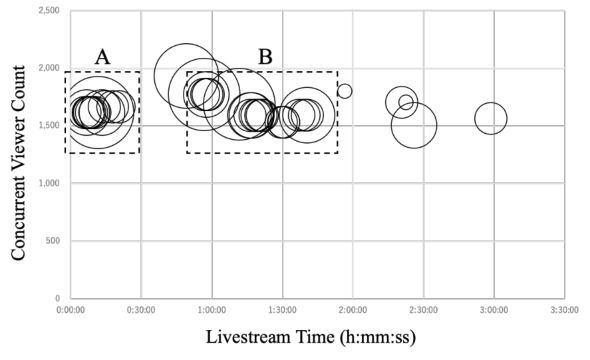
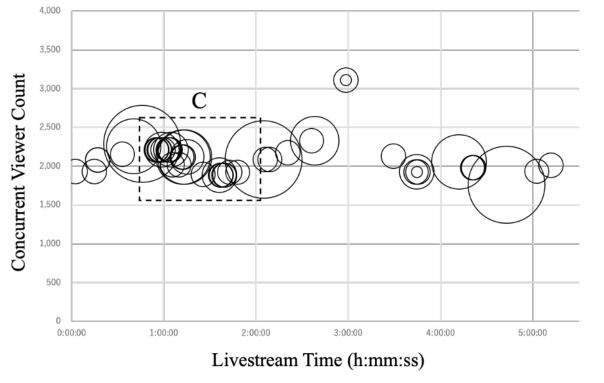
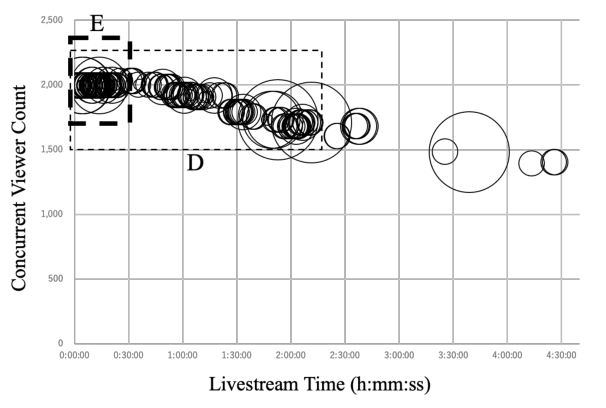
The bubble charts for Streams A, B, and C are shown in Figures 1, 2, and 3. Across all the graphs, the smallest bubble size represents one gift. In Figure 2 (Stream B: IRL) and 3 (Stream C: Game), the maximum size is 50 gifts, with proportional bubbles for 5, 10, and 25 gifts, whereas Figure 2 also includes 20 gifts. In Figure 1 (Stream A: Just Chatting), the maximum size is 25 gifts, with proportional bubbles corresponding to 5, 10, 15, and 20 gifts. As Twitch subscription gifts cost US$5 per unit, a single subscription gift on these three streams would have resulted in a PWYW donation ranging from US$5 to US$250.
In each chart, the sections where “donation bursts” occurred are labeled Section A, B, C, D, and E.
From the bubble charts for these three genres, the following were revealed.
1) The bubble charts, which plot subscription gift counts along the livestream timeline, show when, at what scale, and how frequently subscription gifting occurred in each of the three genres, allowing us to identify the sections in which “donation bursts” occurred. 2) In the analyzed streams, the scale and timing of subscription gifting
were similar for ‘Just Chatting’ and ‘IRL’ but differed markedly for ‘Game.’ In ‘Game,’ donation bursts persisted over a considerably longer period, and intense bursts occurred within short time windows. 3) Concurrent viewer counts, plotted on the vertical axis, remained largely stable throughout the broadcasts in ‘Just Chatting’ and ‘IRL.’ However, in ‘Game,’ they declined by approximately 30% from the start to the end of the stream.
Analysis of Each “Donation Burst” Section Using an LLM The following are summaries of Streamer A’s voice in each section generated by the LLM.
Section A: Streamer A paid for physical gifts (flowers and others) that were never delivered and consulted viewers about whether to file a complaint. In response, viewers sent a large number of subscription gifts, and the chat became highly animated. Section B: Streamer A watched numerous past streams along with viewers, generating considerable excitement.
400 Kunigita Section C: While traveling by car to a location for a thrilling outdoor activity, Streamer A became increasingly nervous and excited as the destination approached, and shared this excitement with viewers. Section D: This stream is a viewer-participation game tournament hosted by Streamer A. Excitement rose and fell with the progress of the games and tournament. Section E: Before the tournament began, awards for the top-ranked participants were announced, and Streamer A’s relative was introduced as a participant, generating considerable excitement.
DISCUSSION AND CONCLUSION In this study, the author visualized PWYW donation behavior on Twitch, where viewers donate to a streamer, using bubble charts. The author identified sections in which “donation bursts” occurred and analyzed the streamer’s voice in those sections using an LLM. The analysis yielded the following findings. Because this study is an exploratory case study of three streams from a single streamer, these findings should be interpreted as suggestive rather than generalizable.
1. Sections A and C suggest that “donation bursts” occur when viewers strongly wish to support a streamer who is in trouble or in suspense. 2. Sections B and D suggest that “donation bursts” also occur when both
the streamer and the viewers are thoroughly enjoying the stream. 3. Section E suggests that “donation bursts” also occur when the streamer offers an incentive to viewers, eliciting strong positive responses. 4. ‘Just Chatting’ and ‘IRL’ streams consist primarily of conversation and
actions with limited narrative structure, making their developments difficult to predict. Therefore, viewers may remain attentive in anticipation of what happens next, which may explain why concurrent viewer counts did not change substantially during these streams. In contrast, ‘Game’ streams, including tournaments, have a more discernible narrative structure, and viewers may stop watching once the outcome becomes foreseeable, which could explain the decline in concurrent viewer counts.
This study was limited to three streams across three genres from a single high-profile streamer on one platform; thus, the findings are exploratory and may not generalize to other streamers, languages, or platforms. In addition, the LLM-generated summaries were verified only by the author, and independent coding by multiple coders is a subject for future work. Accordingly, analyses of multiple streams within each genre, across a wide range of genres, and across multiple streamers are warranted. The findings should be examined more deeply using theoretical frameworks, such as the Uses and Gratifications Theory, as employed in prior studies. Future research will continue to analyze PWYW donation behavior in live-streaming services using bubble charts and LLMs.
REFERENCES
Hämäläinen, M., Rueter, J., & Alnajjar, K. (2024). Analyzing Pokémon and Mario Streamers’ Twitch Chat with LLM-based User Embeddings. Proceedings of the 4th International Conference on Natural Language Processing for Digital Humanities. Hilvert-Bruce, Z., Neill, J. T., Sjöblom, M., & Hamari, J. (2018). Social motivations
of live-streaming viewer engagement on Twitch. Computers in Human Behavior. Huang, K., Lin, Y., & Lou, X. (2023). Exploring Purchase Preferences of Chinese Gen Z Fans for Human and Virtual Idols on TikTok. Proceedings of the 2nd International Conference on Interdisciplinary Humanities and Communication Studies. lay295. (2025). TwitchDownloader. Retrieved September 17, 2025, from
TwitchDownloader: https://github.com/lay295/TwitchDownloader Twitch. (2026). Twitch.tv. Retrieved September 1, 10 and 18, 2026, from https:// www.twitch.tv. TwitchTracker. (2026). Twitch Subs Count & Stats. Retrieved September 1, 10 and
18, 2026, from TwitchTracker: https://twitchtracker.com Yao, D., Lu, S., & Chen, X. (2024). Crowding-Out in Content Monetization Under Pay What You Want: Evidence From Live Streaming. Production and Operations Management.
SEARCH THE AHFE DIGITAL BOOKSTORE BY ISBN
Explore the complete digital volume
Human Factors in Design, Engineering, and Computing
Read this individual research paper free through the original publisher, or explore the full digital proceedings book.