Valeria Minucciani, Gabriella Dalla Serra (2026). Rethinking Inclusivity in Dissonant Heritage. In: Human Factors in Design, Engineering, and Computing. AHFE Open Access, vol. 238, pp. 601–610. https://doi.org/10.54941/ahfe1008292
Nowadays, approaches to cultural heritage increasingly promote objectives of inclusivity, participation and accessibility. Yet can heritage interpretation and enhancement processes truly be considered inclusive if certain memories and narratives remain marginalised or excluded?The paper follows a progressive line of inquiry, moving from questioning inclusivity as applied to heritage, to analysing how this concept may be redefined when dealing with dissonant heritage and finally examining selected case studies illustrating how such a reframed understanding may become operational.Cultural dissonance originates from the selective nature of heritagisation, through which certain cultural expressions are assigned the status of heritage. It arises when heritagisation encounters dramatic memories, contested values and conflicting narratives, which challenge traditional practice with heritage.Thus a paradox emerges: while the “Design For All” is generally geared towards conflict resolution, in dissonant heritage contexts inclusivity may instead be achieved by making conflict visible. Interpretative tensions should therefore not be removed but revealed to foster constructive dialogue.Yet making conflict visible also means acknowledging the existence of silenced memories and marginalised narratives, thus challenging the assumption that heritage interpretation and enhancement are inherently inclusive processes. On the contrary, they reflect social and political power structures, therefore making inclusivity both a technical and political issue.In conclusion, the paper argues that inclusivity in dissonant heritage should not be understood as the resolution of interpretative conflict, but rather as its recognition. It should depend less on achieving consensus than on critically engaging with disagreement: revealing rather than hiding, provoking rather than appeasing.
Contemporary societies are increasingly confronted with new complex and interconnected challenges, including widening social inequality, limited intergenerational and intercultural communication and unsustainable models of development. Within this context, inclusivity has emerged not only as a fundamental societal concern but also as a crucial strategy for effectively addressing these challenges and ensuring that all individuals can participate equitably in social, cultural and civic life.
In line with this perspective, the ‘Design for All’ (DfA) has become one of the most influential frameworks for promoting inclusivity.
602 Minucciani and Serra Accordingly, by recognising and valuing human diversity rather than designing for a hypothetical ‘standard’ user, approaches to cultural heritage should as well promote inclusive and holistic design strategies to ensure equal access and participation.
Yet can heritage truly be considered inclusive if certain narratives continue to be marginalised throughout the heritagisation process? Can it be regarded as actually respectful of diversity if specific memories are deliberately removed from the collective imaginary or if identities and values of some groups or minorities remain insufficiently recognised and legitimised? These questions become particularly significant when dealing with heritage associated with dramatic events, controversial ideologies or historically marginalised communities. In such contexts, cultural dissonance exposes the limitations of conventional understanding of inclusivity and a paradox emerges: while the traditional ‘Design For All’ approach is generally geared towards conflict resolution by removing barriers, mitigating exclusion and fostering social cohesion, in dissonant heritage sites inclusivity may, on the contrary, be achieved by making conflict visible. Whenever heritage embodies competing memories, contested interpretations and conflicting values, interpretative – and selective – tensions inevitably arise, therefore, inclusive design can no longer aim to simply remove these tensions; rather, it must recognise, expose and harness them as opportunities for critical reflection, constructive dialogue and democratic engagement. Approaching dissonant sites consequently requires a deep reconsideration of the notion of inclusivity itself through the lens of dissonance: inclusive no longer means merely ensuring access or participation, but also “including different perspectives” and “acknowledging the difference between those perspectives” (Van Assche and Duineveld, 2013).
Building upon these premises, the paper follows a progressive line of inquiry. It first recalls and examines the founding notions of inclusivity, heritage and heritagisation in order to question the assumption that heritage creation, interpretation and enhancement processes are inherently inclusive. It then introduces the theory of heritage dissonance together with the broader framework of Critical Heritage Studies, demonstrating how inclusivity must be redefined when dealing with contested heritage. Finally, it discusses a series of selected case studies that illustrate how such a reframed understanding can be translated into design practices that operate at various scales – artistic, architectural and urban – in order to harness the latent educational value of dissonant sites. Rather than proposing a catalogue of exemplary projects or an exhaustive overview of existing practices, the selected case studies serve to demonstrate the wide range of possible approaches through which design can deal with heritage dissonance.
Ultimately, this paper argues that dissonant heritage requires a shift from an understanding of inclusivity as conflict resolution to an understanding of inclusivity as conflict recognition and critical engagement with it. Such an approach may therefore unlock the educational, cultural and social potential that characterises all cultural heritage—that becomes even more significant in presence of dissonance—and may as well open even broader horizons for application and improvement of DfA principles.
REFRAIMING INCLUSIVITY WHEN DEALING WITH DISSONANT HERITAGE As previously discussed, inclusivity has become a fundamental concern in contemporary society, increasingly shaping public policies, design practices and institutional agendas.
It is now necessary to introduce the concept of heritagisation, defined as the “social and cultural process of selecting certain cultural expressions (an object, a space, a practice) to which communities, groups or individuals assign a value distinct from their original one […]: through heritage designation, the quality and status of heritage are conferred, serving to justify the legitimacy of measures for protection, support and management, and the legitimacy of imposing restrictions, regulated at various levels and by different authorities” (Tamma, 2015). This definition highlights that the value attributed to a particular trace of the past is not objective, rather it inevitably depends on the historical, social and cultural context in which such an assignment takes place. Consequently, neither the attribution of meanings nor the designation of heritage itself can ever be considered universal or objective.
From this perspective, heritagisation extends far beyond the mere preservation or promotion of cultural assets as it constitutes a delicate social dynamic through which both tangible and intangible elements are transformed into symbols invested with cultural, social and political significance (Epasto, 2025). Such a process inevitably entails acts of selection to determine which memories, narratives and traces can be recognised and legitimised as heritage. This, therefore, inevitably reflects the specific context within it is produced and consequently bears its specific social, cultural and political values. As Waterton and Smith observe, heritage “only emerges when something is narrated, defined, and/or treated as heritage in the ‘right’ sociocultural context” (Waterton and Smith, 2009a). Its significance lies not in the past itself but rather in the present, not in those who have left a legacy, but in the heirs who have chosen what to inherit (Davallon, 2002).
Heritagisation can thus be intended as a “process of meaning-making influenced by the present” (Smith, 2006). This perspective inevitably rises a series of critical questions: which and whose narratives were selected? Which interests do they represent? Within which social, political and cultural context? It is precisely the spatial and temporal specificity of heritage, by virtue of the possibility of constantly altering its value and narrative, that transforms it into a potential space of contestation. And such an interpretative and selective nature can ultimately be identified as the intrinsic dissonance common to all cultural heritage, insofar as it is potentially subject to constant negotiation and reinterpretation of meanings, therefore becoming a potential source of conflict and controversy.
From this understanding of heritage as a socially constructed and continuously negotiated process emerges the theory of dissonant heritage, as the dissonance evokes tension, instability and irregularity. The application of this concept into heritage studies was introduced by Tunbridge and Ashworth to describe the tensions generated by heritage associated with difficult, traumatic or controversial pasts. On the one hand, the notion conveys the sense of discrepancy and unease that ‘dramatic’ or ‘negative’ heritage may
604 Minucciani and Serra provoke in certain users; on the other implement a reconciliation, by learning from the past and aiming to achieve a new balance.
Although initially associated with sites bearing witness to traumatic events, the concept of heritage dissonance has progressively evolved into a broader interpretative framework. No longer recognised as an exceptional condition affecting only ‘negative’ heritage, it becomes an intrinsic and universal characteristic of all cultural heritage. Cultural dissonance “should not only be understood as a culmination of divergent views or as an open conflict over the meanings of heritage but conceived in relation to the ever-changing values attached to heritage both in time and within and across communities” (Ashworth and Tunbridge, 1996).
Such an understanding directly follows from the selective and interpretative nature of heritage: the creation of any cultural heritage may potentially fail to recognise or actively exclude those who do not share, or are not included in, the meanings associated with that heritage. Likewise, since the values attributed to heritage are historically and culturally contingent, they may continuously be altered if reinterpreted in different times, scales and places (Ashworth et al., 2007). Consequently, the same heritage may undergo successive renegotiations of meaning across different temporal, spatial and cultural contexts, inevitably generating dissonance and tensions among individuals and communities that attribute different values, memories and identities to the same place, object or practice; in this sense, any approach or process of interpretation of heritage has the potential to generate dissonance, precisely because it legitimises one particular interpretation of it, thereby excluding the other alterative ones (Waterton and Smith, 2009b).
The work of Tunbridge and Ashworth marked the beginning of an extensive body of research which investigates how different communities forge, maintain and negotiate their identities and their heritage. Increasing attention has consequently been devoted to the ways in which dominant narratives on heritage are imposed and legitimised, often resulting in the marginalisation of alternative memories and interpretations. However, such narratives are increasingly being challenged by the growing recognition of plurality of community experiences and claims to identity.
These reflections laid the foundations for the emergence of ‘Critical Heritage Studies’, a field that aims to move beyond an object-centred understanding and deconstruct dominant interpretations of cultural heritage, by instead emphasising its discursive, processual, relational and performative dimensions (Hamm, 2019).
DISSONANT HERITAGE INCLUSIVITY PARADOX As previously discussed, the traditional DfA approach to cultural heritage is primarily oriented towards mitigating exclusion and ultimately resolving conflict. Within this framework, making heritage inclusive generally entails improving accessibility, removing physical and social barriers, reversing exclusionary dynamics and promoting integration and equality.
When dealing with dissonant heritage, however, this logic is fundamentally challenged. Inclusivity may no longer be achieved by resolving conflict or eliminating inherent tensions but, on the contrary,
Rethinking Inclusivity in Dissonant Heritage 605 by deliberately making them visible. This constitutes the central paradox of inclusivity in dissonant heritage: both the concept of inclusivity itself and the design practices through which it is pursued require critical reconsideration, as dissonant heritage demands approaches that often appear to contradict the traditional principles of Design for All. This paradox is increasingly reflected in contemporary heritage research, where the concept of dissonance as a problem to be resolved has been superseded by its consideration as a resource capable of generating dialogue, critical reflection and social learning.
Dissonance ceases to represent a problematic condition of heritage and instead “can function as a form of resistance to hegemonic discourses and become a prerequisite for the construction of pluralistic and multicultural societies based on inclusivity, understanding and acceptance” (Kisić, 2016). Rather than being understood exclusively as a manifestation of violence or historical trauma, dissonance possesses a significant “latent potential” (Kisić, 2016) that can be activated to stimulate change whenever established narratives are questioned by alterative interpretations. Its educational value lies in its capacity to provoke reflection, promote discussion and foster continuous renegotiation of heritage meanings.
The paradox of inclusivity can thus be reformulated as follows: because heritage is intrinsically selective and interpretative, dissonance inevitably generates tensions concerning representation and inclusion. Consequently, inclusive design cannot simply aim to remove these tensions, as they are precisely what should be acknowledged and made visible in order to stimulate dialogue, social learning and democratic exchange. In dissonant heritage contexts, inclusivity should therefore seek not to hide but to reveal, not to appease but to provoke.
This perspective becomes even more significant when dissonance resides not in tangible heritage assets but rather in its intangible meanings, memories and interpretations constantly recreated by communities and groups in response to their environment, their interaction with nature and their history, and gives them a sense of identity and continuity, thereby promoting respect for cultural diversity and human creativity (UNESCO, 2003).
HERITAGISATION PROCESSES AS EVIDENCE OF THE LIMITS OF INCLUSIVITY IN HERITAGE It has so far been argued that applying the principles of inclusivity to dissonant heritage gives rise to a fundamental paradox, since inclusivity in presence of dissonance depends more on revealing conflict and critically engaging with it then on appeasing it. Rather than resolving the tensions embedded within heritage, inclusive approaches should therefore reveal them and harness them as fruitful opportunities for dialogue, reflection and growth.
Yet making the interpretative conflict around a cultural asset visible also entails acknowledging the existence of silenced memories, alternative narratives and marginalised interpretations linked to that very heritage. And if this conflict stems precisely from dynamics of exclusion within heritagisation, then the assumption that the processes of creating and interpreting heritage are inclusive must itself be questioned.
606 Minucciani and Serra On the contrary, heritage-making is never a neutral process as it inherently involves acts of selections, legitimizations and exclusions that inevitably reflect specific social, cultural and political power structures. As discussed in the previous paragraphs, heritage cannot be understood independently from the historical, political and cultural context that has assigned to it a certain value and, consequently, its status as heritage.
The understanding of heritage as a social construct shaped by current political, economic and social interests directly corresponds to its intrinsic dissonance. If heritage is continuously read and interpreted by different actors, at different historical moments and through changing systems of values, then it remains inherently open to negotiation and contestation. It is potentially “subject to constant revision and modification” thus becoming “both a source of and a reflection of social conflict” (Ashworth et al., 2007). Consequently, heritage must inevitably engage with the ethical dimension, which requires recognising the legitimacy of multiple and often competing interpretations advanced by different communities and successive generations.
Building upon these premises, inclusivity can no longer be regarded only as a technical or social issue, but it also must be understood as an inherently political one. The process of heritagisation and the resulting selection of cultural heritage are never neutral but rather powerful mechanisms used for constructing and legitimising specific narratives, collective identities and sets of values. Consequently, questioning inclusivity in heritage ultimately means questioning the power relations that determine whose memories are preserved, whose identities are recognised and whose voices are ignored.
This raises a broader question that is central to this paper: is cultural heritage truly capable of strengthening collective identity and social cohesion, or is it simultaneously a source of conflict whenever it reinforces a clear-cut distinction between ‘us’ and ‘them’? In other words, can heritage “be, paradoxically, a tool of social fragmentation as well as of cohesion” (Ashworth et al., 2007)? And ultimately, can heritage ever be inclusive if the very process through which it is created is inherently selective?
OPERATIONALISING INCLUSIVITY IN DISSONANT HERITAGE: CASE STUDIES This theoretical discussion is complemented by the analysis of three selected case studies, illustrating how the reframed understanding of inclusivity proposed throughout this paper can be translated into design practice. Collectively, the three case studies illustrate three complementary ways of operationalising inclusivity in dissonant heritage: reinterpreting a dominant narrative, revealing an invisible narrative and embedding a forgotten narrative into everyday life. A the same time, operating at different scales – object, architecture and urban space.
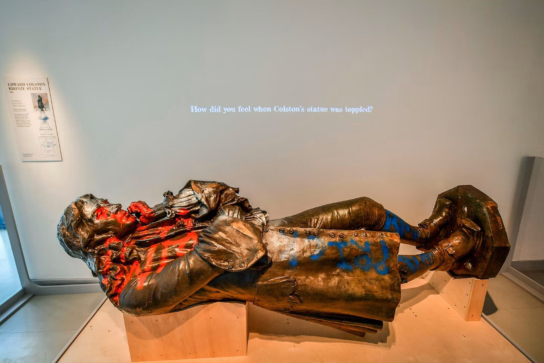
At the scale of the individual artefact, the recent history of Edward Colston’s statue in Bristol represents one of the most significant examples of an inclusive approach to dissonant heritage. The monument was erected in 1895 to celebrate Colston as one of Bristol’s greatest benefactors. After discovering the Colston’s central role in the transatlantic slave trade, on
Rethinking Inclusivity in Dissonant Heritage 607 7 June 2020 the statue was pulled down, vandalised and thrown into Bristol Harbour, becoming an international symbol of the conflict surrounding public memory.
Rather than restoring the monument to its former position or removing it entirely, Bristol City Council initiated a participatory process involving the local community. Today, the statue is exhibited horizontally, still covered with the graffiti left during the protests and surrounded by protest placards collected immediately after the event. To avoid any form of glorification of the artifact, it has been placed in a corner of the Protest Gallery, shielded from immediate view when entering the room. This location – together with a trigger warning near the entrance - also allows visitors who do not desire to see the statue to avoid it.
Far from attempting to erase the conflict, the museum deliberately preserves it. The occasion fosters constructive discussion about slavery and racial injustice: in this sense, a more inclusive reinterpretation of its meaning is proposed,
Figure 1: Vandalised statue of Edward Colston on display (from The Washington Post, 2021).
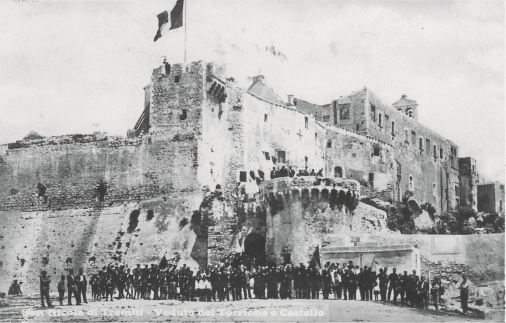
At the architectural scale, a particularly significant example is provided by the fortified abbey complex on San Nicola Island, in the Tremiti archipelago (Foggia, Italy). Today the site is primarily interpreted and enhanced as a remarkable monastic and defensive complex, bearing witness to its religious function throughout the centuries. However, this dominant narrative conceals another equally significant chapter of the island’s history: by virtue of its isolated location in the Adriatic Sea, San Nicola has been repeatedly used as a penal colony. This contested – and alternative – narrative did not find adequate recognition in local policies of enhancement and narration of the island’s heritage so far.
Unlike many dissonant heritage sites, this controversial past has left almost no visible material traces, since imprisonment relied largely on the adaptive reuse of the existing monastic buildings. The dissonance therefore resides primarily within the island’s intangible heritage, surviving through letters,
608 Minucciani and Serra judicial records, autobiographical accounts and family memories rather than through its architecture.
Figure 2: Fascist rally in front of the castle’s entrance gate in 1930. The prisoners watched the event from the Angevin Tower, Section D of the prison. (from Tremiti Islands Municipal Library).
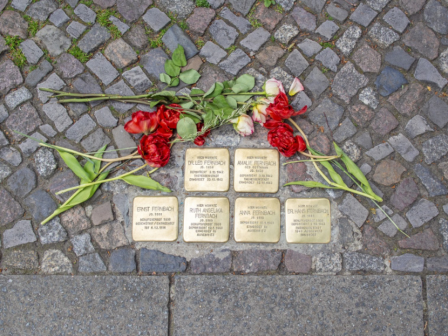
At the urban scale, one of the most influential examples is represented by the ‘Stolpersteine’ (‘stumbling stones’), conceived by the German artist Gunter Demnig. These small brass plaques are embedded in the pavement outside the former homes of victims of Nazi persecution and record their names, dates of birth, deportation and death. Since their introduction, more than 115,000 Stolpersteine have been installed across approximately 2,000 European cities.
Rather than imposing memory through visible and impactful architecture, they introduce traumatic memories into everyday urban life through minimal and widely dispersed interventions. Their educational power depends upon voluntary engagement: pedestrians may choose to ignore the plaques.
Figure 3: Stolpersteine in Berlin (from VisitBerlin.de).
Rethinking Inclusivity in Dissonant Heritage 609 The project therefore turns remembrance into an active and personal experience, where memory is activated through the simple act of walking— or, metaphorically, of stumbling—which invites passers-by to pause, reflect and, if they wish, further explore the stories behind each plaque. The Stolpersteine therefore create opportunities for individual reflection while simultaneously restoring visibility to countless lives, whose testimonies have been erased from history. In doing so, they exemplify how inclusivity in dissonant heritage may consist not in resolving conflict but in ensuring that marginalised memories continue to occupy a legitimate place within the shared urban landscape.
CONCLUSIONS
Rather than providing an exhaustive overview of inclusivity in dissonant heritage or a comprehensive review of existing design practices, this paper seeks to contribute to an ongoing debate by proposing a reframing of the understanding of inclusivity when dealing with contested heritage. The brief discussion presented here, together with the selected case studies, is therefore intended not to offer definitive answers but to open new perspectives for both research and design practice.
The paper has argued that, in dissonant heritage contexts, inclusivity cannot simply ensure universal accessibility or participation but rather it requires acknowledging and legitimising the plurality of—potentially even conflicting—memories, meanings and interpretations around the same heritage. From this perspective, an inclusive approach should not evaluate only users’ positive reactions as indicators of successful heritage activation. On the contrary, disagreement, discomfort and even conflict – the ‘negative’ reactions to heritage - may themselves constitute meaningful and constructive outcomes, insofar as they stimulate critical reflection, dialogue and social learning.
This discussion also points towards a broader issue that extends beyond the scope of the present paper: the right to interpret heritage. There is nowadays a certain widespread yet latent sense among ordinary people of being detached from cultural heritage, as they have little opportunity to actively participate in choosing and defining its meanings. Moreover, selecting heritage inevitably also means selecting history, thereby legitimising certain narratives while overlooking or silencing others. Within this context, inclusivity should also seek to promote forms of co-creation that enable individuals and communities not only to access and experience heritage, but also to actively participate in its interpretation, construction and continual reinterpretation.
Ultimately, the educational potential of cultural heritage may find one of its most fertile spaces precisely in dissonance. Rather than suppressing conflict in pursuit of consensus, dissonant heritage fosters critical engagement with competing memories, uncomfortable histories and alternative perspectives. In such contexts, inclusivity may depend less on achieving agreement than on creating legitimate spaces for disagreement.
REFERENCES
Ashworth, Gregory J., Graham, Brian, Tunbridge, John E. (2007). Pluralising Pasts.
Heritage, Identity and Place in Multicultural Societies. London: Pluto Press. Battilani, Patrizia. (2017). “It’s easy to say cultural heritage. Problems and prospects of a century of cultural heritage”. in: History and Future. Journal of Contemporary History and Historiography Online, 45. Cambridge University Press. (n.d.). Cambridge Dictionary. Davallon, Jean. (2002). “How is heritage created?”. Humanities and Social Sciences, 36. Dolff-Bonekämper, Gabi. (2004). “Cultural Heritage and Conflict: The View from
Europe”. in: Museum International, 56(1–2). Epasto, Simona. (2025). “European heritage: between conservation, preservation, and the contestation of territorial power structures”, in: Geography and Heritage, Benetti, Silvia, Cerutti, Silvia, Pettenati, Giacomo (Eds.). Florence: Geographical Studies Society. Hamm, Marion. (2019). “Making Heritage Contentious. On the Productivity of
Conflict Dissonances”, in: Dissonant Heritages and Memories in Contemporary Europe, Lähdesmäki, Tuuli, Čeginskas, Viktorija L., Kaasik-Krogerus, Sigrid, Mäkinen, Katja (Eds.). Cham: Palgrave Macmillan. Kisić, Višnja. (2016). Governing Heritage Dissonance. Promises and Realities of Selected Cultural Policies. Belgrade: Center for Museology and Heritology, University of Belgrade. Smith, Laurajane. (2006). Uses of Heritage. London: Routledge. Smith, Laurajane, Waterton, Emma. (2009b). “The Envy of the World? Intangible
Heritage in England”, in: Intangible Heritage, Smith, Laurajane, Akagawa, Nobuko (Eds.). London/New York: Routledge. Tamma, Michele. (2015). “Cultural rights, patrimonialization, sustainability”, in: Citizens of Europe. Culture and Rights, Zagato, Lauso, Vecco, Marilena (Eds.). Venice: Edizioni Ca’ Foscari. Tunbridge, John E., Ashworth, Gregory J. (1996). Dissonant Heritage: The
Management of the Past as a Resource in Conflict. Chichester: Wiley. UNESCO. (1972). Convention Concerning the Protection of the World Cultural and Natural Heritage. Paris: UNESCO. UNESCO. (2003). Convention for the Safeguarding of the Intangible Cultural
Heritage. Paris: UNESCO. Van Assche, Kristof, Duineveld, Martijn. (2013). “The Good, the Bad and the Self-Referential: Heritage Planning and the Productivity of Difference”. in: International Journal of Heritage Studies, 19(1). Waterton, Emma, Smith, Laurajane. (2009a). “There Is No Such Thing as Heritage”,
in: Taking Archaeology out of Heritage. Newcastle upon Tyne: Cambridge Scholars Publishing.
SEARCH THE AHFE DIGITAL BOOKSTORE BY ISBN
Explore the complete digital volume
Human Factors in Design, Engineering, and Computing
Read this individual research paper free through the original publisher, or explore the full digital proceedings book.