Shin’ichi Fukuzumi (2026). Stakeholder Requirements for Quality-in-Use. In: Human Factors in Design, Engineering, and Computing. AHFE Open Access, vol. 238, pp. 751–755. https://doi.org/10.54941/ahfe1008307
When considering the measurement of quality in use, it is necessary to confirm the meaning of the sub-sub-characteristics "impact of use by stakeholder'' (ISO/IEC25019) defined for each quality characteristics/ sub-characteristic, and to clarify for each quality characteristic what each stakeholder expects from the target when the operator uses the target. In this paper, we proposed that it is appropriate to classify quality sub-sub characteristics and to define measurement quantities for what the target, result, organization, and society require. As a result, it was extracted that "what each stakeholder expects from the target product" are “What is requirements for the object to be used”, “What is requirements for the results used”, “What is requirements by organizations”, “Things to appeal to”, “Impact on public/society” and “Social acceptance”
Quality-in-use is defined as extent to which the system or product, when it is used in a specified context of use, satisfies or exceeds stakeholders’ needs to achieve specified beneficial goals or outcomes (ISO/IEC 25019, 2023), Quality- in-use model in ISO25019 is structured by three quality characteristics, they are, “Beneficialness”, “Freedom from risk” and “acceptability”. However, they are not independent each other. Because “Beneficialness” and “Freedom from risk” are also included in an influence on public and society which is one of stakeholders dealt with in this standard. From this, When considering the measurement of quality in use, it is necessary to confirm the meaning of the sub-sub-characteristics “impact of use by each stakeholder” (ISO/IEC 25019, 2023) defined for each quality characteristic/sub-characteristic, and to clarify for each quality characteristic what each stakeholder expects from the target when the operator “uses” the target.
This paper outlines what each stakeholder expects from the subject, focuses specifically on social acceptability, and proposes the requirements necessary for measuring quality in use.
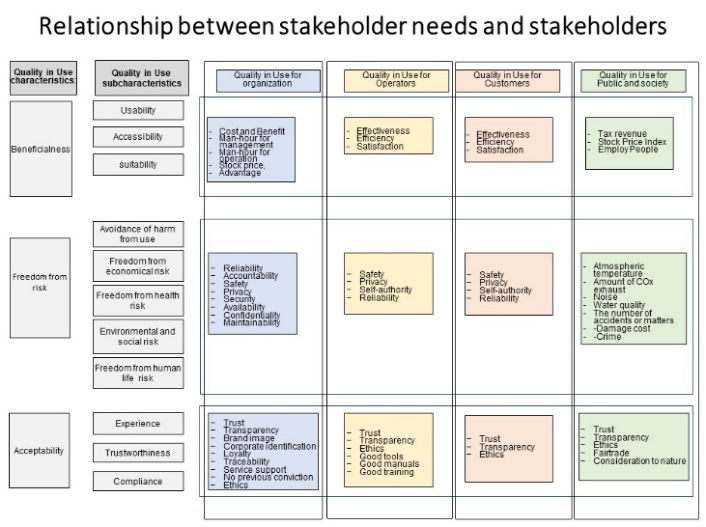
THE MEANING AND CLASSIFICATION OF SUB-SUB-CHARACTERISTICS As mentioned above, in ISO/IEC 25019, sub-sub-characteristics are indicated as “impacts of use by each stakeholder”. Figure 1 shows the quality
752 Fukuzumi characteristics and the influence on the use by each stakeholder. However, at present, only sub-sub-characteristic items are listed, and it is not clearly indicated what each stakeholder requires to the target. In the next section, we will consider the stakeholders’ needs and apply them.
Figure 1: Quality characteristics and the influence on the use by each stakeholder ISO/IEC 25019, 2023).
Operator A stakeholder as an “operator” is the direct user who interacts with the object. Consequently, the benefits for the operator -as evidenced by the sub-characteristics- are usability and accessibility themselves; furthermore, efficiency, effectiveness and satisfaction which are the sub-sub-characteristics of the sub-characteristics are regarded within the concept of usability as outcomes of use (ISO9241-11, 2018), representing what is sought from the product, system, or service when utilizing it.
Safety also refers to reliability and safety/security when used by operators, and these are also “requirements for products, systems, and services’” when using the target. Similarly, acceptability for the operator includes trust/ confidence and ethical considerations, such as whether it is safe to use, as well as tools, manuals, and education that should be provided when actually using the product, so it can be seen that these are also “requirements of the product, system, and service” when using the target. From the above, the meaning of sub-sub-characteristics for the operator is “what is requirements for the object to be used”.
Stakeholder Requirements for Quality-in-Use 753 Customer
A stakeholder as a “customer” is a standpoint to use the results of direct user manipulating of the target. Therefore, the meaning of sub-sub-characteristics is almost the same as shown in 2-1, but instead of asking for the product, system, or service itself, it is required for its output, in other words, it is ``required for the results of the product, system, or service used by the operator.’’
Responsible Organization For “organizations responsible for use,” it is important to meet 2-1 and 2-2 and ensure that the organization can achieve its goals by using the target. Therefore, the benefits are directly linked to profits, such as reduced man-hours, increased profits, and increased stock prices. These are the contents that the organization wants to achieve by using (introducing as an organization) the target product, system, or service, in other words, “what the organization wants as a result of using it”. Regarding safety, it also refers to things that an organization must protect, such as trust, safety, security, and confidentiality, in other words, “what the organization expects as a result of its use.” Regarding acceptability, it is the content that we want to achieve by using objects such as credibility as an organization and brand image, and the content that we must bear at the same time. In other words, it can be expressed as “the ability of an organization to appeal to the outside world what has been obtained as a result of its use”.
Public and Society The stakeholder “Public/Society” shows the impact on the public and society when the target product, system, or service is used. In other words, the impact from the perspective of benefits is population growth due to tax revenue and an increase in the number of employees. Impacts from a safety perspective include the environment and community safety, both of which are “effects caused by the results of use”. Regarding acceptability, it is not the impact, but rather the things that are ultimately required for technology to be accepted by society, such as reliability, ethics, and environmental compatibility. For this reason, the third quality characteristic is “acceptance” by each stakeholder, and it is best to refer to the acceptability in public and society as “social acceptability”.
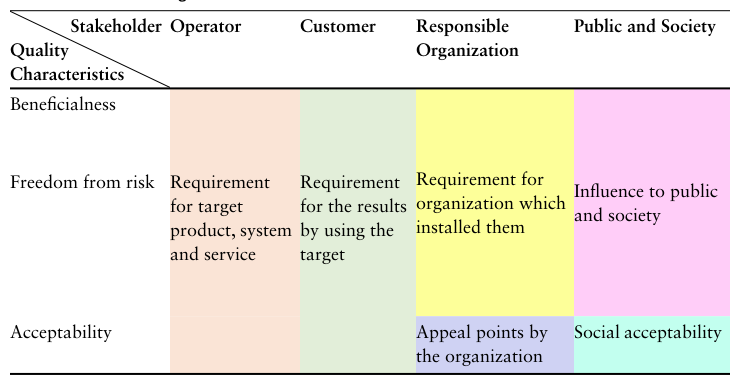
TOWARD THE MEASUREMENT OF QUALITY-IN-USE To measure the quality during use, it is necessary to calculate the measured amount of the sub-sub-characteristics, and for this purpose, it is necessary to convert the sub-characteristics into functions using the sub-characteristics as variables. However, as shown in Table 1, although the operator, customer, and organization are expressed in the same “requirement,” the layers are different. In the case of organizations, it also includes “what can be appealed to.” In addition, in public and society, it shows what society wants in terms of the ``influence’’ of using it and the ``social acceptance’’ of organizations.
754 Fukuzumi In this way, since the meaning of sub-sub characteristics is not necessarily the same for each stakeholder, it is necessary to convert the sub-characteristics into functions for each stakeholder. In addition, since each sub-characteristic is just a representative example, as summarized in Table 2, when using “products, systems, and services”, it is appropriate to define measurement shown below
What is requirements for the object to be used
What is requirements for the results used
What is requirements by organizations
Things to appeal to
Impact on public/society
Social acceptance Especially, trustworthiness is important for social acceptability.
Table 2: The meanings of sub-sub-characteristics for each stakeholder.
These characteristics include accountability, accuracy, authenticity, availability, controllability, information security, integrity, privacy, quality, reliability, resilience, robustness, safety, security, transparency, and usability.
These include items related to benefits and safety, so it is important to define the measured quantities using variables that include accountability, accuracy, authenticity, availability, controllability, transparency, and even explainability, which are considered necessary for acceptability(ISO22989, 2022).
Figure 1 shows that trustworthiness is a part of acceptability, and the sub-sub-characteristics of acceptability also include the characteristics of trustworthiness listed above. Furthermore, since these differ depending on the stakeholder, in order to measure social acceptability, it can be said that accountability, which is the characteristics of trustworthiness excluding items included in other requirements, and items that include transparency and ethics, which are common to the sub-sub-characteristics, are important. Of course, compliance, which is listed as a quality sub-characteristic of
Stakeholder Requirements for Quality-in-Use 755 acceptability in Table 1, is the minimum that must be observed, and it is also important to consider the experiences that each stakeholder has had so far.
CONCLUSION
This paper outlines “what each stakeholder expects from the target product,” focusing particularly on social acceptability, and examining the necessary requirements for measuring quality during use. As a result, it was extracted that “what each stakeholder expects from the target product” is:
What is requirements for the object to be used
What is requirements for the results used
What is requirements by organizations
Things to appeal to
Impact on public/society
Social acceptance Furthermore, it was shown that accountability, transparency, ethics, compliance, and experience are necessary requirements for measuring quality during use. As future works, we will propose quantification and functionalization for specific measurements.
REFERENCES
Booher, H.R., Minninger, J. (2003) “Human systems integration in army systems acquisition”, in: Handbook of human systems integration, Booher, Harold (Ed.). pp. 663–698. ISO 9241-11 (2018): Ergonomics of human-system interaction-Part 11: Usability:
Definitions and concepts ISO/IEC 25019 (2023): Systems and software engineering — Systems and software Quality Requirements and Evaluation (SQuaRE) — Quality-in-use model. ISO/IEC 22989:2022 Information technology — Artificial intelligence — Artificial
intelligence concepts and terminology.
SEARCH THE AHFE DIGITAL BOOKSTORE BY ISBN
Explore the complete digital volume
Human Factors in Design, Engineering, and Computing
Read this individual research paper free through the original publisher, or explore the full digital proceedings book.