Tia Bajaj, Madhusudan Vijayakumar, Rajeev Ramprasad (2026). From Heuristics to Evidence: A Comparative Usability Evaluation and Design Implications for Space Mission Planning Tools. In: Human Factors in Design, Engineering, and Computing. AHFE Open Access, vol. 238, pp. 877–887. https://doi.org/10.54941/ahfe1008319
Space mission planning tools have evolved to support increasingly complex analytical tasks, yet their interfaces often impose steep learning curves and usability barriers for students, engineers with varying levels of expertise, and users with diverse cognitive and sensory needs. Previous research addressed these challenges by developing a human-centered framework consisting of aerospace-specific accessibility heuristics, an architecture ruleset, and interface design guidelines grounded in Universal Design for Learning (UDL) combined with Nielsen's usability heuristics. Building on this foundation, this paper presents the implementation and formative comparative usability evaluation of TARA (Toolkit for Astrodynamics Research and Application), a web-based mission planning platform designed to incorporate these principles into practical engineering workflows. A within-subjects evaluation was conducted by performing representative mission planning tasks using both TARA and NASA's General Mission Analysis Tool (GMAT). Task completion outcomes, execution times, usability ratings, and qualitative feedback were collected to assess workflow efficiency, perceived ease of use, and user confidence. This study demonstrates a systematic approach to translating usability heuristics into aerospace software design and evaluating their effectiveness through practical user interaction. Results revealed TARA's task-oriented architecture facilitated faster mission planning, while visualization controls and icon discoverability introduced challenges in navigation and interpretation. Participants generally perceived TARA as easier to learn and less complex.
Space mission planning is one of the most technically complex and interdisciplinary problems in aerospace engineering (Bloebaum & McGowan, 2012; Defoort et al., n.d.; Isaji et al., 2022; Ross, 2003). Mission designers must balance spacecraft design, trajectory optimization, and mission requirements while technology constraints keep changing (Englander et al., 2017; Harris
et al., 2024). The work is iterative and relies on repeated trade studies to reach a feasible mission architecture (Ross, 2003; Takubo et al., 2025). Tools such as NASA’s General Mission Analysis Tool (GMAT) (Corbin, 2024), Systems Tool Kit (STK) (Advancing Space Mission Analysis and Design with Simulation, n.d.), and FreeFlyer (Engineering Services and Products for Space Missions, n.d.) support this work with strong analytical capability. Despite their analytical capabilities, these tools often require technical expertise and familiarity with specialized software interfaces, introducing steep learning curves and usability challenges for students, early-career engineers, and users with diverse needs (Laskey & Keebler, 2023; Mittendorf, n.d.; Moon et al., 2012).
From a human factors perspective, the usability of mission planning tools directly influences how effectively users configure simulations, interpret results, and perform mission trade studies. Usability, defined by ISO 9241-11 as the extent to which specified users achieve specified goals with effectiveness, efficiency, and satisfaction, is therefore an essential consideration in aerospace software development. Complex navigation structures, information-dense interfaces, and limited contextual guidance can increase cognitive load, diverting attention from the engineering analysis itself (“Recognizing and Overcoming Barriers to Participation in STEM,” 2022; Interagency Roadmap to Support Space-Related STEM Education and Workforce, n.d.). Addressing these challenges requires integrating human- centered design principles into the architecture of mission planning tools without compromising their technical capabilities.
Our previous research (Bajaj, Vijayakumar, & Ali, 2025) addressed these challenges by proposing a human-centered design framework with aerospace- specific accessibility heuristics, an architectural ruleset, and interface design guidelines. Grounded in Nielsen’s usability heuristics (CAST, 2024; Nielsen, 1994) and Universal Design for Learning (UDL) principles, the framework emphasized progressive disclosure, multimodal representation, simplified navigation, and reduced visual clutter. While this work established a systematic approach to integrating accessibility and usability principles into aerospace applications, the effectiveness of these guidelines remained to be evaluated through practical user interaction.
Building on this foundation, this research implements the proposed principles in TARA, a web-based mission planning tool. A formative comparative usability study evaluates TARA against industry standard GMAT through representative mission planning tasks. Using a within- subjects experimental design, task completion outcomes, execution times, usability ratings, and qualitative feedback were collected to assess workflow efficiency, perceived ease of use, and user confidence.
This paper makes three contributions: (1) empirical evidence comparing a heuristics-driven mission planning tool with an established tool, (2) a traceable connection between proposed usability heuristics, implemented design, and observed user interactions, and (3) a set of redesign requirements that will drive the next design iteration. Together, these contributions provide a systematic approach to evaluating human-centered design principles in aerospace mission planning tools and identifying opportunities for improving their usability through iterative development.
RESEARCH QUESTIONS The research aims to establish evidence-informed understanding of how human-centered design principles influence mission planning workflows by asking the following research questions:
RQ1: How does TARA compare with GMAT in task completion, execution time, and user independence?
RQ2: How do users perceive the usability, ease of learning, and reliability of TARA compared with GMAT?
RQ3: What usability challenges remain in TARA, and how do they relate to the proposed design heuristics?
RQ4: To what extent do task segmentation, reduced visual clutter, intuitive navigation, and improved aesthetics enhance usability in mission planning tools?
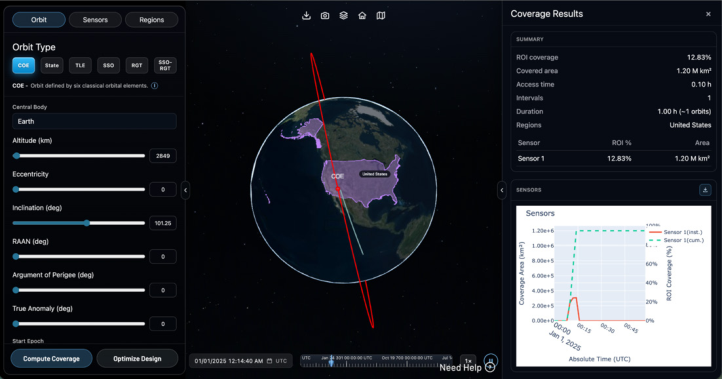
DESIGN RATIONALE TARA integrates a Python-based orbital mechanics backend with a Django web application whose user interface was designed in Figma, providing an interactive environment for space mission planning. TARA organizes mission planning activities into dedicated modules for mission design, analysis, and operations. The present study focuses on the design interface, which enables users to configure spacecraft orbits, visualize trajectories, and analyze coverage.
Figure 1: Illustration of the updated aesthetics and task oriented architecture of TARA.
Unlike conventional mission planning tools that present multiple resources, parameters, and functionalities within a common workspace, TARA adopts a task-oriented architecture based on progressive disclosure. Users make a few selections at the start to choose a task, and each task then opens on its own focused screen with dedicated controls. This approach aims to reduce unnecessary interactions and cognitive load while preserving access to
advanced analytical capabilities. The resulting architecture incorporates four key design decisions, each derived from the previously established usability heuristics and evaluated in the present study:
D1. Task segmentation (progressive disclosure; UDL multiple means of action and expression). Each task has its own screen with only the inputs it needs. We expected this to reduce extraneous cognitive load.
D2. Reduced visual clutter (aesthetic and minimalist design; Clean Layouts and Simplified Interaction ruleset). Each screen shows fewer elements at once, with clear visual grouping.
D3. Task-oriented information architecture (match between system and the real world; recognition rather than recall). Navigation is organized around mission design goals, not software objects.
D4. Improved aesthetics (Interface Aesthetics and Design Enhancement guidelines). Consistent typography, color, and spacing are intended to support legibility and trust.
Figure 1 illustrates the implementation of TARA. Through this implementation, this study evaluates whether these design choices improve task completion, navigation efficiency, and perceived usability while identifying limitations that inform subsequent refinements.
STUDY AND DESIGN PARTICIPANTS A formative comparative usability study was conducted employing a within- subjects design involving six participants with varying levels of experience in aerospace mission planning. Small samples are standard for formative evaluations, as four to five participants typically reveal the most frequent usability problems (Virzi, 1992). Each participant performed equivalent tasks using both TARA and GMAT, with the order of tool evaluation randomized to reduce potential learning and order effects. The evaluation focused on general usability, workflow efficiency, and user perceptions rather than directly assessing accessibility for users with disabilities.
EXPERIMENTAL TASKS Five representative orbit design tasks supported by both TARA and GMAT were developed to assess usability workflows. The tasks are highlighted in Table 1. These tasks were selected to evaluate users’ ability to configure simulations, perform orbital analyses, interpret visualizations, and retrieve results.
Table 1: Comparative study tasks between TARA and GMAT.
Table available in the original PDF paper.
Task Task Description Evaluation Criteria Assess initial setup and parameter entry T1. Create a mission For an Earth-observation CubeSat mission, create a circular orbit with an altitude of 500 km and an inclination of 45 degrees.
(Continued)
Table 1: Continued.
Table available in the original PDF paper.
Task Task Description Evaluation Criteria T2. Propagate and interpret Evaluate workflow and result interpretation Propagate the orbit and find out if the spacecraft flies over San Luis Obispo within the next day (if any).
Assess navigation and iterative analysis
T3. Orbit modifier The team wants more coverage near the poles. Change an aspect of the orbit and check whether the change helped.
T4. Ground track Display the satellite’s ground track and identify at least three countries it passes over.
Evaluate visualization controls and spatial interpretation Assess export functionality and work reproducibility
T5. Export results Save the analysis, so another team member can review and reproduce the work.
TESTING PROCEDURE Usability testing was conducted in person in a quiet, distraction-free setting using a Windows-based computer. Each session lasted approximately 40–60 minutes and followed a structured testing protocol, with a facilitator guiding the session and an observer documenting participant interactions and observations.
Before testing, participants were informed of the study’s objectives, procedures, data collection methods, and their rights as research participants. Informed consent was obtained before each session. Participation was voluntary, and participants were informed of their right to withdraw at any time without penalty. All collected data were retained within Cal Poly to protect participant confidentiality.
At the beginning of each session, participants were introduced to the think-aloud protocol (Ericsson & Simon, 1993), which the facilitator demonstrated before allowing participants to practice. Participants then completed a background questionnaire to document their prior experience with aerospace mission planning tools before proceeding to the usability evaluation.
Participants then completed the five mission planning tasks in each application. Throughout the evaluation, participants were encouraged to verbalize their expectations, decisions, and difficulties as they interacted with each interface. The facilitator guided the testing procedure, while the observer documented navigation challenges, unexpected interactions, and instances requiring assistance. Upon completing the tasks, participants filled out a usability questionnaire and provided open-ended feedback on interface clarity, ease of navigation, and confidence in the analytical results generated by each tool.
USABILITY MEASURES AND ANALYSIS The evaluation combined quantitative performance measures with qualitative observations. On the quantitative side, (1) task completion outcomes were
recorded to distinguish independent completion from tasks requiring facilitator assistance or remaining incomplete, (2) Execution times were measured to assess workflow efficiency, and (3) Post-task feedback captured participants’ perceived usability and confidence. Following each tool evaluation, participants completed a seven-item usability questionnaire adapted from the System Usability Scale (SUS; Brooke, 1996), using a seven-point Likert scale ranging from 1 (strongly disagree) to 7 (strongly agree). As summarized in Table 2, the questionnaire assessed perceived complexity, learnability, consistency, and confidence. Because the questionnaire differed from the standardized SUS instrument, responses were analyzed descriptively rather than converted into conventional SUS scores. On the qualitative side, observations and responses to six open-ended questions were examined to explore participants’ confidence in the tool, recurring usability problems, and relate them to the four design decisions introduced in Design Rationale. The open-ended questions are shown in Table 3. These findings provide the basis for evaluating the original human- centered framework and identifying evidence-informed redesign requirements.
Item Questionnaire Dimension Assessed Q1 I think that I would like to use this system frequently Willingness to use
Q2 I found the system unnecessarily complex. Perceived complexity Independence Q3 I think that I would need the support of a technical person to be able to use this system.
Q4 I thought there was too much inconsistency in this system. Consistency Learnability Q5 I would imagine that most people would learn to use this system very quickly.
Q6 I found the system very cumbersome to use. Ease of use Q7 I felt very confident using the system. User confidence
Evaluation Theme Questionnaire Research Relevance RQ2 Confidence and Trust How confident are you that the result is correct, and what makes you say that? How much would you trust these results for a real mission, and what would you need to see first?
RQ3
Usability Challenges What was the most difficult part of the experience RQ1, RQ4 Workflow Efficiency Where was TARA or GMAT faster or slower than the other?
Design Improvements What should we improve first, and why? RQ1-RQ4 Other Observations What else should I have asked you about? RQ1-RQ4
Evaluation Theme Questionnaire Research Relevance
From Heuristics to Evidence: A Comparative Usability Evaluation 883 As summarized in Table 2, the questionnaire assessed perceived complexity, learnability, consistency, and confidence. Because the questionnaire differed from the standardized SUS instrument, responses were analyzed descriptively rather than converted into conventional SUS scores. On the qualitative side, observations and responses to six open-ended questions were examined to explore participants’ confidence in the tool, recurring usability problems, and relate them to the four design decisions introduced in Section 2. The open-ended questions are shown in Table 3. These responses provided context for the task-performance and questionnaire findings by documenting what participants noticed, where they experienced uncertainty, and what information they needed to trust the results. The findings were used to evaluate how well the original human-centered framework addressed the observed barriers and to identify evidence-informed redesign requirements for future versions of TARA. In particular, the analysis distinguished between issues with interface discoverability and navigation, concerns about analytical transparency, and requests to expand capability beyond the tested workflows.
RESULTS
Task Performance: Task completion outcomes and execution times were analyzed by comparing TARA and GMAT across five representative mission planning activities as shown in Table 4. Success was defined as completion without facilitator assistance; partially completed, assisted, failed, and not-started tasks were not included in the successful-completion count. The results revealed task-dependent differences in performance, indicating that the effectiveness of each interface varied with the nature of the activity being performed. Note that success here refers to tasks completed without help. The initial analysis suggests that TARA’s task-oriented workflow supported more efficient completion of coverage analysis (T2), where participants could access relevant simulation inputs and outputs through a dedicated interface. However, this advantage did not consistently extend to tasks requiring extensive interaction with orbital visualizations. Ground track analysis (T4), in particular, exposed difficulties associated with navigation and visualization controls. These observations suggest that simplifying the organization of analytical workflows does not necessarily improve the efficiency of every interaction.
Table 4: Task success and median time on task by tool.
Table available in the original PDF paper.
Task GMAT Time (s) GMAT Success TARA Time (s) TARA Success T1 160 4/6 (67%) 76 5/6 (83%)
Perceived Usability and User Confidence: Post-test questionnaire responses and participant feedback provided additional insight into the perceived usability of both applications as shown in the appendix. Participants generally rated TARA to have lower complexity, not needing technical support, and being less cumbersome, and higher on how quickly most people would learn it. These perceptions were consistent with the intended benefits of TARA’s task-oriented architecture and simplified interface. Ratings for wanting to use the system frequently were close, and inconsistency was rated slightly higher for TARA. Confidence ratings were the same for both tools (mean 4.5). However, perceived ease of use did not necessarily translate into greater confidence in the analytical results. Participants expressed a need for clearer information about the underlying simulation models, assumptions, and computational methods. Familiarity with GMAT, its development rooted in NASA, and its established use in aerospace engineering influenced perceptions of reliability. These observations indicate that both interface usability and transparency of analytical methods contribute to user confidence in engineering software. Observed Usability Challenges: Qualitative observations identified several recurring usability challenges in TARA, particularly those associated with visualization controls, interface discoverability, and workflow continuity. Participants experienced difficulties locating or interpreting certain icon- based controls relating to globe navigation, map view settings, and ground track features. The controls were present, but their purpose was not immediately apparent, requiring additional exploration or facilitator assistance. Additional difficulties involved navigation between tasks and the preservation of previously entered information. These observations revealed opportunities to improve control visibility, interaction feedback, and workflow continuity. Despite these challenges, participants responded positively to the organization of task-specific workflows and the visual presentation of analytical results. The feedback indicates that TARA’s design offers potential usability benefits while identifying areas where the original human-centered guidelines require further refinement.
DISCUSSION
The findings suggest that human-centered design principles can improve usability in specialized aerospace mission planning workflows, although their effectiveness depends on the task being performed. TARA’s task- oriented architecture supported more efficient coverage analysis by simplifying simulation setup and presenting relevant inputs through dedicated workflows, consistent with cognitive load theory (Sweller, 1988). However, these benefits did not consistently extend to visualization- intensive tasks, where participants encountered difficulties navigating maps and interpreting ground tracks. This highlights an important distinction: simplifying analytical workflows does not necessarily simplify interaction with their results. The observations provide preliminary support for task segmentation, reduced visual clutter, and task-oriented navigation (D1–D3), while the independent contribution of aesthetics (D4)
From Heuristics to Evidence: A Comparative Usability Evaluation 885 remains uncertain. Furthermore, perceived ease of use did not necessarily translate into greater confidence in analytical correctness, emphasizing the importance of transparency in the underlying computational models and assumptions.
The observed usability challenges revealed limitations in the original human-centered design framework. Several controls were available but difficult to locate or interpret, illustrating Norman’s (2013) distinction between affordances and signifiers. Nielsen’s (1994) principles of recognition and consistency further emphasize the importance of familiar icon conventions and intuitive navigation. Building on these observations, four redesign requirements were identified:
(R1) improve the visibility and consistency of visualization controls, including map navigation and time-dependent displays
(R2) incorporate recognizable icons, descriptive labels, accessible names, and clear interaction feedback in accordance with relevant accessibility guidance (W3C, 2023)
(R3) preserve user inputs and scenario states across navigation and workflow changes
(R4) improve analytical transparency by providing access to simulation models, assumptions, and computational methods.
These findings motivate extending the original accessibility heuristics to explicitly address signifier and visualization-control consistency, workflow continuity, and transparency of analytical results.
CONCLUSION AND FUTURE WORK This research advances human-centered design framework for aerospace mission planning tools through its implementation in TARA and a comparative usability evaluation against GMAT. The findings demonstrate the benefits of task-oriented workflows and progressive disclosure while revealing challenges associated with visualization, interface discoverability, workflow continuity, and user confidence. Importantly, the study establishes a traceable connection between proposed usability heuristics, their implementation in software, and observed user interactions. By translating these observations into actionable design requirements, the research contributes an evidence- informed refinement of the original framework and guides the development of more intuitive, transparent, and accessible aerospace mission planning applications.
Future work will focus on implementing the identified redesign requirements in subsequent iterations of TARA and include planned modifications. Subsequent usability evaluations will examine whether these modifications improve task completion, workflow efficiency, and user confidence. Future studies will also involve larger and diverse participant groups, including users with disabilities, to evaluate the accessibility objectives of the original framework.
REFERENCES
a.i. solutions. (n.d.). Get FreeFlyer: Astrodynamics software for space mission design, analysis, and operations. Retrieved October 04, 2026, from https://ai-solutions. com/get-freeflyer/ Bajaj, T., Vijayakumar, M., & Ali, D. (2025). From capability to accessibility: A
usability heuristics approach to space mission planning tools. In [TODO: editors and proceedings title], AHFE International Conference (Vol. 199, pp. 368–378). AHFE International. https://doi.org/10.54941/ahfe1006849 C Bloebaum, C. L., & McGowan, A.-M. R. (2012). The design of large-scale complex engineered systems: Present challenges and future promise. 12th AIAA Aviation Technology, Integration, and Operations (ATIO) Conference and 14th AIAA/ ISSMO Multidisciplinary Analysis and Optimization Conference, Indianapolis, Indiana. https://doi.org/10.2514/6.2012-5571 Brooke, J. (1996). SUS: A quick and dirty usability scale. In P. W. Jordan, B. Thomas,
B. A. Weerdmeester, & I. L. McClelland (Eds.), Usability evaluation in industry (pp. 189–194). Taylor & Francis. CAST. (2024). Universal Design for Learning Guidelines version 3.0. https:// udlguidelines.cast.org Corbin, E. (2024, July 31). General Mission Analysis Tool (GMAT). Goddard
Engineering and Technology Directorate. https://etd.gsfc.nasa.gov/capabilities/ capabilities-listing/general-mission-analysis-tool-gmat/ Defoort, S., Balesdent, M., Klotz, P., Schmollgruber, P., Morio, J., Hermetz, J., Blondeau, C., Carrier, G., & Bérend, N. (2012). Multidisciplinary aerospace system design: Principles, issues and ONERA experience. AerospaceLab, 4, 1–1. https://aerospacelab.onera.fr/en/al4/multidisciplinary-aerospace-system-design Englander, J. A., Vavrina, M. A., Lim, L. F., McFadden, L. A., Rhoden, A. R., & Noll,
K. S. (2017). Trajectory optimization for missions to small bodies with a focus on scientific merit. Computing in Science & Engineering, 19(4), 18–28. https://doi. org/10.1109/MCSE.2017.3151246 Ericsson, K. A., & Simon, H. A. (1993). Protocol analysis: Verbal reports as data (Rev. ed.). MIT Press. Fairclough, C. (2025, April 2). Advancing space mission analysis and design with
simulation. Ansys. https://www.ansys.com/blog/advancing-space-mission- analysis-design-with-simulation Harris, G. W., He, P., & Abdelkhalik, O. O. (2024). Control co-design optimization of spacecraft trajectory and system for interplanetary missions. Journal of Spacecraft and Rockets, 61(4), 939–952. https://doi.org/10.2514/1.A35680 Isaji, M., Takubo, Y., & Ho, K. (2022). Multidisciplinary design optimization
approach to integrated space mission planning and spacecraft design. Journal of Spacecraft and Rockets, 59(5), 1660–1670. https://doi.org/10.2514/1.A35284 ISO. (2018). ISO 9241-11:2018. Ergonomics of human-system interaction, Part 11: Usability: Definitions and concepts. International Organization for Standardization. Laskey, L., & Keebler, J. R. (2023). Evaluating system usability, workload suitability,
and user experience of game-based virtual reality in spaceflight education and training. Journal of Aviation/Aerospace Education & Research, 32(1). https://doi. org/10.15394/jaaer.2023.1948 Mittendorf, K. F. (2023, June 16). Reimagining access: Critical examination of barriers to full STEM workforce participation for disabled individuals. National Academies of Sciences, Engineering, and Medicine. https://nap.nationalacademies. org/resource/27245/Mittendorf_Reimagining_Access_Barriers_to_STEM_ Workforce_for_Disabled_Individuals.pdf
From Heuristics to Evidence: A Comparative Usability Evaluation 887 Moon, N. W., Todd, R. L., Morton, D. L., & Ivey, E. (2012). Accommodating
students with disabilities in science, technology, engineering, and mathematics (STEM): Findings from research and practice for middle grades through university education. National Science Foundation. National Science and Technology Council. (2022). Interagency roadmap to support space-related STEM education and workforce. Executive Office of the President. https://bidenwhitehouse.archives.gov/wp-content/uploads/2022/09/09- 2022-Interagency-Roadmap-to-Support-Space-Related-STEM-Education-and- Workforce.pdf Nielsen, J. (1994). Heuristic evaluation. In J. Nielsen & R. L. Mack (Eds.), Usability
inspection methods (pp. 25–62). John Wiley & Sons. Norman, D. A. (2013). The design of everyday things (Rev. and expanded ed.). Basic Books. Recognizing and Overcoming Barriers to Participation in STEM. (2022, April 1).
Aerospace America. https://aerospaceamerica.aiaa.org/departments/recognizing- and-overcoming-barriers-to-participation-in-stem/ Ross, A. M. (2003). Multi-attribute tradespace exploration with concurrent design as a value-centric framework for space system architecture and design [Dual master’s thesis, Massachusetts Institute of Technology]. https://dspace.mit.edu/ handle/1721.1/82788 Sweller, J. (1988). Cognitive load during problem solving: Effects on learning.
Cognitive Science, 12(2), 257–285. https://doi.org/10.1207/s15516709cog1202_4 Takubo, Y., Gammelli, D., Pavone, M., & D’Amico, S. (2025). Agile tradespace exploration for space rendezvous mission design via transformers (arXiv:2510.03544). arXiv. https://doi.org/10.48550/arXiv.2510.03544 Virzi, R. A. (1992). Refining the test phase of usability evaluation: How
many subjects is enough? Human Factors, 34(4), 457–468. https://doi. org/10.1177/001872089203400407 W3C. (2023). Web Content Accessibility Guidelines (WCAG) 2.2. W3C Recommendation. https://www.w3.org/TR/WCAG22/
Appendix A: Post-Test Questionnaire Results Table A1: Median and mean post-test questionnaire ratings by tool.
Questionnaire Item GMAT, n = 4 Median (Mean)
TARA, n = 6 Median (Mean) I think that I would like to use this system frequently. 5.5 (5.3) 6.0 (5.8)
I found the system unnecessarily complex. 4.0 (4.0) 3.0 (2.8) 3.0 (3.0) 1.5 (1.8) I think that I would need the support of a technical person to be able to use this system.
2.0 (2.0) 2.0 (2.3)
I thought there was too much inconsistency in this system.
4.0 (4.0) 6.0 (6.0)
I would imagine that most people would learn to use this system very quickly.
I found the system very cumbersome to use. 4.0 (3.8) 2.0 (2.5) I felt very confident using the system. 5.0 (4.5) 5.0 (4.5)
SEARCH THE AHFE DIGITAL BOOKSTORE BY ISBN
Explore the complete digital volume
Human Factors in Design, Engineering, and Computing
Read this individual research paper free through the original publisher, or explore the full digital proceedings book.