Mosa Ramohlokoane, Bankole Awuzie, Thabelo Ramantswana (2026). Constructing a Best-Fit Measurement Scale for Evaluating IEQ, Productivity, and Wellbeing for Individual Attributes of Employee Workspaces. In: Human Factors in Design, Engineering, and Computing. AHFE Open Access, vol. 238, pp. 911–920. https://doi.org/10.54941/ahfe1008322
Employees spend extended time confined within their workplaces where workspace conditions can influence their wellbeing and productivity. Indoor Environmental Quality (IEQ) factors are therefore important consideration in workspace design. However, existing workspace assessment approaches evaluate environmental quality, wellbeing and productivity separately limiting their ability to account for differences in individual employee preferences. This study addresses this gap through the development and preliminary validation of an integrated measurement scale informed by IEQ, Flourishing Theory and Person-Environment Fit Theory and includes individual user attributes. Measurement items were adapted from previously validated instruments and organized into constructs assessing IEQ factors, personalisation and overall comfort. A quantitative approach was adopted, with the adapted measurement scales pilot tested among 25 office-based employees in South Africa. Descriptive statistics were used to examine participants’ responses, while Cronbach’s alpha was used to assess the internal consistency of the constructs. Five of the six constructs demonstrated acceptable to excellent internal consistency although these findings are interpreted cautiously given the small pilot sample. The findings provide preliminary support for the measurement properties of the adapted scales while identifying areas requiring further development. The proposed integrated approach contributes to workspace assessment by considering individual user perceptions alongside IEQ, wellbeing and productivity. Further validation with a larger sample is required to examine the construct structure and strengthen the psychometric properties of the proposed scale. The study provides a foundation for developing a more comprehensive and user-centred tool to inform the design of work environments responsive to diverse employee needs.
Employees spend extended periods of their time confined within their office environments (Borsos et al., 2021), where the workspace design makes a salient contribution towards shaping their performance and general wellbeing (de Castro Jacinto et al., 2022). Given this amount of time spent indoors, a
proposed measure to improve the workspace of employees would be the collaboration of indoor and outdoor variables (de Castro Jacinto et al., 2022) to cater to occupant wellbeing and productivity, with the consideration of Indoor Environmental Quality (IEQ) factors. The direct influence of IEQ factors, such as air quality, lighting, acoustics, thermal comfort and spatial configuration, on employee’s psychological, emotional and social wellbeing has been elucidated in recent literature (Liu et al., 2023). Scholars have thus advocated for the incorporation of diverse space types, including creative, motivational, training and socially interactive spaces during the design of these workspaces (Saraf et al., 2022; Marmo et al., 2025), as a measure of improving levels of employee productivity and wellbeing.
The overall objective of workspaces should be to support the wellbeing and productivity of its employees (Bourikas et al., 2021) taking into consideration variables of IEQ, biophilia and space (Croffi et al., 2023). Scholars have also advocated that the improvement of IEQ within workspaces would not only yield positive results for the employee but also increase productivity levels for the organisation (Wargocki & Wyon, 2017; Liu et al., 2023). This is associated with workspace performance being described as a measure of individual performance within the office, how an individual performs in terms of allocated work considering quality, quantity and effort of workmanship (Elnaklah et al., 2020; Franke & Nadler, 2021).
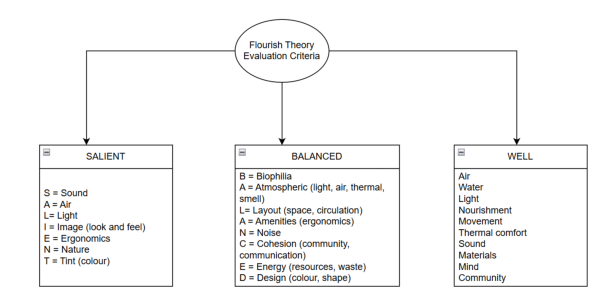
To support the achievement of these outcomes, workspace design theories including the Flourishing Theory (FT) and Person-Environment Fit Theory (PEFT) have emerged. Whereas FT emphasizes how environmental conditions and experiences, including sensory stimuli, support an individual’s psychological flourishing and overall wellbeing (Clements- Croome, 2021), the PEFT focuses on the alignment which exists between an individual’s personal traits and the characteristics of their environment (Kristof-Brown & Guay, 2011). Often, these theories are associated with distinct measurement scales which are usually deployed towards assessing productivity, wellbeing, or environmental quality, respectively (Menshikova et al., 2025). Clements-Croome et al., (2019) has indicated that the creation of a flourishing productive workspace requires the integration of physical and psychological aspects of the employee as well as the workspace elements. The aspect of flourishing includes the FT which considers design of the workspace, perceptions and feelings of the occupant within their allocated workspace (Clements-Croome et al., 2019). An example would be the inclusion of biophilia which creates the illusion of an in-depth connection of nature which positively impacts the productivity and wellbeing of the occupant (Al-Dmour et al., 2021). Whereas the PEFT is considered a multidimensional construct as it encompasses various aspects of the work environment in which employees are centred (Kristof-Brown & Guay, 2011). It has been established that when organisations cater to individual wellbeing, the likelihood of employee retention increases (Su et al., 2015). The P-E fit
Constructing a Best-Fit Measurement Scale for Evaluating 913 indicates that the wellbeing of an employee is not only influenced by their environment but also their individual characteristics (Shipp & Jansen, 2011). Individual attributes comprise of abilities, knowledge, needs, skillsets, beliefs, and values while organisational values, role characteristic and structures make up the environmental characteristics (Shipp & Jansen, 2011). The adoption of such an approach to workspace design is expected to foster positive attitudes, relationships, and health outcomes that ultimately enhance productivity among employees.
Given the perceived positive impact of the three domains there is however, no widely adopted or comprehensively unified tool, that integrates all three domains. This has culminated in fragmented workspace assessments which limit the ability of Facilities Managers to create workspaces that are holistically aligned with individual employee needs. This study seeks to address this knowledge-practice gap through the development of a best-fit, integrated measurement scale which combines IEQ factors, employee wellbeing and productivity considerations into a holistic toolkit. The objective of the proposed scale is to capture employee preferences, individual attributes and appropriate workspace features in a manner that informs the design of optimal employee-centred workspaces.
EXISTING MEASUREMENT SCALES FOR WORKPLACE PRODUCTIVITY AND WELLBEING There are various questionnaires which have been developed to measure productivity from the employee and building perspective. Questionnaires include, Work Limitations Questionnaire (WLQ), the Health and Work Performance Questionnaire (HPQ), and the Work Productivity and Activity Impairment Questionnaire (WPAI), which assess the productivity of employees related to health-related work productivity (Gardner et al., 2016; Drewnowski, 2020) while the Individual Work Performance Questionnaire (IWPQ) assessed from an individual performance level as opposed to collectively (Koopmans et al., 2012). Certification tools like WELL Building Standard (International Well Building Institute, 2019), Facility Innovations Toward Wellness Environment Leadership (FitWell) (Center for Active Design, 2019), Healthy Active by Design (Heart Foundation, 2019) and Comprehensive Assessment System for Built Environment Efficiency (CASBEE)-Wellness Office (Hayashi et al., 2021), have been used to assess the level of wellbeing experienced by employees within their designated workspaces (Candido et al., 2021). The tools allow for measurements of accuracy to be conducted to ensure that required levels are achieved and maintained (Candido et al., 2021). Additionally, an updated WELL Building Standards (WELL v2) which incorporates ergonomic workstations as a manner of promoting increased employee wellbeing within workspaces (International WELL Building Institute, 2022).
MEASUREMENT SCALE DEVELOPMENT Identification of Variables
The development of the proposed measurement scale followed a deductive approach informed by the scale development process described by Boateng et al. (2018). Rather than developing measurement items independently, existing validated constructs and items were identified, adapted and integrated to address the relationship between workplace environmental conditions, individual employee attributes, wellbeing and productivity.
Conceptualization of the Scale The proposed scale was conceptualized around the integration of three domains: Indoor Environmental Quality (IEQ), Flourishing Theory (FT) and Person-Environment Fit Theory (PEFT). IEQ provides a basis for assessing physical workplace conditions, while FT considers environmental and experiential factors associated with employee wellbeing and flourishing. PEFT considers the alignment between individual characteristics and environmental conditions. Integrating these domains provides a framework for assessing the workplace from both environmental and individual user perspectives.
Scale Identification of Constructs The constructs were identified through a review of existing theoretical and measurement approaches relating to IEQ, workplace wellbeing and productivity. Six principal constructs were selected: thermal perception, visual perception, acoustic perception, ergonomic perception, workspace personalization and overall comfort. Collectively, these constructs capture employees’ perceptions of physical workplace conditions and their interaction with the workspace. The selection of constructs was further informed by workplace flourishing criteria and PEFT-related factors, including ergonomics, biophilia, indoor air quality, privacy, environmental conditions, workplace design and individual attributes (Candido et al., 2019; Engelen et al., 2019; Armitage & Amar, 2021; Clements-Croome, 2021).
Constructing a Best-Fit Measurement Scale for Evaluating 915 Item Generation and Adaptation
A deductive item-generation approach was adopted (Boateng et al., 2018), with items adapted from previously validated measurement instruments identified in the literature. The resulting scale comprised 12 items for thermal perception, 10 for visual perception, four for acoustic perception, four for ergonomic perception, four for workspace personalization and three for overall comfort. Adaptation of existing items enabled the proposed instrument to retain a basis in established measurement approaches while aligning the items with the workplace context and objectives of the integrated scale.
Integration of Individual Attributes Individual employee attributes were incorporated to extend the assessment beyond physical workplace conditions. These included identity and work style, health and sensory attributes, communication, technology and motivation. Their inclusion was informed particularly by PEFT, which emphasises the relationship between individual characteristics and environmental conditions. The integration of these attributes enables the proposed scale to account for differences in how employees perceive and respond to workplace conditions, providing a more individual-centred approach to the assessment of wellbeing and productivity.
Proposed Integrated Scale The resulting measurement scale integrates environmental perceptions, individual attributes and workplace outcomes within a single assessment framework. The proposed structure therefore extends conventional workspace assessment by considering not only the conditions provided by the built environment but also the characteristics and preferences of individual users. The resulting instrument was subsequently pilot tested to provide a preliminary assessment of its measurement properties.
METHODOLOGY
Research Approach A quantitative research approach was adopted to undertake preliminary validation of the proposed measurement scale. A structured questionnaire was used to assess individual attributes, perceptions of Indoor Environmental Quality (IEQ) and workplace design, and perceived workplace-related wellbeing and productivity. The empirical assessment was undertaken in two stages: an initial pre-test followed by pilot validation.
Pre-test and Questionnaire Refinement The questionnaire was initially pre-tested with five office-based employees to assess the clarity, interpretation and suitability of the questions and response options. Feedback from the pre-test informed minor refinements to the questionnaire prior to wider pilot administration. As the refinements did not substantially alter the constructs or measurement structure of the instrument, the responses from the pre-test were retained as part of the preliminary analysis.
Pilot Validation and Data Collection Following the pre-test, the refined questionnaire was administered electronically to a further 20 office-based employees from different sectors and industries in Gauteng, South Africa, resulting in a total sample of 25 participants. Snowball sampling was used to recruit participants who were required to have worked within their respective sectors for a minimum of six months. Data collection was undertaken between May and June 2026. The questionnaire comprised four sections: (1) demographic information; (2) individual attributes; (3) IEQ and workplace design; and (4) the perceived impact of the workspace on productivity and wellbeing. Sections three and four employed five-point Likert-type response scales.
Data Analysis Descriptive statistics, including means and standard deviations, were calculated to examine response patterns across the constructs. Cronbach’s alpha was used to assess the internal consistency of the multi-item measurement scales, with a coefficient of approximately .70 or above considered indicative of acceptable internal consistency (Tavakol & Dennick, 2011). The combined sample of 25 participants was used for the preliminary analysis. Given the exploratory nature and limited sample size of the study, the findings are interpreted as preliminary evidence of the performance and internal consistency of the adapted measurement scales rather than definitive psychometric validation.
The adapted measurement scales were pilot tested with 25 participants from various sectors to assess their suitability for measuring workplace environmental perceptions in relation to wellbeing and productivity. The items were adapted from previously validated instruments and organized
Constructing a Best-Fit Measurement Scale for Evaluating 917 into six constructs: thermal perception, visual perception, acoustic perception, ergonomic perception, personalization, and overall comfort. Descriptive statistics and Cronbach’s alpha were used to examine the performance and internal consistency of the adapted scales. As presented in Table 2, mean scores ranged from 3.11 to 3.56 on the five-point scale. Visual perception recorded the highest mean score (M = 3.56, SD = 1.03), followed by acoustic perception (M = 3.49, SD = 1.06), overall comfort (M = 3.45, SD = 0.91), and thermal perception (M = 3.39, SD = 1.08). Ergonomic perception (M = 3.13, SD = 1.01) and personalization (M = 3.11, SD = 1.35) recorded comparatively lower mean scores. The standard deviations ranged from 0.91 to 1.35, demonstrating variation in responses across all six constructs. Personalization showed the greatest variability, while overall comfort showed the least. The internal consistency of the constructs was assessed using Cronbach’s alpha. Thermal perception demonstrated excellent internal consistency (α = .928), while visual perception demonstrated acceptable internal consistency (α = .720). Ergonomic perception (α = .838) demonstrated good internal consistency, and personalization (α = .747) demonstrated acceptable internal consistency. Overall comfort demonstrated excellent internal consistency (α = .931). Acoustic perception recorded the lowest coefficient (α = .424), indicating weak internal consistency among the items comprising this construct. Based on the foregoing, it can be discerned that five of the six adapted constructs achieved Cronbach’s alpha coefficients above .70, providing preliminary evidence of satisfactory internal consistency within the pilot sample. Given that acoustics provided a low coefficient, the study revised the variable scale measurement from a 4-point to a 5-point scale through the addition of a neutral midpoint, and was subsequently reverse-coded to align its directionality with the remaining items in the acoustic comfort construct. After which Cronbach’s alpha was recalculated and reanalyzed the coefficient. The findings then found an excellent internal consistency (α = .906). The re-coding was essential as acoustics forms part of IEQ in terms of adequate design features for workspaces. The findings support the continued use and testing of these constructs even though the acoustic perception scale was refined. The descriptive statistics complement the reliability analysis by demonstrating that the adapted scales captured variation in participants’ perceptions across the workplace environmental dimensions.
DISCUSSION, LIMITATIONS, AND CONCLUSIONS The study aimed to develop and undertake preliminary validation of an adapted measurement scale incorporating workplace environmental conditions and individual user perceptions in relation to wellbeing and productivity. The measurement items were drawn from previously validated instruments and adapted to the context of the study, with subsequent pilot testing providing an initial assessment of their performance. Despite the initial sample size of 25 participants their response provided an overview of various sectors such as mining and education.
The findings provide preliminary support for five of the six constructs, with thermal perception, visual perception, ergonomic perception, personalization, and overall comfort demonstrating acceptable to excellent internal consistency. The lower reliability of the acoustic perception construct (α = .424) required review and of the scale which was conducted and thus resulted in an excellent internal consistency. Importantly, the mean scores should be interpreted as representing participants’ perceptions of the measured workplace dimensions rather than as direct evidence of the validity or importance of individual constructs. The proposed scale contributes to workplace assessment by integrating perceptions of indoor environmental conditions with individual user attributes, thereby supporting a more user-centred approach to understanding workplace wellbeing and productivity. This is particularly relevant where standardised building conditions may not adequately reflect differences in individual workplace preferences and experiences.
The results are nevertheless preliminary given the pilot sample of 25 participants and its geographical limitation to one province. Further validation using a larger independent sample is required to assess construct validity, dimensionality and test-retest reliability. Overall, the study provides an initial basis for further development of a measurement approach that considers both workplace environmental conditions and individual user perceptions in the design and assessment of productive and supportive work environments.
REFERENCES
Al-Dmour, Y., Garaj, V., & Clements-Croome, D. (2021). The flourishing of Biophilic workplaces: “Second Home” office as a case study. Intelligent Buildings International, 13(4), 261–274. doi: 10.1080/17508975.2020.1807895 Armitage, L., & Amar, J. (2021). Person-environment fit theory: Application to the
design of work environment. In R. Appel-Meulenbroek, & V. Danivska (Eds.), A Handbook of Theories on Designing Alignment Between People and The Office Environment (pp. 33–45). London and New York: Routledge. Bernheimer, L. (2017). The Shaping of Us: How Everyday Spaces Structure Our Lives, Behaviour, and Wellbeing (1st ed.). San Antonio: Trinity University Press. Boateng, G., Neilands, T., Frongillo, E., Melgar-Quiñonez, H., & Young, S. (2018).
Best Practices for Developing and Validating Scales for Health, Social, and Behavioral Research: A Primer. Frontiers in Public Health, 6(149), 1–18. Borsos, Á., Zoltán, E., Pozsgai, É., Cakó, B., Medvegy, G., & Girán, J. (2021). The comfort map-A possible tool for increasing personal comfort in office workplaces. Buildings, 11(233), 1–13. doi: 10.3390/buildings11060233
Constructing a Best-Fit Measurement Scale for Evaluating 919 Bourikas, L., Gauthier, S., Khor Song En, N., & Xiong, P. (2021). Effect of Thermal,
Acoustic and Air Quality Perception Interactions on the Comfort and Satisfaction of People in Office Buildings. Energies, 14(2), 333. doi: 10.3390/en14020333 Candido, C., Marzban, S., Haddad, S., Mackey, M., & Loder, A. (2021). Designing healthy workspaces: Results from Australian certified open-plan offices. Facilities, 39(5), 411–433. Candido, C., Thomas, L., Haddad, S., Zhang, F., Mackey, M., & Ye, W. (2019b).
Designing activity-based workspaces: Satisfaction, productivity and physical activity. Building Res Information, 1(47), 275–289. Center for Active Design. (2019, June 20). Fitwell. Retrieved November 12, 2025, from https://fitwel.org/ Clements-Croome, D. (2021). Flourish Theory: A model for multisensory human-
centric design. In A.-M. R., & D. V. (Eds.), A Handbook of theories on designing Alignment Between People and The Office Environment (pp. 176–186). London and New York: Routledge. Clements-Croome, D., Turner, B., & Pallaris, K. (2019). Flourishing workplaces: A multisensory approach to design and POE. Intelligent Buildings International, 11((3–4)), 131–144. Croffi, J., Soebarto, V., Kroll, D., & Barrie, H. (2023). Indoor environmental quality
and occupants’ satisfaction in highrise mixed-use buildings: Preliminary results from a case study. Launceston, Australia: Architectural Science Association. de Castro Jacinto, C., de Paula Junior, A., Silva, S., & Mateus, R. (2022). Review and analysis of existing methods to assess the Indoor Environmental Quality (IEQ) for office buildings. Acta Polytechnica CTU Proceedings (pp. 138–144). Prague: Czech Technical University in Prague. doi: 10.14311/APP.2022.38.0138 Dolan, P. (2014). Happiness by Design: Change What You Do, Not How You Think
(1st ed.). New York: Avery Publication Group. Drewnowski, A. (2020). Impact of nutrition interventions and dietary nutrient density on productivity in the workplace. Nutrition Reviews, 78(3), 215–224. Elnaklah, R., Fosas, D., & Natarajan, S. (2020). Indoor environment quality and
work performance in “green” office buildings in the Middle East. Building Simulation, 13, 1043–1062. doi: 10.1007/s12273–020-0695-1 Engelen, L., Chau, J., Young, S., Mackey, M., Jeyapalan, D., & Bauman, A. (2019).
Is activity-based working impacting health, work performance and pereptions? A systematic review. Building Research and Information, 4(47), 468–479. Franke, M., & Nadler, C. (2021). Towards a holistic approach for assessing the impact of IEQ on satisfaction, health and productivity. Building Research and Information, 49(4), 417–444. Gardner, B., Dale, A., Buckner-Petty, S., Van Dillen, L., Amick 3rd, B., & Evanoff,
B. (2016). Comparison of employer productivity metrics to lost productivity estimated by commonly used questionnaires. Journal of Occupational and Environmental Medicine, 58(2), 170–177. Graham, L. T., Parkinson, T., & Schiavon, S. (2021). Lessons learned from 20 years of CBE’s occupant surveys. Buildings and Cities, 2(1), 166–184. Hayashi, T., Hiyama, K., & Kubo, R. (2021). CASBEE-Wellness Office: An objective
measure of the building potential for a healthily built environment. Japan Architectural Review, 4(1), 233–240. Heart Foundation. (2019, February 02). Health active by design master checklist.
Retrieved November 15, 2025, from www.healthyactivebydesign.com.au/images/ uploads/Partners/Resources/Healthy_Active_by_Design_master_checklist.pdf International Well Building Institute. (2019, June 20). The WELL building standard.
Retrieved November 12, 2025, from www.wellcertified.com/well
International WELL Building Institute. (2022). The Well Building Standard TM v.2.0. New York: Delos Living LLC. Koopmans, L., Bernaards, C., Hildebrandt, V., van Buuren, S., van der Beek, A., & de
Vet, H. (2012). Development of an individual work performance questionnaire. International Journal of Productivity and Performance Management, 62(1), 6–28. Kristof-Brown, A., & Guay, R. (2011). Person-environment fit. In APA (Ed.), APA handbook of industrial and organizational psychology (Vol. 3, pp. 3–50). Washington, DC: S. Zedeck. Liu, F., Chang-Richards, A., Wang, K., & Dirks, K. (2023). Effects of indoor
environment factors on productivity of university workplaces: A structural equation model. Building and Environment, 233. doi: 10.1016/j.buildenv.2023.110098 Marmo, L., Rovolis, A., & Avdikos, V. (2025). The role of collaborative workspaces in promoting networking opportunities: A comparison between urban and peripheral contexts. Regional Studies, Regional Science, 12(1), 23–42. Menshikova, M., Bonacci, I., Scarozza, D., & Zifaro, M. (2025). The employee
satisfaction with the new normal ways of working: A cluster analysis. Journal of Asia Business Studies, 19(3), 863–892. Pritchard, R., & Watson, M. (1991). Understanding and measuring group productivity. In T. Oaks (Ed.), Group Process and Productivity (pp. 251–275). CA, US: Sage Publications Incorporation. Residovic, C. (2017). The new NABERS indoor environment tool - the next frontier
for Australian buildings. Procedia Engineering, 180, 303–310. doi: 10.1016/j. proeng.2017.04.189 Saraf, M., Tharim, A., & Ahmad, A. (2022). Factorial validity of biophilic elements in the home workspace towards Academic’s perceived productivity. 3rd International Conference on the Built Environment and Engineering (IConBEE). Putrajaya, Malaysia: AIP Publishing. Shipp, A., & Jansen, K. (2011). Reinterpreting time in fit theory: Crfting and
recrafting narratives of fit in medias res. Academy of Management Review, 1(36), 76–101. Su, R., Murdock, C., & Rounds, J. (2015). Person-environment fit. In A. P. Association (Ed.), APA Handbook of career interventions (pp. 81–89). Washington, DC: P.J. Hartung, M.L Savickas & W.B. Walsh. Tavakol, M., & Dennick, R. (2011). Making sense of Cronbach’s alpha. International
Journal of Medical Education, 2, 53–55. doi: 10.5116/ijme.4dfb.8dfd Wargocki, P., & Wyon, D. (2017). Ten questions concerning thermal and indoor air quality effects on the performance of office work and schoolwork. Building and Environment, 112, 359–366. doi: 10.1016/j.buildenv.2016.11.020
SEARCH THE AHFE DIGITAL BOOKSTORE BY ISBN
Explore the complete digital volume
Human Factors in Design, Engineering, and Computing
Read this individual research paper free through the original publisher, or explore the full digital proceedings book.