Doreen Nielsen, Yong Lin, Anthony White (2019). Meeting Service Needs of the Changing Profile of Student Customers. In: Advances in The Human Side of Service Engineering. AHFE Open Access, vol. 8. https://doi.org/10.54941/ahfe100252
The objective of this paper is to investigate how Higher Education Institutes (HEIs) in the United Kingdom (UK) can redefine education services to meet the needs of student customers. The student demographics extracted from the UK’s Higher Education Statistics Agency (HESA), Key Information Sets (KIS) and an example HEI, University of Greenwich, UK, are explored and analysed. Additionally, the National Statistics Survey (NSS) on student satisfaction is also examined. Statistical analysis alone is insufficient to form a contextual view of the general student customers’ profile. The changing demographics and the current student customers’ prolific use of technology highlighted the fact that the past understanding of student profiles and their education needs no longer apply in the current context. A new method of student customer profiling is suggested. Service procurement in HEIs and the Service Consumption Life Cycle of student customers are discussed in the context of service needs and iterative interactions with specific service delivery focal areas within the HEI. A recommendation is made for periodic risk regulation assessments using new student customer profiles against areas of service needs to ensure a set of quality service delivery to meet the needs of these new students.
Student demographics have evolved to be more cosmopolitan over the years as a result of both local and global students’ aspirations for better quality Higher Education in the United Kingdom (UK). An assessment of demographics available at national and institutional levels found that while it presents a generic view through categorisation, the information is still rather “basic”. Student customer profiling is discussed as an extension to the demographics data and an essential tool to help Higher Education Institutions (HEIs) to establish better services to meet the needs of the changing profiles of student customers. The student customers’ need and use of service is discussed in the context of their service consumption life cycle where they interact with focal areas within the HEI that offer them services.
THE CHANGING STUDENT PROFILES Many student customers are increasingly seen using mobile technology but there are still some who are lagging behind. They proficiently read and reply to emails from their smart phones in quick succession like how they do texting of messages. So what kind of IT literate and skilled student profiles do these students fit into? All HEIs who follow the UK government mandate, submit a compilation of their student customer demographic data to the Higher Education Statistics Agency (HESA). The currently available resources are those found at national and institution level demographics.
Demographics The different types of national demographic data and surveys collected on students over the years form a generalised view. The statistics compiled by HESA show data compiled over the last five years. This is useful for considering changing trends in student population, rankings in specific categories and increase or decrease in numbers. Some of the demographic classifications include a collection of HEIs by geographical regions, students’ domicile by geographic regions or countries, etc. The full-time or part-time mode of study is also tabulated. Other student specific information include the distribution of the student population by different categories for example gender, ethnicity, domicile and age but this is not enough to understand the distinctive characteristics of the student (see Tables 1, 2 and 3).
As a result of the rise in tuition fees for UK local students, there was a significant drop in student numbers in the academic year 2012/13, especially in part-time student numbers (see Table 1). It can be noted that there is a peak in number during 2011/12 because many students decided not to take the “gap year” study break to take advantage of the tuition fee freeze. This spread of information is useful for senior management in setting HEI level goals and making high level strategic decisions that may have sweeping impacts for the HEIs. Even though it is useful to be able to review in further detail the student distribution in both categories by country, it is not enough to build a student profile that the HEI can use to understand and support student learning.
Table 1: An extract of all student enrolments on HE courses by mode of study and domicile 2008/09 to
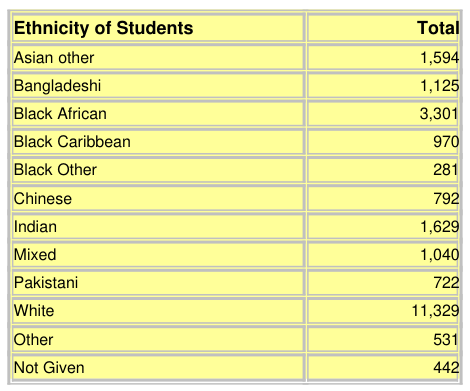
Table 4: University of Greenwich student population by ethnicity 2012 - 2013 (University of Greenwich,
Table available in the original PDF paper.
Planning and Statistics (2014)) Ethnicity of Students Total
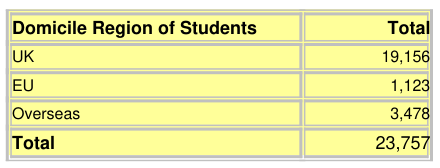
Individual HEIs compile their own students’ demographics at institutional, faculty and departmental level for their own internal analysis on student recruitment, retention, withdrawals, completion, etc as well as for external statistical returns to HESA. Demographics compiled by the Planning and Statistics department of University of Greenwich for example, provided similar breakdown classifications (see Tables 4 and 5). The figures are used by senior management for projection purposes and strategically plan recruitment goals for example. This demonstrates that even at institution level, it is still not possible to establish distinctive student characteristics for the purpose of supporting student customers in the teaching and learning environment which is where service is largely consumed.
Table 5: University of Greenwich student population by domicile 2012 - 2013 (University of Greenwich,
Planning and Statistics (2014)) Domicile Region of Students Total
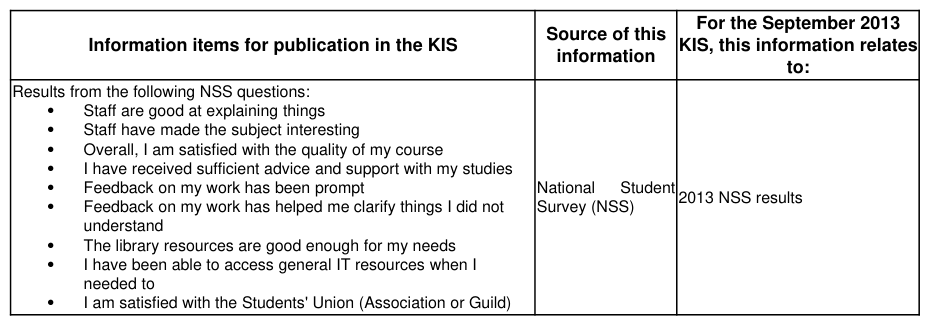
Student Customer Profiling Additional demographics currently available at the national and HEI levels are only sufficient for understanding entry level student customer classifications. Entry level in this instance refers to first year student entry into HEIs. The HEI sector in the UK has the annual National Student Survey (NSS) managed by Ipsos MORI (an independent research agency) where HEI students are encouraged to participate to provide feedback on student satisfaction (NSS, 2014). This annual survey is commissioned by the Higher Education Funding Council for England (HEFCE) on behalf of various bodies. Data comparison tables showing satisfactions and dissatisfactions on various metrics are then made available in the Key Information Sets (KIS) and Unistats (the official resource for comparing UK Higher Education courses). While the NSS provides prospective students with information to assist in their decision making in the choice of HEIs for further education, HEIs also use the data as a feedback and measure for their institutional guide on service improvements at a general level (see Table 6).
Table 6: Extract of Key Information Set (KIS) on the NSS derived information (Author: Unknown) Information items for publication in the KIS Source of this For the September 2013 KIS, this information relates information to:
Further to this, at HEI level (for example at the University of Greenwich) the Business Faculty independently implemented course or module level student customer surveys on student satisfaction. Towards the end of the course or module run, the student customers are encouraged to respond to the surveys electronically (see Table 7). Although the survey questions draw on more specific areas related to the course or module delivery experience, they are mapped quite closely in line with the NSS survey questions. The data collected is also not sufficient to help establish student customer profiling requirements. Besides, it is difficult at the operations level to target service areas and levels required for a better customer satisfaction rating. The nature of the service contract and service consumption require student customers to be constantly engaged and interacting with the service systems and providers within the HEIs to achieve their learning goals for contractual completion. Contractual completion refers to the student meeting the learning outcomes and passing the assessments set within each of the courses. Based on the above demographic and survey data available both at national and institutional levels, it can be concluded that it is necessary for HEIs to establish a method of data collection of student profiles. This new extended data collected can be used to better understand student customers and their needs, help in establishing better service delivery and therefore better student customer retention rates.
Table 7: Faculty level sample survey questions focused at course/module delivery (Author: Business Faculty, University of Greenwich)
Table available in the original PDF paper.
Please complete the evaluation survey at the end of your course.
How would you rate the value of this course overall?
How would you rate the quality of lectures on this course?
How would you rate the quality of the tutorials on this course?
How would you rate the quality of the learning materials on this course? (e.g. Recommended books, Moodle site, Handouts, etc.)?
How would you rate the operational efficiency and effectiveness on this course? (e.g. Timetable, clarity of general organisation, marking completed within indicated timeframes).
Please add any additional comments which will help to clarify how you have answered any of the questions above.
The successful use of customer profiling in many industry sectors have ensured its continuous use in many different ways to bring about organisational empowerment to engage more effectively with their customers. According to Forsythe (2012), customer profiling provides a “systematic means of understanding customers better”. Meanwhile Forsythe (2012), Schofield (2006) and Kippenberger (2000) found its usefulness in corporate strategy for managing customer satisfaction in a better way and improving rates of customer retentions. Customer profiling has also helped organisations to increase their customer base (Moberg, 1996). Gary-Bobo (2008) extended the idea that profiling benefits both the student customer and the HEI. This means that HEIs can use customer profiling for better empowerment and service delivery resulting in improved customer satisfactions and student customers in turn benefit from getting what they want.
The student customer population at each HEI in the UK comprise of undergraduate and postgraduate students who enter Higher Education at different entry levels. Since HEIs are increasingly harnessing the power of IT to deliver services to student customers especially in the teaching and learning focal area. When profiling student customers, it is crucial to include IT literacy and skill sets assessments and consider the following points on student customer types and distribution within a specific HEI at macro level:
The largest cohorts are mostly from the UK domiciled students with the next largest cohort from non European Union member countries (non-EU) and the smallest cohorts from European Union member countries (see Table 1 and 5). From the IT adoption and cultural perspectives, each of these countries where the student customers come from, has different levels of technology infrastructural accessibility and use to facilitate teaching and learning. As a result, the student customers have varied IT literacy and skill sets.
The demographic data on student domiciles show that there is a high level of mobility in the student population (see Tables 2, 3 and 5). In the global context, the population in many countries including the UK has become more cosmopolitan. This is evident in the spread of ethnicity of student customers for example in the University of Greenwich as seen in Table 4. Typically, many different ethnic groups of student customers come from families whose parents or grandparents are migrants. Some of these student customers are either born locally in the UK or they themselves are children migrants. The student customers’ records might reflect one particular domicile origin but in the last 10 years of their lives, they might have lived in another country and therefore experienced a different level of IT adoption and cultural perspectives.
Undergraduate First year entry cohorts no longer comprised of the usual entry level age group. For various reasons, there are now more mature student customers in Higher Education. Similarly from the IT adoption and cultural perspectives, each of these student customers has different levels of past technology use and therefore have varied IT literacy and skill sets
It has also been observed that many local undergraduate (UK) students used their first year experience in HEIs as a “taster year” unlike foreign students who are more “restricted” due to their visa restrictions and various other legislative controls. This means that if they are not happy with the education service they procured, they will transfer from their first HEI to their next available choice HEI. Such transfers can occur either at the end of their half term or at the end of their full term of the first academic year. These in- coming student customers will not have the same HEI IT adoption and cultural experience so their IT literacy and skill sets will defer from the existing student cohorts.
As a result of inter-HEI (between UK HEIs and HEIs from different non-EU countries) contractual service level agreements, many of the UK HEIs have large groups of 2nd and 3rd Year Direct Entry cohorts joining their existing cohorts of student customers. IT adoption and cultural perspectives in HEIs from each of these countries are vastly different in terms of the levels of technology use to facilitate teaching and learning. Many of these student customers who do not have English as their first language struggled to cope in their learning on top of having varied IT literacy and skill sets.
Special short term in-coming ERASMUS exchange student customers from HEIs from 33 participating European Union countries and various cohorts of student customers from other Higher Education student exchange programmes are another category of student customers (British Council and ERASMUS, 2014). Due to their backgrounds, short half term (otherwise also referred to as a logical half of the UK’s one academic year) contracts and stay, many of them will benefit from this profiling.
Students returning to resume their academic studies from interruptions as a result of work placements which are part of their contracts as well as those who interrupted their studies for various personal reasons need particular support to continue with their service consumption. They are the ones who will find that their familiar peer groups are somewhat different from their previous experience. New or revised service systems that they need to interact with that are either in the face-to-face or online contexts might have been implemented in their absence.
A particular small group of student customers with special needs include all students with disabilities such as visual, auditory and/or speech impairment and mobility impairment (Gov.UK). Many service providers do not necessarily know how to support these student customers. It has been found that this group of student customers found implementing assistive technology help with their learning. The “special needs” for each disabled student customer is unique. The UK government supports these “special needs” individuals financially.
Lastly, the individual student customer’s social, cultural and financial factors (in terms of affordability) also account for IT adoption, IT literacy and skill sets. The student customers’ family’s and friends’ IT adoption and use have an influence on them. Financial factors will also determine affordances at different stages of the student customers’ lives in terms of when and what type of technology they can afford.
Framing the Student Profile With the increasing use of technology in teaching and learning, student customer profiling on their IT literacy and skill sets is evidently relevant for better learning experience. Various independent small scale studies in different HEIs documented a wide range of technology enhanced learning experiences implemented (Self, 2009; De Cocco and Kenedy, 2012). So it helps service providers in the HEI to better understand and prepare for supporting learning needs that can be facilitated through the use of technology. The collective data from the student customers profiling can provide a holistic view and be used to feed into the re-engineering processes by way of re-evaluation, re-define, re-design, re-package, stream-lining, and re-implementations of service delivery.
The HEI at its organisational level must initiate a directive to establish generic student profiles periodically to be used across faculties for profiling to work effectively. This profile should include IT literacy and IT related skills. It will form a framework for better understanding of the HEI student customers, providing (face-to-face or online) support and development of students’ learning needs, working towards satisfactory service consumption. A potentially useful mechanism for extracting relevant data is to identify key indicators required for framing the student profile:
Formal and mandatory assessment of IT literacy and IT related skills to inform both parties, i.e. the student customer and the service provider (such as the lecturers and academic administrators).
Scope of IT literacy and IT related skills should be faculty specific to ensure assessment and capture of more relevant information that fits the skills requirements needed for the specific programme of study under the faculty. Specific tests and questionnaires should be used to capture the student customer profiles.
Feedback from student customers should be collated as feeds into recommended face-to-face or online learning support to ensure the appropriate level and relevant skills development is received by the student customer.
Every student customer should be assessed at the beginning of their entry into the learning contract at least once a year. This includes all returning students who have been “absent” for various reasons. Specific feedback from this exercise will facilitate and allow customization of IT support service for each individual.
Collation of student profile data at faculty and HEI levels for collective assessments and reviews to establish best practices in terms of student customer support and development.
Provide relevant access and supporting information to service providers so that they are empowered to perform their service provisions.
SERVICE PROCUREMENT IN HIGHER EDUCATION When student customers register with the HEI, the student enters into a contract both with the HEI and the faculty within the HEI. Teaching and learning development is the service that student customers consume while they learn and work towards the final goal. In this instance, the goal refers to the student customers achieving their required passes and credits that demonstrated they have met their learning goals or outcomes defined by the HEI. Since the learning process in HEIs is facilitated through the use of technology, student customers must have a reasonable level of IT literacy or IT skills to be able to facilitate and manage their own learning independently.
Service Contract The student receives the definitions and specifications of the degree procured in the form of programme and course or module levels handbooks. The programme level handbooks details include the list of courses or modules covered over a specific timeframe, the lecturers, the contacts, the credits accumulated, etc. The course or module level handbooks define in more detail, the teaching topics and plans, obligatory learning commitments in terms of hours, the length of the course, the assessment details, etc. This might include pre-requisite student capabilities or academic qualifications. Additionally, learning outcomes at programme level and more specific details at course level define the contractual obligations between the student customer and service provider. This service contract generally adequately covers the general expectations and understanding between the student customer and service providers. The service provider in this instance refers to the lecturer or tutor. It also includes the administration services provided by the faculty but details are not elaborated here. With the HEIs increasingly higher adoption rate of technology in their service delivery, the service contract however, does not usually cover any other areas such as IT related skills (assuming that the course is not a technical one).
Service Consumption Life Cycle Typically in the HEI, each academic year runs on a fix number of terms, so it is easy to associate each year to service consumption life cycle (see Figure 1). The number of the service consumption life cycles depends very much on the student customers’ programme of study, otherwise translated as service contracts procured by the student customers. The contact time between the student customers and service deliverers depends on whether the contract is for a full-time or part-time degree. A full-time undergraduate degree for example, takes between three to four years to completion while the full-time postgraduate degree takes between one and a half to two years to completion. Part time degrees take double the length of time to completion. This is based on the assumption that there are no periods of study interruptions.
The longer the tenure of the service contract, the more familiar the student customers are with the service consumption process and the use of technology tools to facilitate access. Where student customers failed to pass their course or courses, they failed to meet their learning outcomes or goals. These failed cohorts who have to be re- assessed go through a slightly extended service consumption life cycle that is slightly different from the other main cohorts of student customers. This extended version is classed as an “Exception Minor Subset” service consumption life cycle (see Figure 1). The number of such exceptions allowed for each student customer depends on the policy of the faculty. In identifying this, it is possible for the HEI to classify and define appropriate service support in this area. If they pass this re-assessment, their progression will be reviewed and determined by the HEI academic panel. For those student customers who failed their re-assessments, they will be required to go through the full course specific learning cycle in the following academic year. But this group of student customers will be assigned to the normal cohort of students’ service consumption group.
Exception Minor Subset
Figure 1. A Full-Time Single Service Consumption Life Cycle equals to an academic year (on the left) and a Full-Time 3-Service Consumption Life Cycles for the 3-year Undergraduate Student Customer (on the right) (Author's)
E-Finance Payments VLE E-Library
E-Social Network
E-Registration E-Communications E-Student Support
Figure 2. Focal areas used by student customers during Service Consumption Life Cycle (Author's)
Figure available in the original PDF paper.
During the period of the service consumption life cycle, the student customers will interact with some key functional focal areas of services (see Figure 2). The focal areas largely exists as independent silos but over time, there has been attempts at building bridges between them to simplify student customers’ access to these service areas such as using a single login through web access. The use of service blue printing technique when mapped against the student customer profiles help to plot the overall service processes, perspectives, activities and evidence (Shostack, 1984). Staged periodic HEI level audits across these focal areas of services will produce results that identify frequency of usage in key service interaction points, service gaps and issues for service re-engineering to rectify and improve services in the HEI.
Inductions and briefings are run bi-annually at faculty level for the different cohorts of new entry level student customers. The major event occurs during the Inductions or “Freshers’ Week” before the start of the service consumption life cycle while the second one occurs before the start of the second half of the next term. There are still some student customers who are found to have missed these sessions for various reasons, some of which are due to external influences. Faculties have to determine how to address these gaps and develop an exception process that can handle this issue and close service gaps. The following describe the focal areas of student customers’ interactions via the use of technology:
The main source of learning is through interacting with the Virtual Learning Environment (VLE) which hosts the learning contents, course or module related communications, and facilitates electronic assessments and re-assessments submissions and feedback. This is the most important focal area because it is the primary service providing source for student customers with the highest frequency of interactions. Specific functional development of the course or module website is implemented to encourage students to interact with the system for learning engagement and deep learning.
o While the faculty might dictate a general management instruction on the provision of this service system, there is still disparity in the level of the detail development. A validation process is needed to improve standardisation, recommend and streamline services for each course or module.
o There are short term service contract student customers (found in the different groups of student customer types and distribution) who do not know how to use the VLE so they need to be briefed.
o Applications and appeals for extenuating circumstances that may impact the student customers’ assessments submission are also managed through this channel.
o IT access and related network problems lie in a separate domain under the HEI’s Network and ICT department. From the service prospective, when accessibility problem occurs with this particular service system, student customers are channeled to the ICT Help Desk for assistance. It must be noted that when there is accessibility problems with the HEI’s network, the VLE is also not accessible.
The E-Library resource methods of access for academic content, self-help book check-outs and returns, e- fines, etc require specialised briefing on how to access the resource. Some student customers who missed these briefings for various reasons including some short term service contract student customers need to have similar sessions organised. Student customers use this resource regularly for access to additional learning contents for their learning and assessments preparations.
E-Registration and self management of student customers’ private and course related information. There are two specific peak times in access to this resource which usually occur before the start of the academic terms. So this means both at the beginning and at the mid-point of the service consumption life cycle.
E-Finance related payments, disbursements, access and procedures are very often not clearly understood by student customers. Problems such as delayed payments results in access to learning resources being denied which often resulted in confusion for students because information is not available or unclear.
E-Communications relate to HEI and faculty related channels for marketing information, publication and emails. Although this is largely intuitive, there are other areas such as sources of contacts which still confused student customers. This is also another high frequency access focal area.
E-Student support covers disability assessments, counseling, language support, etc. Although this is very important for the minority of student customers, this focal area is still largely a “mystery” to even other service providers within the HEI.
E-Social Network refers to the Student Union and Clubs access which promotes active social interactions. This is a frequently used resource by students for communications, publicity, information access and distributions.
Following service reviews and process reengineering for each focal area leading up to implementing better services to meet the service needs of the new profile of student customers, HEIs can still consider taking their service delivery to another level. Raban (2011) suggests the use of risk regulation where reviews and assessments are part of the corporate governance requirement for HEIs. While this justifies a means for improvement, Crouchley (2004) argues that performance measurements used as indicators of HEI performance are flawed due to specific limitations in “tick box exercises”. In this instance, the continuing use of updated student customer profiles to map against the focal areas discussed above will result in a more accurate holistic view of the HEI service delivery. It is even possible to analyse specific service details within each focal area to determine the frequency of use, re-distribution of support levels required, cost reductions and cost effective operations. Service gaps found can be rectified by repeating the re-engineering service processes using service blueprinting techniques to iteratively test and re-test before implementations to ensure efficiency and effectiveness in service delivery.
CONCLUSIONS
An exploration of the potential use of student customer demographics and NSS data for understanding the changing student customer profiles is made. It is found that both sets of data do not fully conclude with a clear student customer profile. More student customers are now expected to engage in the use of technology in HEIs for their learning environment, administrative functions and Higher Education Social purposes. Student customer profiling is suggested through the analysis of cohort compositions and categorizations including their IT literacy and skills. The collective data from the profiling exercise will then be used for training and updating of cohorts of student customers’ IT literacy and skill sets.
The student customers’ service consumption life cycle is discussed in the context of their need to interact with various focal areas for their service consumption. Even though HEIs have progressively updated their silos of online systems in their service focal areas with some attempts on building bridges to inter-connect these systems, they are still not functioning as cohesively as in an ideal scenario. These service focal areas functionally exist autonomously and as specialised service centres, they need to form and function cohesively for better service delivery. The use of student customer profiles should also greatly improve accessibility because the service focal areas will have a better defined expectation of how best to deliver services. Additionally, the student customer profile including students’ view of what a good learning experience affordance mean should ultimately translate to better student retention.
REFERENCES
Bristish Council (2014), ERASMUS, European Union's flagship educational exchange programme for Higher Education students, teachers and institutions, Website: http://www.britishcouncil.org/erasmus-about-erasmus.htm Crouchley, R., and Taylor, J. (2004), “Higher Education Performance Indicators: Invited Comments on the Papers by Draper
and Gittoes and Bratti et al.Source: Journal of the Royal Statistical Society”, in Series A (Statistics in Society), Vol. 167, No. 3(2004), pp. 497-499, Wiley for the Royal Statistical Society. Website: http://www.jstor.org/stable/3559776 De Cicco, E. and Kennedy, S (2012), “Learning in a digital age: Extending higher education opportunities for lifelong learning” Website: http://www.jisc.ac.uk/publications/programmerelated/2012/learning-in-a-digital-age.aspx ERASMUS (2014), European Commission: EU Programme for Education, Training, Youth and Sport, Website:
http://ec.europa.eu/programmes/erasmus-plus/index_en.htm Forsythe, P. J., (2012) "Profiling customer perceived service quality expectations in made-to-order housing construction in Australia", Engineering, Construction and Architectural Management, Vol. 19 Iss: 6, pp.587 – 609, Emerald Group Publishing Limited Gary-Bobo, R.J. and Trannoy, A. (2008), “Efficient Tuition Fees and Examinations”, Journal of the European Economic
Association, Vol. 6, No. 6 (Dec., 2008), pp. 1211-1243Published by: Wiley on behalf of European Economic Association. Website: http://www.jstor.org/stable/40282703
Gordon, G. (2005), “Enhancing Practice: Responding to Student Needs” Website: http://www.enhancementthemes.ac.uk/pages/docdetail/docs/publications/responding-to-student-needs-booklet Gov.UK, https://www.gov.uk/browse/disabilities Gunnar Moberg, (1996) "How Skandia AFS defines and grows its customer base", Managing Service Quality, Vol. 6 Iss: 5, pp.24 – 26, MCB UP Ltd Higher Education Statistics Agency (HESA), Website: http://www.hesa.ac.uk/dox/unistats/UNISTATS_Definitions_v1.0.pdf Higher Education Statistics Agency (HESA), Website: http://www.hesa.ac.uk/content/view/3103/393 Key Information Set (KIS), Website: http://unistats.direct.gov.uk/find-out-more/key-information-set#kis Kippenberger, T, (2000), "Holding on to your customers", The Antidote, Vol. 5 Iss: 5, pp.21 – 23, MCB UP Ltd Raban, C., (2011), “The Quality Assurance Agency for Higher Education (QAA): Risk Regulation”, Website:
http://www.qaa.ac.uk/Publications/InformationAndGuidance/Documents/Risk-regulation.pdf Schofield, P., Katics, N., (2006), “Swedish Hotel Service Quality and Loyalty Dimensions”, in Joseph S. Chen (ed.) 2 (Advances in Hospitality and Leisure, Volume 2), Emerald Group Publishing Limited, pp.123-157, Emerald Group Publishing Limited Self, R.J., (2009) “Addressing the challenges of low ICT literacy in UK university student”, HEA-ICS Workshop, “e” Teaching
and Learning 2009, University of Greenwich, London, 2 June 2009 Website: http://www.derby.ac.uk/files/richard_self_- _addressing_the_challenges_of_low_ict_literacy_in_uk_university_students.pdf Shostack, G.L., (1984) "Designing Services that Deliver", Harvard Business Review, vol. 62, no. 1 January - February 1984, pp.
133–139 The National Statistics Survey (NSS), Website: http://www.thestudentsurvey.com/ University of Greenwich, Planning and Statistics (2014), Website: http://portal.gre.ac.uk/cp/render.UserLayoutRootNode.uP?uP_tparam=utf&utf=/cp/redirect/cms%3Fdest%3Dhttp%3A%2F %2Fwww.gre.ac.uk/offices/pas
LISTED IN THE AHFE DIGITAL BOOKSTORE CATALOGUE
Explore the complete digital volume
Advances in The Human Side of Service Engineering
Read this individual research paper free through the original publisher, or explore the full digital proceedings book.
ISBN 978-1-4951-2091-6
Explore this ISBN in the AHFE Bookstore ↗Listed in the July 2026 bookstore catalogue; search by ISBN to confirm current availability · Digital book purchase optional