Javid Ahson, Hisashi Masuda (2019). Effects of Social Promotion for Customer Choice in the High Mobility of Mobile Phone Market. In: Advances in The Human Side of Service Engineering. AHFE Open Access, vol. 8. https://doi.org/10.54941/ahfe100254
Current mobile phone markets have becoming high mobility of mobile-phone users by standardizing the mobile phone devices. In Japan, before introducing MNP (mobile number portability), the Japanese market was saturated in between three international companies named NTT DoCoMo, KDDI au and Softbank with their specified mobile phones. The competitive condition around the mobile phone market to switch from specific to standardized mobile phones is becoming severe. However, in Japan, the current main strategy has been price competition still because the devices are well developed and the traditional mobile phone market has a low mobility of mobile-phone users. Conversely, in Pakistan, to be undertaking social promotions based on high mobility of mobile phone users. In this case, how can we develop and balance individual/social promotion in the high mobility of mobile-phone users? Mobile-carriers should understand customer preference for mobile phones and services rather than increasing their market shares. Customer retention and loyalty are important goals for mobile carrier companies. We found the equilibrium of individual/social promotion effect based on numerical simulation. Marketers can better cultivate relationships with existing customers instead of attracting new customers. We will design an optimal customer selection, formulating a distinct marketing mix and modifying the marketing organization.
The mobile phone industry is one of the fastest growing industries in the world and increasing very fast as developing countries emerge (Keithy Conly, 2010). Mobile phones industries have gone through major changes and are constantly progressing to meet consumer expectations (A.T.Kearney 2013). Worldwide mobile phone industry is well defined by whole market share and price based upon product type. The mobile phone industry can further categorized into three different divisions: low-price, middle, and high-price. In the global mobile phone industry, scale and market share are the major goals (Keithy Conly, 2010). The ability to grow globally is critical as development in markets increased and new potential customers come forward. However, it is still possible to be profitable in the market without expanding rapidly against severe competition by stabilizing their position. Currently mobile phone market has becoming high mobility of mobile-phone users by standardizing the mobile phone devices.
Almost half of the population of the earth is now using mobile communications and a billion mobile phone subscribers added in the last 4 years (A.T.Kearney 2013). Still countless adults and young people would grow the social and economic benefits of mobile technology. Moreover, emphasizing on a huge opportunity for future evolution and a challenge to all players in the industry ecosystem to expand the range of products and services to overcome this demand.
The main objective of this research is to support the social promotions in the field of telecommunications in Japan. In addition, we are adopting social promotion strategy, which provided by the Pakistani telecommunication industries for their whole community. We are not saying individual promotions are not use full but we are finding a balancing point using some models and numerical simulations. In this paper, we use the terms; switching brands, social promotions, individual promotions, customer’s loyalty, customer satisfaction, and ultimately customer retention. The research questions are how to stop switching brands, how to promote social promotions in the society and discuss the advantages of social promotions in short, and long run.
Currently in Japan, there are three major companies, which saturated enough. In addition, the focus of all companies is to attract the new customers or poach customers from the other telecom carriers. For this purpose, these companies are making many promotions for only those who want to switch their carrier (individual promotion) and sometimes companies ignore the demands of their old customers. But this paper is highlighting the efficient promotion strategy which is not only for new customers or for those who are switching from other carriers but this strategy is also for old customers, this research is to introduce social promotions in telecom industry to achieve customer loyalty for customer retention and also to attract new customers. As maintaining customers is an important thing for marketers because the cost of marketing activities issued by the service providers to attract new customers is much greater than the costs incurred to maintain existing customers (Kotler and Keller, 2009).
This paper divided into 6 sections. Section 1.1 presents a background of telecommunication industry worldwide and especially in japan. Sub-Section 1.2 explains the research questions and purposes of study. Sub-Section 1.3 is about research approach. There are some related works discussed in section 2. Section 3 reviews the making of models for social promotions. Section 4 is about main results and numerical simulations. Section 5 is implications and finally the discussion section concludes the paper in section 6.
BACKGROUND
Telecommunication companies in Japan In Japan, before introducing MNP (mobile number portability), Japanese market was saturated in between three international companies named NTT DoCoMo, KDDI au and Softbank with their specified mobile phones. Meanwhile there was no such competition of mobile phone because every mobile phone carrier has its own specific mobile phones different from one another. Soon 3G technologies introduced and mobile phone demand increased tremendously and everyone desires to get latest mobile phone so after specified mobile all mobile companies shifted to Standard mobile like I-Phone and Android phone.
Japanese consumers tend to use mobile phones more as a device to connect to the Internet in order to download various contents, such as games, (currently social games are attracting the interest of the younger generation). Also mobile digital TV, movies, and music as well as using value-added services, such as shopping at convenience stores and making train and airplane reservations (Funk, 2005, for example). Small handsets can now even view homepages built for PC access and have come to be devices for mobile computing. Because of this critical situation, many people start switching their carriers to take benefits. In Japan, every mobile carrier’s aim has become to get new customers. Every company introduces many exciting offers for those who want to change their networks only and somehow they failed to meet the requirements of the old customers. Due to lack of attention, many companies lose their old customer. All attention was on individual promotion not for the whole members or social promotions. Using the social value of user community is one solution for the differentiation factors in the future. As the competitive condition around the mobile phone, market to switch from specific to standardized mobile phones is becoming severe.
Telecommunication companies in Pakistan In contrast, Pakistan to be undertaking social promotions based on the high mobility of mobile phone users. In this region of the world, telecommunication industry is growing rapidly (Saeed, R.. Nisar, F., Lodhi, R. N., Ahmad,M., Human Side of Service Engineering (2019)
Arshad. M. 2013). Since 2004, after the deregulation, cellular market in Pakistan observed incredible development rates of over 170% and the trend is continuing to the present (Pakistan Telecommunication Authority, 2011-2012). Many companies became a part of this sector in the last decade and competing fiercely for the market share. The total number of cellular subscribers is above 108.99 million at the end of the year 2012. The telecom industries are trying their level best to attract and retain the customers through several marketing skills.
In Pakistan there are five main telecom operators Zong, Warid, Ufone, Telenor and Mobilink which are offering GSM (Global System of Mobile services) and all of them are successfully obtaining their goals in their particular ways (Saeed, R.. Nisar, F., Lodhi, R. N., Ahmad,M., Arshad. M. 2013). In order to compete successfully in this situation, the mobile carrier companies have developed social promotion strategies that include the low fees in the air time rates, free friends and family calls, free SMS (Short Message Service), free credit and small top ups. Some time on different national or religious occasions like in December 25, many mobile carrier companies provide a free internet facility for all their users. There are so many examples of social promotions in Pakistan. The goal of such strategies is to not only beat the competition and retain the customers; it also attracts the new customers by offering the attractive packages.
Brand Switching For developing the mobile phone industry well, it is difficult to make differentiation by promotions for individual. However, in Japan, currently the main strategy is price competition still because the device is well developed; traditional mobile phone market was low mobility of mobile-phone user. ‘Switching Brands’ has been widely used in the field of economics, psychology. This concept further implemented in marketing as well. By incorporating the influence of governmental economic policy, this work provides an integrated framework to analyze the experiences and significances of switching brands (Genesh et al., 2000: 65). Meanwhile, with the rapid growth of mobile phone market globally, consumer’s switching brands should understand to compose an inclusive marketing strategy for players in the market.
There are numerous Models to investigate about the behavior of people. The convenient one described by (Dick and Basu, 1994; Sheeran and Abraham, 2003). Experience counted to be a way in order to make decision. The customer as its existing product but many companies has unsuccessful in understanding the market mix strategy. Numeral studies have investigated the advantage of customer-focused brand switching and their potential to achieve super results (Oliver, 1999; Russell-Bennett et al., 2007). Theoretically, it is important to investigate the building blocks of customer satisfaction and brand switching. As a substitute, the practical implementation helps to enhance the experience of customer in term of brand switching. This study particularly focuses on the importance of customer satisfaction with determinants on brand switching because the core objective of strategic marketing is the resultant of customer satisfaction (Jaworski and Kohli, 1991; Luo and Seyedian, 2003; Webb et al., 2000).
As there is positive impact of customer satisfaction on sustainability of brand (Howell, 2004), meanwhile, brand switching occur due to the decrease and increase in the satisfaction level and the willingness of the customer to purchase other brands is some time decrease and increase. Also supported by Trivedi and Morgan (1996) as well as Klein (2001) stated many examples where many loyal customers switched towards other. Motivation through Extrinsic and intrinsic factors may affect the brand switching. The major roles in intrinsic motivation are through choices and varieties (McAlister and Pessemier, 1982) or attribute satiation (Zuckermann, 1979). Also consequential behavior can also be the effect by curiosity (Sheth and Raju, 1974). If the goal of purchasing not achieved many consumers shift towards other brand (Van Trijp et al., 1996). Young adults easily switched towards other brands if they have limited income (Ness et al., 2002; Dick et al., 1996).Researches trigger out many crucial factors affecting the behavior such as price, variety and packaging (Ness et al., 2002; Dick et al., 1996; Veloutosou et al., 2004) involvement (Baltas, 1997; Shukla, 2004), and dissatisfaction (Abendoth, 2001; Shukla, 2004).
Social promotion There is no doubt that the ultimate objective of every company is to create the certain level of sales and deliver such promotions that may create profit to continue the business activities. Every business develops the sales evaluation and develops the strategies to accomplish it, especially in the service industry. This is the serious link between the social promotion and customer loyalty. The social promotion and sales battle has created the need of continuously retaining the older customers and creating fascination for the perspective customers. The national and multinational Human Side of Service Engineering (2019) companies are spending millions of the dollars to give a boost to the social promotions in the short time. The researchers of social sciences have a long debate on the influence of social promotion on the behavior of customers. The overall observation in social promotion is to motivate all consumers to act positively towards offering of company. The customers are satisfied and they will keep on purchasing the products even on the normal price. Contrary to this, Dodson & Taybout, (2001) found that social promotion acts as an external incentive and there is less possibility that the customers will repurchase the products after the campaign is over.
Individual Promotion The individual promotion is certainly very important. It may change the customer approach to purchase the product on the normal price. Price discounts may also encourage low-probability purchasers to try. Individual promotion is the strategy of a company to get new customers or when they observe one customer’s last purchase history then they provide some discount and some promotions to those customers. Individual promotions are for short term and although at that time after getting exciting offer that customer will be satisfy but in business point of view marketers have to think for whole community not for only one (Gedenk, K., Neslin. 1999). There will be a negative impact on the brands worth if that customers still move to other company due to more exciting offer because price used as a measure of excellence for many service consumers.
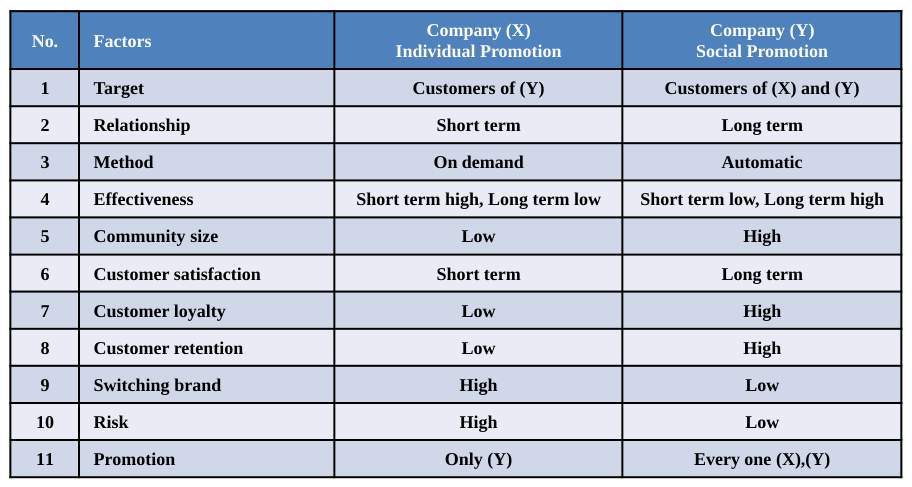
Characteristics of Individual and Social Promotions We summarized the characteristics of individual and social promotions (see Table 1).
Table 1: Characteristics of Individual and Social Promotions No. Factors Company (X) Individual Promotion Company (Y) Social Promotion
Research Questions and Purposes This research collected to answer many questions as; Firstly, how can we develop balance of individual/social promotion in the high mobility of mobile-phone user? Secondly, what would be the impact when balance of individual/social will developed? Thirdly, mobile-carrier companies should understand customer preference for mobile phones and services rather than increasing the market share with the purpose to show that customer retention, satisfaction and loyalty are important goals for mobile carrier companies.
In today’s low growth and highly competitive marketplace, customers are getting an important area of analysis and planning. It is very useful for the mobile carrier companies to recognize how their sales and social promotions campaigns stimulate the customer’s behavior and the grade of the effectiveness of their activities in a specific way.
It also conveys the importance for the policy makers and regulating bodies to make an understanding of the role of sales and social promotions in varying the behavior of the customer in this vibrant industry. It may provide support to the academic researchers to recognize the customer’s behavior of the telecom industry by filling the gap in the literature by exploring the connection between sales and social promotions as well as customer’s retention and customer’s loyalty.
The main purpose of the study is to find how can we built a brand loyalty in the mind of customer in order to find that we are studying the dimensions of customer satisfaction which help us to find brand switching in services. This study based on how we can make customers satisfy by providing them social promotions in telecommunication industry. If customer is satisfied with the product or services then he or she will remain loyal to the product or brand.
Approach We propose a model to compare the effects of two different promotions. The two different promotions are the individual promotion and social promotion. We apply the "Customer Poaching and Brand Switching"(Fudenberg and Tirole, 2000) to the individual promotion. Next, we extend the individual promotion model for competition of individual and social promotion effects. We focus on the welfare assistant promotion as one of a social promotion effects.
RELATED WORKS Hotelling model (Hotelling, 1929) can express customers' behavior on location and product characteristics.
Fudenberg (2010) extended hotelling model for customer poaching. Definition of Customer poaching is “Attracting customers of their competitor by offering them price discrimination”. In this model, duopoly poaching under both short-term and long-term contracts assuming either that each consumer's brand preferences are fixed over time. Fudenberg mentioned, "Changing preference.” However, this setting of model is required more assuming for model.
Zhang (2011) is applying Fudenberg (2010) to "behavior-based personalization" by customers' purchase histories. She constructed a two-period duopoly model about personalization. Consumers have heterogeneous tastes and uniformly distributed on a hotelling line.
MAKING MODELS FOR SOCIAL PROMOTIONS In this section, we construct models for representing effects of social promotion and individual promotion. First, we prepare the benchmark model using Hotelling Model (Hotelling, 1929). Second, we represent an individual promotion as a “customer poaching” by Fudenberg (Fudenberg and Tirole, 2000). Finally, we construct an individual plus social promotion model based on these basic models. The targeted social promotion is a welfare assistant promotion. We consider the promotion strategies how do manage customers within a variety of social structure. The point of the social promotion model is that we divide customers to three types: Low-income, Middle- income and High-income.
We believe that the next idea of a mobile-phone market in Japan is social promotions. Because of price competition is prevalent in current Japanese situation. Thus, we focus and propose the model considering social promotion effects. Naturally, we require the empirical research for the validation of the proposed model in the further research.
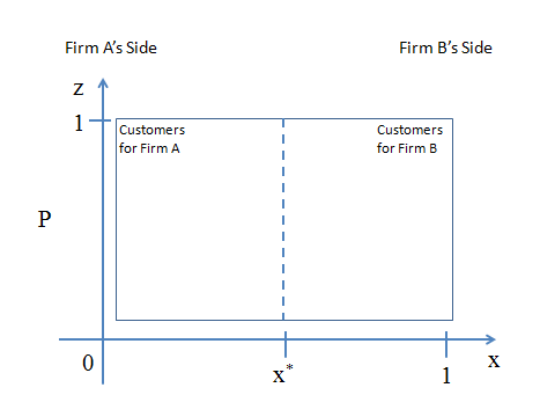
A Benchmark Model by Hotelling Model We set two firms and n-period model based on the Hotelling Model (Hotelling, 1929) (see Figure 1). We prepare the condition of firm’s side and customer’s side. After we calculate the equilibrium by using neutral customer that they are not discriminate two firms. Finally, we get the position of the neutral customers.
In firm’s side, we set the Firm A and Firm B. Firm A provides service a. Firm B provide service b. These services are non-durable. The value of services is v. These prices of service are P. Service a and service b is constant, that is, they are not changed by time. The marginal cost of services normalized to Zero. Two firms act simultaneously. Human Side of Service Engineering (2019)
In customer’s side, customer preference is represented by a line in [0, 1] on the x-axis (see Figure 1). The customers are bounded to use either service a or b on the every period. There are neutral-customers that are not discriminate service a and b. The preference of neutral-customers is x*. We use a uniformly distribution as a customer distribution function. That is, f(x) = 1 on the z-axis. Utility functions for firm A and B are,
Equations and mathematical formulas are available in the original paper PDF.
Utility function represented by uA and uB. Parameter t is a transportation cost. Variable x is represented customers preference position on the preference interval [0, 1].
Figure 1. Concept of Hotelling Model. (Hotelling, 1988)
We focus on the neutral-customers x*. Neutral-customers are not discriminate service a and b, that is, each of utility function is same by x*. Therefore, with a – b is not zero,
Next step, we calculate the profits of firm A and B. Profit πA and πB of firm A and B are, with the distribution function f(x) = 1,
(a+b)/2
Profit πA and πB are linear functions of a or b. By profit maximization, the value of a is maximum point in the closed interval. In equilibrium, both profit of firm A and B is same. That is,
We got x* is 1/2 and service a is close to 1/2 from 0 to 1/2 on the x-axis.
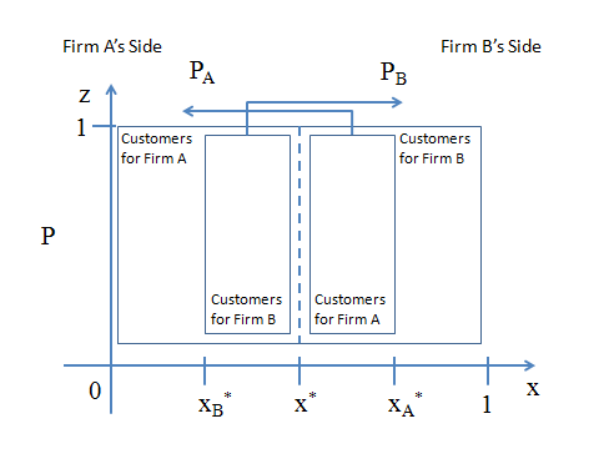
A Model for Individual Promotion In this subsection, we consider an individual promotion by using “customer poaching” (Fudenberg and Tirole, 2000) extended from Hotelling model (Hotelling, 1929). Firm A and B conduct a price discrimination strategy for rival’s customers (see Figure 2). The discount prices are PA for customers in firm B’s side and PB for customers in firm A’s side. Service a is close to 1/2 from the previous subsection. We add two utility functions to previous one,
We focus neutral-customers from there as well. In firm B’s side, neutral-customers is x B
*. In firm A’s side, neutral- customers is xA
*. Therefore,
f ( x)dx
1 f ( x)dx
We calculate the discount prices PA and PB by profit maximization, π A ' (PA)=−2 PA+P
In the same way, the discount price PB is P/2.
Figure 2. Concept of a Customer Poaching Model. (Fudenberg and Tirole, 2000)
A Model for Individual and Social Promotion We proposed an extended model for representing effects of the individual and social promotion based on the previous sections. Here, we focus on the welfare assistant promotion as a social promotion. There are many social promotions. We believe that it is very important to discuss the welfare assistant promotion considering current economic situation all over the world.
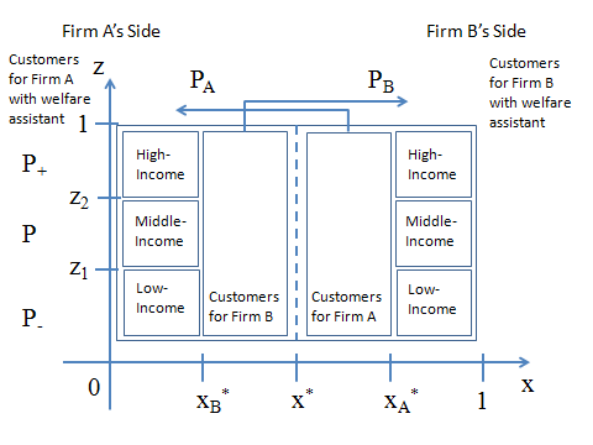
We divide customer type as High-income, Middle-income and Low-income (see Figure 3). z1 and z2 represents the difference between customers, on the z-axis. Firms provide high value v+ by Price P+ to High-income customers. Firms provide normal value v by Price P to Middle-income customers. Firms provide low value v - by Price P- to Low-income customers. In addition, we add the social value VS for representing the effects of social promotion to the previous discussion. Cs represents the cost of conducting the social promotion. The utility functions are, with v -- P- = v – P = v+ - P+,
(1−z2)dx+P
2 (x A
2 )−CS xB
Here, we set P- z1 + P (z2-z1) + P+ (1-z2) = P + C for cancelling the social promotion cost Cs. Therefore, neutral- customers xA
* is,
2t (1−2a) ,
(B)+t (1−2a)
(B))+2Pt (1−2a)
1 f ( x)dx
Figure 3. Concept of a Welfare assistant promotion
There are two different logics. The two logics are independent. First is “Customer poaching” which discussed previously in subsection. Second is “Welfare assistant Promotion” as concrete one of the social promotion cases. I divide existing customers of each firm to three types: High-income, Middle-income and Low-income customers. We think that the social values vS is functions of time. We set the simplest forms for the social value vS as following, a and b are parameters, t is a time, v S(t )=ct+d. (13)
NUMERICAL SIMULATION FOR THE MODELS
Introduction
In this section, we aim to simulate the proposed model with focusing the change of social value v s (t). We set the actual number for the formula. First, we prepare the customer-poaching model as a benchmark. Second, we check the aspect of proposed individual and social promotion model.
As an output from this section, we got the matrix of change the parameter, t and appreciation rate c. The parameter c is increasing rate of social value vs(t). Naturally, we need to check by empirical researches. However, it is important to understand the mechanism of model for getting the results from real investigation.
In addition, we need to understand of social promotion effects. How do we evaluate the social value is the issue in current economy of all over the world. Our approach is one of them that how do we evaluate the social value.
A Model for Individual Promotion: No Social Promotion Effect We check the difference between profits of Firm A and Firm B based on the section 3.2 (see Figure 4). Here, we set that P is 1, and a is 0.49, that is b is 0.51. We check the five periods.
1 2 3 4 5
Benchmark
Pi_A - Pi_B
-1 -0.8 -0.6 -0.4 -0.2 Period
Figure 4. Benchmark: No Social Promotion Effect
Figure available in the original PDF paper.
There is no change in relation to the difference of profits. The reason is that the condition is equilibrium.
A Model for individual and Social Promotion In this subsection, we add the social value based on section 3.3(see Figure 5). The parameter setting is the following: P =1, t =15, a=0.49, d=-0.5 and c = {0.01, 0, -0.01}. In Figure 5, A11 represents the both appreciation rate is 0.01. A21 represents the appreciation rate of firm A is 0 and one of firm B is 0.01. A31 represents the appreciation rate of firm A is -0.01 and one of firm B is 0.01 and so on.
1 2 3 4 5
Pi_A - Pi_B -0.2 -0.4
-0.6
Benchmark A11 A21 A31 A12 A22 A32 A13 A23 A33
Period
Figure 5. Simulation of Individual and Social Promotion Model
Figure available in the original PDF paper.
We got the nine (9) patterns of the results (see Table 2). In Table 2, “positive” means that the appreciation rate c is 0.01; “constant” means that one is 0 and “negative” means that one is -0.01 Note: The graph for numerical simulation show the difference of Firm A’s profit and Firm B’s one each parameter c. The c means appreciation rate of social value Vs.
Social Promotion Effect Firm B
IMPLICATION We find the equilibrium of individual/social promotion effect based on numerical simulation by which we provided some important insights, such as the dissatisfaction, felt by consumers has positively influenced the brand switching decision. Therefore, the company needs to review all factors that can increase customer satisfaction both in terms of product quality improvement, quality of service as well as in providing them promotions with no hidden elements. Marketers also need to communicate the quality of product and quality customer service to existing and prospective new customers. Due to the social promotions consumers, who are satisfied, tend to keep using the same brand and even invite other customers to use the same brand of product.
Marketers need to do new developments in their offered product, thus they can meet the consumers’ needs and desires. We also find that social promotions affect the consumers’ brand switching decision. It means that marketers need to know in certain forms how social promotion influence consumers’ brand switching decision. Marketers must be able to influence consumer-purchasing patterns by conducting more attractive promotions programs for the whole community of members, such as bonuses, incentives, discounts and others.
CONCLUSIONS
We hypothesize that social promotions have long-term effects for the communities in relation to the service. Here, we showed the long-term effect of some social promotion strategy, a welfare assistant promotion, with dividing three types based on a "positive,” "constant" and "negative" effect. We believe that actual behaviors of long-term effects of social promotion are non-linear. Thus, we need to fit the behaviors of long-term effects based on empirical researches. This paper modifies the framework and tries to produce referential findings from the study of mobile phone market in terms of experiences and significances of switching carrier in Japan. These numerical results expected that this research would develop enhancement in understanding of switching brands or carriers for researchers.
Particularly in Japan there is less work done in the service sector like telecommunication. Thus, this study aims to cover the empirical gap in literature. Generally, our empirical findings have supported prior studies. The study finds consumer dissatisfaction affects positively on brand switching decision, which it means that dissatisfied consumers will try to find information on other products they consider and perceive have the added-value and in line with their expectations, and they may stop buying a product or influence others not to buy. We also find that social promotions positively related to branding switching decision. Meanwhile, the need of the variety seeking moderates the relationship between customer dissatisfaction and brand switching decision, which the presence of low level of need to seek the variation has weakened this relationship.
ACKNOWLEDGMENT
We are very grateful to Professor Youji Kohda for his comments and suggestions. JSPS KAKENHI Grant Number 25885040 supported this work.
REFERENCES
Abendoth, L.J. (2001), “Disentangling regret from expectancy-disconfirmation”, Advances in Consumer Research, Vol. 28, pp.
371-2.
A., T., Kearney.,Global Retail Development Index™ Annual report 2013. Blattberg, N. (1990). Sales Promotion: Concepts, Methods, and Strategies. New Jersey: Prentice Hall. Campbell, L., Diamond, W. D. (1990). Framing and Sales Promotions: The Characteristics of a Good Deal? Journal of Consumer Marketing, pp. 25-31. Chakarvarthi, N. (1984). A Price Discrimination Theory of Coupons. Marketing Science, pp. 46-128. Chandon, P. (2000). A Benefit Congruency Framework of Sales Promotion Effectiveness. Journal of Marketing. Conly, K. Global Mobile Phone Industry (2010). Das, G. (2009). Impact of sales promotion on buyer’s behavior: an empirical study of Indian retail customers. Global Marketing
Journal,pp. 11-24. Dodson, J. A., Taybout. (2001). Impact of Deals and Deal Retraction on Brand Switching. Journal of Marketing Research. Fudenberg, D., J. Tirole. 2000. "Customer Poaching and Brand Switching." The RAND Journal of Economics, 31(4), pp. 634- 657. Edrem, T., Swait, J. (2004). Brand Credibility, Brand Consideration, and Choice. Journal of Consumer Research, pp. 191-198. Haroad Hotelling. (1929). "Stability in Competition." The Economic Journal, 39(153),pp. 41-57. Howell, D. (2004), “Today’s consumers more open to try new brands”, DSN Retailing Today. Juanjuan Zhang. (2011). "The Perils of Behavior-Based Personalization." Marketing Science, 30(1), pp. 170-186. Klein, N. (2001), No Logo, Flamingo, London. Luk, S., Yip, L. (2008). The Moderator Effect of Monetary Sales Promotion on Relationship between Brand Trust and Purchase Behavior. Journal of Brand Management, pp. 452-464. Luo X, Seyedian M (2003). Contextual marketing and customer-orientation strategy for e-commerce: An empirical analysis. Int.
J. Electron. Commer., 8(2): pp. 95-118. McAlister, L. and Pessemier, E. (1982), “Variety seeking behavior: an interdisciplinary review”, The Journal of Consumer Research, Vol. 9 No. 3, pp. 311-22. Nagar, K. (2009). Evaluating the Effect of Consumer Sales Promotions on Brand Loyal and Brand Switching Segments VISION-
The Journal of Business Perspective, pp. 35-48. Ness, N., Gorton, M. and Kuznesof, S. (2002), “The student food shopper”, British Food Journal, Vol. 104 No. 7, pp. 506-25. Nijs, V. R. (2011). The category demand effects of price promotions. Marketing Sciences, pp. 1-22. Oliver RL (1980). A cognitive model of the antecedents and consequences of satisfaction decisions. J. Mar. Res., 17(4): pp. 460- 69. Omotayo, O. (2011). Sales Promotion and Consumer Loyalty: A Study of Nigerian Telecommunication Industry. Journal of Competitiveness, pp. 45-56. Pakistan Telecommunication Authority. (2010-2011). Annual Report. Islamabad, Pakistan: Pakistan Telecommunication
Authority. Peattie, K., Peattie, S. (1994). Sales Promotion- A missed Opportunity for Services Marketers? International Journal of Service Industry Management, pp. 22-39. PTA. (2011). Press Releases. Retrieved 09, 09, 2012, from www.pta.gov.pk:http://www.pta.gov.pk/index.php?
option=com_mediacenter&view=category&id=92&Itemid=739. Rust, R. T., Zahorik, A. J. (1993). Customer satisfaction, Customer Retention, and Market Share. Journal of Retailing, pp. 193-
215. Sheth, J.N. and Raju, P.S. (1974), “Sequential and cyclical nature of information processing models in repetitive choice behavior”, in Ward, S. and Wright, P. (Eds), Advances in Consumer Research, Association for Consumer Research, Urbana, IL. Shukla, P. (2004), “Effect of product usage, satisfaction and involvement on brand switching behavior”, Asia Pacific Journal of
Marketing and Logistics, Vol. 16 No. 4, pp. 82-105. Trivedi, M. and Morgan, M.S. (1996), “Brand-specific heterogeneity and market-level brand switching”, Journal of Product & Brand Management, Vol. 5 No. 1, pp. 29-39. Van Trijp, H.C.M., Hoyer, W.D. and Inman, J.J. (1996),“Why switch? Product category-level explanations for true variety-
seeking behavior”, Journal of Marketing Research, Vol. 33 No. 3, pp. 281-92. Vargo SL, Lusch RF (2004). The four service marketing myths: remnants of a goods-based, manufacturing model. Journal of Service Research, 6(4): pp. 324-335. Zuckermann, M. (1979), Sensation Seeking: Beyond the Optimal Level of Arousal, Erlbaum, Hillsdale, NJ.
LISTED IN THE AHFE DIGITAL BOOKSTORE CATALOGUE
Explore the complete digital volume
Advances in The Human Side of Service Engineering
Read this individual research paper free through the original publisher, or explore the full digital proceedings book.
ISBN 978-1-4951-2091-6
Explore this ISBN in the AHFE Bookstore ↗Listed in the July 2026 bookstore catalogue; search by ISBN to confirm current availability · Digital book purchase optional