Ichii Kenta, Hisashi Masuda (2022). Influencer attributes and characterizations on Tourists' intention to revisit destination in social media influencer marketing. In: The Human Side of Service Engineering. AHFE Open Access, vol. 62, pp. 1–7. https://doi.org/10.54941/ahfe1002533
Social media influencer marketing has recently received significant attention. However, this kind of social media influencer marketing has not been fully demonstrated in the context of tourism destination management/marketing. This study developed a research model based on the theory of persuasion, consisting of three influencer attributes and three characterizations as antecedents of revisit intention to destination. Data were collected through an experimental survey for respondents who live in Tokyo and Osaka in Japan. Here, two YouTubers (a man and a woman) created each tourism promotion video about one Kyoto cuisine restaurant in Kyoto. Respondents were assigned to a group to watch one of the videos, and after watching the video, they answered questions about the YouTuber and their intention to visit the tourist destination via a web questionnaire. The study found that PSR (Parasocial relationship) had a significantly positive impact on revisit intentions to destination relative to other characterizations on all groups. But the personal attributes positively related to PSR differed depending on the YouTubers and the respondents' place of residence. Therefore, tourism video marketing strategies utilizing social media influencers in destination marketing need to be fine-tuned based on the influencer's personal attributes, and characterizations considering the targets' place of residence.
Social media influencer marketing has recently received significant attention. The amount of investment in influencer marketing will be $15 billion by 2022 (Schomer, 2019). In contrast to traditional marketing channels, companies are increasingly emphasizing the importance of collaborating with influe- ncer who are closer to the customer. The number of studies on this type of influencer marketing is also on the rise (Hwang and Zhang, 2018; de Bérail et al., 2019; Munnukka et al., 2019).
In the field of influencer marketing in social media, many studies have validated Parasocial Relationship (PSR) formation between influencers and followers as an important construct. PSR is a construct that describes pseudo- relationships formed by audiences toward information disseminators on the media (Horton and Wohl, 1956). This concept has been emerged in mass communication research, but it has also been used to explain the influence of social media influencer (Lee and Watkins, 2016; Sokolova and Kefi, 2020).
However, this kind of social media influencer marketing has not been fully demonstrated in the context of tourism destination management/marketing. In tourism management, it is important to strengthen the brand of the tou- rism destination itself in addition to increasing the performance of the various individual local stakeholders. How to improve the brand of a tourist desti- nation through the promotion of local tourism businesses is an important perspective for destination management organizations (DMOs).
The purpose of this study is to analyze how the tourism promotion by local tourism businesses through video by influencers affects the evaluation of the destination by its viewers from the perspective of social media influencer marketing. In other words, we will examine the effects of tourism marketing on destination brands through influencer-based tourism video promotion in individual businesses such as local cuisine restaurant. In this way, we aim to extend the perspective of social media influencer marketing research to the context of destination management/marketing.
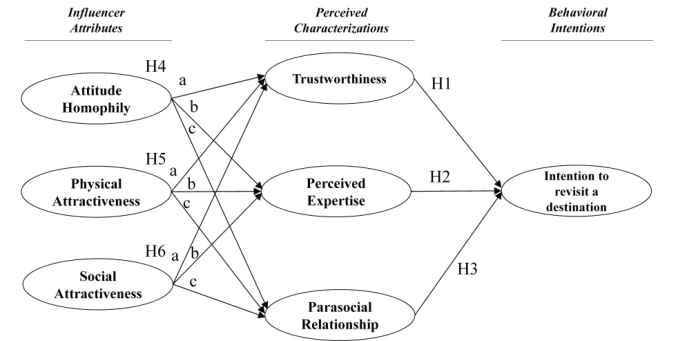
RESEARCH MODEL In this study, referring to related research (Masuda et al., 2022) and based on persuasion theory, we developed a hypothesis-based research model con- sisting of three influencer’s personal attributes (attitude homophily, physical attractiveness, and social attractiveness) and three characteristics (trustwor- thiness, perceived expertise, and PSR) as antecedents of intention to revisit a tourist destination (Fig. 1). Viewers of tourism video promotion by an influe- ncer can rate the influencer and the destination after watching the promotion video. In this paper, we examine the impact of influencer attributes and the characteristics on the evaluation of the tourism destination itself.
METHODOLOGY
To test our hypothesis, we created two types of tourism promotion videos and compare the viewer’s evaluation of them to examine the differences in their effectiveness. For this experiment, we prepared two videos that was composed of the experience of eating and drinking a same menu at a Kyoto cuisine restaurant as a one of tourist attractions by different two creators (male and female). The targeted destination is Kyoto City which is one of the famous sightseeing areas in Japan. The information presented in the videos is selected from the perspective of each creator. The first one is a video in which a male YouTuber himself gives an explanation. The second one is a video created by a female YouTuber. The videos are structured as follows: begin as they enter the restaurant, take their seat, watch preparations of the
Influencer Attributes and Characterizations on Tourists’ 3
Figure 1: Proposed research model.
cuisine food, eat, give their impressions while closing the video. The videos are approximately 7 minutes long.
For this survey, residents of areas near and far from the tourist destination will be targeted as respondents. Specifically, the areas are Osaka and Tokyo in Japan. Osaka is a close area to Kyoto, and Tokyo is far area. The reason why we chose to focus on two regions this time is two. One is that the ease of access to tourist attractions differs between regions close to and far from Kyoto in the COVID-19 disaster, which is expected to lead to differences in the evaluation of tourist destinations. Second, the YouTubers in this experiment are active in the vicinity of the target tourist destination. Therefore, they share a common sphere of life with viewers in residential areas close to tourist destinations, and the differences of influence may be observed against the far residents of the destination.
The survey question items in the evaluation of tourism promotion videos were constructed with reference to extant literature. In terms of influencer’s personal attributes, the first construct on attitude homophily like a concept of similarity between video viewers and distributors was adapted from Lou and Kim, 2019. The physical attractiveness and social attractiveness were based on Duran and Kelly (1988). Next, as for the influencer characteristics, trustworthiness and perceived expertise were constructed based on Lou and Kim (2019). The PSR was constructed based on Rubin and Perse (1987). As a tourism marketing outcome, intention to revisit a destination was used based on Tosun (2015).
The data for the verification was collected in September 2021 from Japa- nese residents in Tokyo and Osaka, who had visited the tourist destination (Kyoto City) as a tourist within the past five years. Respondents were asked questions about the content of the video and their intention to revisit the destination (Kyoto) after watching the designated video embedded in the web questionnaire. The respondents were divided into four groups based on their region of residence and video type. The descriptive statistics of the data obtained in this study are as follows (Table 1).
4 Ichii and Masuda
Table 1. Profiles of the Respondent (n = 243) .
Table available in the original PDF paper.
Characteristics Frequency (n) Percentage (%) Gender
Male 137 57.56 Female 99 41.60 I don’t want to answer. 2 0.84 Age less than 20 3 1.25 20–29 12 5.00 30–39 32 13.33 40–49 49 20.42 50–59 72 30.00 60–69 47 19.58 more than 70 25 10.42 Prior knowledge of the target restaurant
Yes, I knew. 20 8.23 No, I didn’t know. 223 91.77 Prior knowledge of the video performer Yes, I knew. 15 6.17 No, I didn’t know. 228 93.83 Type of video viewed
Tokyo resident/male video 61 25.10 Tokyo resident/female video 61 25.10 Osaka resident/male video 61 25.10 Osaka resident/female video 60 24.69
As a hypothesis testing method, PLS-SEM (Partial Least Squares Structural Equation Modeling) is employed. PLS-SEM has a wider range of adapta- tion than SEM based on covariance structure (CB-SEM) because it does not require assumptions about the distribution of observed variables. It also allows for robust analysis with less data used than CB-SEM (Hair et al. 2016).
RESULTS
The results of the hypothesis testing are as follows (Table 2). In particular, PSR was found to have a significant positive impact on the intention to revi- sit a tourist destination for all groups. Trustworthiness also had a significant positive impact on the intention to revisit, except for Osaka residents who watched the video of the female YouTuber. The impact of influencers’ per- sonal attributes on PSR and trustworthiness differed from video to video. Among Tokyo residents who watched the video of the male YouTuber, only physical attractiveness positively influenced PSR, while attitude homophily and social attractiveness positively influenced trustworthiness. For Osaka residents who watched the video of the male YouTuber, attitude homophily and social attractiveness positively influenced PSR, and only social attracti- veness positively influenced trustworthiness. Among Tokyo residents who watched the video of the female YouTuber, physical attractiveness and social
Influencer Attributes and Characterizations on Tourists’ 5
Male YouTuber Female YouTuber
Tokyo Residents Osaka Residents (n = 61) Tokyo Residents 4 Osaka Residents (n = 60)
Hypothesis/Structural path β Result β Result β Result β Result
destination 0.303* A 0.315** A 0.285* A 0.229 R
destination 0.033 R 0.213 R 0.099 R 0.182 R
Expertise 0.229 R 0.332 R 0.254 R 0.293 R
Table 2. Results of hypothesis testing (H1-H6) for each type.
Table available in the original PDF paper.
H1 Trustworthiness →Intention to revisit a
H2 Perceived Expertise →Intention to revisit a
H3 PSR →Intention to revisit a destination 0.510*** A 0.311** A 0.479*** A 0.399** A
H4a Attitude Homophily →Trustworthiness 0.326* A 0.140 R 0.294* A 0.155 R
H4b Attitude Homophily →Perceived Expertise 0.100 R 0.186 R 0.297 R 0.109 R
H4c Attitude Homophily →PSR 0.136 R 0.321** A 0.160 R 0.261** A
H5a Physical Attractiveness →Trustworthiness -0.223 R 0.184 R -0.070 R 0.385** A
H5c Physical Attractiveness →PSR 0.457** A 0.259 R 0.275* A 0.187 R
H6a Social Attractiveness →Trustworthiness 0.626*** A 0.456** A 0.535*** A 0.277 R
H6b Social Attractiveness →Perceived Expertise 0.409* A 0.202 R 0.226 R 0.395* A
H6c Social Attractiveness →PSR 0.327 R 0.375** A 0.434** A 0.504*** A
6 Ichii and Masuda
attractiveness positively influenced PSR, with only social attractiveness posi- tively influencing trustworthiness. Among Osaka residents who watched the video of the female YouTuber, attitude homophily and social attractive- ness positively influenced PSR, while only physical attractiveness positively influenced trustworthiness.
DISCUSSION
As the result of the hypothesis testing, we found a broad influence of PSR on the intention to revisit a tourist destination in the tourism video marketing utilizing YouTubers of a local cuisine restaurant. If the degree to which view- ers feel a pseudo-relationship with the performer in the promotion video of an individual tourism business is high, it may have a positive impact on the eva- luation of the tourism destination itself. On the other hand, trustworthiness to the performer in the video also influenced the intention to revisit a desti- nation, but its influence was relatively smaller than PSR. Besides, rather than emphasizing perceived expertise of influencers, emphasizing trustworthiness and/or PSR could have a positive impact in the tourism marketing strategy. As for how to improve PSR and trustworthiness, there were differences in the impact of each video and region of residence. For Tokyo residents, who are farther away from Kyoto, social attractiveness and attitude homophily influenced their trustworthiness, and for PSR, the influence came from phy- sical attractiveness. For those residing in Osaka, which is close to Kyoto, there was an influence from attitude homophily and social attractiveness regarding PSR. The YouTubers in this case are active in the region, including Osaka, this difference may be depended on the cultural characteristics of residents in Osaka and Tokyo as well as the physical distances.
CONCLUSION
From the perspective of social media influencer marketing, this study exa- mined how tourism marketing through video influencer against local cuisine restaurant affects the evaluation of the tourism destination itself. The results showed that PSR and trustworthiness had a widespread influence on the intention to revisit a tourist destination. Additionally, we found differences in the formation of PSR and trustworthiness depending on the video type and the region of residence of the viewers. Since tourism management involves multiple stakeholders, multifaceted evaluation of tourism promotional effects is crucial. This study provides a theoretical foundation for such multifaceted evaluation in tourism marketing utilizing video performer. On the other hand, the characteristics of video influencer themselves vary widely. Therefore, the current verification of this study cannot cover a sufficiently comprehensive analysis. Influencer marketing is influenced by multiple factors, including the content of the video. Changing the target of tourism attractions may make a difference in these relationships. In the future, it will be necessary to examine the effectiveness of this kind of tourism marketing, considering more diverse video explainers and the degree of recognition of video performers among
Influencer Attributes and Characterizations on Tourists’ 7
viewers. Besides, due to cultural influences are also taken into account, inter- national studies are needed to conduct to understand how a wide variety of tourist destinations and hotspots differ from one another in terms of tourism promotion by utilizing influencers.
ACKNOWLEDGMENT
This research is funded by the COVID-19 Corresponding Research of the Society for Serviceology.
REFERENCES
de Bérail, P., Guillon, M., and Bungener, C. (2019) The relations between You- Tube addiction, social anxiety and parasocial relationships with YouTubers: A moderated-mediation model based on a cognitive-behavioral framework. Com- puters in Human Behavior, 99, 190–204. Duran, R. L., and Kelly, L. (1988) The influence of communicative competence on
perceived task, social, and physical attraction. Communication Quarterly, 36(1), 41–49. doi: 10.1080/01463378809369706. Hair, J. F., Hult, G. T. M., Ringle, C., and Sarstedt, M. (2016) A primer on partial least squares structural equation modeling (PLS-SEM): Sage publications. Horton, D., and Richard Wohl, R. (1956) Mass communication and para-social
interaction: Observations on intimacy at a distance. Psychiatry, 19(3), 215–229. Hwang, K., and Zhang, Q. (2018) Influence of parasocial relationship between digital celebrities and their followers on followers’ purchase and electronic word- of-mouth intentions, and persuasion knowledge. Computers in Human Behavior, 87, 155–173. doi: https://doi.org/10.1016/j.chb.2018.05.029. Lee, J. E., and Watkins, B. (2016) YouTube vloggers’ influence on consumer luxury
brand perceptions and intentions. Journal of Business Research, 69(12), 5753– 5760. Lou, C., and Kim, H. K. (2019) Fancying the New Rich and Famous? Explicating the Roles of Influencer Content, Credibility, and Parental Mediation in Adolescents’ Parasocial Relationship, Materialism, and Purchase Intentions. Front Psychol, 10, 2567. doi: 10.3389/fpsyg.2019.02567. Masuda, H., Han, S. H., and Lee, J. (2022) Impacts of influencer attributes on
purchase intentions in social media influencer marketing: Mediating roles of cha- racterizations. Technological Forecasting and Social Change, 174, 121246. doi: https://doi.org/10.1016/j.techfore.2021.121246. Munnukka, J., Maity, D., Reinikainen, H., and Luoma-aho, V. (2019) “Thanks for watching”. The effectiveness of YouTube vlogendorsements. Computers in Human Behavior, 93, 226–234. Rubin, R. B., and McHugh, M. P. (1987) Development of parasocial interaction
relationships. Schomer, A. (2019) Influencer Marketing: State of the social media influencer market in 2020. Retrieved from https://www.businessinsider.com/influencer-marketing-r eport. Sokolova, K., and Kefi, H. (2020) Instagram and YouTube bloggers promote it, why
should I buy? How credibility and parasocial interaction influence purchase inten- tions. Journal of Retailing and Consumer Services, 53. doi: https://doi.org/10. 1016/j.jretconser.2019.01.011. Tosun, C., Dedeo˘glu, B. B., and Fyall, A. (2015) Destination service quality, affective image and revisit intention: The moderating role of past experience. Journal of Destination Marketing and Management, 4(4), 222–234.
LISTED IN THE AHFE DIGITAL BOOKSTORE CATALOGUE
Explore the complete digital volume
The Human Side of Service Engineering
Read this individual research paper free through the original publisher, or explore the full digital proceedings book.
ISBN 978-1-958651-38-4
Explore this ISBN in the AHFE Bookstore ↗Listed in the July 2026 bookstore catalogue; search by ISBN to confirm current availability · Digital book purchase optional