Shotaro Okamoto, Hiroki Takahashi, Koji Kimita, Nariaki Nishino (2022). Effects of Incentivized Fake Reviews on E-commerce Markets. In: The Human Side of Service Engineering. AHFE Open Access, vol. 62, pp. 8–15. https://doi.org/10.54941/ahfe1002534
This study analyzes difficulties posed by dealers operating in e-commerce who intervene in reviews and undermine credibility by offering money to purchasers who post highly positive reviews of their products: the incentivized fake review problem. Moreover, we study its effects on e-commerce markets. Offering biased incentives to receive more favorable reviews undermines the review mechanism validity. In e-commerce market transactions, reviews by buyers more strongly affect sales of products than in other markets. Because a loss of trust in reviews reduces the transaction volume, this incentivized fake review problem might reduce the profits of e-commerce operators and of dealers. No report of the relevant literature has described a theoretical test of these problem-related hypotheses, this study explores the subject. First, we developed a model in which buyers obtain information about sellers' products through user-generated reviews. Sellers can distort the reviews indirectly by providing incentives for highly rated reviews. Next, based on this model, we derived a Nash equilibrium incentive amount by taking a game theoretical approach to the situation of reading about incentive amounts offered by the seller. Finally, we analyzed transaction situations and the seller's gain in the equilibrium. The results revealed many points to be consistent with findings from earlier studies and with actual conditions prevailing in e-commerce markets. However, this research is limited to the proposal and analysis of a theoretical model. Therefore, future studies must be undertaken using economic experiments to verify the consistency of a model using actual transaction data and to verify the attitudes of buyers when purchasing.
According to the Japanese Ministry of Economy, Trade and Industry (METI), the market scale of electronic commerce, e-commerce, is expanding. Particu- larly in the field of business-to-consumer (BtoC) product sales, the market scale in Japan has increased from 10 trillion yen in 2019 to 12.2 trillion yen in 2020, partially because of nest egg demand caused by the COVID19 pandemic.
Uncertainty about the existence and quality of products to be purchased is a frequent difficulty related to e-commerce. To provide a reliable tran- saction environment for both merchants and consumers, product reviews
Effects of Incentivized Fake Reviews on E-commerce Markets 9
are often requested from consumers. To provide a trustworthy transaction environment for both merchants and consumers, consumers are often asked to provide reviews of products. These online user-generated reviews are called electronic word of mouth (eWOM). Effects of eWOM on ecommerce sales have been widely cited in a meta-analytic study conducted by Rosario et al. (2016). A description of the association of eWOM with e-commerce sales is cited below.
On average, eWOM was found to be positively correlated with sales (0.091), but the effects varied among platforms, products, and metrics factors.
As it became clear that reviews contribute to ecommerce sales, improper practices began to undermine the credibility of the reviews. For example, earlier reports have demonstrated that some store owners offer refunds in the form of discounts or gift cards to buyers who post positive reviews. In general, these are known as incentivized reviews. Unlike fake reviews, where the seller gives money to a third party to post a review, incentivized reviews are difficult to detect because the actual buyer posts the review. An article, ‘Which?’ (Calnan (2021) and Walsh (2019)) revealed some best-selling Ama- zon products that have been the subject of a series of complaints from buyers: incentives for their positive reviews were being offered. Reviews posted after providing incentives only for positive or highly rated reviews are designated in this study as incentivized fake reviews to distinguish them from mere incen- tivized reviews. For this study, the manner by which e-commerce consumers make purchasing decisions must be clarified.
LITERATURE Earlier research examining sellers intervening in user-generated content, i.e., reviews, or offering incentives to buyers to post reviews, has taken three main directions. One is to study market transactions as a game structure, assu- ming rational seller and buyer utility functions, and from the perspective of what equilibrium is achieved when incentives are introduced. This avenue of research includes work reported by Miller et al. (2005) and Li (2010). Another direction is a study that uses actual e-commerce transaction data as input to formulate a macro-scale model that explains consumer behavior. Then the study uses statistical methods to ascertain whether incentives are effective or not, mainly multiple regression analysis, in which dummy varia- bles are used to express whether incentives are effective or not. An example is regression analysis by Hu et al. (2011). The other direction uses Baye- sian inference for structural modeling of how individual consumers learn about products based on their purchasing experiences, reviews, and other information. After tuning the parameters of that model to explain transa- ction data in real markets better, the study sets up hypothetical product and consumer conditions and then undertakes discussion of how consu- mers make purchasing decisions. Examples of this is work include a study reported by Zhao et al. (2013), which is based on the model presented by Erdem and Keane (1996).
PURPOSE OF STUDY To implement the results of our research in cooperation with e-commerce platform vendors, it is necessary to demonstrate, quantitatively, the benefits of changing review policies for platform vendors and to propose methods to maintain a better e-commerce transaction environment. To this end, quan- titative evaluation of difficulties facing e-commerce in its current state is important. Additionally, after constructing a model of the utility of rational sellers and buyers from a microscopic standpoint, the model is used to assess indicators such as expected social surplus and expected transaction volume. This market model incorporating incentivized faux reviews can easily and quantitatively show gains of players in equilibrium.
MODELING INCENTIVIZED FAKE REVIEW MARKET The market includes N buyers and one seller. One type of product is being sold. The buyers are arranged in a queue. Each buyer decides at each time whether to buy the product or not. The market has a product review system in place. Buyers who have purchased a product review it. In this model, the buyer is assumed to not make a decision in the review process. A high or low evaluation is determined probabilistically. Each buyer chooses a strategy based on reviews posted before making a purchase decision.
The seller, by contrast, sells one product to each buyer at a fixed selling price p. The seller’s strategy is to determine the reward amount θ for highly rated reviews. This decision is made before the transaction with the buyer begins. The decision does not change across transactions with N buyers. We further assume that this reward gives buyers an incentive for highly rated reviews. It is noteworthy that selling price p is treated as an exogenous varia- ble in this model. The seller cannot strategically determine it. This decision is made before the transaction with the buyer begins. It does not change across transactions with N buyers. We also assume that this reward gives buyers an incentive to give highly rated reviews. It is noteworthy that the selling price p is treated as an exogenous variable in this model. The seller cannot determine it strategically.
GOODS QUALITY AND REVIEW MODEL A unique feature of this model is that, in the design of the buyer’s utility function, the expected utility in each transaction is Bayesian inferred from the review available to the buyer at that time. This feature represents a situation in which the subjective value of an actual e-commerce product is uncertain for each consumer. In this model, products are treated as being one of two types: high quality and low quality. Each has utility to the purchaser of 1 and 0. The following assumptions are made to approximate the real transaction situation with respect to the quality of the goods.
1) Neither the seller nor the buyer can control the quality of the goods in each transaction.
Effects of Incentivized Fake Reviews on E-commerce Markets 11
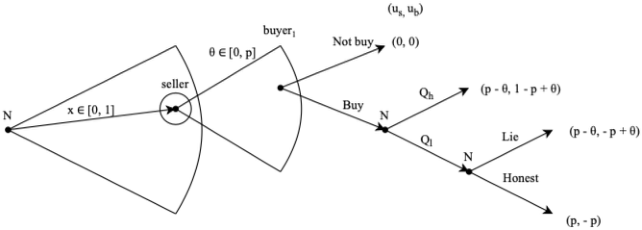
Figure 1: Seller and first buyer decision tree.
2) The quality realized in each transaction is random, but, as a property of the seller, we shall introduce a probability x of delivering a high-quality good. This x remains unchanged for all transactions with N buyers.
Product reviews posted by consumers were treated in the following simplified manner.
1) Consumers who have made a purchase shall always post a review. 2) Reviews of two types are posted: either high or low. 3) If the seller does not pay compensation for high rating reviews (θ = 0), then purchasers are to be honest based on the quality of the product realized in their transactions: buyers who receive high-quality goods will post a high rating; those who do not will post a low rating. 4) If the seller offers a reward, then the buyer might post a high evaluation even if the seller receives a low-quality good. For simplicity, we view this process as stochastic.
That is, we assume that a relative amount θ/p of reward θ to the selling price p that is closer to 1 is more likely to be associated with a buyer posting a fake review; an amount closer to 0 is associated with a buyer who is less likely to lie.
Figure 1 below presents what has been described above as a game tree. It is noteworthy that it only depicts the seller determining the amount of compen- sation and the first buyer making a purchase and reviewing the decision. At the end of each branch, a tuple is shown, indicating the seller and the written payoff.
DECISION-MAKING MODEL The buyer estimates how likely the seller is to provide a high-quality product based on the state of reviews which are visible before purchase and based on the expected value of the compensation which the seller will provide for highly rated reviews. The buyer consequently calculates the expected utility. Although the detailed formulation is omitted from this paper, the posterior distribution in the Bayesian inference on x described in the preceding section can be derived easily using the β distribution as a conjugate prior distribution.
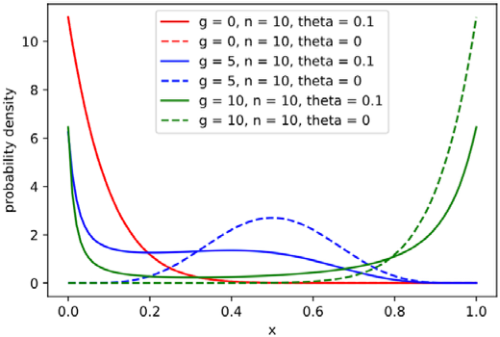
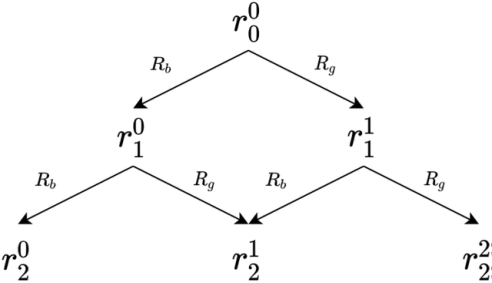
Figure 2: Example of posterior on x.Figure 3: Example of review state transition.
Figure 2 presents an example posterior distribution for the seller’s probabi- lity of offering a high-quality product x based on the state of reviews and the expected reward amount (theta). For this study, g represents the number of high ratings; n denotes the total number of reviews. Theta is the reward amount. It is noteworthy that p = 0.5 is used here as the selling price. It is apparent that x shifts to the low-quality side because consumers know that some of the observed reviews are false if a reward is offered.
However, we assume that the seller knows x in advance but that the seller must determine an amount of reward (θ) for highly rated reviews for a situa- tion in which the seller does not know what kind of quality will be realized in the actual transaction. Therefore, in this model, the expected gain is found by exhaustively calculating the probability of what the state of the review will be when a certain reward amount is set, and then by taking the sum multiplied by the gain for each transaction. The seller’s strategy is to set the amount of compensation which maximizes this expected gain. Figure 3 presents the state transitions of the review. This amount represents the circumstances when the number of reviews is 0–2. A seller with known buyer rationality can calculate
Effects of Incentivized Fake Reviews on E-commerce Markets 13
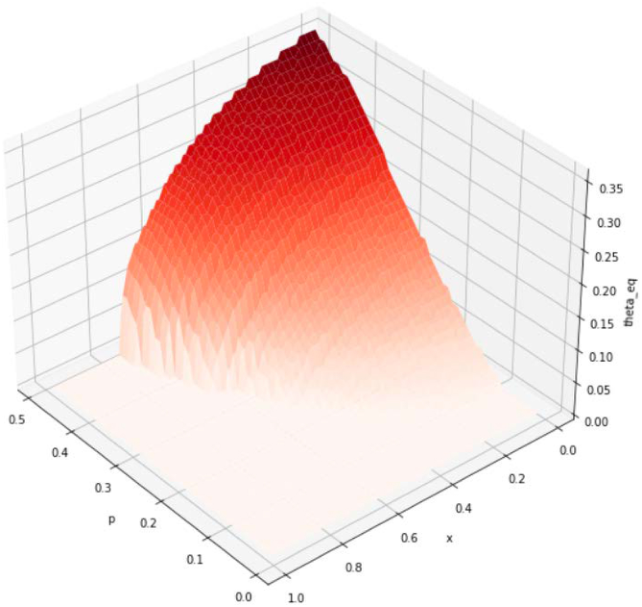
Figure 4: Distribution of stable compensation amounts when N = 10.
the probability of transition to each state. In the figure, Rb represents a low rating; Rg is a high rating. The lowercase letter r represents the review sta- tus. A subscript number stands for the total number of reviews. A superscript number expresses the total number of highly rated reviews among them.
SIMULATION METHOD Because both sellers and buyers are rational, a situation arises in which they mutually guess the amount of reward (θ) for the optimal highly rated review. In this model, this mutual guessing is regarded as a game. The reward amount that becomes the Nash equilibrium is the analytical target. The amount of compensation which results in a Nash equilibrium is called the stable com- pensation amount. The exogenous variables used in this model to run the simulation to obtain the stable compensation are described below.
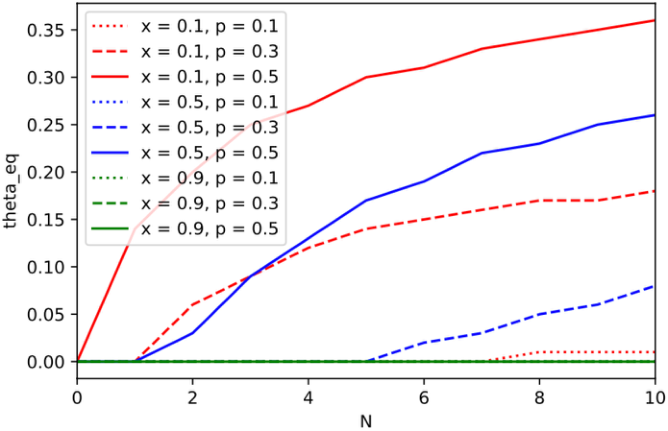
1) Number of buyers: N 2) Selling price of the commodity: p 3) Probability that the seller provides high quality goods: x Because of computational time constraints, solutions were obtained for N in the range up to N = 10. Also, p was varied by 0.01 in the range of 0 ≤p ≤0.5 because the first buyer does not purchase under the condition of p>0.5. Subsequent buyers do not purchase. Consequently, no need exists to
Figure 5: Relation between the number of buyers N and the amount of stable compensation.
conduct the simulation. For the analyses, x was varied by 0.01 in the range of 0 ≤x ≤1.
RESULTS
Figure 4 below shows a three-dimensional graph of the stable reward amount for each x and p under the conditions above when N = 10. When x is small and p is large, the stable reward tends to be large.
For several (x, p) combinations, Figure 5 depicts the change in the stable reward amount versus N. When it is easy to offer a high-quality product (when x is large), the Nash equilibrium consistently offers no reward. Othe- rwise, the equilibrium is to pay a greater reward as the number of buyers N increases.
CONCLUSION
This study models and simulates the problem of incentivized fake reviews, which can present difficulties in actual e-commerce markets. By simulating a Nash equilibrium under various conditions when the seller and buyer meth- ods rationally speculate about the amount of compensation to be offered, one finds the following trends.
1) The compensation amount is greater when the number of buyers is larger. 2) The reward amount will be greater if the selling price is higher. 3) The reward amount will be smaller when the probability of providing high-quality products is high.
Effects of Incentivized Fake Reviews on E-commerce Markets 15
Although all the points noted above can be readily imagined intuitively, this study has novelty in that it was derived from simulations as a Nash equi- librium in this model. In addition, because 1) can be regarded as an increase in advertising expenditures accompanying market size expansion, this study addresses important difficulties of marketing strategy decision-making.
REFERENCES
Babi’c Rosario, A., Sotgiu, F., De Valck, K. and Bijmolt,T. H.: The effect of electronic word of mouth on sales:A meta-analytic review of platform, product, and metric factors, Journal of Marketing Research, Vol. 53 (2016), 297. Calnan, M.: Best-selling Amazon products show signs of fake and incentivised
review practice, 2021. https://www.which.co.uk/news/2021/06/best-selling-ama zon-products-show-signs-of-fake-and-incentivised-review-practice/ Erdem, T. and Keane, M. P.: Decision-making under uncertainty: Capturing dynamic brand choice processes in turbulent consumer goods markets, Marketing Science, Vol. 15 (1996), 1–20. Hu, N., Bose, I., Gao, Y. and Liu, L.: Manipulation in digital word-of-mouth:
A reality check for book reviews, Decision Support Systems, Vol. 50 (2011), 627–635. Li, L.: Reputation, trust, and rebates: How online auction markets can improve their feedback mechanisms, Journal of Economics & Management Strategy, Vol. 19 (2010), 303–331. Miller, N., Resnick, P. and Zeckhauser, R.: Eliciting informative feedback: The peer-
prediction method, Management Science, Vol. 51 (2005), 1359–1373. Mukherjee, A., Venkataraman, V., Liu, B. and Glance, N.: What yelp fake review filter might be doing?, in Seventh international AAAI conference on weblogs and social media, 2013. Walsh, H.: Thousands of ‘fake’ reviews removed from Amazon: it’s not enough,
2019. https://www.which.co.uk/news/2019/04/thousands-of-fake-reviews-remo ved-from-amazon-its-not-enough/ Wang, J.-C., Chiu, C.-C. and Tang, J.-J.: The correlation study of eWOM and product sales predictions through SNA perspectives: an exploratory investiga- tion by Taiwan’s cellular phone market, in Proceedings of the 7th international Conference on Electronic Commerce, 2005. Zhao, Y., Yang, S., Narayan, V. and Zhao, Y.: Modeling consumer learning from
Read this individual research paper free through the original publisher, or explore the full digital proceedings book.
ISBN 978-1-958651-38-4
Explore this ISBN in the AHFE Bookstore ↗Listed in the July 2026 bookstore catalogue; search by ISBN to confirm current availability · Digital book purchase optional