Nikka Ko, Youji Kohda, Naoshi Uchihira (2022). Applying Nudges to Nemawashi: Consensus-building Without Losing Diversity. In: The Human Side of Service Engineering. AHFE Open Access, vol. 62, pp. 100–108. https://doi.org/10.54941/ahfe1002547
In Ringi system, which is a decision-making process followed by organizations in Japan, Nemawashi is often used in order to form a consensus. The term Nemawashi generally used in the sense of explaining the situation to the parties concerned in advance during an informal setting for obtaining their approval to a certain extent so that negotiations can go well. Nemawashi can create a consensus with a bias in advance, which may lead to a loss of diversity of ideas in decision-making. Therefore, we thought that if we could successfully apply Nudge to Nemawashi, we could reduce the loss of diversity, which can be a disadvantage of Nemawashi. In this paper, we conducted a questionnaire survey of people in organizations where Nemawashi practiced in order to find out whether the application of Nudge, which can be an important tool for documentation and facilitation, to Nemawashi has a positive, negative, or no effect on the advantages and disadvantages of Nemawashi. Therefore, Nudges can be used to support strengthening Nemawashi and reduce the loss of diversity that can be a weakness of Nemawashi in the following ways: (1) provide information at the appropriate time, (2) increase the appeal of Nemawashi by creating attention-grabbing devices, (3) ensure that people behave in accordance with social norms, (4) make sure that people react in some way to what they do or don't do, and (5) ensure people are satisfied with the results. (3) to make sure that people behave in accordance with social norms, (4) to check what kind of situation is expected to occur if a certain choice is taken or not taken, and whether the result is likely to be satisfactory, (5) to create a system that will immediately respond in some way to the doers of the words or actions, and (6) to prepare time to carefully review what has happened. We proposed a model for applying Nudge to Nemawashi in order to achieve consensus-building between decision-makers and Nemawashi practitioners without losing diversity in the process of decision-making.
Nemawashi functions as a mediating tool for making satisfactory decisions in order to create value for the company. However, the person who per- form the Nemawashi can create a consensus with bias in advance, and may lose the diversity of ideas in decision-making. On the other hand, Nema- washi is also capable of incorporating the opinions of people involved in consensus-building into a decision-making plan and adjusting their interests, which is similar to Nudge, as a mechanism or method that encourages peo- ple to voluntarily, rather than forcibly, choose a desired action, and thus
Applying Nudges to Nemawashi: Consensus-Building Without Losing Diversity 101
has a high affinity. This paper proposes that if consensus-building that helps people make better choices voluntarily can be created through Nemawashi, while retaining the freedom of choice that Nudge provides, it will be possible to create the best and more valuable consensus-building so that people invo- lved in consensus-building can make their own choices, their motivation is not impaired, and diversity is not lost. The purpose of this research is to find and model a method for applying Nudge that strengthens the advantages of Nemawashi and reduce the loss of diversity that can be a disadvantage of Nemawashi.
NEMAWASHI According to the sixth edition of the Kojien (Dictionary of Japanese Litera- ture), Nemawashi is figuratively, talking to the various parties around you in advance, to make it easier to achieve a certain thing (Shinmura, 2008). Nema- washi is the act of creating a consensus on a certain direction, conclusion, or decision through private meetings among the members who agree with each other in advance, or as a result of personal contact with each other, before an official meeting to resolve a problem or make a decision (Minami, 1985). In addition, there are differences between Japan and the West in terms of the positioning of meetings as decision-making forums and the role of Nemaw- ashi. Because of the organizational culture, Nemawashi places a great deal of emphasis on the maintenance of human relationships, whereas the esse- nce of Nemawashi in Western companies, which have a culture that tolerates mutual differences, is to seek a consensus that can be reached by both parties by overcoming differences (Atarashi, 2014). Based on the above, the defini- tion of Nemawashi in this paper is to form a consensus in an informal setting. In order to achieve this goal, we decided to create a situation in which those who perform Nemawashi can easily reach a consensus in advance through daily communication.
NUDGE Nudge, proposed by Thaler as a behavioral economics discipline that applies psychology to decipher how people are influenced by information and emotions, is defined as a mechanism to predictably changing peo- ple’s behavior without prohibiting choice or significantly changing economic incentives (Thaler and Sunstein, 2009). The acronym NUDGES is used for iNcentives, Understanding mappings, Defaults, Give feedback, Expect error, and Structure complex choices as the six basic principles of a good Nudge choice structure (Thaler and Sunstein, 2009). In addition, the Behavioral Insights Team (BIT), which is part of the UK’s Cabinet Office, developed a framework of four frameworks (EAST): Easy, Attractive, Social, and Timely (The behavioural insights team, 2014). In this paper, a nudge is defined as an initiative that is built in accordance with the above mechanisms and frameworks.
Table 1. Survey questionnaire on whether Nemawashi is active.
Table available in the original PDF paper.
No. Question content 1 Are you actively using Nemawashi in your work? 2 Do you have a bad impression of Nemawashi? 3 Do you think that Nemawashi is effective for decision-making?
RESEARCH METHODS Preliminary Investigation on Whether Nemawashi is an Active Organization
First, a preliminary survey was conducted using a questionnaire (see Table 1) by recruiting 30 collaborators from Company A employees involved in plan- ning and proposal work in order to ascertain whether or not the Nemawashi process was actually active in Company A, which was selected as the survey target.
Evaluation of the Impact of Applying Nudge to NEMASHI on the Strengths and Weaknesses of Nemawashi In this research, the authors gave attention to documentation and facilita- tion, which can be important tools for Nemawashi, and evaluated whether applying Nudge, which can be performed for each, for Nemawashi to have a positive, negative, or no effect on the strengths and disadvantages of Nema- washi. Next, we analyzed the best way to apply Nudge to improve the disadvantages of Nemawashi, and developed a model for applying Nudge to Nemawashi that achieves consensus-building without losing diversity. In preparing the questionnaire to be used in the evaluation of advantages and disadvantages of Nemawashi and the Nudge for material preparation and facilitation were organized as follows.
About Nemawashi effectiveness: advantages and disadvantages of Nema- washi in collective decision-making (Watabe et al. 2008), the advantages of Nemawashi are: (1) the knowledge and skills of many people are useful in the decision, (2) the decision is easily accepted by the group, (3) the decision is of high quality (Gordon, 1987), (4) as a decision made by everyone, the decision is likely to be implemented quickly, (5) the motivation of the decision participants increases (Hamaguchi, 1982), (6) more time can be spent on the proposal review, and (7) the interests of the people involved are coordinated, so the proposal can reflect the opinions of the decision participants. On the other hand, the disadvantages are: (1) it takes a long time to make a decision, (2) individual opinions and expertise may be ignored, (3) it promotes risky decisions, (4) it may lead to group-thinking (Janis, 1982), (5) it becomes dif- ficult for planners to coordinate the opinions of many people and select an appropriate proposal, and (6) it takes a very long time before a final decision is made.
Nudge effectiveness: according to the Nudge framework EAST by insource company, the following is mentioned in the document preparation technique (Insource, 2020).
Applying Nudges to Nemawashi: Consensus-Building Without Losing Diversity 103
Easy: People are more likely to choose actions that are easy and straight- forward, so creating materials that are easy to understand at a glance and narrowing down the options will lower the hurdle to action.
Attractive: People are more likely to choose what is attractive to them, so make it appealing by creating a device that attracts their attention.
Social: People are influenced by social norms, so you can motivate them by telling them how others are behaving.
Timely: People are more likely to respond to a timely approach, so provide information at the right time (when they want that information/service).
Nudge can be thought of in the context of a facilitator as follows (Busi- nessballs, 2022) (Kodera, 2021).
iNcentives: When a participant makes a choice that is good for the place, create an environment that provides benefits to the participant so that he or she will take that action again.
Understand mappings: Check what kind of situation is expected to occur if the choice is taken or not taken, and whether the result is likely to be satisfactory.
Defaults: The facilitator prepares in advance the choices they want the participants to make.
Give feedback: Create a system that allows for an immediate response to a certain action or behavior from the person who said or did it.
Expect error: When in a group or in the heat of the moment, there is a tendency for people to make unreasonable decisions or act reflexively, so provide time to review what has happened.
Structure complex choices: Narrow down the myriad of options to make it easier for members to choose which way to go.
Based on the above, the researchers developed a questionnaire (see Table 2) to investigate the effects of Nudge on the advantages and disadvantages of Nemawashi. Next, as shown in Table 2, we asked 20 members of the plan- ning and coordination team at Company A, which conducted the preliminary survey described in Table 1, whether Nudges (1-4) and Facilitating Nudges (5-10) had a positive or negative effect on the advantages (A~G) and disa- dvantages (H-M) of Nemawashi. A quantitative analysis was conducted by administering a questionnaire in which the facilitator Nudges (5-10) scored the advantages of Nemawashi (A-G) and disadvantages of Nemawashi (H- M) respectively, whether they have a positive, negative, or no effect. For the scoring, the initial score was set as +1 for the advantages of Nemawashi and -1 for the disadvantages of Nemawashi, and +1 was added for each Nudge if it had a good effect, -1 if it had a bad effect, and ±0 if it had no effect.
RESEARCH RESULTS Results of the Preliminary Analysis
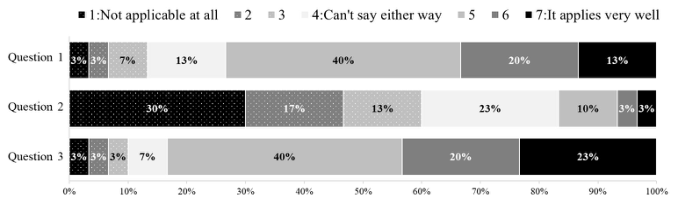
As illustrated in Figure 1, question 1 which is listed in Table 1 indicates that more than half of the respondents are proactive about Nemawashi. Que- stion 2 shows that about half of the respondents have a good impression of Nemawashi. Question 3 asks about the effectiveness or purpose of Nemaw- ashi, and more than 80% of the respondents believe that it is effective for
Table 2. Questionnaire on the effect of Nudge on the advantages and disadvantages of Nemawashi.
Table available in the original PDF paper.
Nudge No. Content Documentation 1 Lower the hurdles for people to make choices and take action by creating materials that are easy to understand at a glance or by creating materials that narrow down the options. 2 Include devices that draw people’s attention to the materials to make them more appealing. 3 Tell them how other people are behaving in the materials and make them behave in accordance with social norms. 4 Provide information (materials) at the right time (when people want the information or service). Facilitating 5 When a decision-maker makes a choice that is good for the place, create an environment where that choice can be given merit, so that the same action can be taken again. 6 Find out what the decision-maker expects to happen if he or she does or does not take a certain choice, and whether the outcome is likely to be satisfactory. 7 Prepare in advance the choices you want the decision-maker to make. 8 Create a mechanism to immediately communicate to the decision maker the reactions of those around them to the decision-maker’s words and actions. (e.g., using a whiteboard on the spot and confirming as you go.) 9 Provide time for decision-makers to take a long, hard look at what has happened, as they tend to make bad decisions and reflexive behaviors that are not rational when they are in a group or in the heat of the moment. 10 Narrowing down the choices from a myriad of options makes it easier for decision-makers to choose which way to go.
Nemawashi No. Content Advantage A The knowledge and skills of a large number of people can be incorporated and used in decision-making. B Decisions are more likely to be accepted by the people involved. C It is a quality decision. D As a decision is made by everyone, it is easy for decisions to be implemented quickly. E Increase the motivation of decision-making participants. F You can spend more time on proposal review and make it good. G Since the interests of the parties involved are reconciled, the proposal can reflect the opinions of the decision participants. Disadvantage H It takes time to make decisions. I Personal opinions and expertise may be ignored. J Facilitate high-risk decision-making. K It can lead to groupthink (where irrational or dangerous decisions are tolerated in group discussions). L The proposer will have to coordinate the opinions of many people, making it difficult to select an appropriate proposal. M It takes a very long time for a final decision to be made.
Applying Nudges to Nemawashi: Consensus-Building Without Losing Diversity 105
Figure 1: Results of a survey on whether Nemawashi is active.Table 3. Nudge application to Nemawashi advantages and disadvantages questionnaire results.
Table available in the original PDF paper.
Table 4. Score evaluation of the effect of Nudge application on the advantages and disadvantages of Nemawashi.
Table available in the original PDF paper.
efficient decision-making. Based on the above results, it can be said that the employees involved in planning and proposal work at Company A are acti- vely engaged in Nemawashi-keeping, and it was judged to be an appropriate research subject for this study.
Results of Evaluation of Nudge’s Effect on Nemawashi
Table 3 illustrates the average score of the questionnaire survey administered to 30 members of Company A, an organization where Nemawashi is often practiced. In Table 4, the results of the scoring in Table 3 and the results of the variability evaluation were used to evaluate whether Nudge had a positive, negative, or no effect on the advantages and disadvantages, after excluding those with high variability as having low reliability. The score ratings in Table 3 are given as +1 for good effects, −1 for bad effects, and ±0 for no effects on the advantages and disadvantages of Nemawashi.
Table 5. Proper application of Nudge to the advantages and disadvantages of Nemawashi (except Nudge 1, 5, 7, and 10). (Prepared by the author).
Table available in the original PDF paper.
Nudge Appropriateness to Nemawashi Based on the results illustrated in Table 4, the authors analyzed the applica- tion of Nudges 9 and 12 in Table 3 to reduce the loss of diversity of ideas by creating a biased consensus in advance of the Nemawashi process. It should be noted that Nudges 7 and 10 in Table 4 had a low score of 2 and −2, respectively, in the overall evaluation (9), and had a negative effect on the merit of Nemawashi. These two Nudges have the potential to bias the thinking of the decision-makers in advance, and both of them may interfere with the advantages of Nemawashi, which are the ability to incorporate the knowledge and skills of many people, the realization of high-quality decision- making, and the possibility of a proposal that reflects the opinions of the decision-participants. In addition, the disadvantages of Nemawashi include Furthermore, the disadvantages of Nemawashi may also cause bias in the thinking of decision-makers, which may lead to the exclusion of individual opinions, increased risk, and groupthink, as shown in Table 3 (I, J, and K). In particular, Nudges I, J, and K lead to the loss of diversity of ideas, and therefore, Nudges 7 and 10 were evaluated as inappropriate for application to Nemawashi. Next, Nudges 1 and 5, which have low scores of 3 and 4 in the overall evaluation (9) in Table 3 following Nudges 7 and 10, may cause bias in the thinking of the decision-maker in the shortcomings of Nemaw- ashi, as well as Nudges 7 and 10, and may contribute to the shortcomings of Nemawashi, I, J, and K. Based on the above, the results of applying other Nudges to Nemawashi, excluding Nudges 1, 7, 5, and 10, which may cause the loss of diversity of thought, which is a disadvantage of Nemawashi, are shown in Table 5. As shown in the (12) of Table 5, by optimizing the Nudges, the advantages of Nemawashi can be strengthened and the loss of diversity of ideas, which can be a disadvantage of Nemawashi, can be reduced, thus increasing the effectiveness of Nemawashi.
DISCUSSION
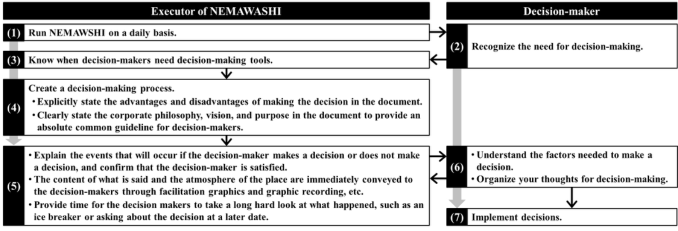
Figure 2 shows a model of the Nudge that reduces the loss of diversity of ideas and increases the effect of Nemawashi, respectively. Figure 2 (3) corre- sponds to the “Nudge to provide information at the appropriate time”, and it is possible to know the timing (2) at which the decision-maker needs the decision-making material from the usual Nemawashi (1), and it is possible to know the appropriate timing to provide information. Next, Figure 2 (4) corresponds to “Nudge to attract attention and increase appeal”and “Nudge
Applying Nudges to Nemawashi: Consensus-Building Without Losing Diversity 107
Figure 2: Applying nudges to Nemawashi: Consensus-building without losing diver- sity. (Prepared by the author).
to make people behave in accordance with social norms,” which is to create materials that help decision-makers make better choices voluntarily while lea- ving them free to choose. Figure 2 (5) continues with “Nudge to confirm what kind of situation is expected to occur if a certain choice is taken or not, and whether the result is likely to be satisfactory,” “Nudge to create a mechanism to immediately respond in some way to the doer of the words or actions,” and “Nudge to take time to review what has happened. This corresponds to “Nudge to prepare time to review what has happened”, “Nudge to create a mechanism to have some kind of immediate response to the doer of the words and actions”, and “Nudge to prepare time to review what has happened”, and is to input and facilitate decision-making materials so that the decision- maker can make a better choice voluntarily, leaving the freedom of choice as expected in Figure 2 (4). As a result, the decision-maker, having grasped the decision-making materials, organizes his thoughts for decision-making (6), and finally makes a decision (7).
CONCLUSION
In this paper, researchers focused on documentation and facilitation, which are important aspects of Nemawashi, and evaluated whether Nudge in each of them has a positive, negative, or no effect on the advantages and disadvan- tages of Nemawashi by comparing them quantitatively. As a result, we found and modeled a way of applying Nudge that strengthens the advantages of Nemawashi and reduces the loss of diversity of ideas, which can be a disa- dvantage of Nemawashi. However, this research has not yet reached the point of validating this model. Therefore, it is necessary to validate this model in the future and quantitatively evaluate its actual effect on Nemawashi. Furth- ermore, we believe that Nemawashi can be applied to the decision-making of highly uncertain decisions, as it has been shown to influence the innovation process and other aspects of the process (Ko and Uchihira, 2021).
ACKNOWLEDGMENT
The authors would like to express my deepest gratitude to the employees and supporters who cooperated in completing the questionnaire.
REFERENCES
Atarashi, M. (2014) Global standard Nemawashi technique disclosed by a legendary foreign top executive, CCC Media House (in Japanese). Businessballs. (January 11, 2022) Nudge Theory. Businessballs Website: https://ww
w.businessballs.com/improving-workplace-performance/nudge-theory/ Gordon, Judith R. (1987) A diagnostic approach to organizational behavior, Allyn & Bacon. Hamaguchi, E. (1982) Japan as a Society of Contextualism, Toyo Keizai (in
Japanese). Insource. (December 14, 2020) What are the materials that work on the reader’s emotions and encourage them to take action?; How to create materials using the “Nudge Theory (in Japanese). insource Website: https://www.insource.co.jp/con tents/column_nudge_creation.html Janis, Irving L. (1982) Groupthink: Psychological Studies of Foreign-Policy Decisions
and Fiascoes, Houghton Mifflin. Ko, N., Uchihira, N. (2021). The Role and New Function of “Nemawashi” in “Creative Justification of Resource Mobilization”; Case Study of Japanese Large Company A, The Development Engineering Society of Japan Volume 41 No. 1 (in Japanese). Kodera, Y. (December 2, 2021) Using Nudge Theory to Create a Facilitator’s Envi-
ronment (in Japanese). Workshop Design Office Website: https://ws-plan.pro/faci litator-preparation-with-nudge-theory/ Minami, H. (1985) Japan’s Ego, Iwanami Shoten (in Japanese). Shinmura, I. (2008) Koujien 6th edition, Iwanami Shoten (in Japanese). Thaler, Richard, H., Sunstein, Cass, R. (2009) Nudge: Improving Decisions About Health, Wealth and Happiness, Penguin. The behavioural insights team. (April 11, 2014) EAST: Four Simple Ways to Apply
Behavioural Insights. The behavioural insights team Website: https://www.bi.tea m/publications/east-four-simple-ways-to-apply-behavioural-insights/ Watabe, K., Clyde W, Holsapple., Andrew B, Whinston. (1992). Consensus-based group decision support method, Information Processing Society of Japan Volume 33 No. 6 (in Japanese).
LISTED IN THE AHFE DIGITAL BOOKSTORE CATALOGUE
Explore the complete digital volume
The Human Side of Service Engineering
Read this individual research paper free through the original publisher, or explore the full digital proceedings book.
ISBN 978-1-958651-38-4
Explore this ISBN in the AHFE Bookstore ↗Listed in the July 2026 bookstore catalogue; search by ISBN to confirm current availability · Digital book purchase optional