Katsuhito Fukuta, Youji Kohda, Hideomi Gokon (2025). Knowledge structuring for initial response to the 2024 Noto Peninsula Earthquake in Japan. In: Human Factors in Design, Engineering, and Computing. AHFE Open Access, vol. 199, pp. 2417–2428. https://doi.org/10.54941/ahfe1007054
Large-scale disasters impose an immense burden on affected municipal staff, as they are tasked with duties far exceeding their regular responsibilities, such as managing shelters and distributing aid supplies. While support personnel from other municipalities are crucial in these situations, the valuable knowledge and experience they gain on-site are often not systematically retained by the supported municipality after their departure. This research addresses this critical gap by aiming to systematically organize and visually share the comprehensive disaster response experiences of dispatched personnel, including the challenges they faced and the solutions they implemented, thereby ensuring that this vital information remains with the affected municipalities for future use.Previous research has explored various aspects of disaster management, including knowledge accumulation from past events and the optimization of municipal staffing. However, there is a lack of research focused on structuring this critical knowledge in a format that can be used quickly and intuitively at all stages of a disaster response. Our study fills this void by proposing a novel system that structures knowledge into a mandala format, facilitating quick comprehension and informed decision-making. The mandala format, originally a symbolic diagram in Buddhist cosmology, has recently been adapted as a tool for idea generation and information organization in fields like education and business.Specifically, this research introduces the "Mandala" concept, focusing on the critical issue of delayed initial responses during disasters. The Mandala systematically organizes and visualizes the causes of these delays, which are derived directly from the experiences of dispatched personnel, thereby providing a clear roadmap for preventing similar issues in future events.To construct Mandala, we employed a hybrid analytical approach, combining both inductive and deductive reasoning. We utilized interview data from the 2024 Noto Peninsula Earthquake in Japan as our primary source. The methodology involved initial open coding to decontextualize the interview data, followed by thematic classification. The final step was the construction of the Mandala by reconfiguring the thematic classification results.Our analysis highlighted the profound importance of knowledge held by dispatched support personnel for streamlining operations during the initial stages of a disaster, especially considering the overwhelming demands on local municipal staff. Through this process, we successfully constructed a Mandala with "Causes for Delayed Initial Response" at its center. This Mandala effectively organizes multiple contributing factors and their interrelationships, systematically derived from the interview data. We anticipate that this Mandala will serve as an invaluable tool for municipal staff, enabling swift and effective decision-making during future disaster responses.In conclusion, this study was able to demonstrate the effectiveness of a hybrid qualitative data analysis approach in structuring knowledge from published text data into a visually intuitive mandala format. This research is expected to make a significant contribution to a more efficient, effective, and resilient initial response capacity in the event of future disasters, ultimately minimizing the impact on the community.
The Noto Peninsula Earthquake in Japan, which occurred on the evening of New Year’s Day, January 1, 2024, caused extensive damage across various areas, including Ishikawa Prefecture. A significant challenge in the immediate aftermath was that severe damage to roads and infrastructure made it difficult for many municipal employees to physically reach the municipal government office. As a result, the initial disaster response had to be handled by the very limited number of staff who were able to assemble, placing an enormous strain and an overwhelming workload on these individuals.
These types of initial challenges, particularly the immense burden placed on the first responders available, are common in large-scale disasters. Previous studies have highlighted the difficulties that affected municipalities face. For example, in the 2016 Kumamoto Earthquake in Japan, the delayed
assembly of staff and an unusable government building also led to a situation where a limited number of personnel had to manage an excessive workload, creating challenges in municipal support, shelter management, and supply transportation (Kakimoto & Kurohiji, 2019).
Learning from the lessons of past large-scale disasters, many municipalities and companies regularly train and educate their staff in disaster response. However, these efforts face a fundamental limitation: large-scale disasters do not occur frequently in the same area, meaning that experiential knowledge is difficult to retain and pass down effectively over long cycles. Consequently, even with training, a fully prepared team is often impossible to assemble in the right positions immediately after a disaster. This highlights the critical challenge: how to enable the personnel who are actually available at that moment—regardless of their experience—to respond with maximum efficiency. Simply passing down lessons is not enough; a more structured and systematic approach, grounded in research, is required.
Furthermore, disaster response has been researched to prepare for such situations. This research has progressed from two main perspectives: “knowledge accumulation and sharing” and “streamlining response operations and problem-solving.”
The first perspective, “knowledge accumulation and sharing,” focuses on learning from past disasters. One stream of this research documents the practical measures and ingenuity of experienced responders (Tomosho et al., 2014; Arita et al., 2016). Another crucial stream involves analyzing failures to understand their root causes, for which various frameworks and databases have been developed (Hatamura, 2005; Nakao, 2008). Among these approaches, this study specifically builds upon the structured framework provided by Hatamura’s (2005) Failure Mandala.
The second perspective, “streamlining response operations and problem- solving,” aims to support concrete activities at disaster sites. Efforts here include developing methods for assessing workload and optimizing personnel allocation (Inaba et al., 2015; Inoue et al., 2018) and using tools like the KJ Method, a qualitative data analysis method for organizing ideas, to identify and solve broad societal challenges post-disaster (Ohara et al., 2011).
However, a significant gap exists between these two perspectives. While a vast amount of knowledge has been accumulated, particularly through sophisticated failure analysis like the Failure Mandala, research on structuring this knowledge into a practical format that “anyone can utilize quickly and easily” amid the chaos of a disaster remains insufficient. Foundational research has been conducted to structure knowledge into “mandala-style” models for decision support (Fukuta et al., 2024; Fukuta & Gokon, 2025), but these efforts have not yet reached the stage of ensuring reliability and accuracy through analysis from multiple perspectives. A highly accurate and versatile system has not yet been established that allows even inexperienced staff to immediately apply deep knowledge in the field.
To address this gap, our study aims to construct a more accurate and robust mandala model. By building on existing methods and incorporating analysis from multiple perspectives, we seek to develop a new system that serves as a methodological bridge between deep knowledge accumulation and practical
Knowledge Structuring for Initial Response to the 2024 Noto Peninsula 2419
problem-solving. The ultimate goal is to establish a tool that supports rapid situational comprehension and informed decision-making for any responder, regardless of their experience level.
THE RESEARCH IMPLEMENTATION PROCESS This study utilizes the results of a specific survey as qualitative data. These results are from the “Interview Project with Municipal Support Staff,” which was conducted by the Special Committee on the 2024 Noto Peninsula Earthquake of the Institute of Social Safety Science (ISSS). This study analyses these survey results using qualitative data analysis methods. The objective is to extract and structure knowledge to facilitate a smooth initial response during disasters.
The data used consists of the results from an interview survey of 37 municipal support staff members. The survey contained 19 items, which included topics such as past disaster response experience, assigned missions, and the overall picture of the disaster response (see Table 1). This study systematically analyzed interview results to synthesize the common experiences of support staff into comprehensive concepts.
Table 1: Institute of Social Safety Science (ISSS): List of interview survey items.
Table available in the original PDF paper.
No. Survey / Interview Items
1 Number of past disaster response experiences
2 Experience in training (at or above drill participation level)
3 Mission 4 Personal key factors for building trust with the affected municipality 5 Response status of the local government office 6 Procurement and supply of goods 7 Consolidation of information, including damage reports 8 Understanding the overall picture and roadmap of the disaster response 9 Staff assembly status 10 Clarification of supporters’ roles and the chain of command 11 Reorganization of the Disaster Response Headquarters 12 The organization’s BCP and reallocation of human resources 13 Support for evacuation shelters and evacuee life 14 Building damage assessment, roads, water (incl. sewage), identifying and supporting vulnerable persons sheltering at home, acceptance of volunteers (NPOs), setup and operation of consultation services, and waste disposal 15 Coordination of dispatched personnel 16 Handover from the Chief Support Coordinator 17 Handover from the General Support Team to the affected municipality 18 Onsite living conditions (base camp) 19 Applying lessons learned back to one’s own municipality Our analysis followed a multi-step hybrid approach. The process began with a deductive analysis using Hatamura’s (2005) Failure Mandala as an
initial framework, which was then supplemented with an inductive analysis to capture emergent themes from the data.
Building on this foundational analysis of causes, we developed two complementary models: a causal loop diagram based on systems thinking (Minato, 2016) to illustrate the systemic feedback structures, and a mandala- style knowledge model to provide a comprehensive, practical map for practitioners. Finally, we performed a quantitative text mining analysis to validate our qualitative models.
ANALYSIS OF INTERVIEW RESULTS The analysis followed a hybrid deductive-inductive process. First, to analyze the causes of delays in the initial disaster response, a deductive approach was used.
We applied codes from Failure Mandala (Hatamura, 2005) as an initial analytical framework to categorize the interview data. This allowed us to systematically sort the data in accordance with established failure patterns.
However, any data that did not fit within this pre-existing framework was subsequently analyzed using an inductive approach. Through open coding, we generated new, emergent categories directly from the data itself. The synthesized results of these analyses are presented below (see Table 2). For clarity, categories from the original framework (Hatamura, 2005) where no corresponding data was found (i.e., a code count of zero) have been omitted from Table 2. Categories marked with an asterisk (*) were classified on the basis of the initial deductive framework, while those marked with a dagger (†) were newly generated through our inductive analysis. This approach allowed us to leverage an existing theoretical model while also capturing the unique, context-specific aspects of the Noto Peninsula Earthquake case.
Building upon this foundational analysis of causes, we then re-examined our findings from a solution-oriented perspective. The themes and categories in Table 2 were reviewed and re-organized to derive actionable strategies for streamlining the disaster response. This re-categorization focuses on practical countermeasures and improvements from a practitioner’s standpoint (see Table 3).
Table 2: Analysis of causes for delayed initial response.
Table available in the original PDF paper.
Core Factors Detailed Cause Code Count Locus of Responsibility Ignorance* Lack of experience† 22
Causes attributable to individuals*
Lack of knowledge/ skills† 19
Unexpected causes*
Unknown* Occurrence of abnormal events* Occurrence of unknown events*
Continued
Knowledge Structuring for Initial Response to the 2024 Noto Peninsula 2421
Table 2: Continued Core Factors Detailed Cause Code Count Locus of Responsibility
Table available in the original PDF paper.
68
Poor response to issues†
Poor organizational structure*
Causes attributable to the organization*
15
Poor information sharing† 60 Differences in values†
Causes not attributable to either individuals or the organization*
7
Being a victim of the disaster oneself† Note. This framework integrates categories derived from both deductive and inductive analyses. * These categories were primarily classified based on the deductive framework (Hatamura, 2005). † These categories were primarily generated through inductive analysis of case data.
Table 3: Results of analysis: Categories and subcategories.
Table available in the original PDF paper.
Stakeholder Category Subcategory Code Count
122
Resolve staff shortages for tasks
Common to all disaster response stakeholders
Support from assisting municipalities
72
Provide disaster response know-how and expertise
31
Utilize the know-how of the dispatching municipality
12
Roadmap Gain common understanding among stakeholders
9
Choose indicators for disaster response progress
3
Grasp the overall picture of the disaster response Continued
Table 3: Continued Stakeholder Category Subcategory Code Count
Table available in the original PDF paper.
5
Response to changing situations
Respond in accordance with onsite situation changes
Eliminate the negative effects of organizational silos
7
Consolidate damage information
Information consolidation and sharing
15
Identify isolated communities
20
Visualize information 55 Affected/Recipient municipality
Communicating support needs
Become able to obtain necessary support Reduce the burden on staff 5
Subcategories with higher code counts were interpreted as themes of greater importance to the responding support staff. For instance, the subcategory with the highest code count (122) pertained to “reducing the burden on affected municipal staff,” while the next highest (121) related to “improving efficiency by establishing a forum to share operational challenges in addition to providing support.” Nevertheless, the analysis did not rely solely on code frequency; opinions judged by the researchers to be significant were retained as analytical categories, regardless of their code count.
MODELING THE CAUSAL STRUCTURE OF THE INITIAL RESPONSE Having identified the fundamental causes of delay through our hybrid analysis (see Table 2), our next objective was to understand how these individual causes are interconnected and create feedback loops that impede the initial response.
To achieve this, we first selected the key stakeholders (“Affected Municipality,” “Assisting Municipality”) and the most critical causal factors from Table 2 (e.g., ‘Poor Staffing/Personnel Issues,’ ‘Poor Information Sharing,’ ‘Roads are Impassable’). These factors were then organized into a narrative sequence that illustrates the chain of events: Problem, its underlying Cause, and the attempted Solution (see Table 4).
Knowledge Structuring for Initial Response to the 2024 Noto Peninsula 2423
Table 4: Results of analysis: Categories and subcategories.
Table available in the original PDF paper.
Event Stakeholder Action Problem Cause Solution Affected municipality Earthquake occurs on New Year’s Day Reduce workload by getting support staff
Initial response- Staff can’t assemble - Heavy workload per person - Slow response
- Staff are victims - Staff are on leave - Family care duties - Roads are blocked
Assisting Municipality
Support re- establishing the local Disaster Response HQ
- Local staff are too busy to assess the full situation
Staff dispatch- Can’t grasp local needs - Difficult to provide best support
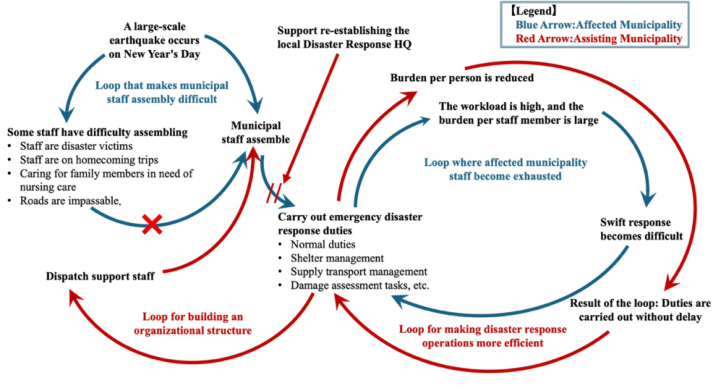
This causal narrative then formed the direct basis for the causal loop diagram (see Figure 1). In this diagram, the arrows indicate causal relationships, forming two primary feedback loops: a red loop illustrating the vicious cycle within the Affected Municipality, and a blue loop representing the intervention by the Assisting Municipality. The analysis of this diagram makes it clear that the primary challenge for a swift initial response is, first and foremost, securing the necessary personnel to carry out response operations.
Figure 1: Causal diagram of stakeholder interactions in disaster response.
THE DISASTER RESPONSE EFFICIENCY MANDALA Causal loop diagrams are well-suited for capturing the overall disaster response as a system, as they can incorporate aspects that are not purely logical. However, each step in such a diagram inherently contains elements that are not fully captured.
To address this limitation, we have restructured the knowledge that cannot be fully represented in the loop diagram into a tree-based model. This tree structure is designed to organize knowledge on the basis of its causal factors, particularly for information that is overly complex for a loop diagram. Furthermore, it functions to link this knowledge to various countermeasures and improvement strategies.
This research conducted a multi-faceted analysis of the causes and underlying factors contributing to delays in disaster response. The analytical process began by positioning a specific cause at the center of a mandala, with related factors arranged peripherally. Subsequently, a deeper examination of these factors allowed us to comprehend the overall structure of the failure and identify concrete countermeasures and improvement strategies.
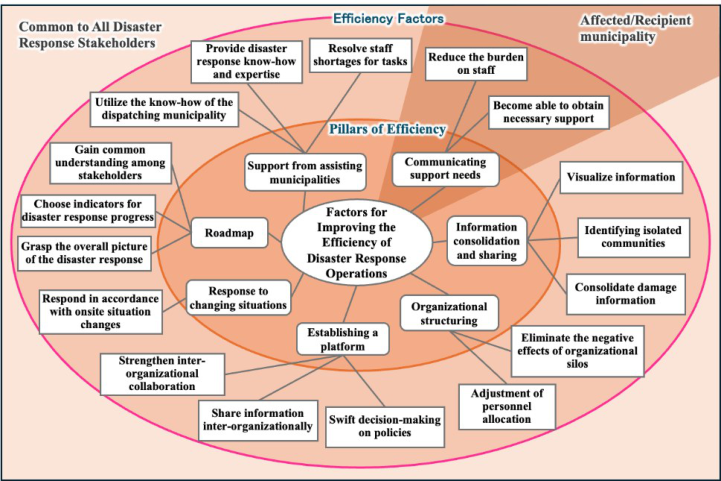
While the causal loop diagram (Figure 1) illustrates the feedback mechanisms of the problem, the mandala model was developed to provide a more comprehensive, hierarchical map of all contributing factors for practitioners.
Initially, we established the central theme as “how to enhance the efficiency of disaster response operations.” Surrounding this theme, we positioned the “categories (causes) required for a rapid response,”as extracted from Table 2. These were then organized into a tree structure by linking associated sub- categories (factors) to each primary category (see Figure 2).
Knowledge Structuring for Initial Response to the 2024 Noto Peninsula 2425
This diagram illustrates the countermeasures and improvements derived from the analysis. Note, however, that not all measures proposed herein were implemented during the actual 2024 Noto Peninsula Earthquake. This figure represents a proposal developed on the basis of the causes and factors necessary for a swift initial response, as identified by analyzing interview data.
CORROBORATING THE MODEL THROUGH QUANTITATIVE TRIANGULATION To reinforce the validity of our qualitatively constructed models (the causal loop diagram and the mandala model), we performed a quantitative text analysis. This method serves as a form of triangulation, adding a layer of objective, data-driven evidence to our interpretive findings.
While our qualitative analysis identified key themes on the basis of their contextual significance, co-occurrence network analysis provides a purely statistical visualization of the most prominent word relationships in the entire dataset. A strong alignment between the two suggests that our interpretations are not only contextually rich but also quantitatively central to the discourse. This alignment, therefore, strengthens the overall reliability of our conclusions beyond what either method could achieve alone.
We analyzed the structured model using text mining techniques. The analytical method adopted was co-occurrence network analysis, which visualizes the structure of relationships between words by connecting words that appear together in a text with lines. In the network diagram, words are represented by nodes (points), and the strength of the co-occurrence is represented by the thickness of the lines, allowing for the relationships between vocabulary to be intuitively understood. For this analysis, we used the text mining tool KH Coder (Higuchi, 2020). All texts were subject to analysis. Since the text data was in Japanese, the analysis was conducted in Japanese. The total number of extracted words was 15,458, with 1,907 unique words. The words included in the analysis were limited to those that appeared 10 or more times.
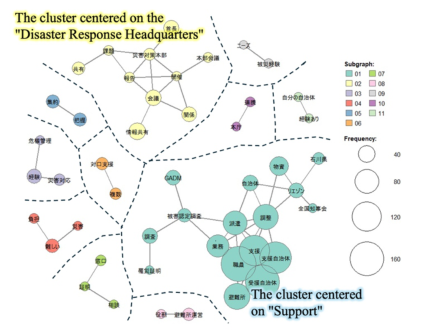
The following network diagram visualizes the co-occurrence relationships between frequently occurring words extracted from the collected text data. This showed a strong association between the disaster response tasks shown in the model and the tasks actually being performed in the field (see Figure 3).
In the mandala model, key categories (causes) for improving efficiency were established, such as “Support from assisting municipalities,” “Information consolidation and sharing,” and “Organizational structuring.” In this network diagram, strong clusters of words corresponding to these categories are formed. The largest cluster, centered on “Support,” shows a dense and strong connection between words like “support,” “staff,” “dispatch,” “recipient municipality,” “assisting municipality,” “coordination,” and “operations.” This objectively indicates that “Support from assisting municipalities,” one of the most critical items in the mandala model, was the most central and frequently discussed theme among the interview participants. The cluster centered on the “Disaster
Response Headquarters” connects words such as “Disaster Response Headquarters,” “meeting,” “information sharing,” and “report.” This validates the importance of categories in the mandala model like “Information consolidation and sharing” and “Establishing a platform.” It shows that information transmission and decision-making at the core of the disaster response were discussed as significant challenges.
Figure 3: Text mining analysis results (co-occurrence network).
Additionally, a cluster of words such as “difficult,” “burden,” and “experience”can be seen in the bottom left of the diagram. This indicates that the fundamental issues the mandala model aims to solve—specifically, the “burden on staff” and “difficulties in response due to lack of experience”— exist as clear topics within the actual text data.
In conclusion, this co-occurrence network analysis can be said to reinforce the structural validity of the mandala model—which was built through intuition and interpretation via qualitative analysis—with objective data.
DISCUSSION
On the basis of interviews with support staff during the 2024 Noto Peninsula Earthquake, this study systematized knowledge for initial disaster response and proposed it as a mandala-formatted knowledge model. The uniqueness of this study lies in structuring the fragmented knowledge accumulated from previous research into a format that “anyone can use quickly and easily,”even inexperienced personnel in chaotic situations. The proposed mandala model supports rapid situational assessment and decision-making by intuitively visualizing the overall picture and causal relationships between challenges (causes) and countermeasures (factors). Furthermore, a key strength of this research is that the model, built through qualitative analysis, was validated using a quantitative method—text mining (co-occurrence network analysis)—which reinforces the objective validity of its structure. This model is expected to be utilized as a real-time decision-support tool at disaster sites and as a practical training material during normal times. However, the limitations of this study include that it is based on a single case, the
Knowledge Structuring for Initial Response to the 2024 Noto Peninsula 2427
Noto Peninsula Earthquake, and that the analysis was limited to support staff. Future work needs to refine the model by incorporating other disaster cases and the perspectives of various stakeholders, such as staff from affected municipalities, and to verify its practical effectiveness through disaster drills.
CONCLUSION
This study successfully structured the chaotic knowledge of initial disaster response into a practical, easy-to-use format. Through a hybrid qualitative analysis, we identified the core causal structures of response delays and constructed a mandala-style knowledge model. The validity of this model was reinforced by quantitative text mining, demonstrating a robust methodological approach. The resulting model is expected to serve not only as a decision-support tool during future disasters but also as a practical training material, ultimately contributing to a more effective and efficient initial response with limited resources.
ACKNOWLEDGMENT
This study utilizes data from the “Interview Project with Municipal Support Staff,” conducted by the Institute of Social Safety Science (ISSS). Although this data is publicly available, it is an invaluable collection of records gathered over a period of about one and a half months, from January 2nd to February 18th 2024, immediately following the disaster. We wish to express our gratitude to the researchers who collected this data and to all the support staff members who cooperated with them.
REFERENCES
Arita, H., Tomosho, T. and Hashimoto, S. (2016). Collection of “On-site Knowledge” to take advantage of earthquake disaster experience for future disaster restoration, Water, Land and Environmental Engineering, Volume 84, Issue 6, pp. 483–486. Fukuta, K., Gokon, H. (2025). A Fundamental study on knowledge structuring of
the initial response to The Noto Peninsula Earthquake in 2024 through qualitative data analysis methods, Transaction of the Japan Society of Civil Engineers, Volume 81, Issue 13, 24–13519. Fukuta, K., Gokon, H. and Ikeda, M. (2024). The Development of a Decision-making model for construction personal with the aim of achieving early completion of re-construction projects, Transaction of the Japan Society of Civil Engineers, Volume 80, Issue 24, 24-0001. Hatamura, Y. (2005). The structure and expression of the Failure Knowledge
Database (Explanation of ‘Failure Mandala’). Japan Science and Technology Agency (JST) Website: https://www.jst.go.jp/pr/info/info161/index.html. Higuchi, K. (2020). Quantitative Text Analysis for Social Surveys: Aiming for the Inheritance and Development of Content Analysis (2nd ed.), Nakanishiya Shuppan. Inaba, J., Numada, M. and Meguro, K. (2015). Basic study on estimation of
workloads and duration of disaster response activities by municipalities, Journal of Institute of Industrial Science, Volume 67, Issue 6, pp. 311–315.
Inoue, M., Fukuoka, J., Onishi, S., Numada, M. and Meguro, K. (2018).
Development of disaster response flow chart based on regional disaster management plan and visualization of inter-organizational relationship, Journal of Institute of Industrial Science, Volume 70, Issue 4, pp. 283–288. Kakimoto, R. and Kurohiji, Y. (2019) The issue of emergency rehabilitation directly after 2016 Kumamoto earthquake, Transaction of the Japan Society of Civil Engineers, Volume 75, Issue 5, pp. 117–127. Nakao, M. (2008). Utilization of failure knowledge database, Construction Planning,
Volume 701, pp. 87–90. Ohara, M., Kondo, S., Kou, T., Numada, M. and Meguro, K. (2011). Overview of social issues after the Great East-Japan Earthquake Disaster: Part 3 of activity reports of 3.11net Tokyo (Researcher’s network for supporting recovery activity from the Great East-Japan Earthquake Disaster), Journal of Institute of Industrial Science, Volume 63, Issue 6, pp. 749–753. Tomosho, T., Arita, H. and Hashimoto, S. (2014). Importance of “On-site
Knowledge” for disaster restoration, 2014 Agricultural and Rural Engineering Society Conference Lecture Abstracts, pp. 118–119.
LISTED IN THE AHFE DIGITAL BOOKSTORE CATALOGUE
Explore the complete digital volume
Human Factors in Design, Engineering, and Computing
Read this individual research paper free through the original publisher, or explore the full digital proceedings book.
ISBN 978-1-964867-75-5
Explore this ISBN in the AHFE Bookstore ↗Listed in the July 2026 bookstore catalogue; search by ISBN to confirm current availability · Digital book purchase optional