Aki Shimbo, Amna Javed, Hideomi Gokon, Youji Kohda (2022). Value creation through third-party certification - Case study of phase-free certification for certifying disaster prevention. In: The Human Side of Service Engineering. AHFE Open Access, vol. 62, pp. 183–190. https://doi.org/10.54941/ahfe1002557
The purpose of this research is to clarify how third-party certification creates value by looking at a case study of third-party certification. An application of the “phase free” concept is discussed as an example of how third-party certification generates value. Disaster prevention is a typical social issue that diverse members of society must proactively confront. It is, however, considered an uncertain cost by many people, wherein preparing for disasters is not an entrenched practice. “Phase free” is a concept originating in Japan that aims to encourage consumers to purchase products and services that are useful in the event of disasters by providing phase-free certification of such products and services. For example, a plug-in hybrid or electric vehicle can be used as a battery when parked. Even though this power storage function is not recognized at normal times, it will be very useful in the event of a disaster. Phase free, thus, refers to the concept of "deriving considerable benefit during times of emergencies from products and services used in everyday life."Generally, third-party certification is considered to bring about a positive effect on eliminating the asymmetry of information, such as by guaranteeing the quality of products and services in the market, by strengthening a company's competitiveness, and by enhancing reliability. However, due to the considerable economic and time burden imposed on producers in complying with strict standards and the lack of understanding among consumers about the value of certification, the use of certification marks has not gained sufficient traction. There are cases, however, in which third-party authentication is considered to have led to the creation of value. For example, non-fungible tokens (NFT) are also seen to be creating new value by allowing third parties to certify (endorse) value using block chain technology. Phase-free certification, like NFT, appears to be successful in creating value.This study elucidates the features of value creation through phase-free certification by looking into the activities of the Phase Free Association (https://phasefree.or.jp/), which carries out third-party certification. The target of the study is the "School Education Initiatives in Naruto City, Tokushima Prefecture," which was certified by the Phase Free Association in 2021 (Gold Prize winner at the Phase Free Award 2021). An interview with representatives of the Phase Free Association was conducted to clarify how the "value of disaster prevention" is embedded in school education. An analysis was conducted focusing on the benefits that school officials, parents, government officials, and other stakeholders gain from this embedded value of disaster prevention. The study clarifies how balance is achieved between normal-time value (teaching the prescribed school education curriculum) and disaster-time value (protecting children from disasters), as well as investigates the mechanism behind the value-creation process.This study, therefore, contributes to research on third-party certification through analysis of a case of phase-free certification that has succeeded in providing value related to disaster prevention to school education, which is an intangible service.
Disaster prevention is a typical social issue that must be proactively confron- ted by diverse members of society. It is, however, considered as an uncertain cost by many people, since preparing for disasters is not an entrenched pra- ctice. Phase-free is a concept, that initially originated in Japan intending to encourage consumers to purchase the products and services that are useful during disasters by providing phase-free certification of such products and services. For example, a plug-in hybrid or electric vehicle can be used as a battery when parked. Normally, this power-storage function is not viewed as being useful, but during a disaster, it can be very useful. Phase-free refers to the concept of deriving considerable benefits during emergency situations through the products and services used in everyday life.
The target of this study is the “School Education Initiatives in Naruto City, Tokushima Prefecture, (Gold Prize winner at the Phase Free Award 2021)” that was certified by the Phase Free Association (PFA) (https://phasef ree.or.jp/).
The structure of this article is as follows. A literature review shows the focus on resource integration in certification, summarizes the theoretical developments of the proliferation of certification schemes, and summarizes the theoretical developments from the Service-Dominant (S-D) logic perspe- ctive. (Vargo and Lush, 2008, 2016). This is followed by an empirical study of the role of third-party certification in gaining the approval of stakeholders in implementing disaster prevention education. It further investigates the mech- anism behind the value-creation process. Finally, a phase-free framework is proposed for studying the created value in a general TPC scheme.
LITERATURE REVIEW
TPC has emerged as a significant value mechanism in the market and soci- ety. Third-party certification is private or public documents to certify the safety and quality claims on a particular set of standards and compliance methods (Deaton, 2004, Hatanaka et al., 2005, p. 355). Previous resea- rch on TPC has been expanded to straddle multiple areas. TPC is vital to market institutions that assist firms in integrating resources into products or services (Chkanikova and Sroufe, 2021) and is significant in institutions that assist in adopting resources into public products or services. This promotes product standardization, key criteria, and metrics for corporate social respon- sibility (Wilburm and Wilburn, 2015), forms global technology networks, and plays a coordinating role in promoting international trade (Loconto and Busch, 2010). Moreover, there are growing considerations for TPC, i.e., achi- eving Sustainable Development Goals (SDGs) (Ikram et al., 2021) ,the safety and quality for combating COVID-19 (Voo et al., 2021). However, there have been criticisms of TPC, for example, limited gains from the addition of industry,company-led standards to Fairtrade certification (Diets et al., 2020), high costs and complicated bureaucratic procedures associated with TPC that make it inaccessible to many small-scale producers (Boiral, 2011, Moroz and Gamble, 2018). In addition, stringent standards can undermine the needs and ambitions of aspiring enterprises (Chkanikova and Sroufe, 2021). A common strand throughout many previous studies is the dedication of exploring how organizations use institutions, generally focusing on the adaptive processes necessary for addressing the demands of the institution. From this perspe- ctive, TPC defines rules and credits created to serve regulatory purposes but tends to break down the entire certification ecosystem, into its parts, and, this process may not capture the values of stakeholders.
While many researchers suggest TPC has both positive and negative delive- rables, there are new opportunities to understand how value is created from TPC. For example, previous research shows the emergence and proliferation of individual interaction (i.e., one-on-one) conditions or a condition for certi- fication schemes, such as a non-fungible token (NFT) (Bamakan et al., 2021), (Cupi, 2022). For example, Shao et al. (2022) reported that “The blockchain
Value Creation Through Third-Party Certification 185
technology could facilitate (instead of replacing) the development of insti- tutional trust and interpersonal trust, and the trusting relationship could jointly explain users’ adoption and usage of blockchain-enabled applicati- ons” (Shao et al., 2022, p. 1). NFT seems to create new values by allowing third parties to certify (endorse) value using blockchain technology. Accor- dingly, numerous studies have investigated TPC in diverse fields butit is unclear that how certifications might cater to different stakeholder needs and challenges associated with ‘creating value’ in the certification ecosystem.
We explored another institutional aspect of TPC, i.e., which value-seeking behavior in stakeholders may lead to increased certification performance. We used the S-D logic (Vargo and Lusch, 2008, 2016) perspective, which deals with a definitive framework of how certification value is generated. In parti- cular, the primary research question is, where and how do the real-world individual stakeholders engage in the value co-creation of certifications? We investigated, what factors drive stakeholders to integrate their resources through phase-free certification by looking into the activities of the PFA.
EMPIRICAL SETTING AND METHOD This research has selected the case study method (Yin, 2009), which is used to illustrate, clarify the contextual meaning, and deepen the research pheno- menon for a specific context (Gummesson, 2000). Naruto city has important challenges regarding the implementation of measures in preparation for a massive Nankai Trough earthquake and tsunami, from which it is assumed there would be extensive damage. Therefore, Naruto city has adopted the phase-fee concept of disaster-prevention education in all its primary and junior high schools. For example, in a 5th-grade math class, students are taught that a tsunami travels 600 meters per minute. They are then asked to calculate the speed of a tsunami in terms of how many meters it travels per second. Therefore, the students become aware that the tsunami is much faster than they can run and start thinking about all the possible ways to cope with such a disaster. Phase-free design is defined by the following five properties, 1) phase-free use, 2) everyday use, 3) intuitive use, 4) inspiring people, and 5) ease of spread (phase-free website, 2022).
Data Collection Data were collected from four sources: interviews, YouTube videos, a spe- cial TV program on phase-fee initiatives in Naruto city, and documentary evidence. The survey targets and methods are listed in Table 1.
The focus of the interview with the representative of the PFA was on anecdotes from the process of the development and diffusion of phase-free certification. The following questions were asked to the representative of the PFA: “Who is involved in phase-free certification?”, “Why and how do they connect with each other?”, and “What were the difficulties in promo- ting phase-free, and how did they mitigate the difficulty?”. The interview also involved the interesting or unexpected stories. The focus of the other methods was on anecdotes about phase-free implementation. Specifically, we coded texts that are characteristic of stakeholders’ attitudes before and
Table 1. Survey targets and methods.
Table available in the original PDF paper.
Date Data Minutes Data for surveyed stakeholders
June 2021
Interview Semi-structured 90’00” Representative of Phase-Free Association (Rep of the PFA) January 2021 YouTube Naruto city official channel of a round-table discussion 50’00” Naruto City Mayor, Naruto high school freshman and sophomore, Rep of the PFA
October 2020
11’33” Naruto City Mayor and Rep of the PFA
Naruto city official channel - a dialogue
February 2021
TV program NHK Tokushima - a special program
5’52” Leading member of the Naruto city board of education, elementary school teachers, fifth-graders . Rep of the PFA June 2021
Documents White paper, Organization Papers, Financial statements etc
after their participation in phase-free certification. An interview and audio data were recorded and subsequently transcribed verbatim. As a mean of recording the outcomes and providing pattern codes of the analysis, inter- pretive codes were constructed. The codes were set by the researchers. Some interpretive codes were initially used, and three pattern codes were created. The pattern code was selected to summarize all the findings as it provides a framework for undertaking empirical observation of resource integration (see Table 2).
FINDINGS As a result of the analysis, the role played by phase-free certification can be summarized in the following three points.
1) Use of a common protocol: The value of everyday goods and servi- ces is unconsciously embedded in the common sense and habits of stakeholders. 2) Use of the resource at hand: Rather than searching for the resources to be required in a disaster, using the resources at hand makes it easy for everyone to participate in the exchange of resources. 3) Use of the phrase “phase-free”: Even though the act of being prepared for a disaster is embedded in people’s perceptions, an appropriate term had to be given to make it real.
Value Creation Through Third-Party Certification 187
Table 2. List of typical codes.
Table available in the original PDF paper.
Examples Pattern Codes Interpretive Codes
Use of a common protocol
accumulated skills
commonplace The importance of disaster prevention measures is undeniable, it goes without saying. (Rep of the PFA) everyday At Math classes, I was impressed to see my stu- dents comparing their running speed to the one of tsunami. (Elementary school teacher) unconscious To protect the lives of its citizens, Naruto City would like to implement measures based on the idea of phase-free, originating in our daily life routines. (Mayor) Use of the resources at hand
egg of Columbus
I hope our children are able to use the emergency skills, little by little implemented by their teachers, to protect themselves in case of an earthquake. (a leader of the board of education) uncertain cost While in the past disaster prevention may have been considered as spending with uncertain cost, viewing it as a value could be beneficial for people. (Rep of the PFA) decision making The speed of a tsunami is 10 meters per second, so 50 meters in 5 seconds, which is much faster than we can run. (5th grader) Use of the unique phrase “Phase-free”
Using a simple term, “phase-free car” instead of a long and complicated explanation of an EV car, could be more convincing for customers. (Rep of the PFA) two for the value of one
When we learnt about speed at Math classes, I realized how fast tsunami is! So I decided I would run away when tsunami come. It was like getting two items at the price of one: I learnt about the speed and also I realized how fast tsunami is. (5th grader) conveniently When I heard about the “phase-free” concept, I thought it was very useful and quite easy to implement, so I am going to spread the idea through my school club activities. (High school sophomore) easily Easy to join a “Phase-free certification program”, which would combine the resources of various industries, would be more convincing for people. (Rep of the PFA)
DISCUSSION
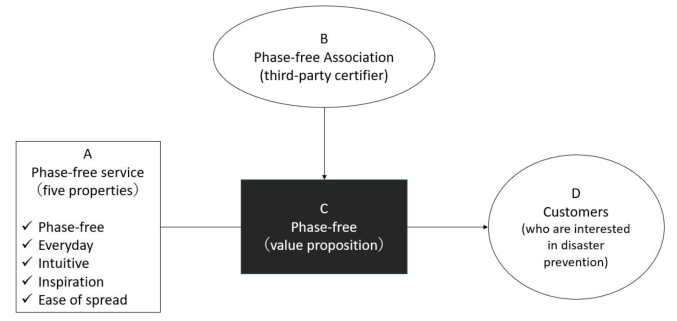
Based on the above findings, this research illustrates the value creation through phase-free certification (Figure 1).
Figure 1: Phase-free value framework.
Phase-free products and services have five properties depicted in box A in Figure 1. This is guaranteed by the Phase Free Association (the box B) through phase-free certification (the box C). Hence, users will trust and use products and services with phase-free certification. Importantly, phase-free certification serves as a value proposition, assuring that the product is useful for disaster prevention.
1) PFA has created a common protocol.
PFA developed “five properties of the phase-free (FPPF)”, a protocol for connecting the stakeholders. The value of phase-free products and services can be judged by whether they meet these five properties or not. In this sense, Phase-Free has created a new framework for understanding, i.e., a common protocol.
2) The use of the resources at hand assures the wide applicability of the phase-free concept.
Phase-free products and services can contribute to disaster prevention not only by adding a special function of disaster prevention to them but also by making a slight modification to the existing products or services. In this sense, they make use of resources that already exist. This opens up the scope of application of the phase-free concept to many products and services.
3) The phase-free certification plays the role of a value proposition.
Once the concept of phase-free is popularized by third-party certification, people will accept the value of products and services with phase-free certi- fication as a matter of course. In other words, they can accept a phase-free ecosystem and can stop investigating the details of the phase-free certifica- tion. Thus phase-free certification has become a value proposition in the framework of S-D logic (Vargo and Lusch, 2016, p. 10).
CONCLUSION
This paper presented the phase-free value framework from an examination of how phase-free certification exchanges resources, integrates resources, and
Value Creation Through Third-Party Certification 189
creates value through observation of school education in Naruto city. Alth- ough NFT and phase-free certification are similar in resource integration, but this research concludes that there are differences as well. Regarding NFT, stakeholders need to seek out benefits for themselves. However, in phase- free certification, a stakeholder needs to use a common protocol, use the resources at hand, and use the unique phrase “phase-free”. The participating stakeholders have abundant resources, and the key to success is to encou- rage awareness of the resources that are deriving considerable benefit during emergencies from products and services used in everyday life. The phase-free value framework is a potential practical structure of value creation specified within TPC. We expect that our findings through the lens of S-D logic will be easier to understand by researchers who need practical advice. However, further research is needed on whether this version of the framework can be applied in general or be restricted to disaster prevention.
REFERENCES
Bamakan, S. M. H., Nezhadsistani, N., Bodaghi, O., & Qu, Q. (2021). A Decentralized Framework for Patents and Intellectual Property as NFT in Blockchain Networks. Boiral, O. (2011). Managing with ISO systems: lessons from practice. Long Range
Planning, 44(3), 197–220. Chkanikova, O., & Sroufe, R. (2021). Third-party sustainability certifications in food retailing: Certification design from a sustainable supply chain management perspective. Journal of Cleaner Production, 282, 124344. Cupi, G. (2022). The Internet of Value and the Circular Economy. In Enabling the
Internet of Value (137–143). Springer, Cham. Deaton, B. J. (2004). A theoretical framework for examining the role of third-party certifiers. Food control, 15(8), 615–619. Dietz, T., Estrella Chong, A., Grabs, J., & Kilian, B. (2020). How effective is mul-
tiple certification in improving the economic conditions of smallholder farmers? Evidence from an impact evaluation in Colombia’s Coffee Belt. The Journal of Development Studies, 56(6), 1141–1160. Gummesson, E. (2000). Qualitative methods in management research. Sage. Hatanaka, M., Bain, C., & Busch, L. (2005). Third-party certification in the global agrifood system. Food policy, 30(3), 354–369. Ikram, M., Zhang, Q., Sroufe, R., & Ferasso, M. (2021). Contribution of certifi-
cation bodies and sustainability standards to sustainable development goals: an integrated grey systems approach. Sustainable Production and Consumption, 28, 326–345. Loconto, A., & Busch, L. (2010). Standards, techno-economic networks, and playing fields: Performing the global market economy. Review of International Political Economy, 17(3), 507–536. Moroz, P. W., Branzei, O., Parker, S. C., & Gamble, E. N. (2018). Imprinting with
purpose: Prosocial opportunities and B Corp certification. Journal of Business Venturing, 33(2), 117–129. Shao, Z., Zhang, L., Brown, S. A., & Zhao, T. (2022). Understanding Users’ Trust transfer mechanism in a Blockchain-enabled platform: A mixed methods study. Decision Support Systems, 113716. Vargo, S. L., & Lusch, R. F. (2008). Service-dominant logic: continuing the evolution.
Journal of the Academy of Marketing Science, 36(1), 1–10.
Vargo, S. L., & Lusch, R. F. (2016). Institutions and axioms: an extension and update of service-dominant logic. Journal of the Academy of marketing Science, 44(1), Voo, T. C., Reis, A. A., Thomé, B., Ho, C. W., Tam, C. C., Kelly-Cirino, C., ... &
Munsaka, S. (2021). Immunity certification for COVID-19: ethical considerations. Bulletin of the World Health Organization, 99(2), 155. Wilburn, K., & Wilburn, R. (2015). Evaluating CSR accomplishments of founding certified B Corps. Journal of Global Responsibility. 5–23. Yin, R. K. (2009). Case study research: Design and methods (Vol. 5). Sage.
LISTED IN THE AHFE DIGITAL BOOKSTORE CATALOGUE
Explore the complete digital volume
The Human Side of Service Engineering
Read this individual research paper free through the original publisher, or explore the full digital proceedings book.
ISBN 978-1-958651-38-4
Explore this ISBN in the AHFE Bookstore ↗Listed in the July 2026 bookstore catalogue; search by ISBN to confirm current availability · Digital book purchase optional