Keijo Houhala, Tuomas Korhonen, Teemu Laine, Vesa Salminen (2025). Reasonable Living as a Proactive Customer Value: Feeling Heard, Seen, and Understood. In: Human Factors, Business Management and Society. AHFE Open Access, vol. 176, pp. 1–14. https://doi.org/10.54941/ahfe1006298
We examine how the concept of procedural fairness could proactively guide value creation and sustainable wellbeing in public services, and decision making concerning it. First, we review the concept of procedural fairness to understand what it means as an aim for the public sector. Second, using pragmatic constructivism, we lay ground for fulfilling such aim by proactively constructing fair public services that will create value, also in the future. Third, we examine a “Value scale”- exercise of the City of Tampere, to understand how stakeholders’ values are incorporated to proactive construction of procedural fairness. Procedural fairness must be made visible so that it can be viewed based on values and customer orientation. The value scale can be used to localize meanings that enable connecting procedural fairness to customer value more effectively. Using the concept of procedural fairness, public administrators can create flexibility into the service system, to enable creating value also in the future.
“A reasonable life” as a central concept of this paper is a harmonious combination of humanity, technology, and experiences of meaningfulness. We seek to be seen and to be heard to feel a sense of meaning in life. In an increasingly technology-based society, this involves the purposeful realization and balance of people’s physical and virtual experiences. The seamless integration of public and private service structures, their collaboration, and service accessibility ultimately create individual and communal customer value. While technological solutions and service providers are essential, many of them remain in the background of service experiences, as only the visible aspects of services are recognized, and these experiences generate customer value and perceptions of it. The entire service package, with all its elements, must be designed and implemented to meet citizens’ expectations of
customer value and, particularly, to support the conditions for a reasonable life (Houhala et al., 2022).
Public and private services face a growing need for moderation, driven by resource scarcity and degrowth thinking, particularly in terms of responsibility, sustainability, and global value creation. Continuous economic growth without considering sustainability is not indefinitely feasible within a closed system like planet Earth (cf. Gibson-Graham et al., 2013; Joutsenvirta et al., 2016).
The research problem in this article examines how the public sector’s value creation can enable reasonable living. The study focuses on the Value Scale (“Arvovaaka”) tool, and the empirical data collected from various stakeholders in the City of Tampere, Finland, 2019–2020. On one hand, enabling a reasonable life for individuals is justifiable from a human perspective. On the other hand, achieving a reasonable life encounters numerous constraints and boundary conditions for implementing economically, socially, and environmentally sustainable practices. For these reasons, examining the conditions for a reasonable life is not only relevant, but also increasingly timely (Abdullah & Karpowitz, 2016; Beauvais & Baechtiger, 2016; Sorvali et al., 2023; Sjöblom, 2024).
THEORETICAL APPROACH Public services moderate and create equal opportunities for accessing services while also regulating excesses that threaten the sustainability of individuals, communities, and our way of life (cf. Malaska, 1996; Acemoglu, 2012; Gibson-Graham et al., 2013; Joutsenranta et al., 2016). Similarly, degrowth thinking emphasizes moderation and shifts attention to well-being and sustainability, as well-being cannot rely solely on limitless production and the resulting economic growth (cf. Piketty, 2013; Mazzucato, 2018). Instead, sustainable well-being should decouple itself from the unattainable demands of continuous economic growth, as finite ecological, social, and cultural resources necessitate this change (cf. Streeck, 2012; Felber, 2010).
Our society faces a crossroads: on one hand, it must deliver reasonable- quality services, while on the other, it must ensure that our way of life does not place an excessive burden on Earth’s limited resources (cf. Malaska, 1996; Helne et al., 2012; Joutsenvirta et al., 2016).
Reasonable living itself is characterized by effortless and smooth daily routines, experiential understanding, and interactive activities enriched by the added value and meanings brought by technology (cf. Nonaka et al., 2000; Houhala et al., 2022). Public services can contribute to reasonable living through rights and responsibilities, which are complemented or expanded by private, market-based services aligned with individuals’ own choices and decisions. Ordinary and reasonable living arises from personal passions, commitments, and experiences, supplemented by the added value provided by societal and private service offerings (cf. Hamel et al., 2007).
The perspective of pragmatic constructivism (Nørreklit et al., 2010), as a central theoretical lens of this paper, seeks effective and successful practices, serving as a theoretical foundation for examining the realization of
Reasonable Living as a Proactive Customer Value: Feeling Heard, See, and Understood 3
reasonable living. If a practice is not built on a sustainable foundation, facts, and genuine possibilities, the outcome may not be desirable (Nørreklit, 2017). Conversely, if a practice is based on a realistic understanding of matters, an actor can identify factual opportunities for the future and develop practices accordingly. However, an actor’s perception of a practice and its associated possibilities is always subjective, grounded in past events (facts), recognized opportunities, values, and their interactions and communication with other actors (see e.g., Nørreklit et al., 2006; Nørreklit et al., 2010; Jakobsen et al., 2011; Cinquini et al., 2013; Nørreklit et al., 2016; Nørreklit, 2017; Nørreklit, 2020). Through interaction and communication, an individual’s worldview connects with others and their worldviews (e.g., Nørreklit et al., 2006), thereby creating opportunities for community and collaborative development.
Each actor’s worldview, and consequently their understanding of reasonableness, is constructed through interaction with other actors. An actor also identifies opportunities for future actions based on their interactions with other actors—not necessarily simultaneously (cf. Nonaka et al., 2000). Thus, an actor can create for themselves a proactive truth about how reasonableness could be generated in the future.
If an actor’s construction of reality is not based on facts, there is a risk of actions grounded in illusion or misconception (Nørreklit et al., 2006; Nørreklit, 2017a), which, despite their apparent realism, may not lead to desired outcomes (Kure et al., 2021). From the perspective of this paper, the contribution of the pragmatic constructivist framework lies in its ability to evaluate whether a possibility or proactive truth is grounded in facts or illusion. Pragmatic constructivism can help identify illusions and their associated problems in practical situations and open shared understandings toward a reality-based reasonableness.
RESEARCH OBJECTIVES, QUESTIONS AND APPROACH The purpose of this article is to examine how public service value creation can proactively construct a shared understanding of a reasonable life for citizens and use this as a foundation for decision-making. This study employs the conceptual framework of pragmatic constructivism to evaluate when service systems align with realistic trajectories for the future, rather than illusions or misconceptions.
The article explores the “Value Scale” tool, developed in the City of Tampere, which provides insights into current and desired states at the intersection of public administration and citizens. It addresses three primary research questions:
How is the system model of public services constructed, and how does value creation emerge?
How is the value model at the public service interface formed and operationalized?
How can a reasonable balance and equity in life be ensured for citizens?
Empirical data were gathered through MS Forms surveys conducted in Tampere in 2019–2020. A total of 32 surveys yielded responses from 124 officials, 21 decision-makers, and up to167 customers. The findings informed a project report, a master’s thesis, an engineering thesis (UAS), and 12 extensive student projects (Houhala, 2020b). In addition to participatory observations and discussions during this process, insights were derived from conversations with Tampere city personnel (Helander et al., 2020).
PUBLIC SERVICES IN A MULTI-PRODUCTION ENVIRONMENT Overall, knowledge production can create a continuously updated and multidimensional situational awareness, enabling the future to be lived from the present. Knowledge can also be used to simulate future scenarios based on the current situation, allowing their significance to be assessed. Meaningful knowledge guides choices in a desired direction and produces future experiences, thereby creating a framework for living the future in the present (cf. Toppinen, 2002). This future orientation is driven by meaningfulness, where humanity and public value creation foster renewal (cf. Houhala, 2018; Dufva, 2020). Thus, values and value creation are part of systematic renewal rather than just a straightforward sense of living (cf. Helkama, 2015; Houhala, 2018).
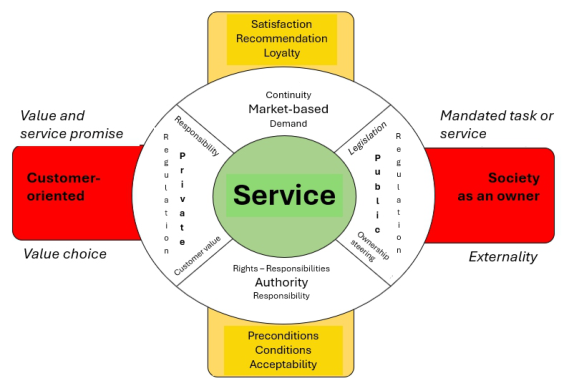
Services are, in many ways, connected to public administration and decision-making systems (cf. Houhala, 2018). Figure 1 models service structures within the interaction between market orientation and official accountability, as well as customer-centricity and societal interests, where the concept of reasonableness is often integrated.
Figure 1: Services in multi-production environments (Houhala, 2020; 2020b).
Service structures still operate on the principles of physical encounters, gatherings, and the need for case-specific official transactions. However,
Reasonable Living as a Proactive Customer Value: Feeling Heard, See, and Understood 5
the utilization of electronic opportunities should be significantly advanced (cf. Nonaka et al., 2000; Nonaka et al., 2003; Parviainen & Rantala, 2020), as increasingly occurred from the spring of 2020 onwards due to the COVID-19 pandemic.
WHAT IS THE REASONABLENESS OF VALUE CREATION?
When defining “reasonableness,” the term carries diverse interpretations. For example, the English equivalents for the Finnish word “kohtuullinen”include “reasonable,” “moderate,” “fair,” “decent,” “appropriate,” “suitable,” or “equitable” (MOT Pro English, 2020). In the context of public services, reasonableness may imply a certain static quality through the term “moderate,” which could be interpreted as acceptance of one’s circumstances, reverence, humility, respect for tradition, and moderation (cf. Schwartz, 1992; Houhala, 2018). Thus, reasonableness is inherently connected to values, attitudes, and preferences, all of which must be considered as context- dependent factors when assessing and interpreting reasonableness (cf. Harris, 2010; Helkama, 2015). In the context of value creation in public services, reasonableness encompasses factors such as responsibility, continuity, and purposefulness (Laitinen et al., 2018), as well as statutory principles like equality, fairness, and reasonableness. Similarly, degrowth thinking and sustainable development emphasize a holistic understanding of sustainability that aligns with humaneness alongside other value perspectives (cf. Felber, 2010; Joutsenvirta et al., 2016). Experiences, perceptions, and resource allocation can reflect reasonableness when it is examined in balance with economic, social, cultural, and ecological perspectives. The synthesis of these factors forms a “multidimensional balance,” which is also the essence of reasonableness. Fundamentally, individuals must be guaranteed the same or equivalent services regardless of their circumstances (Salminen, 2015). Service needs can be assessed by experts, such as social workers (Salminen, 2015). Services should be appropriate and fair “in relation to the client’s functionality, mobility, living environment, and life situation” (Salminen, 2015). Public services, in general, should be designed to be “suitable and accessible to all citizens without causing unreasonably great difficulties” (Salminen, 2015) and “without incurring unreasonable costs for the municipality” (Salminen, 2015).
In the context of public services, defining the concept of reasonableness precisely or objectively is nearly impossible, as the search for reasonableness in value creation is inherently situational, as suggested by Salminen’s (2015) research. However, due to legal requirements, principles like equality, impartiality, and transparency must be demonstrated through comparison with prior decisions. Nonetheless, as circumstances evolve, new interpretations must be made. Therefore, reasonableness is about achieving a balance that can adapt over time and across situations. However, decisions must withstand multidimensional criticism or legal scrutiny to ensure that reasonableness is achieved in a sustainable manner (cf. Gill, 2008; Acemoglu & Robinson, 2012; Houhala, 2018).
Procedural fairness is thus a fitting term to describe reasonableness in the context of value creation. Procedural fairness rests on four pillars: individuals’ ability to express their perspectives, consistency and transparency in authority decision-making, a respectful approach toward individuals, and the trustworthiness of authorities (Herian et al., 2012; cf. Arendt, 1958). These pillars provide a foundation for exploring how the framework of pragmatic constructivism aids in understanding reasonableness within the field of public value creation, serving as a tool for constructing practices with a forward-looking perspective.
The digitalization of services can offer significant benefits if knowledge management eliminates unnecessary bureaucratic practices, such as redundant meetings or outdated processes (cf. Osborne, 2018). Knowledge management reveals obsolete practices, processes, and methods, allowing them to be updated—ideally, so that the value creation for the end customer aligns with future realities.
VALUE-BASED INTERDEPENDENCIES The external impact of political decision-making on organizations must be examined critically and constructively. The most significant added value that decision-makers contribute to value creation lies in building connections to ensure that citizens’ needs form the foundation of public services (cf. Helkama, 2015). Functional services, built on a pragmatically sound foundation, and effective political decision-making can be described as mechanisms where citizens’ needs are met as positive service experiences and customer value while ensuring continuity for service providers. At the same time, the meaningfulness and impact of decision-makers’ work foster societal trust, continuity, and public value creation.
For example, the complexity and multidimensional nature of regulatory and oversight services can appear distant and challenging to grasp from the customer’s perspective. Systemic network relationships related to urban regulatory services can be illustrated using interface models. These models visualize complex and multi-layered organizational structures governed by substance-related legislation. Tools for visualization are essential to unravel such complex systems, enabling the identification of relationships, linkages, and task or process accumulations among actors. This supports future- oriented decision-making. At the intersection points of network relationships, services and distinct tasks or requirements of two or more regulatory units converge. These intersections represent societal interests, legally mandated oversight responsibilities, and priorities that authorities must reconcile with customer needs (Houhala, 2020b).
When the systemic structures of services are modelled at their interfaces, it becomes possible to examine the meanings and capabilities of those services. For this reason, an organization’s value-based self-image serves as an external reflection of its internal capabilities, as internal tensions within the organization manifest externally in the perception of its services. Internal meanings or tensions within the organization influence the customer value, perception, and reasonableness derived from its services, as the organization
Reasonable Living as a Proactive Customer Value: Feeling Heard, See, and Understood 7
synchronizes legislative requirements and customer needs on a value-driven basis (cf. Hamel & Breen, 2007). Thus, an organization’s self-image is perceived by the customer as a meaningful or meaningless evaluation of the service.
UTILIZATION OF TECHNOLOGY AND TOOLS In Tampere’s urban environment service area, a Power BI-based tool called “Value Scale” (in Finnish: “Arvovaaka”) was developed for processing and conducting preliminary analyses of survey data (see Helander et al., 2020). Targeted MS Forms online surveys were used to ask respondent groups to evaluate the same concepts. The Value Scale tool transformed the survey data into a more user-friendly format, enabling comparisons of discrepancies between respondent groups and concepts based on the analyst’s chosen parameters. These comparisons helped units identify both value-adding and tension-laden aspects of services and structures—referred to as value points. This enhanced the overall understanding of regulatory services, enabling the assessment of gaps in services and structures.
Technologically, tools and continuous data flows are essential for producing a societal situational awareness. Data flows become beneficial only when they can generate new insights, deepen the understanding of information significance, and ensure the general acceptability of knowledge production through transparent operations.
Another equally important aspect is identifying development opportunities and areas of excessive quality based on the experiences of respondent groups (guided by values in decision-making). These comparisons can reveal excessive quality or areas requiring improvement, pinpointing issues or process phases that need further examination. Once tension-laden points are identified, it becomes easier to define the problems and influencing factors, enabling corrective actions or systemic service reforms. Comparisons also highlight how respondent groups perceive over- or under-quality within service structures.
A systematic review of the organization, which refines the understanding of processes and makes the interdependencies between tasks visible, helps to address deficiencies in services. Therefore, an organization’s self- image reveals its internal tensions to stakeholders when the perspectives of respondent groups are analyzed and compared. The self-image of an organization may be balanced, tension-filled, or detached, aligning expectations of the organization with its perceived self-image (cf. Houhala, 2018). For services, it is essential to identify feelings related to experiences and meanings to deliver customer value and fulfill service promises made to customers (cf. Osborne, 2018). When conflicting and tension-filled perceptions exist, the significance of services may also be disrupted if the focus of services and interactions does not align with customer needs (cf. Laitinen et al., 2018). It becomes questionable whether services are designed based on the participants’ reality constructs or merely reflect the views or experiences of a small subset.
CUSTOMER-CENTRICITY AND REASONABLE SERVICES Customers expect their problems to be solved and their needs to be met. Similarly, decision-makers aim to demonstrate to voters that promises are fulfilled. Officials are tasked with synthesizing needs, demands, and expectations into functional service concepts, processes, and ecosystems. In all these contexts, values guide the behavior and decision-making of the involved parties.
It is essential to recognize that the linear functionalities of physical service structures must be updated in the future with systematic, digital service frameworks that activate based on situational needs (cf. Laihonen et al., 2013; Houhala, 2018; Houhala, 2020a). This transformation requires knowledge-based management to integrate with cross-sectoral service needs and values. Data gathering aligned with customer needs necessitates removing barriers to automation, which are still embedded in legislation. Services should appear to customers as decision-making options rather than requiring repetitive re-entry of information already known to the service organization.
From the perspective of digital service readiness, achieving customer value means that:
Automation eliminates routine tasks for customers, making services easily accessible.
Services are transparently and openly available for verification online.
Humanity ensures the realization of customer value even as services are digitalized.
Customers automatically and effortlessly receive the services they are entitled to, as promised.
Customers can verify the equality of service delivery.
Automated services must ensure the realization of fairness, as customer value and fundamental rights depend on fairness being upheld. Knowledge- based management, therefore, lies at the core of fairness, determining customer rights, obligations, and accessibility opportunities.
From the customer’s perspective, the prerequisites for a reasonable life consist of effective public and private services—services whose production and consumption are pragmatically true (ecologically, economically, and socially). The appropriate balance, functionality, and holistic support of different services transform the foundation of life from individual to communal (cf. Martela & Jarenko, 2017; Otala et al., 2017). Indicators of a reasonable life divide customers into groups, but these groups also differ in their technological needs and adoption levels. For instance, services for individuals with memory disorders differ from those for other people of the same age group, requiring solutions such as sensor technology and smart innovations to ensure smooth daily living. This forms part of building elements of fairness and proactive truths: pre-existing data comprises both facts and possibilities for adapting future actions. It is assumed that technology, combined with humanity, can indicate a true picture of everyday life and identify needs for services, assistance, or interventions related to
Reasonable Living as a Proactive Customer Value: Feeling Heard, See, and Understood 9
deviations (cf. Hamel & Breen, 2007). Proactive truth also involves predicting future service solutions and their allocation based on data (cf. Dufva, 2020). Simultaneously, the composition of independent living conditions incorporates necessary interaction and communication connections with societal governance and decision-making requirements, ensuring individuals receive their entitled services despite their deficiencies.
Without service structures enabled by technology, many of the services aligning with the markers of a good life remain unattainable. Sole reliance on physical service structures is unlikely to guarantee sufficient service provision, nor does it enable proactive truth about fairness. Physical services alone cannot ensure that the most disadvantaged individuals manage their affairs within complex administrative structures. In such cases, equality may not be realized (Salminen, 2015), even if the service system adheres to procedural fairness (Herian et al., 2012). Alongside data streams used to examine reasonable life, applying social dynamics is also necessary, grounding background materials in extensive data repositories and behavioral knowledge. Ultimately, this concerns understanding social factors, groups, their interactions, and mutual communication (cf. Nonaka et al., 2003). The development of the public sector has been based on strong self- governance, assembling the necessary funding, and services adopted through shared experiences and interactions. These services have thus been built on locally adopted meanings and choices, grounded in prevailing values. Fundamentally, public services are services citizens have chosen for themselves and financed through taxes. Still, the principle of good governance—that matters should be efficiently organized—remains valid. The core task of governance is to ensure the realization of customer value rather than oversee specific services. Therefore, the value of governance is built on the realization of reasonable rights and obligations. Governance tools should include knowledge-based management tools to monitor situational awareness, flows, connections, and clusters: creating a reality based on citizen-provided data, aided by technology. It is also important to remember that, while humanity and reality are ultimately defined by individuals themselves (cf. Malaska, 1996; von Wright, 1996), the human perception of reality increasingly incorporates broader demands for fairness and their contradictions (cf. Streeck, 2012; Acemoglu & Robinson, 2012; Joutsenvirta et al., 2016).
The good governance expected by customers provides opportunities, prevents losses, and operates in the background. The governance service itself is not the visible part of the service, but its benefits are. Similarly, the relationship of governance to humanity forms a service structure that includes openness and transparency, citizens’ sense of justice, acceptability, and community. It is worth asking whether service experiences trigger positive or negative developments, whose underlying factors or root causes can be observed. Measuring service experiences is, therefore, essential.
VERIFYING REASONABLENESS IN A CASE ENVIRONMENT The synthesis of self-image and social dynamics related to a reasonable life emerges from the Value Scale tool, developed and tested in the city of Tampere. This tool allows the examination of current and desired states of concepts through perceptions (see Houhala, 2020b; Helander et al., 2020). The Value Scale facilitates the evaluation of services, structures, and experiences as well as related perspectives through the lens of perceptions. This approach aids in forming a proactive understanding of reality by utilizing perceptions gathered from services to guide their development. Enhanced services can then transfer experiences from users to others or to those in need of services. These peer experiences help create preconceptions or even foundations for future decision-making (cf. Helander et al., 2020; Houhala, 2020b), thereby influencing future public services. It becomes increasingly crucial to systematically identify, analyze, and address negative or failed service experiences to enhance meaning and user satisfaction.
However, the comparisons derived from the Value Scale did not reveal the root causes of the concepts or the priorities of the underlying factors influencing them. Therefore, the data from the Value Scale was further refined to identify the underlying components or root causes that shaped the concepts. This additional analysis revealed that governance and legislative requirements are predominantly associated with the visible aspects of supervisory services and their implementation (see Houhala, 2018). They did not address the internal factors or substance of supervisory services. This raises the question of whether implementing administrative requirements, codes, and quality and operational guidelines results in systemic value losses or inefficiencies.
By default, standardized procedures and public services comply with governance requirements and values, but the interactions between these requirements may lead to outcomes that deviate from the intended goals. Thus, while meeting administrative demands, the unintended systemic consequences of overlapping or conflicting requirements highlight the need for careful evaluation and adjustment to align with value creation objectives.
DIGITALIZATION AS A PRODUCER OF REASONABLENESS The digitalization of services should begin with a thorough reconsideration of their functionality and connection to other services before launching service production (cf. Houhala, 2020a). Ineffective services and harmful development trends can be transformed into beneficial outcomes by understanding interfaces, functional flows, and accumulations at the interfaces, as well as the connections formed there. Such services and operational platforms may include transportation, data-driven decision- making, circular economy systems, or other multi-service setups that are often tied to society’s technological infrastructure as well as to regulatory and supervisory services.
Aging populations and the specific needs of special groups require attention to the need for physical services alongside digital ones. Additionally, these services must meet the functional requirements of various users.
Reasonable Living as a Proactive Customer Value: Feeling Heard, See, and Understood 11
Functional goals should be more ambitious to ensure that service structures integrate seamlessly, forming cohesive systems despite specialized requirements and functionalities. Technology has the potential to remove barriers to the availability or accessibility of services that physical service structures may impose.
In conclusion, forming a proactive understanding of fairness within the context of public services—enabling anticipation of future services and their fairness—could be significantly enhanced with digital systems at the intersection of governance and citizens.
CONCLUSION AND RECOMMENDATIONS The analysis on the “Value Scale”, supported by the pragmatic constructivist approach highlights the need for a proactive and pragmatic approach to service development, which inherently supports the goals of a “reasonable life.” The term “reasonableness” is explicitly mentioned in various texts and legislation, yet it is inherently difficult to define. The concept of reasonableness is subject to deliberate subjective and flexible consideration of appropriateness and proportionality (cf. absoluteness, e.g., Moisio, 2006), without neglecting the broad perspective of sustainability. For example, a clearly formulated legal text may include situational flexibility expressed in terms of reasonableness. Applying the principle of reasonableness inherently requires consideration of broader perspectives to ensure sustainable well- being (cf. von Wright, 1996).
The application of reasonableness allows for maintaining timeliness and verifying fact-based validity of the given practice from the perspective of individual actors and different stakeholders (Jakobsen et al., 2011; Nørreklit, 2017b), and enabling flexible development of the practice based on this foundation, as demonstrated by pragmatic constructivism on actors’ reality construction. Reasonableness involves an understanding of one’s own actions and the relationships between various stakeholders, enabling anticipatory and seamless improvements. This iterative approach allows the service system to evolve in small steps before broader formal reforms take place (cf. Lukka, 2007). Since the future cannot be fully known at the time of defining a particular issue (e.g., a service), the concept of reasonableness allows the customer experience to be anchored to the situation at hand. At present, we can anticipate—or form a proactive truth—that digital service pathways will play a role in realizing reasonable public services. However, the minimum standard of service may vary annually, differing during an economic downturn compared to a boom period. It is crucial to define the assumptions underpinning societal discourse and decision-making in each situation and identify whether these assumptions are factual or create an illusory image of the operating environment and its future developments.
ACKNOWLEDGMENT
The authors if this paper wish to express their gratitude of the City of Tampere for granting access to this fruitful dataset and the interesting case
study opportunity. Furthermore, the authors wish to thank MS Word/ Chat GPT/4o for support in translating and proofreading the manuscript originally in Finnish. Altogether, the authors are responsible for the entire content of the article and its possible errors or limitations.
REFERENCES
Abdullah C. & Karpowitz C. & Raphael C., (2016) “Equality and Equity in Deliberation: Introduction to the Special Issue”, Journal of Public Deliberation 12(2). doi: https://doi.org/10.16997/jdd.253. Acemoglu, D. & Robinson, J. A. (2012): Why Nations Fail. The Origins of Power.
Prosperity and Poverty. Profile Books Ltd. Arendt, H. (1958): Vita activa - Ihmisenä olemisen ehdot. 4. painos. Vastapaino Tallinna: Raamatutrükikoja OÜ. Beauvais E. & Baechtiger A., (2016) “Taking the Goals of Deliberation Seriously: A Differentiated View on Equality and Equity in Deliberative Designs and Processes”, Journal of Public Deliberation 12(2). doi: https://doi.org/10.16997/jdd.254. Cinquini, L., Mitchell, F., Nørreklit, H., Tenucci, A., (2013): Methodologies for
managing performance measurement, in Mitchell, F., Nørreklit, H., Jakobsen, M. (Eds.), The Routledge Companion to Cost Management. Routledge, Abingdon, Oxon, New York, pp. 360–380. Dufva, M. (2020): Muutostrendit 2020. Sitran selvityksiä 162. Viitattu 9.1.2020 https://media.sitra.fi/2019/12/01114605/megatrendit-2020selvitys1.pdf. Felber, C. (2010). Näkyvä käsi. Kohti yhteishyvän taloutta. Suom. Aino Assmuth.
Gaudeamus. Helsinki: Hakapaino. Gibson-Graham, J. K., Cameron, J., Healy, S. & Talvikallio, E. (2013). Elävä Talous. Yhteisen tulevaisuuden toimintaopas. Suom. Eeva Talvikallio. Vastapaino. Tallinna: Tallinna Raamatutrükikoja Oü. Gill, S. (2008): Valta ja vastarinta uudessa maailman järjestyksessä. Suom. Timo
Soukola. Gaudeamus. Helsinki: Hakapaino Oy. Hamel, G. & Breen, B. (2007): Johtamisen tulevaisuus. Suom. Jorma Alanen.
Talentum Media Oy. Gummerus Kirjapaino Oy. Harris, S. (2010): Moraalinen maisema. Miten tiede määrittää inhimilliset arvot.
Suom. Kimmo Pietiläinen. Helsinki: Hakapaino Oy. Helkama, K. (2015): Suomalaisten arvot. 1. painos. SKS Suomalaisen Kirjallisuuden Seura. ISBN 978-952-222-632-7 (EPUB). Helne, T., Hirvilammi, T., & Laatu, M. (2012). Sosiaalipolitiikka rajallisella
maapallolla. Kelan tutkimusosasto, Helsinki. Herian, M. N., Hamm, J. A., Tomkins, A. J., & Pytlik Zillig, L. M. (2012): Public participation, procedural fairness, and evaluations of local governance: The moderating role of uncertainty. Journal of Public Administration Research and Theory, 22(4), pp. 815–840. Houhala, K. (2018): Arvonmuodostus yksityisen ja julkisen sektorin yhdyspinnoilla
ja miten sitä tiedolla johdetaan. Vaasan yliopisto. Tekniikan ja innovaatio- johtamisen yksikkö. Väitöstutkimus. Houhala, K. (2020): Arvovaaka kehittämistyökaluna. Kaupunkiympäristön arvonmuodostus näkyväksi. Tampereen kaupunki. Houhala, K. (2020a): Lupaus asiakasarvosta: Miten lupauksia voi arvioida ja tulkita? Ympäristö-ja Terveys-lehti 2/2020. s. 18–23.
Reasonable Living as a Proactive Customer Value: Feeling Heard, See, and Understood 13
Houhala, K. (2020b): Arvovaaka kehittämistyökaluna. Mittarit: viranmais-ja valvontapalvelujen mittaaminen – mittaamisen probleemia ja mahdollisuuksia. Tampereen kaupunki. Houhala, K., Kuoppakangas, P., Stenvall, J. & Salminen, V. (2022). Palvelulupauksen
täydentäminen asiakaslupauksella: Arvolupausten lähestyminen ja arviointi omakuvasta? Focus Localis 3/2022. S. 6–25. Jakobsen, M., Johanson, I., Nørreklit, H., (2011): An Actor’s Approach to Management Conceptual Framework and Company Practices. Djøf/Jurist-og Økonomforbundet. Joutsenvirta, M., Hirvilammi, T, Ulvila, M. & Wilén, K. (2016). Talous kasvun
jälkeen. Gaudeamus. Tallinna: Printon Trükikoda. Kure, N., Nørreklit, H., & Røge, K. M. (2021): Objective and results- based management of universities: Constructing reality or illusions? Financial Accountability & Management. 37(2), 204–230. Laihonen, H., Hannula, M., Helander, N., Iivonen, I., Jussila, J., Kukko, M.
& Yliniemi, T. (2013): Tietojohtaminen. Tampereen teknillinen yliopisto, Tietojohtamisen tutkimuskeskus Novi. Laitinen, I., Kinder, T., & Stenvall, J. (2018): Street-level new public governances in integrated services-as-a-system. Public Management Review, 20(6) pp. 845–872. Lukka, K. (2007): Management accounting change and stability: loosely coupled
rules and routines in action. Management Accounting Research, 18(1), pp. 76–101. Malaska, P. (1996). Tulevaisuuden vedenjakajalla. Teoksessa J. Heinonen ja O. Kuusi (toim.) Ekologinen humanismi. Keuruu: Otavan Kirjapaino. pp. 127–140. Martela, F., & Jarenko, K. (2017): Itseohjautuvuus. Miten organisoitua tulevaisuudessa? Alma Talent. Liettua: BALTO print. Mazzucato, M. (2018): Arvo. Globaalin talouden luojat ja välistävetäjät. Suom. Juha
Pietiläinen. Terra Cognita. Painoliber Oy/Libris 2019. Moisio, P. (2006): Suhteellinen köyhyys Suomessa. Yhteiskuntapolitiikka 71(6), 639–645. MOT Pro Englanti. (2020): Kielikone Oy & Gummerus Kustannus Oy. Nonaka, I. & Toyoma, R. (2003): The knowledge-creating theory revisited:
Knowledge creation as a synthesizing process. Knowledge Management Research & Practice. 1. pp. 2–10. Nonaka, I., Toyoma, R. & Konno, N. (2000): SECI, Ba and Leadership: A Unified Model of Dynamic Knowledge Creation. Long Range Planning 33. Elsevier Science Ltd. pp. 5–34. Nørreklit, H., (2017): A Philosophy of Management Accounting: A Pragmatic
Constructivist Approach. Routledge. Nørreklit, H., Nørreklit, L., Mitchell, F., (2010): Towards a paradigmatic foundation for accounting practice. Accounting, Auditing & Accountability Journal 23, pp. 733–758. Nørreklit, H., Raffnsøe-Møller, M., Mitchell, F., (2016): A pragmatic constructivist
approach to accounting practice and research. Qualitative Research in Accounting & Management 13. Nørreklit, L. (2017a): Actor-Reality Construction. In Hanne Nørreklit (Ed.) A Philosophy of Management Accounting, (pp. 23–71): Routledge. Nørreklit, L. (2017b): Epistemology. In Hanne Nørreklit (Ed.) A Philosophy of
Management Accounting, (pp. 72–93), Routledge. Nørreklit, L. (2020): A Pragmatic Constructivist Perspective on Language Games.
Proceedings of Pragmatic Constructivism, 10(1), pp. 11–28.
Nørreklit, L., Nørreklit, H., Israelsen, P., (2006): The validity of management control topoi: Towards constructivist pragmatism. Management Accounting Research 17, pp. 42–71. Osborne, S. (2018): From public service-dominant logic to public service logic:
Are public service organizations capable of co-production and value co-creation? Public Management Review, 20:2. pp. 225–231. Otala, L. & Mäki, T. (2017): Palvelut uudistuvat ja johtaminen muuttuu sotealalla. Teoksessa F. Martela & K. Jarenko. Itseohjautuvuus. Miten Organisoitua tulevaisuudessa?. Alma Talent Liettua: BALTO print. pp. 265–285. Parviainen, J. & Rantala, J. (2020): Ennakoiva analytiikka ja tekoälyn etiikka: miten
ennakoivat teknologiat taipuvat hallintajärjestelmäksi? Futura 1/2020. pp. 61–70. Piketty, T. (2013). Pääoma 2000-luvulla. Suom. Marja Ollila ja Maarit Tillman- Leino. Toinen painos. Riika: Into Kustannus. Salminen, S. (2015): Kohtuulliset palvelut: Tapaustutkimus kuljetuspalvelujen
uudelleen organisoinnista. Lapin yliopisto. Väitöskirja. Schwartz, S. H. (1992): Universals in the content and structure of values: Theory and empirical tests in 20 countries. In M. Zanna (Ed.), Advances in experimental social psychology. Volume 25. New York: Academic Press. pp. 1–65. Sjöblom, J. (2024). Yhteistoiminnallinen kaupunkisuunnittelu ja yhdenvertaisuus:
Kolme tapausta kansalaisten ja viranhaltijoiden vuorovaikutuksesta. Väitöskirja, Tamperen yliopisto. https://urn.fi/URN:ISBN:978-952-03-3305-8 Sorvali, J., Lyytimäki, J., Lähteenmäki-Uutela, A., Huttunen, S., Inkilä, E., Weckroth, M., & Tuulentie, S. (2023). Reiluus puntarissa: Kuusamon tuulivoima- ja kaivossuunnitelmat alueellisina kestävyyskiistoina oikeudessa, mediassa ja mielipiteissä. Alue ja Ympäristö, 52(2), 67–88. Streeck, W.(2012). Ostettua aikaa. Demokraattisen kapitalismin lykätty kriisi. Suom.
Mari Kukkonen. Vastapaino. Vantaa: Hansaprint Oy. Toppinen, A. (2002): Teknologian avulla kestävään tulevaisuuteen. Teoksessa S.
Inkinen, H. Bruun & F. Lindberg. Tulevaisuus.nyt. Riskiyhteiskunnan haasteet ja mahdollisuudet. pp. 257–276. von Wright, G. H. (1996). Viimeisistä ajoista ajatusleikki. Teoksessa J. Heinonen ja O. Kuusi (toim.) Ekologinen humanismi. Keuruu: Otavan Kirjapaino. pp. 47–75.
LISTED IN THE AHFE DIGITAL BOOKSTORE CATALOGUE
Explore the complete digital volume
Human Factors, Business Management and Society
Read this individual research paper free through the original publisher, or explore the full digital proceedings book.
ISBN 978-1-964867-52-6
Explore this ISBN in the AHFE Bookstore ↗Listed in the July 2026 bookstore catalogue; search by ISBN to confirm current availability · Digital book purchase optional