Aleksi Juvonen, Satu Jumisko Pyykko (2025). Systems Intelligence and Perceived Teamwork Effectiveness in an Organizational Context. In: Human Factors, Business Management and Society. AHFE Open Access, vol. 176, pp. 113–123. https://doi.org/10.54941/ahfe1006309
Teams play a fundamental role in modern organizations where effective teamwork is essential for success in increasingly complex and dynamic environments. Systems Intelligence (SI) approaches human systems, such as organizations and teams from bottom-up, human-centered, behavioral and interactional perspectives. Although previous research has reported positive correlations between SI and different successive behavioral outcomes in organizations, the work is limited in terms of examining interactional aspects between actors. The goal of this study was to examine the relationship between SI and perceived teamwork effectiveness. We conducted a survey in a financial sector company. The results showed a positive correlation between SI, its eight factors, and perceived teamwork effectiveness. The results also showed that higher perceived teamwork effectiveness is associated with higher systems intelligence. These results give further support for the systems thinking concept in which team emergent successive behavior is closely linked to interconnected relationships between actors.
Globalization and digitalization have created increasingly complex and dynamic environments for organizations, emphasizing interdependence at multiple levels (Klijn, 2009; Whitcomb et al., 2020). This shift has heightened the need for comprehensive and systemic approaches to problem-solving and team development (Cross et al., 2016; Salas et al., 2014). Efficient teamwork and the ability to operate effectively in complex networks have become essential for organizational competitiveness and innovation (Montes et al., 2005; LePine et al., 2008). Given these demands, the emphasis in organizations has shifted from individual performance to fostering collective capabilities within teams (Gully et al., 2002; Hollenbeck et al., 2012). Team collaboration as a multidimensional construct includes relational and functional dynamics that facilitate effective interaction and shared goals (McEwan et al., 2017). However, merely assembling skilled individuals into a team does not
guarantee its effectiveness (LePine et al., 2008; Rousseau et al., 2006). Instead, successful teamwork requires the ability to collaborate efficiently and adaptively, ensuring that team members can navigate the interdependencies that are critical for team success (Kozlowski & Bell, 2003; Marks et al., 2001). Thus, fostering teamwork is not solely about individual competencies but about developing collective processes that enable teams to function cohesively and successfully achieve their purpose (LePine et al., 2008; Rousseau et al., 2006). In this paper, we define teamwork effectiveness as the quality of interaction between team members reflecting how well individuals communicate, collaborate and respond to each other’s needs (Farh et al., 2012). Teams can be defined as groups that are distinct from other groups and consist of at least two individuals (Salas et al., 1992). The actions of these individuals are dynamic, interdependent and adaptive and their collaboration is aimed at achieving shared goals (Salas et al., 1992). Team behavior can be divided into taskwork and teamwork. Taskwork refers to the execution of core domain-specific competencies and is about “what teams do” (Marks et al., 2001). Teamwork involves the interactive and interdependent behavioral processes between team members that transform team inputs into outcomes such as team performance and member satisfaction (Rousseau et al., 2006; Marks et al., 2001). Teamwork describes “how they are doing it with each other” (Marks et al., 2001).
Teamwork can be approached with the Systems Intelligence (SI) framework. SI adopts a pragmatic, bottom-up approach to interaction and behavior at the employee level within an organization (Törmänen et al., 2021). Unlike traditional organizational metrics and tools, which are often top-down and place agency primarily in the hands of management, SI focuses on the emergent dynamics of individuals and the organization as a whole (Törmänen et al., 2021). SI emphasizes the ability to perceive, respond to and influence complex systems while maintaining awareness of one’s role and impact within these systems (Saarinen & Hämäläinen, 2004). Unlike traditional approaches that focus on individual skills or external observations, SI integrates individual agency with a holistic perspective making it particularly valuable in systemic environments that contain several different actors (Saarinen & Hämäläinen, 2004).
Since SI provides a conceptual framework for acting intelligently and purposefully in systemic environments, Organizational Systems Intelligence (OSI) (Törmänen et al., 2021) serves as a quantitative measure and provides terminology to evaluate how well systemic skills are present in an organization. OSI has been recognized as an essential aspect in multiple areas of organizational functioning but its connection to team collaboration has been understudied. This study aims to examine the relationship between OSI and perceived teamwork effectiveness in an organizational context. This paper contributes a new understanding of teamwork and SI in organizations and supports enhancing teamwork in complex work environments.
Systems Intelligence and Perceived Teamwork Effectiveness in an Organizational Context 115
SYSTEMS INTELLIGENCE Systems Intelligence (SI) is a concept developed by Raimo P. Hämäläinen and Esa Saarinen (2004) referring to:
“[...] intelligent behavior in the context of complex systems involving interaction and feedback. A subject acting with Systems Intelligence engages successfully and productively with the holistic feedback mechanisms of her environment. She perceives herself as a part of a whole, the influence of the whole upon herself as well as her own influence upon the whole. By observing her own interdependence in the feedback intensive environment, she is able to act intelligently.”
The development of SI was inspired by Peter Senge’s influential book The Fifth Discipline (1990), which emphasizes the importance of systemic skills and learning in organizational development. In addition to Senge’s work, SI integrates perspectives from Howard Gardner’s (1983) theory of multiple intelligences and Daniel Goleman’s (1995) concept of emotional intelligence (EI) (Saarinen & Hämäläinen, 2004). SI also correlates with EI, but it uniquely incorporates system-oriented and action-focused dimensions that EI does not encompass (Hämäläinen et al., 2019). The purpose of SI is to provide a practical perspective on systems thinking which has traditionally focused on abstract models and theories. While systems thinking helps to understand complex systems, it has lacked a concrete human- centered dimension that recognizes the significance of individual actions and interactions as part of a larger whole. SI addresses this need by combining systems thinking with a behavior-oriented perspective (Saarinen & Hämäläinen, 2004). It emphasizes individuals’ ability to perceive and understand the interaction between their actions and their environment and to act accordingly. SI has multidisciplinary roots, and it has been applied to many different fields, such as knowledge management (Sasaki, 2014), design thinking (Harviainen et al., 2021; Jumisko-Pyykkö et al., 2021) engineering disciplines (Hämäläinen et al., 2018) and academic success (Helal, 2025).
SI consists of eight factors (Table 1), which can also be grouped into four aspects based on conceptual similarities: systemic perception (systemic perception, attunement), attitude (positive attitude, spirited discovery), thinking (reflection, wise action) and acting (positive engagement, effective responsiveness).
Table 1: The eight factors of systems intelligence.
Table available in the original PDF paper.
Definition of Factor (Hämäläinen et al., 2019)
No. Factor of Systems Intelligence
1. Systemic perception
Seeing, identifying, and recognizing systems, patterns, and interconnections having situational awareness. 2. Attunement Engaging intersubjectivity, being present, mindful, situationally sensitive, and open. 3. Positive attitude Keeping a positive outlook, not getting stuck on negative impressions and effects. 4. Spirited discovery Engaging with new ideas, embracing change.
Continued
116 Juvonen and Jumisko-Pyykkö
Table 1: Continued
Table available in the original PDF paper.
Definition of Factor (Hämäläinen et al., 2019)
No. Factor of Systems Intelligence
5. Reflection Reflecting upon one’s thinking and actions, challenging one’s own behavior. 6. Wise action Exercising long-term thinking and realizing its implications, understanding that consequences may take time to develop. 7. Positive engagement
Taking systemic leverage points and means successfully into action with people. 8. Effective responsiveness
Taking systemic leverage points and means successfully into action with the environment, being able to dance with system.
To measure SI, an Organizational Systems Intelligence (OSI) survey was developed (Törmänen et al., 2021). This measures all eight factors of SI with 32 statements. It aims to assess the level of SI capabilities manifested within an organization. OSI was initially introduced in the context of human resource development aiming to support the advancement of learning organizations (Örtenblad, 2018). The OSI integrates employees’ perceptions of everyday practices highlighting the human behavior and interaction patterns that shape an organization’s culture and operations. It emphasizes micro-level behavior and informal interactions over structural leadership practices or abstract concepts, underscoring the importance of daily interactions at the employee level (Törmänen et al., 2021).
Recently, OSI has been applied to study different dimensions of organizational behavior. Positive correlations have been reported between OSI and organizational learning (Törmänen et al., 2021), job performance (Jumisko-Pyykkö et al., 2022), and occupational wellbeing (Kumpulainen et al., 2023). A mixed methods approach to combine both an OSI survey and interview has been proposed to understand context-specific aspects of SI to support organizational development (Kautiala et al., 2024). Recently, SI has been studied on a team level to understand the impact of a technology mediated team touch (Jumisko-Pyykkö et al., 2025). These previous studies build an encouraging picture of OSI to capture capability of system of interest.
Although the previous research on SI has provided valuable insights into its relationship with different dimensions of organizational behavior, it has paid less attention to interactional dimensions. Interaction between the actors, for example in the form of teamwork, is a key aspect of the human system in organizations. Understanding the connection between SI and teamwork effectiveness can provide valuable insights into how SI enhances teamwork dynamics or vice versa. The goal of this study is to explore the relation between SI and perceived teamwork effectiveness in an organizational context.
Systems Intelligence and Perceived Teamwork Effectiveness in an Organizational Context 117
METHOD
Participants - This case study was conducted in a financial sector company where all employees were invited to participate in an online survey in April 2024. A total of 267 employees responded, yielding a response rate of 44%. The respondents represented 38 teams within the organization. Most of the respondents were female, non-superior position and most respondents has worked 0–10 years in a company (Table 2). The distributions of gender, superior and non-superior positions and working experience observed in the data correspond to the actual distributions within the company.
Survey - The survey included measures of OSI and perceived teamwork effectiveness. It included structured statements based on the theoretical framework of SI. The OSI was measured using a 32-item instrument assessing eight dimensions of systems intelligence: systemic perception, attunement, attitude, spirited discovery, reflection, wise action, positive engagement and effective responsiveness (Törmänen et al., 2021). The OSI was originally measured on a 6-point scale ranging from “almost never”to “almost always” (Törmänen et al., 2021). In this study a 7-point Likert scale was employed extending from ‘never’, ‘very rarely’, ‘rarely’, ‘sometimes’, ‘often’, ‘very often’ to ‘always.’ The study instructed participants to evaluate their own team rather than the whole organization as in the original OSI, for example, in the original OSI there was the statement: “In our organization we form a rich overall picture of situations” (Törmänen et al., 2021). In this study, we had the statement: “In our team we form a rich overall picture of situations”. Perceived teamwork effectiveness was phrased as “On a scale from 0 to 10, how would you rate the effectiveness of teamwork in your team?” It was assessed on an 11-point scale with the labels 0 as “Very bad” and 10 as “Excellent”.
Table 2: Demographic characteristics of the respondents N = 267.
Methods of Analysis - In the OSI, internal consistency was found to be good or acceptable for all factors, which included: systemic perception (α = .86), attunement (α = .86), positive attitude (α = .67), spirited discovery (α = .87), reflection (α = .75), wise action (α = .76), positive engagement (α = .83), and effective responsiveness (α = .80).
Pearson’s correlation was used to examine the relationships between the OSI dimensions and perceived teamwork effectiveness at both individual and team levels, while Spearman’s correlation was applied for ordinal variables such as working experience. The assumptions for parametric tests were assessed and met, justifying the use of Pearson’s correlation and linear
118 Juvonen and Jumisko-Pyykkö
regression analysis. A Mann-Whitney U test was employed to compare the higher- and lower-collaboration groups as the assumptions for parametric methods were not met. A one-way ANOVA was conducted to examine group differences.
RESULTS
The mean overall OSI level in this study was 4.07 referring to “often” on the measured scale (0–6; Table 3). The most positively rated OSI factors were systemic perception (M = 4.38), attunement (M = 4.37), effective responsiveness (M = 4.33) and wise action (M = 4.21), all of which achieved mean scores above 4. The team level score was a mean of the individual responses per team. The team sizes varied from 2 to 14, with a median size of 6 individuals. The standard deviations were notably smaller at the team level (N = 38), suggesting less variation within teams compared to individuals (N = 267).
The results show a significant moderate to strong positive correlation between the overall OSI score, its eight factors and perceived teamwork effectiveness (Table 4). The correlations between OSI and teamwork effectiveness were slightly but consistently higher at the team level (r = .44–.81, p <.001) than at the individual level (r = .42–.65, p <.001). The highest correlations were between teamwork effectiveness and SI factors with a social emphasis (attunement and positive engagement). Additionally, gender, managerial position and working experience showed no significant correlations with perceived teamwork effectiveness or the OSI factors.
Table 3: Descriptive statistics of OSI at both the individual and team level.
* = p <.05, ** = p <.01, *** = p <.001. Individual level N = 267 and team level N = 38.
The linear regression analysis revealed a significant positive relationship between the overall OSI and perceived teamwork effectiveness (p <.001). The model suggests that the overall OSI accounted for 42.8% of the variance in teamwork effectiveness. A one-unit increase in the OSI scores is associated with a 1.277-unit increase in the perceived teamwork effectiveness (B = 1.277, β = 0.654, p <.001).
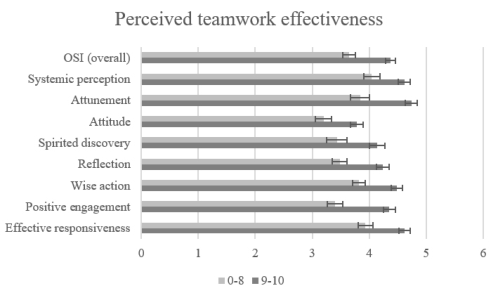
The ANOVA results indicated that there were statistically significant differences in the OSI scores between teams (p = .015). The teams accounted for 21.9% of the total variance in the OSI scores, suggesting that the team level has some influence on the overall OSI scores. Evaluations of the perceived teamwork effectiveness were categorized into two groups: high effectiveness (ratings 9–10) and lower effectiveness (ratings 0–8) (Figure 1). 58% of the participants rated their teamwork effectiveness as high, while 42% rated it as lower. The results showed that participants in the high-effectiveness group (9–10 ratings) reported significantly higher overall OSI scores compared to those in the lower-effectiveness group (U = 2975, p <.001). This differentiation between higher- and lower perceived teamwork effectiveness was evident across all factors of the OSI questionnaire (p <.001).
Figure 1: The OSI in higher- and lower-effectiveness groups of perceived teamwork, with 95% confidence intervals.
120 Juvonen and Jumisko-Pyykkö
DISCUSSION AND CONCLUSION The aim of this study was to examine the relationship between Organizational Systems Intelligence (OSI) and perceived teamwork effectiveness. The study explored how OSI and its eight factors are expressed within organizations and their association with the perceived teamwork.
The results show strong positive correlations between the overall OSI, its eight factors and perceived teamwork effectiveness. Additionally, the results showed that the perceived teamwork effectiveness varied within the organization with higher levels of effectiveness being associated with higher systems intelligence. This reinforces the notion that the ability to recognize, interpret and act within systemic contexts is closely linked to how effectively team’s function. This alignment between the OSI and teamwork effectiveness supports the fundamental principles of systems thinking where organizational effectiveness is seen as emerging from the interconnected relationships between individuals, teams and the broader work environment (Senge, 1990).
As teamwork becomes increasingly important within organizations (Gully et al., 2002; Hollenbeck et al., 2012) and operational environments grow more complex and interdependent (Klijn, 2009; Whitcomb et al., 2020), OSI can provide a valuable framework for understanding and improving teamwork in such circumstances. Unlike traditional approaches that focus primarily on individual competencies or external observation, OSI highlights the importance of relational dynamics and the ways in which individuals contribute to the overall system. This aligns with previous research (LePine et al., 2008; Rousseau et al., 2006; Balkundi & Harrison, 2006), which emphasizes that successful teamwork is not merely the sum of individual efforts but emerges from the ability to manage and leverage team-level interactions. The OSI measure can be used within organizations to identify variations in teamwork and support the development of best practices. Additionally, OSI results can help pinpoint teams that may benefit from targeted interventions.
This study has two main limitations and suggestions for further research. Firstly, the data was collected as a cross-sectional study within a single financial sector company, which limits the causal inferences and generalizability of the results to other industries and times. Secondly, teamwork effectiveness was measured using only a single question. Future research needs to employ more nuanced and multidimensional measures with a richer perspective on team cohesion and interdependent work relationships. For example, The Inclusion of Other in Self (IOS) scale assesses how closely individuals identify with others and the extent to which they incorporate them into their self-concept (Aron et al., 1992). The High- Quality Connections (HQC) theory by Jane Dutton (2003) could also be utilized to measure the quality of internal team interactions. HQC theory emphasizes the role of brief meaningful interactions within organizations and their impact on both individuals and team performance. It provides a framework for examining how team members perceive the strength of their connections, trust and reciprocity, and how these factors influence the
Systems Intelligence and Perceived Teamwork Effectiveness in an Organizational Context 121
overall perception of teamwork and systemic intelligence. Future research is needed to apply longitudinal designs to better understand how SI develops over time and how interventions targeting systemic competencies influence organizational outcomes. Finally, mixed methods studies could provide deeper insights into how employees perceive and apply SI in their daily work interactions (Kautiala et al., 2024).
To conclude, this study highlights the strong correlation between OSI and perceived teamwork effectiveness, reinforcing the systems thinking perspective that teamwork is associated with the richness of interconnected relationships between actors and their environment. As organizational environments become increasingly complex and as technological transformations accelerate, the ability to recognize and facilitate systemic relationships becomes increasingly important. In a world where change outpaces our ability to predict it, our greatest asset may not be more data or faster systems, but the intelligence to see beyond silos, connect with others and act wisely within complexity.
REFERENCES
Aron, A., Aron, E. N., & Smollan, D. (1992). Inclusion of other in the self scale and the structure of interpersonal closeness. Journal of Personality and Social Psychology, 63(4), 596–612. Balkundi, P., & Harrison, D. A. (2006). Ties, leaders, and time in teams: Strong
inference about network structure’s effects on team viability and performance. Academy of Management Journal, 49(1), 49–68. Cross, R., Rebel, R., & Grant, A. (2016). Collaborative overload. Harvard Business Review, 94, 74–79. Dutton, J. E. (2003). Energize Your Workplace: How to Create and Sustain High-
Quality Connections at Work. San Francisco: Jossey-Bass Publishers. Farh, C. I., Seo, M. G., & Tesluk, P. E. (2012). Emotional intelligence, teamwork effectiveness, and job performance: The moderating role of job context. Journal of applied psychology, 97(4), 890. Gardner, H. (1983). Frames of Mind: The Theory of Multiple Intelligences, Tenth
anniversary edition. New York, Basic Books. Goleman, D. (1995). Emotional Intelligence, Bantam Books, New York, NY. Gully, S. M., Incalcaterra, K. A., Joshi, A., Baubien, J. M., (2002). A Meta-Analysis of Team-Efficacy, Potency, and Performance: Interdependence and Level of Analysis as Moderators of Observed Relationships. Journal of Applied Psychology. Vol. 87, No. 5, 819–832. Hämäläinen, R. P., Saarinen, E. and Törmänen, J. (2019). Systems intelligence: A
core competence for next-generation engineers? IEEE International Conference on Teaching, Assessment, and Learning for Engineering (TALE), pp. 641–644, doi: 10.1109/TALE.2018.8615247. Harviainen, J. T., Hämäläinen, R., & Saarinen, E. (2021) System intelligence as an organizational approach for service designers. Touchpoint: The Journal of Service Design, 12(2), 16–29. Helal, H. M. & Hassan, A. E. (2025). Research motivation as a mediating variable
between system intelligence, academic grit, and academic achievement among postgraduate students, faculty of education, Zagazig University. BMC psychology, 13(1), 70.
122 Juvonen and Jumisko-Pyykkö
Hollenbeck., J. R., Beersma, B., Schouten, M. (2012). Beyond Team Types and Taxonomies: A Dimensional Scaling Conceptualization for Team Description. Academy of Management Review 37(1): 82–106. doi: 10.5465/amr.2010.0181. Jumisko-Pyykkö, S., Halme, A., Hattingh., G., Kerkola H., Scotcher B., Rapp., A. Rönkä, W., Saarinen, J., Salonen, T., Siipola, V., Toivonen, E., Vanhala, J., Hämäläinen, R. P., Saarinen, E. (2025). Systems Intelligence and Mediated Team Touch via Smart Sleeves in E-sports, The proceedings of 27th
International Conference on Human-Computer Interaction (accepted). Jumisko-Pyykkö, S., Törmänen, J., Vänni, K., Hämäläinen, R. P., & Saarinen, E. (2022). Systems intelligence, perceived performance and wellbeing. Human Factors, Business Management and Society, 56, 55. Jumisko-Pyykkö, S., Viita-aho, T., Tiilikainen, E., & Saarinen, E. (2021) Towards Systems Intelligent Approach in Empathic Design. Academic Mindtrek 2021, Finland. https://doi.org/10.1145/3464327.3464370 Kautiala, J., Jumisko-Pyykkö, S., Hämäläinen, R. P., & Saarinen, E. (2024).
Systems Intelligence in an Expert Organization: A Mixed Methods Approach. Human Factors, Business Management and Society. https://doi.org/10.54941/ ahfe1004934 Klijn, E-H. (2009). Policy and Implementation Networks: Managing Complex Interactions. In The Oxford Handbook of Inter-Organizational Relations, edited by Steve Cropper, Chris Huxham, Mark A. Ring, and Peter S. Ring, 118–146. Oxford: Oxford University Press. Kozlowski, S. W. J., Bell, B. S. (2003). Work groups and teams in organizations.
Handbook of psychology: Industrial and organizational psychology. Wiley: Vol. 12, pp. 333–375. https://doi.org/10.1002/0471264385.wei1214 LePine, J. A., Piccolo, R. F., Jackson, C. L., Mathieu, J. E., & Saul, J. R. (2008).
A meta-analysis of teamwork processes: Tests of a multidimensional model and relationships with team effectiveness criteria. Personnel Psychology, 61(2), 273–307. https://doi.org/10.1111/j.1744–6570.2008.00114.x Marks, M. A., Mathieu, J. E., Zaccaro, S. J. (2001). A temporally based framework and taxonomy of team processes. Academy of Management Review. Jan;26(3): 356–76. McEwan, D., Ruissen, G. R., Eys, M. A., Zumbo, B. D., Beauchamp, M. R. (2017). The Effectiveness of Teamwork Training on Teamwork Behaviors and Team Performance: A Systematic Review and Meta-Analysis of Controlled Interventions. PLoS ONE 12(1): e0169604. https://doi.org/10.1371/ journal.pone.0169604 Montes, J. L., Moreno, A. R., Morales, V. G. (2005). Influence of support leadership
and teamwork cohesion on organizational learning, innovation and performance: an empirical examination. Elsevier. Volume 25, Issue 10, October 2005, Pages 1159–1172. Rousseau, V., Aubé, C., & Savoie, A. (2006). Teamwork behaviors: A review and an integration of frameworks. Small group research, 37(5), 540–570. Saarinen, E., & Hämäläinen, R. P. (2004). Systems Intelligence: Connecting
engineering thinking with human sensitivity. In Systems Intelligence - Discovering a Hidden Competence in Human Action and Organizational Life (pp. 1–29). Helsinki University of Technology. Salas, E., Dickinson, T. L., Converse, S. A., & Tannenbaum, S. I. (1992). Toward an understanding of team performanceand training. In R. W. Swezey & E. Salas (Eds.), Teams: Their training and performance (pp. 3–29). Norwood, NJ: Ablex.
Systems Intelligence and Perceived Teamwork Effectiveness in an Organizational Context 123
Salas, E., Shuffler, M. L., Thayer, A. L., Bedwell, W. L., & Lazzara, E. H. (2014).
Understanding and Improving Teamwork in Organizations: A Scientifically Based Practical Guide. Human Resource Management, 54. https://doi.org/10.1002/ hrm.21628 Sasaki, Y. (2014) Systems Intelligence in Knowledge Management Implementation: A Momentum of the SECI Model. Proceedings of the 15th International Symposium on Knowledge and Systems Science, 69–74. Senge, P. M. (1990). The fifth discipline: The art and science of the learning
organization. Doubleday/Currency. Törmänen, J., Hämäläinen, R. P., & Saarinen, E. (2021). On the systems intelligence of a learning organization: Introducing a new measure. Human Resource Development Quarterly. Advanced online publication. https://doi.org/10.1002/hr dq.21455 Whitcomb, C. Davidz, H. Groesser, S. (2020). Systems Thinking. MDPI. Örtenblad, A. (2018). What does “learning organization” mean? The Learning
Read this individual research paper free through the original publisher, or explore the full digital proceedings book.
ISBN 978-1-964867-52-6
Explore this ISBN in the AHFE Bookstore ↗Listed in the July 2026 bookstore catalogue; search by ISBN to confirm current availability · Digital book purchase optional