Aleksi Juvonen, Satu Jumisko-Pyykko, Sanna Nieminen, Kirsi Kemell, Mikko Seppälä, Satu Honkanen, Jaana Saarisilta (2026). Organizational Systems Intelligence, Psychological Safety and Perceived Performance. In: Human Factors, Business Management and Society. AHFE Open Access, vol. 215, pp. 231–242. https://doi.org/10.54941/ahfe1007604
Systems Intelligence (SI) approaches organizations through a systemic, pragmatic, bottom-up, and interactional lens, emphasizing how individuals perceive and act within interdependent systems. Psychological Safety (PS) refers to a shared belief among individuals that the group is a safe environment for interpersonal risk taking in a particular context, such as a workplace. Although prior research has shown that both SI and PS are associated with positive work outcomes, such as performance and organizational learning, but their relationship is unexplored. This study examines the associations between SI, PS, and perceived organizational performance at the organizational level. The survey was conducted with 11 industrial SMEs and had 247 respondents. The results revealed positive correlations among SI, PS, and perceived performance and further showed that perceived performance was more strongly associated with SI than with PS. These findings highlight the importance of strengthening both systemic and social capabilities in contemporary work environments characterized by complexity, rapid change, and interdependence.
Organizations today operate in environments characterized by rapid change, increasing complexity, and profound interdependence (Klijn, 2009). In such conditions, achieving organizational goals increasingly depends on how effectively people are able to combine their competencies and work collaboratively (Salas et al., 2015). As work becomes more tightly connected to interdependent networks and the intersecting interests of multiple actors, the importance of collaboration grows both within and across organizational boundaries (Antonacopoulou & Chiva, 2007; Orlikowski, 2000).
Research has highlighted the importance of social and relational conditions in enabling effective collaboration and organizational performance (LePine et al., 2008; Carmeli & Gittell, 2009). Building on this line of research, the present study focuses on two closely related constructs: Systems Intelligence (SI) and Psychological Safety (PS). SI refers to the ability and capability to
succeed within complex wholes (Saarinen & Hämäläinen, 2004). In practice, systems-intelligent behavior manifests as action in which individuals recognize the effects of their behavior on the broader system and intentionally act in ways that support collective success within that system (Hämäläinen et al., 2014). PS, in turn, refers to a shared belief that the work environment is safe for taking interpersonal risks, such as expressing unfinished ideas, asking questions, challenging assumptions, and admitting mistakes without fear of negative consequences (Edmondson, 1999). Together, these constructs offer theoretically and practically grounded bottom-up perspectives on how interpersonal interaction and collective action contribute to organizational functioning.
Despite their conceptual proximity, prior research has not examined these constructs side by side at the organizational level. In prior research, both constructs have been linked to organizational learning (Törmänen et al., 2021; Edmondson, 1999), teamwork effectiveness (Juvonen & Jumisko-Pyykkö, 2025; Bergmann & Schaeppi, 2016), and organizational performance (Jumisko-Pyykkö et al., 2022; Kobayashi, 2025). However, little is known about how SI and PS are empirically related when considered as organizational-level phenomena or how they jointly and comparatively account for employees’ perceptions of organizational performance.
The goal of this study is to address this gap by examining the relationship between organizational SI and PS, and by assessing their relative importance for employees’ perceptions of organizational performance.
SYSTEMS INTELLIGENCE SI was introduced by Raimo P. Hämäläinen and Esa Saarinen (2004) and it refers to the following:
“[...] intelligent behavior in the context of complex systems involving interaction and feedback. A subject acting with Systems Intelligence engages successfully and productively with the holistic feedback mechanisms of her environment. She perceives herself as a part of a whole, the influence of the whole upon herself as well as her own influence upon the whole. By observing her own interdependence in the feedback intensive environment, she is able to act intelligently.”
SI is characterized by the primacy of the whole system, acknowledging interconnectivity, interdependence, and systemic feedback (Saarinen & Hämäläinen, 2004). SI denotes the capacity to act wisely and purposefully as part of complex systems with the aim of enabling success at the level of the whole (ibid.). SI behavior is expressed in practical action in which an individual recognizes how their behavior affects the broader context and acts in ways that support the functioning of the entire system (ibid.). SI is grounded in the systems thinking view of structures, interaction patterns, and possibilities for change. While systems thinking primarily seeks to describe phenomena and their dynamics, SI stresses the application of this
Organizational Systems Intelligence, Psychological Safety, and Perceived Performance 233 understanding in concrete situations and constructive action within them (Saarinen & Hämäläinen, 2004).
The development of SI has been inspired by systems thinking in organizations and work on intelligence, but it has also been widely applied beyond these disciplines. SI has been shaped by Peter Senge’s (1990) The Fifth Discipline, which highlighted the central role of systems thinking in organizational learning and development. SI also draws on Howard Gardner’s (1983) theory of multiple intelligences and Daniel Goleman’s (1995) work on emotional intelligence (Saarinen & Hämäläinen, 2004). While SI shares certain features with emotional intelligence, it differs by emphasizing a distinctly systemic perspective and the individual’s active engagement with the dynamics of the system (Hämäläinen et al., 2019).
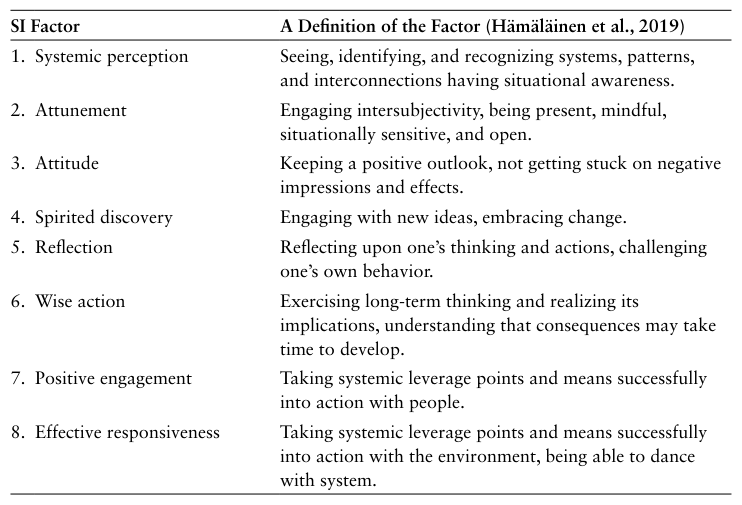
SI is composed of the following eight factors: systemic perception, attunement, attitude, spirited discovery, reflection, wise action, positive engagement and effective responsiveness. The factors and their definitions are presented in Table 1.
Table 1: The eight factors of SI.
Recent research has demonstrated the broad applicability of SI across analytical levels and methodological approaches. SI has been measured at the individual, team, and organizational levels (Törmänen et al., 2016; Törmänen, 2022: Juvonen & Jumisko-Pyykkö, 2025; Törmänen et al., 2021) and applied in mixed-methods research (Kautiala et al., 2024). Prior studies have reported positive associations between SI and multiple individual and collective outcomes, including emotional intelligence, organizational learning, well- being, and academic achievement (Törmänen et al., 2016; Törmänen et al., 2021; Jumisko-Pyykkö et al., 2022; Helal & Hassan, 2025; Kumpulainen et al., 2023). SI has also been utilized in the design and evaluation of sociotechnical
systems and systemic design (Jumisko-Pyykkö et al., 2025a; Jumisko-Pyykkö & Pulkkinen 2025b; Jumisko-Pyykkö et al., 2021).
Previous research has also shown a positive association between SI and performance. At the individual level, SI has been shown to function as a personal resource that predicts job performance in demanding and complex work environments (Liaquat & Escartín, 2025). At the team level, higher levels of SI are associated with more effective teamwork, reinforcing the view that the ability to recognize, interpret, and leverage systemic interdependencies is closely tied to how effectively teams function (Juvonen & Jumisko-Pyykkö, 2025). At the organizational level, SI has been linked to perceived performance, reflecting its role as an organizational systemic capability (Törmänen et al., 2021; Jumisko-Pyykkö et al., 2022). Taken together, these findings indicate that SI is consistently and positively linked to performance across individual, team, and organizational levels.
PSYCHOLOGICAL SAFETY According to Amy Edmondson (1999), PS is a shared belief among individuals that the group is a safe environment for interpersonal risk taking and that each person can be themself without fear of being embarrassed, marginalized, or punished. In a psychologically safe environment, individuals feel able to voice new ideas, ask questions, admit mistakes, and express themselves freely without fear of humiliation or negative consequences.
In a psychologically safe work community, the perceived benefits of speaking up outweigh the potential personal costs (Edmondson & Lei, 2014). PS provides the foundation for open dialogue, constructive dissent, and collective learning. It encourages employees to participate and share their expertise, thereby strengthening collaboration and supporting the achievement of shared goals. PS does not imply the absence of disagreement; rather, it means that differing views can be expressed and handled constructively in ways that support learning (Edmondson, 2018). Edmondson (1999) argued that PS arises from mutual respect and trust among group members, which form the basis for open communication and learning.
PS has been studied from the individual level to the team and organizational levels. PS was initially viewed as an individual-level experience that supported organizational learning and adaptation in changing environments (Frazier et al., 2017) and as a factor in employee engagement (Kahn, 1990). Since the late 1990s, PS has been understood primarily as a group-level phenomenon, following Edmondson’s (1999) definition. On an organizational level, PS is positively associated with variety of beneficial organizational outcomes, such as employee engagement, job satisfaction, collaboration, and performance (Frazier et al., 2017).
PS has also been broadly associated with a wide range of processes that enhance organizational performance. It promotes learning behavior (Ortega et al., 2014; Harvey et al., 2019) and knowledge sharing (Mura et al., 2016), thereby enabling organizations to adapt more effectively in dynamic and complex environments. PS further supports innovation (Andersson et al., 2020) and team functioning (Chen et al., 2017). In addition, it has been associated with organizational performance (Andersson et al., 2020; Kirkman
Organizational Systems Intelligence, Psychological Safety, and Perceived Performance 235 et al., 2013). Through these mechanisms, PS has emerged as an important factor that is positively associated with individual, team, and organizational performance.
In sum, both SI and PS have been extensively studied, and they have broad and positive connections to organizational outcomes including learning, teamwork effectiveness, and organizational performance. However, their relationship on an organizational level is unexplored, as is their joint association with perceived performance. A goal of this study is to explore the relation between SI, PS, and perceived performance on an organizational level.
METHOD
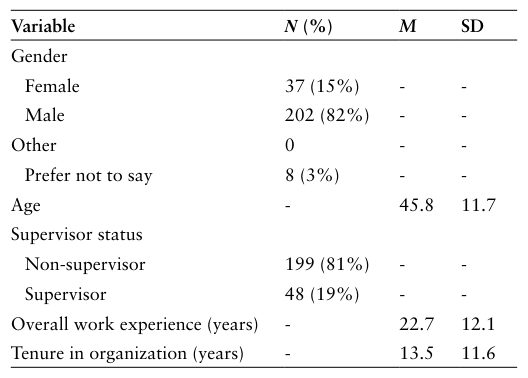
The participants: The data for this study were collected from 11 Finnish industrial companies whose employees were invited to participate in an online survey in November 2025. All the participating organizations were small or medium-sized enterprises (SMEs), with company sizes ranging from 14 to 93 employees. All the employees in each company were invited to take part in the study, and participation was voluntary and anonymous. A total of 247 respondents completed the survey, corresponding to an overall response rate of 58%. Company-specific response rates ranged from 43% to 93%. Table 2 presents the demographics of the respondents. Most of the respondents were male, worked in a non-supervisory position, had an average tenure of 13.5 years with their current employer, and had a total work experience of 22.7 years.
Table 2: The demographic characteristics of the respondents (N = 247).
“very rarely,” “rarely,” “sometimes,” “often,” “very often,” “always”). Perceived organizational performance (Venkatraman & Ramanujam, 1986) was measured with the following single item: “On a scale from 0 to 10, how successful do you perceive your organization to be in its field?” The item was measured on an 11-point scale with the labels 0 indicating “Very poor,” 5 indicating “Average,” and 10 indicating “Excellent” (Törmänen et al., 2021).
Statistical analysis: The study employed a cross-sectional survey design. Data analysis proceeded from descriptive statistics and Pearson correlations to hierarchical linear modeling (HLM). Because the data consisted of individual respondents nested within 11 organizations, the observations were not statistically independent. To account for the hierarchical structure of the data and to avoid underestimating standard errors, HLM with random intercepts was employed. A null model (an intercept-only model) was first estimated to assess the proportion of variance in perceived organizational performance attributable to differences between organizations and to justify the use of an HLM approach. After establishing the presence of between-organization variability, predictor variables were added at the individual level in subsequent models. SI and PS were entered as fixed effects, while organizational membership was specified as a random intercept to model residual between-unit variability.
RESULTS
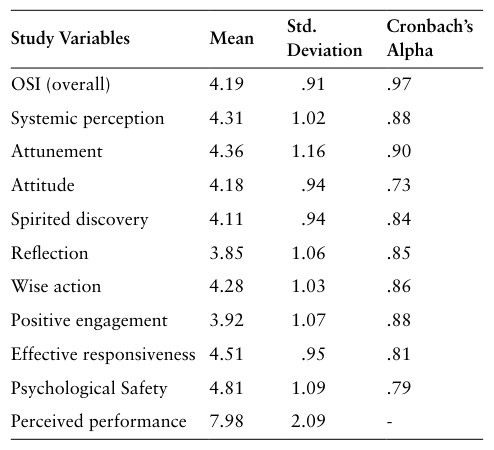
The descriptive statistics showed that the respondents reported moderate levels of SI (OSI overall score 4.19) and PS (4.81) on a 1–7 scale, while perceived organizational performance was rated 7.98 on a 0–10 scale (see Table 3). The overall OSI score was calculated as the mean of all 32 SI items. The internal consistency of the overall OSI was excellent (α = .97) and ranged from moderate to excellent in its factors (α = .73–.90). PS also showed good reliability (α = .79).
Table 3: Descriptive statistics and reliability coefficients for the study variables.
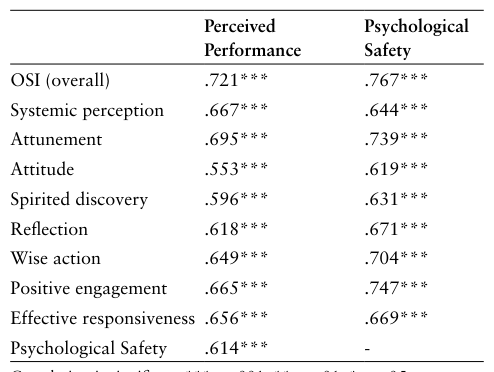
Organizational Systems Intelligence, Psychological Safety, and Perceived Performance 237 Correlations: OSI and its factors correlated positively with perceived performance and PS (see Table 4). The overall OSI showed a strong positive correlation with both perceived performance (r = .721, p < 001) and PS (r = .767, p < .001). All OSI factors correlated positively and strongly with perceived performance (r = .553–.695, p < .001) and PS (r = .619–.747, p < .001). PS had also a positive and strong correlation with perceived performance (r = .614, p < .001).
Table 4: The Pearson’s correlations for OSI (overall and factors), PS, and perceived performance.
Modelling: The study employed hierarchical multilevel modeling to examine factors influencing perceived organizational performance. The analysis proceeded in four stages to assess the incremental validity of each variable group.
Model 1 (the null model): The unconditional model established a baseline for perceived performance with an estimated mean of 8.33 (SE = 0.31, p < .001, CI [7.65, 9.01]). The random intercept at the organizational level was close to statistical significance (variance = 0.842, SE = 0.443, p = .057), and the individual-level residual variance was 3.453 (SE = 0.318, p < .001). The intraclass correlation coefficient (ICC) was .196, indicating that approximately 20% of the total variance in perceived performance was attributable to differences between the organizations, justifying the use of multilevel modelling with the nested structure of the data.
Model 2 (the control variables): When age, gender, supervisory position, total work experience, and tenure in the current organization were added to the model, the marginal R² increased to .052 and the conditional increased R² to .218. The ICC declined to .175, indicating that the controls accounted for part of the between-organization variance. Among the control variables, only supervisory position was statistically significant (estimate = –0.905, SE = 0.302, p = .003, CI [−1.50, −0.31]), with supervisors reporting higher perceived organizational performance. All other control variables were
non-significant. The organizational-level variance component decreased to 0.693 (SE = 0.384, p = .071). Model 3 (the control variables and PS): Adding PS on top of the control variables substantially improved the model’s fit (marginal R² = .352, conditional R² = .410). PS was a strong and statistically significant predictor of perceived organizational performance (estimate = 1.018, SE = 0.101, p < .001, CI [.82, 1.22]). Adding PS made the effect of supervisor position non-significant (p = .066). The ICC further decreased to .090 (conditional ICC = .058). The organizational-level random intercept variance dropped to 0.233 (SE = 0.154, p = .131), indicating that PS explained a considerable portion of the between-organization variance detected in the null model.
Model 4 (the control variables, PS, and OSI): When the overall OSI was entered alongside PS and the control variables, the model’s explanatory power further increased (marginal R² = .519, conditional R² = .555). OSI emerged as a dominant predictor of perceived organizational performance (estimate = 1.349, SE = 0.159, p < .001, CI: [1.04, 1.66]). The inclusion of OSI reduced the effect of PS to non-significance (estimate = 0.235, SE = 0.128, p = .068). None of the control variables showed significant associations with the dependent variable in this model. The organizational-level variance component declined further to 0.147 (SE = 0.113, p = .195), and the ICC fell to .074 (conditional ICC = .036).
DISCUSSION AND CONCLUSION This study examined the relationship between SI and PS, as well as their relative contributions to respondents’ perceptions of organizational performance. Correlation analyses showed that OSI (both overall and across all factors) was strongly and positively associated with both PS and perceived organizational performance, while PS demonstrated weaker but still positive correlations with organizational performance.
The results showed that overall OSI is a stronger predictor of perceived organizational performance than PS. While PS displayed a strong association with performance when examined on its own, its effect become non-significant once OSI was included in the same model, whereas OSI continued to explain substantial variance on both individual and organizational levels. Overall, the findings indicate that the apparent effect of PS on performance largely reflects variance shared with the broader systemic capabilities captured by OSI.
Taken together, the results advance understanding of what organizations require to function effectively within evolving and increasingly complex industrial-sector contexts. Prior research has emphasized that achieving organizational goals depends on social and relational conditions that support the integration of expertise and collaborative work (Salas et al., 2015; Antonacopoulou & Chiva, 2007; Orlikowski, 2000). These findings reinforce prior evidence (Törmänen et al., 2021; Jumisko-Pyykko et al., 2022) that OSI is associated with organizational performance and further highlight a conceptual distinction: OSI encompasses both inward-looking factors (e.g., attunement and positive engagement) and outward-looking
Organizational Systems Intelligence, Psychological Safety, and Perceived Performance 239 factors (e.g., systemic perception and effective responsiveness), whereas PS is primarily oriented toward the internal dynamics of the system. This broader systemic orientation may help explain why OSI emerged as the stronger predictor of perceived organizational performance in this dataset.
This study also has its limitations. First, the sample was drawn from a single Finnish industrial sector and consisted of SMEs with a limited number of participating organizations, which restricts the external validity of the findings. Second, the cross-sectional design allows interpreting associations but not causal effects. Third, perceived organizational performance was measured using a single-item subjective indicator without linkage to objective performance metrics, limiting its conceptual breadth. Additionally, all measures were self-reported and collected at a single time point, which may introduce common method bias and inflate the observed associations.
There are six suggestions for future research: 1) Longitudinal studies are needed to approach both SI and PS as dynamic phenomena in the fast- changing working-life context. Both SI and PS have been studied on the individual, team, and organizational levels, but work is needed to understand the interaction between these levels and their impact on successive outcomes. 3) To develop SI, further work needs to extend research from measuring SI to the interventions to support SI-positive pathways in working life. 4) Future work needs to richly approach the connection between SI and the competitive factors of organizations, such as innovation and creativity, and extend the current studies with objective measurements of outcomes. 5) Future work is also needed to approach SI with finer granularity by investigating the contextual aspects of SI with mixed methods and conducting factor-level analysis in modeling. 6) While past work has focused on the positive impacts of SI, future work needs to also explore its potential negative consequences or the cases of “too much SI.”
To conclude, this study showed positive correlations between organizational SI, PS, and perceived organizational performance and demonstrated that perceived performance was more strongly predicted by SI than by PS. This indicates that performance in today’s complex, rapidly changing, and interdependent work environments is shaped by both systemic and social capabilities. For the development of future organizations, strengthening SI capabilities is therefore essential, as it enhances the ability of individuals within the organization to recognize interdependencies, respond wisely to systemic conditions, and coordinate actions in ways that support collective performance.
ACKNOWLEDGMENTS
The data was collected as a part of the “Sustainable Growth with Systems Intelligence and Network Competence” project funded by Economic Development Centre of Central Finland. We thank Lauri Valkonen for his help in the analysis.
REFERENCES
Andersson, M., Moen, O., & Brett, P. O. (2020). The organizational climate for psychological safety: Associations with SMEs’ innovation capabilities and innovation performance. Journal of Engineering and Technology Management, 55, 101554. Antonacopoulou, E. & Chiva, R. (2007). The social complexity of organizational
learning: The dynamics of learning and organizing. Management Learning, 38, 277–295. Bergmann, B., & Schaeppi, J. (2016). A data-driven approach to group creativity.
Harvard Business Review, 12, 43–62. Carmeli, A., & Gittell, J. H. (2009). High-quality relationships, psychological safety, and learning from failures in work organizations. Journal of Organizational Behavior: The International Journal of Industrial, Occupational and Organizational Psychology and Behavior, 30(6), 709–729. Chen, S., Wang, D., Zhou, Y., Chen, Z., & Wu, D. (2017). When too little or too
much hurts: Evidence for a curvilinear relationship between team faultlines and performance. Asia Pacific Journal of Management, 34(4), 931–950. Edmondson, A. (1999). Psychological safety and learning behavior in work teams.
Administrative Science Quarterly, 44, 350–383. Edmondson, A. (2018). The Fearless Organization: Creating Psychological Safety in the Workplace for Learning, Innovation, and Growth. Edmondson, A. C. & Lei, Z. (2014). Psychological safety: The history, renaissance,
and future of an interpersonal construct. Annual Review of Organizational Psychology and Organizational Behavior, 1, 23–43. Frazier, M. L., Fainshmidt, S., Klinger, R. L., Pezeshkan, A. & Vracheva, V. (2017).
Psychological safety: A meta-analytic review and extension. Personnel Psychology, 70, 113–165. Gardner, H. (1983). Frames of Mind: The Theory of Multiple Intelligences, Tenth anniversary edition. New York, Basic Books. Goleman, D. (1995). Emotional Intelligence, Bantam Books, New York. Helal, M. H., & Hassan, E. A. (2025). Research motivation as a mediating variable
between system intelligence, academic grit, and academic achievement among postgraduate students, faculty of education, Zagazig University. BMC psychology, 13(1), 70. Harvey, J. F., Johnson, K. J., Roloff, K. S., & Edmondson, A. C. (2019). From orientation to behavior: The interplay between learning orientation, open- mindedness, and psychological safety in team learning. Human Relations, 72(11), 1726–1751. Hämäläinen, R.P, Saarinen, E. & Jones, R. (2014). Being better, better. Living with
Systems Intelligence. Aalto-yliopisto. Hämäläinen, R. P., Saarinen, E. and Törmänen, J. (2019). Systems intelligence: A core competence for next-generation engineers? IEEE International Conference on Teaching, Assessment, and Learning for Engineering (TALE), pp. 641–644, doi: 10.1109/TALE.2018.8615247. Jumisko-Pyykkö, S., Halme, A., Hattingh., G., Kerkola H., Scotcher B., Rapp.,
A. Rönkä, W., Saarinen, J., Salonen, T., Siipola, V., Toivonen, E., Vanhala, J., Hämäläinen, R. P., Saarinen, E. (2025a). Systems Intelligence and Mediated Team Touch via Smart Sleeves in E-sports, The proceedings of 27th International Conference on Human-Computer Interaction. Jumisko-Pyykkö, S., Pulkkinen, J. (2025b). Opportunities of Systems Intelligence in Systemic Design. Human Factors, Business Management and Society. Vol 176. 34–45.
Organizational Systems Intelligence, Psychological Safety, and Perceived Performance 241 Jumisko-Pyykkö, S., Törmänen, J., Vänni, K., Hämäläinen, R. P., & Saarinen, E.
(2022). Systems intelligence, perceived performance and wellbeing. Human Factors, Business Management and Society, 56, 55. Juvonen, A., Jumisko-Pyykkö, S. (2025). Systems Intelligence and Perceived Teamwork Effectiveness in an Organizational Context. Human Factors, Business Management and Society. Vol 176. 113–123. Kahn, W. A. (1990). Psychological conditions of personal engagement and
disengagement at work. Academy of Management Journal, 33, 692–724. Kirkman, B. L., Cordery, J. L., Mathieu, J., Rosen, B., & Kukenberger, M. (2013).
Global organizational communities of practice: The effects of nationality diversity, psychological safety, and media richness on community performance. Human relations, 66(3), 333–362. Klijn, E-H. (2009). Policy and Implementation Networks: Managing Complex Interactions. In The Oxford Handbook of Inter-Organizational Relations, edited by Steve Cropper, Chris Huxham, Mark A. Ring, and Peter S. Ring, 118–146. Oxford: Oxford University Press. Kobayashi, M. (2025). Effectiveness of a group-based psychological safety
intervention to prevent workplace bullying and sustain work engagement: A cluster randomized controlled trial. Behavioral Sciences, 15(10), 1302. Kumpulainen, K. R., Sajaniemi, N., Suhonen, E., & Pitkäniemi, H. (2023).
Occupational well-being and teamwork in Finnish early childhood education. Journal of early childhood education research, 12(2), 71–97. LePine, J. A., Piccolo, R. F., Jackson, C. L., Mathieu, J. E., & Saul, J. R. (2008).
A meta-analysis of teamwork processes: Tests of a multidimensional model and relationships with team effectiveness criteria. Personnel Psychology, 61(2), 273– 307. Liaquat, S., & Escartín, J. (2025). Systems Intelligence and Job Autonomy in Managing Stressors and Performance: A Time-Lagged Study in Multinational Firms. Sustainability, 17(7), 3125. Mura, M., Lettieri, E., Radaelli, G., & Spiller, N. (2016). Behavioural operations in
healthcare: a knowledge sharing perspective. International Journal of Operations & Production Management, 36(10), 1222–1246. Newman, A., Donohue, R. & Eva, N. (2017). Psychological safety: A systematic review of the literature. Human Resource Management Review, 27, 521–535. Orlikowski, W. J. (2000). Using technology and constituting structures: A practice
lens for studying technology in organizations. Organization Science, 11, 404–428. Ortega, A., Bossche, P., Sánchez-Manzanares, M., Rico, R., Gil, F. (2014). The influence of change-oriented leadership and psychological safety on team learning in healthcare teams. J. Bus. Psychol. 29(2):311–21 Paredes-Saavedra, M., Vallejos, M., Huancahuire-Vega, S., Morales-García, W.
C., & Geraldo-Campos, L. A. (2024). Work team effectiveness: Importance of organizational culture, work climate, leadership, creative synergy, and emotional intelligence in university employees. Administrative Sciences, 14(11), 280. Saarinen, E., & Hämäläinen, R. P. (2004). Systems Intelligence: Connecting engineering thinking with human sensitivity. In Systems Intelligence - Discovering a Hidden Competence in Human Action and Organizational Life (pp. 1–29). Helsinki University of Technology Senge, P. M. (1990). The fifth discipline: The art and science of the learning
organization. Doubleday/Currency. Shahzad, F., Luqman, R. A., Khan, A. R., & Shabbir, L. (2012). Impact of organizational culture on organizational performance: An overview. Interdisciplinary journal of contemporary research in business.
Törmänen, J., Hämäläinen, R. P., & Saarinen, E. (2016). Systems intelligence inventory. The Learning Organization, 23(4), 218–231. Törmänen, J., Hämäläinen, R. P., & Saarinen, E. (2021). On the systems intelligence
of a learning organization: Introducing a new measure. Human Resource Development Quarterly. Advanced online publication. Törmänen, J., Hämäläinen, R. P., & Saarinen, E. (2022). Perceived systems intelligence and performance in organizations. The Learning Organization, 29(2), 100–115. Venkatraman, N., & Ramanujam, V. (1986). Measurement of business performance
in strategy research: A comparison of approaches. Academy of management review, 11(4), 801–814.
LISTED IN THE AHFE DIGITAL BOOKSTORE CATALOGUE
Explore the complete digital volume
Human Factors, Business Management and Society
Read this individual research paper free through the original publisher, or explore the full digital proceedings book.
ISBN 978-1-964867-91-5
Explore this ISBN in the AHFE Bookstore ↗Listed in the July 2026 bookstore catalogue; search by ISBN to confirm current availability · Digital book purchase optional