Takumi Iwaasa, Mayu Shirakawa, Shinya Sato, Shota Nagata, Yuta Takahashi, Katsutake Okimoto (2025). Evaluating the Impact of a Sports-and-Agriculture Workcation on Employees’ Well-Being: A Controlled Study Among Japanese Workers. In: Human Factors, Business Management and Society. AHFE Open Access, vol. 176, pp. 281–292. https://doi.org/10.54941/ahfe1006325
Workcation, a blend of “work” and “vacation,” has garnered increasing attention in Japan amid expanding flexible work styles. Integrating sports and agricultural activities into such programs may boost physical and mental well-being, alleviate stress, and enhance productivity; however, empirical data remain sparse. In a four-week study conducted in Yamaguchi Prefecture from late November to mid-December 2023, employees (n = 10) from three Tokyo-area companies participated in a sports-and-agriculture workcation, while a non-participating control group (n = 35) served as a comparator. Data were collected at four time points to assess psychological detachment, perceived exercise benefits, daily step counts, and a range of mental health indicators (Athens Insomnia Scale, K6, work engagement, and psychological safety). An ECG-based wearable device monitored sleep and stress, and semi-structured interviews explored participants’ experiences in a novel work setting. Although quantitative analysis revealed no significant difference in psychological detachment between groups, workcation participants demonstrated substantially heightened perceptions of exercise benefits during and shortly after the on-site period. Interview responses further indicated that exposure to new environments, physical activities, and agricultural tasks contributed to a sense of mental refreshment. By contrast, some participants encountered logistical obstacles such as limited infrastructure, restricted workspace availability, and organizational concerns related to fairness. These findings highlight both the potential advantages of sports-and-agriculture workcations and the importance of addressing infrastructural and policy barriers to fully capitalize on their benefits.
In response to the global spread of COVID-19, numerous companies and public agencies have rapidly adopted telework and other remote working arrangements. While these shifts underscore the importance of flexible work styles unbound by geography or time, they also highlight psychosocial risks, including employee isolation and difficulties in mentally detaching from work. Against this backdrop, the concept of “workcation”—working in tourist destinations or other non-routine locations while incorporating leisure activities—has attracted considerable attention. Demonstration projects by organizations such as NTT DATA Institute of Management Consulting, JTB, and various airlines have hinted at potential benefits of workcations, including stress reduction and enhanced work engagement. However, many of these findings remain preliminary due to methodological constraints, such as small sample sizes.
Simultaneously, airlines like the ANA Group have promoted workcations to support regional revitalization, and the Japan Tourism Agency has spotlighted local governments leveraging workcations to stimulate economic activity and foster innovative work styles. Nonetheless, policy refinements and infrastructure improvements are still required to fully exploit the potential of workcations.
Moreover, prolonged remote work has emphasized the importance of mental and physical well-being within flexible work environments, prompting greater focus on psychological detachment, K6 (a measure of psychological distress), the Athens Insomnia Scale (assessing sleep quality), work engagement, and psychological safety (reflecting employees’ perceptions of interpersonal risk-taking within teams). Although novel work arrangements show promise in supporting these mental health parameters, robust empirical data remain scarce.
Classification of Workcation and the Features of Workcation Combining Sports and Agriculture Workcations manifest in diverse forms. According to Tanaka (2020), three main types can be identified: (1) “vacation-based,” in which employees take work along on a vacation and intersperse it with leisure; (2) workcations “embedded in daily life,” involving telework from satellite offices or other alternate locations; and (3) “off-site” programs for corporate events such as training or meetings in resort areas. Within these categories, some programs have begun to include agricultural experiences and sports activities, aiming to provide additional benefits for both participants and host regions.
A “sports workcation” specifically incorporates exercise or sports into daily schedules, often leveraging natural environments to promote health, reduce stress, and enhance productivity. Similarly, an “agriculture workcation” engages participants in local farming communities, where they can experience cultivating and harvesting regional produce. When sports and agriculture converge, such a hybrid model may yield synergistic benefits by
Evaluating the Impact of a Sports-and-Agriculture Workcation on Employees’ Well-Being 283
combining physical activity, active relaxation, and deeper cultural immersion in the local setting.
Despite growing interest, empirical research on sports- and agriculture- focused workcations remains limited. Preliminary evidence suggests that these interventions may enhance mental health, workplace well-being, and job performance, yet more rigorous research—featuring larger sample sizes and stronger methodological designs—is needed to validate these outcomes.
Purpose and Significance of This Study This study examines how a workcation program integrating sports and agricultural activities affects employees’ physical and psychological well- being, paying particular attention to psychological detachment, perceived exercise benefits, and other mental health indicators such as the Athens Insomnia Scale, K6, work engagement, and psychological safety. Conducted in Yamaguchi Prefecture from late November to mid-December 2023, the study employs a design that includes both an intervention group (participating in the sports-and-agriculture workcation) and a non- participating control group. Data collection at multiple time points before, during, and after the intervention allows for assessing not only immediate changes but also the persistence of any benefits over time.
Previous workcation research often relied on single-group pre-post comparisons, making it difficult to rule out external influences on observed changes. By including a non-participating control group, the present study aims to provide more robust evidence on the causal impact of workcation participation on well-being-related outcomes. In addition to quantitative measures (including wearable data on sleep and stress), semi-structured interviews captured rich qualitative insights into how participants perceived changes in their psychological safety, mental health, and productivity. Findings from this study are expected to inform both corporate policy and regional initiatives aimed at advancing workcation models.
METHODS
Study Design We adopted a longitudinal approach that contrasted a group participating in a 5-night, 6-day sports-and-agriculture workcation in Yamaguchi (the intervention group) with a control group maintaining their usual work routines. The study spanned approximately four weeks, from late November to mid-December 2023, with data collected at four time points: Week 1 (baseline), Week 2 (during the workcation for the intervention group), Week 3, and Week 4 (post-workcation follow-up). The control group continued standard work practices throughout the study, offering a comparison for any observed temporal effects.
Participants Participants were recruited from three companies in the Tokyo metropolitan area: a casualty insurance company, an airline, and an electronics
manufacturer. In total, 10 individuals (8 men, 2 women; mean age = 44.3 years, SD = 8.4) joined the workcation. Research funding partially covered transportation and accommodation, while participants bore the costs of meals and incidental expenses on-site. A non-workcation control group of 35 individuals (18 men, 17 women; mean age = 41.1 years, SD = 9.3) continued their usual work schedules. All participants were volunteers and were assured that non-participation would not result in any disadvantage. Exclusion criteria included testing positive for COVID-19 (confirmed by PCR tests), having a position incompatible with remote work, lacking a discretionary work arrangement, or not possessing a valid driver’s license; no participants met these criteria.
Details of the Workcation Field Trial The workcation took place in the northern region of Yamaguchi Prefecture from late November through mid-December 2023, leveraging the area’s mountainous terrain and coastal environment. Situated at the southwestern tip of Honshu, Yamaguchi borders both the Sea of Japan and the Seto Inland Sea and is known for its relatively mild climate, scenic landscapes, and agricultural richness. Principal activities during the workcation included Nordic walking, light exercise at local sports facilities, and hands-on farming experiences such as harvesting regionally grown produce.
A satellite office served as the primary workspace, offering basic network infrastructure but presenting certain constraints for high-confidentiality tasks and extended online meetings. Participants were encouraged to structure their schedules flexibly, incorporating both remote work and local tourism or exercise. This arrangement was intended to facilitate smoother transitions between “on” (work) and “off” (leisure) modes, thereby promoting mental recuperation without compromising professional productivity.
Outcome Measures and Data Collection
Table 1 summarizes the outcome measures and data collection methods used in this study. Data were collected at four time points—Weeks 1, 2, 3, and 4—covering the pre-workcation baseline (Week 1), the on-site workcation period in Yamaguchi (Week 2), and two post-workcation follow- up weeks (Weeks 3 and 4). Psychological detachment and perceived exercise benefits were assessed using four-point Likert scales. We also measured work engagement, mental health indices (K6, Athens Insomnia Scale), and psychological safety at each time point.
Daily step counts and sleep duration were tracked via smartphone or wearable devices, and an ECG-based device measured sleep quality and stress via heart-rate variability. Semi-structured interviews were conducted within one week after the workcation concluded to explore participants’ remote work experiences, leisure activities, satisfaction, challenges, and perceptions of psychological safety.
Evaluating the Impact of a Sports-and-Agriculture Workcation on Employees’ Well-Being 285
Table 1: Overview of measured variables and data collection schedule.
Table available in the original PDF paper.
Variable Measurement/Instrument Data Collection Time Points Psychological Detachment Four-point Likert-scale Weeks 1, 2, 3, 4
device logs tracking daily step counts and sleep duration
Conducted within 1 week
Semi-Structured
Interview guide on
Interviews
following the workcation
workcation experiences, challenges, and perceptions
Statistical Analysis We performed two-way repeated-measures ANOVA on psychological detachment and perceived benefits of exercise, using group (workcation vs. non-workcation) and time (Weeks 1–4) as factors. Where a significant or marginal interaction was detected, we conducted t-tests to compare mean values between groups at each time point. Statistical significance was set at p <.05, and. 05 ≤p <.10 was regarded as a marginal trend.
RESULTS
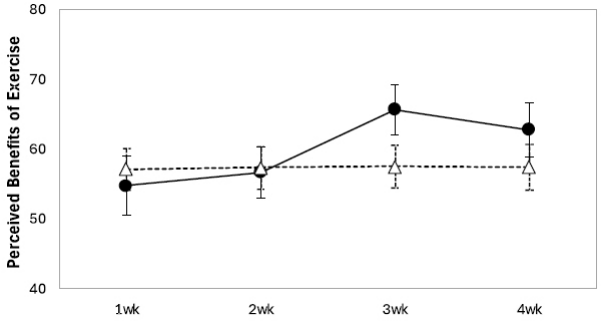
Changes in Perceived Benefits of Exercise (Figure 1) A two-way repeated-measures ANOVA revealed a significant interaction between group (workcation vs. non-workcation) and time (Weeks 1–4) for perceived benefits of exercise (p <.001). As shown in Figure 1, participants in the workcation group reported a marked increase in perceived benefits from Week 1 to Week 3. Post-hoc comparisons indicated that the greatest improvements occurred during and immediately after the on-site workcation (Weeks 2 and 3).
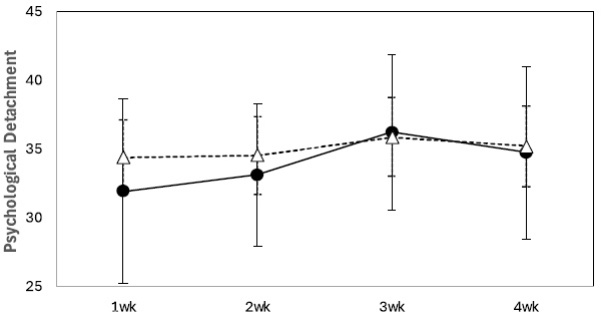
Changes in Psychological Detachment (Figure 2) As shown in Figure 2, no significant group-by-time interaction emerged for psychological detachment, although there were within-subject improvements from Weeks 1 or 2 to Week 3. Because these changes did not differ significantly between the workcation and non-workcation groups, factors
beyond the intervention may have contributed to the pattern. Further research with a larger sample size and longer intervention may help determine whether sports-and-agriculture workcations can produce stronger effects on psychological detachment over time.
Figure 1: Perceived benefits of exercise.Figure 2: Psychological detachment.
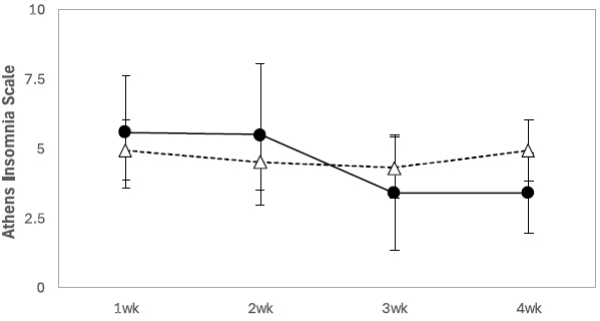
Changes in the Athens Insomnia Scale and Sleep Duration (Figures 3 and 4) A significant group-by-time interaction (p = .025) was observed for the Athens Insomnia Scale (AIS), with the workcation group showing a notable reduction in AIS scores from Weeks 1 to 3, whereas the non-workcation group remained largely unchanged. As shown in Figure 3, the improvement in insomnia symptoms was most pronounced during and immediately after the workcation period.
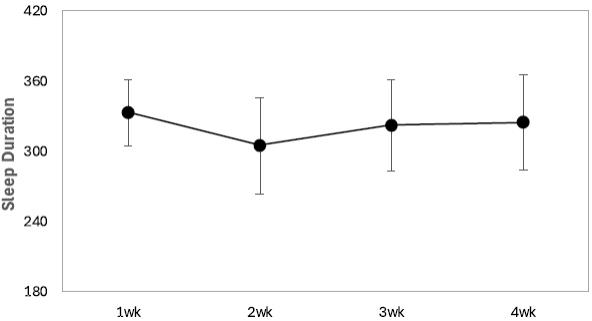
Regarding sleep duration, weekly averages (see Figure 4) showed no clear statistically significant changes from Weeks 1 to 4, as confidence intervals overlapped considerably. Some participants reported feeling insufficiently
Evaluating the Impact of a Sports-and-Agriculture Workcation on Employees’ Well-Being 287
rested during the most active phase of the workcation, but this was not reflected in a consistent group-level trend.
Although no corresponding figure is provided for step count, annotated data in the main table suggest that daily step counts in the workcation group rose from Week 1 to Week 2 (when sports activities were most concentrated) and then declined by Week 4.
Figure 3: The athens insomnia scale.Figure 4: Sleep duration.
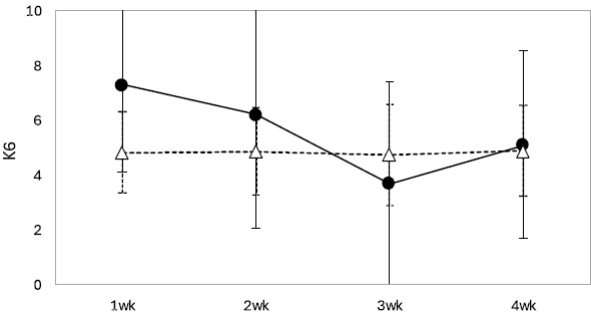
Changes in Mental Health (Figures 5 and 6) In the K6 scores (see Figure 5), a significant group-by-time interaction (p = .023) indicated that workcation participants experienced a clear reduction in distress levels by Week 3. The non-workcation group, in contrast, showed relatively stable scores over the four-week period.
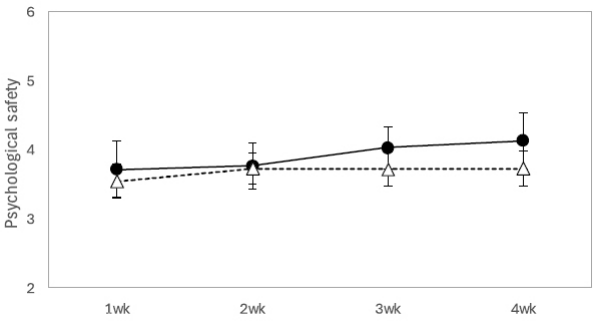
Psychological safety approached significance (p = .099), with the workcation group demonstrating a modest upward trend from Weeks 3 to 4 (see Figure 6). Although this borderline result should be interpreted with caution, it suggests a possible increase in participants’ sense of interpersonal risk-taking safety over time.
Although no figure is provided for overall work engagement, supplementary analyses revealed no significant group-by-time interaction for the composite score. However, the subscale of vigor showed a statistically significant improvement (p = .015) in the workcation group, and absorption approached significance (p = .053). These findings suggest that certain facets of work engagement may benefit from sports-and-agriculture activities, even if the global index of work engagement did not reach significance in this study.
Qualitative Insights From Interviews Semi-structured interviews with the ten workcation participants highlighted how the novel environment and the opportunity for physical activities mitigated the sense of monotony often associated with conventional telework. Many participants reported feeling “mentally refreshed” by engaging in activities such as Nordic walking, which provided a clear break from routine work.
Evaluating the Impact of a Sports-and-Agriculture Workcation on Employees’ Well-Being 289
At the same time, participants expressed concerns about network stability and workspace availability, which hampered tasks requiring confidentiality or paper-based processes. In several cases, workloads exceeded expectations, leaving limited time for vacation-like experiences. Some respondents also raised issues of “unfairness” in their organizations, as those not attending the workcation faced different responsibilities.
DISCUSSION
Enhanced Awareness of Exercise Benefits In contrast to psychological detachment, the perceived benefits of exercise showed a clear group-by-time interaction, with workcation participants reporting substantial gains during and shortly after the on-site period (Weeks 2 and 3). These results support the notion that integrating physical activities—such as Nordic walking or farm work—into a daily schedule can heighten awareness of exercise’s positive health effects. Interviewees frequently noted that the unique setting “naturally increased their level of physical activity,” providing a change of pace from conventional telework. This finding underscores the potential value of incorporating structured sports or agricultural experiences into remote-work arrangements to encourage healthier lifestyles.
Improvement and Persistence of Psychological Detachment Contrary to initial expectations, no statistically significant group-by- time interaction emerged for psychological detachment. Participants in both the workcation and non-workcation groups nevertheless showed within-subject improvements over time, suggesting that factors beyond the intervention itself may have contributed to increased detachment. Nonetheless, interview data indicated that many participants found the novel setting and outdoor activities conducive to “mentally refreshing” breaks. Although no clear, intervention-specific quantitative effect was detected, the qualitative feedback implies that changing one’s routine and environment— particularly through physical activities—can facilitate mental disengagement from work. A larger sample or longer intervention might clarify whether sports-and-agriculture workcations can further bolster detachment beyond the effects of time and adaptation alone.
Regional Infrastructure and Organizational Policy Issues Despite these positive trends, interviews revealed multiple challenges tied to regional infrastructure and corporate policies. Participants cited unreliable internet connectivity, limited workspace availability, and sparse transportation as barriers to an optimal remote-work experience. Some employees also voiced concerns about “unfairness” toward colleagues who remained at their usual workplaces. These findings suggest that successful implementation of sports-and-agriculture workcations requires not only strengthened local resources but also more flexible and supportive organizational structures. Encouraging broader acceptance of hybrid work
models and other diverse work styles is increasingly crucial. Without appropriate policy measures and openness to varied work arrangements, the potential benefits of such programs may be curtailed.
Significance of This Study and Future Directions This study advances workcation research by including both an intervention group and a non-participating control group, along with repeated measures over four weeks. Beyond showing gains in perceived exercise benefits, our findings point to potential mental health advantages, particularly for insomnia (AIS) and distress (K6). Although psychological safety approached, rather than reached, significance, the modest upward trend observed suggests that more extended or intensive interventions could further enhance employees’ sense of interpersonal risk-taking safety.
While the overall work engagement scores did not differ significantly by group over time, the vigor subscale improved, and absorption showed a marginal effect in the workcation group. These mixed results imply that specific facets of work engagement—particularly those tied to energy and focus—may be bolstered by incorporating sports and agriculture into remote-work arrangements.
Nonetheless, several limitations warrant attention. The relatively small sample size likely reduced statistical power to detect group differences in psychological detachment and other measures. Moreover, because participants were volunteers, a self-selection bias may have favored those more inclined to enjoy new work environments and physical activities. Future research could benefit from larger, more diverse samples, extended follow- up periods, and more rigorous (e.g., randomized or quasi-experimental) designs. Such approaches would clarify the longevity of any mental and physical health benefits and reveal how organizational or regional factors might moderate these outcomes.
CONCLUSION
In sum, this controlled study found that a sports-and-agriculture workcation substantially heightened awareness of exercise’s positive effects, improved insomnia symptoms, and reduced psychological distress. Although no significant group-by-time interaction was observed for psychological detachment, interview data and within-subject changes suggest that novel work settings and physical activities can promote mental refreshment. Challenges remain, however, in areas such as local infrastructure, workspace availability, and equitable workload distribution.
Taken together, our findings indicate that sports-and-agriculture workcations can offer both physical and psychological benefits if supported by adequate regional infrastructure and flexible organizational policies. Larger-scale, more methodologically rigorous studies are needed to determine the durability of these outcomes and to understand the contextual factors that influence workcation success. By addressing logistical and policy hurdles, stakeholders may more fully harness the potential of workcations to enhance well-being and productivity in evolving work environments.
Evaluating the Impact of a Sports-and-Agriculture Workcation on Employees’ Well-Being 291
ACKNOWLEDGMENT
We would like to express our sincere gratitude to Sompo Japan Insurance Inc., ANA Akindo Co., Ltd., kokoromil Inc., Mizuno Corporation, and all those in Yamaguchi Prefecture for their invaluable cooperation and support throughout the course of this study.
REFERENCES
ANA Holdings. (2024). “News Release: ‘Research Report on Industry- Academia-Government Collaboration for Workcation Incorporating Sports and Agriculture.”’ ANA Holdings Website: https://www.anahd.co.jp/group/pr/ 202403/20240329-2.html. Cross Marketing. (2020). “Survey on Workcation.” Cross Marketing Website: https://www.cross-m.co.jp/report/20200904workation. Iwaasa, T., Ebara, T., Mizuno, M., & Yoshikawa, T. (2022). “Supprts workation
ga shurosha no kenko to shinri shakaiteki sokumen ni oyobosu koka [Effects of sports workcation on workers’ health and psychosocial aspects].” Ningen Kogaku [Journal of the Japan Ergonomics Society], 58(4), 174–185. Iwaasa, T., & Mizuno, M. (2020). “Job satisfaction and intention to stay in relation to sport and exercise activities among nurses of university hospitals.” Juntendo Medical Journal, 66(2), 142–153. Japan Tourism Agency. (2021). “‘New Travel Styles’ Survey Report.” Japan Tourism
Agency Website: https://www.mlit.go.jp/kankocho/workationbleisure/useful/img/ commitment_pdf_03.pdf. Japanese Ergonomics Society. (2022). “Taburetto, sumatofon nado o mochiita zaitaku waku / zaitaku gakushu o okonau sai ni jissen shitai 7-tsu no ningen kogaku hinto [Seven Ergonomic Tips for Home-Based Work or Study Using Tablets and Smartphones].” Japanese Ergonomics Society Website: https://www.ergonomics.jp/offcial/pagedocs/product/report/ 7tips_guideline_0623_Jp_final.pdf Nawijn, J., & Damen, Y. (2014). “Work during vacation: Not so bad after all.”
Tourism Analysis, 19(6), 759–767. NTT DATA Institute of Management Consulting. (2020). “Effect verification of Okinawa workcation.” NTT DATA Institute of Management Consulting Website: https://www.nttdata-strategy.com/newsrelease/200727.html Ohara, M. (2022). “Okinawa ni okeru workation no kankyo joken ni kansuru
tansakuteki kenkyu [An exploratory study of the environmental conditions for workcation in Okinawa].” Chiiki Sangyo Ronso [Regional Industrial Studies], 17, 113–126. Oka, K., Hirai, K., & Tsutsumi, T. (2003). “Chunensha ni okeru shintai fukatsudo o kiteisuru shinriteki yoin—undo ni kansuru ishi-kettei no baransu [Psychological factors associated with inactivity among middle-aged individuals: Decisional balance regarding physical activity].” Kodo Igaku Kenkyu [Japanese Journal of Behavioral Medicine], 9(1), 23–30. Pecsek, B. (2018). “Working on holiday: The theory and practice of workcation.”
Balkans Journal of Emerging Trends in Social Sciences (Balkans JETSS), 1(1), 1–13. Sompo Japan Insurance Inc. (2024). “News Release: ‘Research Report on Workcation Combining Sports and Agriculture.”’ Sompo Japan Insurance Website: https://www.sompo-japan.co.jp/-/media/SJNK/files/news/2023/ 20240329_1.pdf?la=ja-JP
Sonnentag, S., & Fritz, C. (2007). “The Recovery Experience Questionnaire: Development and validation of a measure for assessing recuperation and unwinding from work.” Journal of Occupational Health Psychology, 12(3), 204–221. Tanaka, A., & Ishiyama, K. (2020). “Nihon-gata workation no koka to kadai—
teigi to bunrui, oyobi stakeholder e no eikyo [The effects and challenges of the Japanese-style workcation: Definitions, classifications, and influences on stakeholders].” Nihon Kokusai Kanko Gakkai Ronbunshu [Journal of Japan Society of International Tourism Studies], 27, 113–122. World Health Organization & International Labour Organization. (2022). “Health and Safe Telework: Technical Brief.” WHO/ILO Website: https://www.who.int/ publications/i/item/9789240040977.
LISTED IN THE AHFE DIGITAL BOOKSTORE CATALOGUE
Explore the complete digital volume
Human Factors, Business Management and Society
Read this individual research paper free through the original publisher, or explore the full digital proceedings book.
ISBN 978-1-964867-52-6
Explore this ISBN in the AHFE Bookstore ↗Listed in the July 2026 bookstore catalogue; search by ISBN to confirm current availability · Digital book purchase optional