Kentaro Inaba, Yasuyuki Hochi, Takumi Iwaasa, Yuki Mizuno, Yasuyuki Yamada, Emiko Togashi, Yumi Arai, Motoki Mizuno (2025). The Mediating Role of Teamwork in the Relationship between Authentic Leadership and Work Engagement among Japanese Nurses. In: Human Factors, Business Management and Society. AHFE Open Access, vol. 176, pp. 250–256. https://doi.org/10.54941/ahfe1006322
Authentic leadership has attracted increasing attention in healthcare settings as a leadership style that fosters trust, transparency, and ethical behavior among healthcare professionals. While previous studies have demonstrated its positive impact on staff motivation and team performance, the pathways through which authentic leadership influences work engagement among nurses remain insufficiently understood, particularly regarding team-level factors such as teamwork. This study aimed to investigate whether teamwork mediates the relationship between authentic leadership and work engagement among hospital nurses in Japan.A cross-sectional survey was conducted among 47 nurses working at hospitals in Japan. Participants completed validated scales measuring authentic leadership, teamwork, and work engagement. Data were analyzed using Pearson’s correlation analysis and mediation analysis with the PROCESS macro in SPSS.The correlation analysis revealed significant positive associations among authentic leadership, teamwork, and work engagement at the 1% significance level. The mediation analysis further indicated that authentic leadership had a significant positive effect on teamwork, and teamwork had a significant positive effect on work engagement. The direct effect of authentic leadership on work engagement was not significant when teamwork was included as a mediator, while the indirect effect through teamwork was statistically significant.These findings suggest that authentic leadership enhances nurses’ work engagement primarily by promoting teamwork rather than through a direct effect. The study highlights the critical role of teamwork in translating authentic leadership into higher engagement among nurses. These results have important implications for leadership development and team-building strategies within healthcare organizations. Further research is needed to explore these relationships in diverse healthcare settings and with larger samples.
In recent years, the concept of authentic leadership has garnered significant attention within healthcare organizations, particularly as the industry faces increasing demands for quality care, ethical conduct, and collaborative team environments. Authentic leadership, characterized by self-awareness, relational transparency, balanced processing, and an internalized moral perspective, is recognized for its potential to foster trust, openness, and ethical behavior among healthcare professionals (Walumbwa et al., 2008). As healthcare systems become more complex and multidisciplinary, the leadership style adopted by nurse managers and supervisors is increasingly
The Mediating Role of Teamwork in the Relationship between Authentic Leadership 251
seen as a critical factor influencing not only organizational outcomes but also the well-being and motivation of nursing staff.
Work engagement, defined as a positive, fulfilling, work-related state of mind characterized by vigor, dedication, and absorption (Schaufeli et al., 2002), has emerged as a key predictor of job performance, staff retention, and patient care quality in nursing. High levels of work engagement among nurses are associated with lower burnout rates, improved job satisfaction, and better patient outcomes (Bakker & Demerouti, 2008). Given the high- stress environment of healthcare settings, identifying organizational and interpersonal factors that enhance nurses’ work engagement is of paramount importance.
Previous research has established a positive association between authentic leadership and work engagement among nurses (Laschinger et al., 2013; Wong & Laschinger, 2013). However, the mechanisms through which authentic leadership exerts its influence on work engagement remain insufficiently explored. In particular, team-level factors such as teamwork may play a pivotal mediating role in this relationship. Teamwork, defined as the collaborative efforts of a group to achieve shared goals and provide mutual support, is essential in healthcare settings where patient care is often delivered by multidisciplinary teams. Effective teamwork has been linked to improved communication, higher job satisfaction, and enhanced patient safety (Salas et al., 2015).
Despite the theoretical rationale for considering teamwork as a mediator, empirical studies examining the mediating role of teamwork in the relationship between authentic leadership and work engagement are limited, especially in the context of Japanese healthcare. Cultural and organizational characteristics unique to Japan, such as hierarchical structures and collectivist values, may further influence these dynamics, underscoring the need for context-specific research.
This study aims to address this gap by investigating whether teamwork mediates the relationship between authentic leadership and work engagement among hospital nurses in Japan. By employing validated measures of authentic leadership, teamwork, and work engagement, and utilizing mediation analysis, this research seeks to elucidate the pathways through which authentic leadership may foster higher engagement among nurses. Understanding these mechanisms is crucial for informing leadership development and team-building interventions in healthcare organizations, with the ultimate goal of enhancing nurse well-being and patient care quality.
The findings of this study are expected to contribute to the growing body of literature on leadership and engagement in healthcare by highlighting the central role of teamwork. Furthermore, the results may offer practical implications for nurse managers and policymakers aiming to cultivate supportive and high-performing teams within hospitals. Given the ongoing challenges faced by the nursing workforce, especially in the wake of global health crises, insights into effective leadership and teamwork strategies are more relevant than ever.
METHODS
This study targeted 150 staff nurses without managerial positions working at a mid-sized hospital (Hospital A) located in the Tokyo metropolitan area, Japan. Data were collected using a web-based questionnaire administered via Google Forms. A paper containing the survey link and QR code was distributed to Hospital A, and nurses were invited to participate in the study. The data collection period was from January to February 2024. Prior to the survey, informed consent was obtained from all participants. Supervisors received a face-to-face explanation of the study’s purpose and ethical considerations, while potential participants were provided written information and consent forms through the web interface. Only nurses who agreed to participate were asked to complete the questionnaire.
Work engagement was assessed using the Japanese version of the Utrecht Work Engagement Scale (UWES-9, Shimazu et al., 2008; Schaufeli, et al., 2019). This scale measures three sub-factors: vigor, dedication, and absorption. Responses were recorded on a 7-point scale from “not at all” to “every day (feel it all the time).” Both total and subscale scores were used in the analysis.
Statistical analysis was conducted in several steps. First, descriptive statistics were calculated for all variables. Correlational analysis was then performed to examine the relationships among authentic leadership, teamwork, and work engagement. Mediation analysis was conducted using the PROCESS macro (Model 4; Hayes, 2022), with authentic leadership as the independent variable, teamwork as the mediating variable, and work engagement as the dependent variable. Bootstrapping with 5,000 resamples was used to estimate 95% confidence intervals. All statistical analyses were performed using IBM SPSS Statistics version 29 for Windows.
The Mediating Role of Teamwork in the Relationship between Authentic Leadership 253
This study was approved by the ethics committee at the Graduate School of Sports and Health Science, Juntendo University (Application Number: 2021-115). All data were collected and managed in accordance with ethical guidelines, and participant anonymity was strictly maintained.
RESULTS
A total of 47 nurses (6 males and 41 females) participated in this study. The mean age of the respondents was 34.0 years (SD = 8.0), with a range from 23 to 57 years. The average number of years of service at the current workplace was 4.3 years (SD = 2.5, range: 1–9 years), and the mean years of nursing experience was 9.6 years (SD = 6.0, range: 2–34 years). The average weekly working hours were 40.2 (SD = 9.2), with a minimum of 8 and a maximum of 55 hours.
Due to the limited sample size, composite scores for authentic leadership, teamwork, and work engagement were calculated for each scale and treated as single-factor variables in the analysis. Correlation analysis revealed that all three variables-authentic leadership, teamwork, and work engagement- were significantly and positively correlated at the 1% level (Table 1). This indicates that higher perceptions of authentic leadership were associated with higher levels of teamwork and work engagement, and that teamwork was also positively related to work engagement.
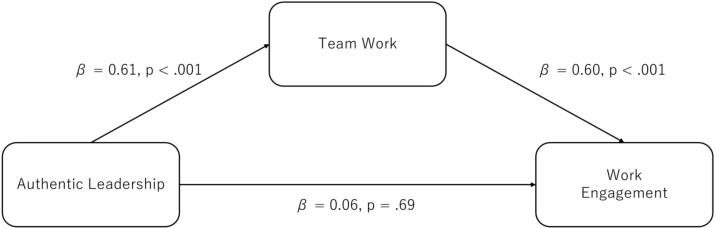
Mediation analysis was conducted using the PROCESS macro (Model 4), with authentic leadership as the independent variable, teamwork as the mediator, and work engagement as the dependent variable. The results showed that authentic leadership significantly predicted teamwork (B = 0.52, SE = 0.10, t = 5.11, p <.001, 95% CI [0.32, 0.73], β = 0.61). When both authentic leadership and teamwork were included as predictors of work engagement, teamwork had a significant positive effect on work engagement (B = 1.37, SE = 0.33, t = 4.14, p <.001, 95% CI [0.70, 2.03], β = 0.60), while the direct effect of authentic leadership on work engagement was not significant (B = 0.11, SE = 0.28, t = 0.40, p = .69, 95% CI [–0.46, 0.69], β = 0.06). The total effect of authentic leadership on work engagement was significant (B = 0.83, SE = 0.26, t = 3.14, p = .003, 95% CI [0.30, 1.36], β = 0.42), but the direct effect became non-significant when teamwork was included in the model. The indirect effect of authentic leadership on work engagement via teamwork was significant (indirect effect = 0.72, BootSE = 0.28, 95% BootCI [0.26, 1.35]), as the confidence interval did not include zero.
These results indicate that teamwork fully mediates the relationship between authentic leadership and work engagement among nurses in this sample.
Figure 1: A model of authentic leadership and work engagement mediated by teamwork.
DISCUSSION
This study investigated the mediating role of teamwork in the relationship between authentic leadership and work engagement among nurses in a Japanese hospital. The results revealed that authentic leadership was significantly and positively associated with both teamwork and work engagement, and that teamwork fully mediated the relationship between authentic leadership and work engagement. These findings align with a growing body of literature in nursing and organizational psychology, which highlights the importance of leadership style and team processes in fostering positive work outcomes.
Authentic leadership, characterized by self-awareness, relational transparency, balanced processing, and an internalized moral perspective, has been shown to create trustful relationships and healthy work environments for nurses. Previous studies have demonstrated that authentic leaders can enhance job satisfaction, lower burnout, and promote well-being by empowering staff and building positive interpersonal relationships. In particular, Laschinger et al. (2012) found that authentic leadership indirectly improved job satisfaction and mental health among new nurses by fostering structural empowerment and relational social capital-concepts closely related to teamwork. Similarly, Laschinger et al. (2013) and Wong & Laschinger (2013) reported that authentic leadership’s effects on job satisfaction and performance are often mediated by positive team climate, empowerment, and social capital.
The present study extends these findings by demonstrating a full mediation effect: authentic leadership did not have a direct effect on work engagement when teamwork was included in the model, but its indirect effect via teamwork was significant. This suggests that the influence of authentic leadership on engagement is realized primarily through the enhancement of team processes such as mutual support, information sharing, and
The Mediating Role of Teamwork in the Relationship between Authentic Leadership 255
collaborative problem-solving. These results support theoretical frameworks like the Job Demands-Resources (JD-R) model (Demerouti et al., 2001), which posits that workplace resources-including effective teamwork-are critical mediators between leadership and employee engagement.
Moreover, the findings have practical implications for nurse managers and healthcare organizations. While leadership training remains important, these results indicate that interventions solely focused on individual leaders may be insufficient. Instead, comprehensive strategies that simultaneously develop authentic leadership and foster strong teamwork are likely to be more effective in improving nurse engagement and, ultimately, patient care quality. This is particularly relevant in the context of increasing demands on healthcare staff and persistent workforce challenges.
However, several limitations should be noted. The sample size was relatively small and drawn from a single hospital, which may limit the generalizability of the findings. The cross-sectional design precludes causal inference, and reliance on self-report measures may introduce bias. Future research should employ longitudinal or multi-site designs and incorporate objective indicators of teamwork and engagement to confirm and extend these findings.
CONCLUSION
This study demonstrated that teamwork fully mediates the relationship between authentic leadership and work engagement among Japanese hospital nurses. The findings highlight the necessity for nurse managers and organizations to not only cultivate authentic leadership, but also to actively foster effective teamwork in order to enhance work engagement. Interventions and training programs that simultaneously target leadership development and team-building are likely to yield the greatest benefits for nurse well-being and patient care quality. Further research with larger and more diverse samples is needed to confirm and extend these findings.
ACKNOWLEDGMENT
This work was supported by JSPS KAKENHI Grant Number 21K01637.
REFERENCES
Bakker, A. B., & Demerouti, E. (2008). Towards a model of work engagement. Career Development International, 13(3), 209–223. Demerouti, E., Bakker, A. B., Nachreiner, F., & Schaufeli, W. B. (2001). The job
demands-resources model of burnout. Journal of Applied psychology, 86(3), 499. Hayes, A. F. (2022). Introduction to Mediation, Moderation, and Conditional Process Analysis: A Regression-Based Approach (3rd ed.). The Guilford Press. Laschinger, H. K. S., Wong, C. A., & Grau, A. L. (2012). The influence of authentic
leadership on newly graduated nurses’ experiences of workplace bullying, burnout and retention outcomes: A cross-sectional study. International journal of nursing studies, 49(10), 1266–1276.
Laschinger, H. K. S., Wong, C. A., & Grau, A. L. (2013). Authentic leadership, empowerment and burnout: A comparison in new graduates and experienced nurses. Journal of Nursing Management, 21(3), 541–552. Misawa, M., Sasai, Y., & Yamaguchi, Y. (2009). Development of the Teamwork
Measure for Nursing Teams. Japanese Journal of Social Psychology, 24(3), 219– 232. (in Japanese). Salas, E., Shuffler, M. L., Thayer, A. L., Bedwell, W. L., & Lazzara, E. H. (2015).
Understanding and improving teamwork in organizations: A scientifically based practical guide. Human Resource Management, 54(4), 599–622. Shimazu, A., Schaufeli, W. B., Kosugi, S. et al. (2008). Work engagement in Japan: Validation of the Japanese version of Utrecht Work Engagement Scale. Applied Psychology: An International Review, 57, 510–523. Schaufeli, W. B., Salanova, M., González-Romá, V., & Bakker, A. B. (2002). The
measurement of engagement and burnout: A two sample confirmatory factor analytic approach. Journal of Happiness Studies, 3(1), 71–92. Schaufeli, W. B., Shimazu, A., Hakanen, J., Salanova, M., & De Witte, H. (2019).
An ultra-short measure for work engagement: The UWES-3 validation across five countries. European Journal of Psychological Assessment, 35,4 577–591. http:// dx.doi.org/10.1027/1015-5759/a000430 Walumbwa, F. O., Avolio, B. J., Gardner, W. L., Wernsing, T. S., & Peterson, S.
J. (2008). Authentic leadership: Development and validation of a theory-based measure. Journal of Management, 34(1), 89–126. Wong, C. A., & Laschinger, H. K. (2013). Authentic leadership, performance, and job satisfaction: The mediating role of empowerment. Journal of Advanced Nursing, 69(4), 947–959.
LISTED IN THE AHFE DIGITAL BOOKSTORE CATALOGUE
Explore the complete digital volume
Human Factors, Business Management and Society
Read this individual research paper free through the original publisher, or explore the full digital proceedings book.
ISBN 978-1-964867-52-6
Explore this ISBN in the AHFE Bookstore ↗Listed in the July 2026 bookstore catalogue; search by ISBN to confirm current availability · Digital book purchase optional