Yuki Mizuno, Motoki Mizuno, Yasuyuki Yamada, Yasuyuki Hochi, Takumi Iwaasa, Kentaro Inaba, Emiko Togashi, Yumi Arai, Hidenori Hayashi (2023). Longitudinal Study of Communication in Nursing Organizations Using Wearable Sensors. In: Artificial Intelligence, Social Computing and Wearable Technologies. AHFE Open Access, vol. 113, pp. 383–390. https://doi.org/10.54941/ahfe1004211
Communication between medical staff is extremely important in team medical care. The authors have used AI technology to quantitatively measure communication in multiple nursing organizations and have examined good communication and teamwork. In this study, we compared the results of two separate surveys conducted in two hospital wards at different times, and examined changes in communication behavior calculated using AI technology. The subjects were the neurosurgical ward of Hospital A and the psychiatric ward of Hospital B. The survey used a business card-type electronic batch to measure communication activity for two weeks. After that, a questionnaire survey was conducted on the teamwork of nurses. The survey was conducted in 2017 (30 people) and 2018 (33 people) at Hospital A, and in 2014 (33 people) and 2020 (21 people) at Hospital B. After each survey, feedback was provided to all participants. The total communication time at Hospital A decreased by 25% for the second survey compared to the first (p <.01). That time of nurses with less than 3 years of experience (inexperienced) decreased by 19.2%, those with 3 to 9 years (mid-level) increased by 29.2%, and those with more than 9 years (veteran) increased by 5.9%. Comparing communication patterns, inexperienced and mid-level nurses spent less time in two-way communication and as listeners (p<.05), while veterans spent more time as speakers (p<.001). The communication time at Hospital B decreased by 33% less than the first survey (p<.05), 36% less for inexperienced and mid-level (p<.05), and 23% less for veterans. Comparing the time spent talking directly by years of experience, all groups spent the same amount of time talking in the first survey. In the second survey, inexperience and mid-level nurses spent significantly more time interacting with veterans (p<.05). The results suggests that the means of smooth information transmission and a chain of command were constructed, and the overall dialogue time was shortened. In addition, the teamwork scale improved in all items, suggesting that a system was created that allowed each individual to act on their own judgment, such as taking coordinated actions as necessary. According to longitudinal research, we were able to confirm changes in communication patterns and dialogue partners, and it is believed that there was a change in awareness of communication. It can be expected to lead to a better information transmission system and better team building.
Team medical care is practiced in various medical settings to cope with the increase in workload owing to improvements in the quality and safety of med- ical care (Hosoda, 2001; MHLW, 2010). Such care involves a wide variety of highly specialized staff sharing goals and information, working together, and providing medical care that accurately responds to the patient’s situation.
To improve the quality of medical care, three perspectives are important: (1) communication, (2) information sharing, and (3) team management (MHLW, 2011). Communication between medical professionals plays an important role.
To date, we have used “behavior sensors” to measure interactive com- munication in hospital wards and have conducted objective evaluations of the amount of conversation and interaction patterns of nurses during their working hours (Mizuno et al., 2015; Takahashi et al., 2015; Mizuno et al., 2016). Additionally, after the survey, the results provided feedback to all sur- vey participants and the status of organizational communication was shared throughout the organization. Feedback from superiors to subordinates within an organization is effective in improving subordinates’ motivation and com- mitment (Shigemasu, 2017). However, the impact on the entire organization is not clear, and by conducting a longitudinal survey, it is possible to con- firm changes in the entire organization. Among the several surveys we have conducted so far, we conducted two surveys in two cases.
Therefore, this study compared the results of a longitudinal survey of two wards and examined changes in organization-wide awareness of communi- cation behavior across organizations.
Method
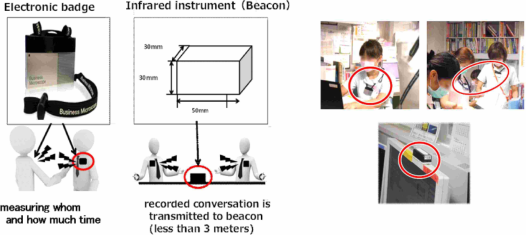
The participants were from two wards: the neurosurgical ward of Hospital A and the psychiatric ward of Hospital B. The amount of communication activ- ity was measured for two weeks in each ward, and a questionnaire survey was conducted using a nurse teamwork scale. Communication was measured via a business card-shaped electronic badge (behavior sensor, Figure 1) and quan- tifying when, where, and who spoke with whom, for how many minutes, and in what tone of voice. In surveys since 2017, AI analyzes the activity status during measurement using a unique algorithm, making it possible to classify the activity into “Two-way communication,” “Pitcher (speaker),” “Catcher (listener),” “Attending meetings and handovers (no conversation),” “Other work (work without conversation),” and “Individual work.” The teamwork scale of the questionnaire consists of three main parts. The first is “Team orientation,” which consists of two factors: orientation for completing tasks and orientation for interpersonal relations. The second is a “Team process,” which consists of four factors: monitoring and coordination, clarification of task, information sharing, and mutual feedback. The third is “Team lead- ership,” which consists of two factors: instructions for job directions and concern for interpersonal relations.
All studies were approved by the ethics committees of the surveyed hos- pitals and the institutions to which the principal investigator belonged. The participants were nurses who provided informed consent in advance and expressed their intention to participate in the behavioral sensor and questionnaire survey.
Hospital A conducted the survey in 2017 and 2018, whereas Hospital B conducted the survey in 2014 and 2020. After each survey, the results were fed back to all subjects.
Longitudinal Study of Communication in Nursing Organizations 385
Hospital A Hospital B 1st (2017) 2nd (2018) 1st (2014) 2nd (2020)
8.5±7.4 years 7.5±7.5 years 11.1±7.3 years 9.4±7.5 years
Survey schedule December, 2017 October, 2018 October, 2014 October, 2020 Participant 30(male:4, female:26) 33(male:4, female:29) 30(male:16, female:14) 21(male:2, female:19) Age 30.6±8.4 years old 31.5±7.5 years old 34.9±6.9 years old 35.7±7.0 years old Years of experience as a nurse Less than 3 years 23.3% 36.4% 22.6% 33.3% 3 to less than 9 years 40.0% 30.3% 38.7% 38.1% 9 years or more 36.7% 33.3% 38.7% 28.6%
RESULTS
Hospital A (1st survey in 2017, 2nd survey in 2018) The average interaction time during the survey period was 1,789.6 minutes in the first survey, but 1,527.5 minutes in the second survey, and communica- tion activities decreased by 25% (p<0.01). Nurses’ years of experience were categorized as less than 3 years (inexperienced), 3 to less than 9 years (mid- level), and 9 years or more (veteran), and the interaction time was compared for each type. The conversation time for inexperienced nurses decreased by 19%, mid-level nurses by 29% (p<0.05), and veterans by 5% (Table 1). From communication patterns of the items that changed significantly, “two- way communication,” “catcher” and “attending meetings and handovers” decreased by 20-60%, “pitcher” and “other tasks” increased by 30-40%. Comparing by years of experience, inexperienced and mid-level nurses spent less time engaging in “two-way communication”and “catcher”(p<0.05), and significantly increased time engaging in “pitcher”and “other tasks”(p<0.05). Veteran nurses had significantly more time such as “pitcher” and “other tasks.”
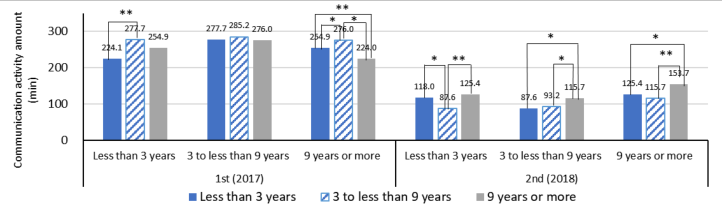
Comparing the amount of time in dialogue with subordinate, colleagues, and supervisors in the first survey (Figure 2), inexperienced nurses had more opportunities to interact with mid-level nurses than veterans (p<0.01). Mid-level nurses interacted equally with all groups, and veterans had more opportunities to interact with mid-level nurses (p<0.05). In the second sur- vey, conversation time was reduced by more than half. Inexperienced and mid-level nurses spent more time talking to veterans (p<0.05). An analysis
of variance (ANOVA) was performed on the three groups based on years of experience, but no significant differences were observed in the interaction time depending on the years of experience in either survey.
Regarding teamwork, there was a tendency for the values to be in higher the second survey, and those related to human relations for “concern for inter- personal relations” were higher (p<0.1). For inexperienced nurses, the values for most leadership-related items, such as “job directions” and “concern for interpersonal relations,” increased (p<0.1). For mid-level nurses, “clarifica- tion of task” increased, while for veteran, items related to building good interpersonal relationships such as “orientation for interpersonal relations” and “concern for interpersonal relations” increased.
Table 2. Survey results for Hospital A.
Table available in the original PDF paper.
Figure 2: Communication amount by years of experience for Hospital A.
Hospital B (1st time in 2014, 2nd time in 2020) Because the first survey used older sensors, the results for Hospital B were compared with the amount of communication activity and conversation time per survey participant (Table 3). The average conversation time for the first survey was 392.0 minutes, but 263.9 minutes for the second, resulting in a 32% decrease in communication activities (p<0.01). The conversation time
Longitudinal Study of Communication in Nursing Organizations 387
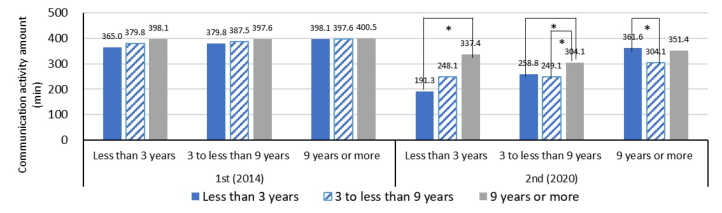
for inexperienced and mid-level nurses decreased by 36% (p<0.05), and by 24% for veterans. Comparing conversation time by years of experience (Figure 3), in the first survey, inexperienced nurses had more opportunities to interact with mid-level nurses than veterans (p<0.01), and mid-level nurses conversed equally in all groups. Veteran nurses had more opportunities to interact with mid-level nurses (p<0.05), and the least opportunity to inter- act with each other. In the second survey, conversation time was reduced by more than half. Inexperienced and mid-level nurses spent more time talking with veterans, and veterans spent more time talking with colleagues (p<0.05). ANOVA was performed on the three groups based on years of experience, but no significant differences were observed in the interaction time depending on the years of experience in either survey.
Regarding the results related to teamwork, values tended to be higher in the second survey, with values related to leadership, such as “job directions” and “concern for interpersonal relations” (p<0.05) increasing. The results were the same when comparing years of experience. Furthermore, the values of “clarification of task” were significantly higher in all groups (p<0.1).
Table 3. Survey results for Hospital B.
Table available in the original PDF paper.
Figure 3: Communication amount by years of experience for Hospital B.
DISCUSSION
At Hospital A, the survey results were fed back three months after the first survey was completed, and a second survey was conducted seven months later. The interval between surveys was ten months, and 26 nurses (86%) participated in the survey twice, suggesting that they may have taken action
considering the content of the feedback. At Hospital B, the interval between the first and second sessions was six years, and only one nurse participated twice. Although the survey intervals and number of nurses participating over time differed, a significant reduction in interaction time was a common find- ing for both organizations. In a previous study (Takahashi et al., 2015), key people in an organization (connectors of communication networks) and those who are able to communicate in a balanced manner (assertive people) tended to spend less time talking. This finding suggests a tendency to communicate effectively. A decrease in conversation time does not mean that communica- tion does not occur. Considering the results of the teamwork scale, we were able to create a system in which nurses could act more independently based on their own judgment, such as monitoring each other’s work progress and making adjustments as necessary. Furthermore, by sharing information that visualized communication between the entire organization and individuals within it after the first survey, the overall interaction time was shortened in the second survey and a means of smooth information transmission and chain of command was established. It was suggested that building an effective communication system is important for team medical care, and visualizing communication will lead to the practice of team medical care.
Furthermore, among the communication types that could only be collected at Hospital A, there was a significant increase in “other work.” Other work was mainly work in the hallways and around the beds in the hospital room, and it is assumed that nursing time increased. Although it was not possible to analyze patterns in Hospital B, it is possible that nursing time increased because interaction time decreased in the second survey. In other words, more time can be spent with patients and the quality of nursing care can be expected to improve.
Regarding the dialogue status by years of experience, both organizations implement “preceptorship” (Nayer and Yvonne, 2000) in the education of inexperienced nurses. Nurses with four or five years of experience serve as trainers for inexperienced nurses, providing one-on-one guidance, and inexperienced nurses inevitably spend more time interacting with mid-level nurses. Therefore, although this trend was observed in the first survey, in the second, inexperienced nurses spent less time talking with mid-level and more time talking with inexperienced and veteran nurses. This is because the com- munication pattern for inexperienced nurses is that the time from listener to speaker has increased, and at first, instructions and advice to inexperienced nurses were passively received from the preceptor in charge. In the second sur- vey, the environment changed to one in which inexperienced nurses were able to seek advice and opinions from colleagues other than preceptors and veter- ans, and we assumed that the atmosphere within the organization improved. This is also linked to the results of the teamwork scale, with higher scores for items that build good interpersonal relationships.
Regarding the increase in conversation time from veterans to inexperi- enced, the second survey at Hospital B was conducted during the COVID-19 pandemic. The wards were busy, and many nurses were physically and men- tally exhausted. Therefore, veteran nurses increasingly took on the role of follow-up and counseling support to relieve inexperienced nurses’ anxieties
Longitudinal Study of Communication in Nursing Organizations 389
and worries. Since the values for items related to leadership were high, it can be inferred that the communication behavior of the entire organization was an environment where human relationships and team leadership were better from the first survey. Additionally, supportive behavior from superi- ors and the maintenance of good interpersonal relationships are important for teamwork (Takayama and Takeo, 2009). The presence of leadership that values relationships with members, recognizes trust, and achieves goals increases teamwork ability, which can be expected to improve teamwork in an organization.
However, this study has some limitations. After the survey ended, a report on the state of communication across the organization based on the data measured by all participants is made within three months, and printed copies of their personal data are returned to each participant. Whether this feed- back results in subsequent behavioral changes is not clear. Additionally, since the second survey at Hospital B was conducted during the pandemic, it was not possible to confirm aspects of nursing work that differed from normal nursing work owing to infectious disease control and medical strain issues. Approximately 20% of the nurses did not express their intention to partic- ipate in the survey in the informed consent stage, and it cannot be denied that the mental burden of conducting the survey during the pandemic may have been higher than in normal times. In the future, we will provide feed- back on the results of this study to survey participants, conduct interviews, and clarify the factors behind the changes in communication activities and awareness. Furthermore, we would like to understand the characteristics of ward work styles and propose a model for good team medical care depending on the situation.
CONCLUSION
We longitudinally investigated communication activities using wearable sensors and confirmed changes in communication activities and patterns. Although conversation time decreased, teamwork and interpersonal relation- ships improved, and there was a change in awareness of communication. This has resulted in changes in the quality of nursing care. Visualization of communication and feedback can lead to better information transmission sys- tems and better team building and can be expected to lead to more effective improvements in team medical care.
ACKNOWLEDGMENT
This work was supported by JSPS KAKENHI Grant-in-Aid for Scientific Research (B), Grant Number 17H02566. We would like to express our gratitude to everyone involved.
REFERENCES
Hosoda, M. (2001). What is “The Team Medical Care”? From the Viewpoint of Medical Staffs. Japanese Society of Health and Medical Sociology, Vol. 12, pp. 88–101.
Ministry of Health, Labour, and Welfare. (2010). The report of “Team Medical Care Promoting,” Team medical promotion policy review working group of Health, Labour, and Welfare Ministry in Japan, Retrieved from https://www.mhlw.go.jp /shingi/2010/03/dl/s0319-9a.pdf. Ministry of Health, Labour, and Welfare. (2011). Summary of “Basic Concept and
Practical Case Studies for Promoting Team Medical Care,” Team medical pro- motion policy review working group of Health, Labour, and Welfare Ministry in Japan, Retrieved from https://www.mhlw.go.jp/stf/shingi/2r9852000001ehf7-att/ 2r9852000001ehgo.pdf. Mizuno, M., Yamada, Y., Hochi, Y., Honda, R., Takahashi, H., Shoji, N., Aida, H., Okada, A. and Mizuno, Y. (2015). Behavioral sensor-based organizational design and management in Japan: From the perspectives of communication chan- nel in nursing organization. Proceedings of the 19th Triennial Congress of the International Ergonomics Association. CD-ROM. Mizuno, Y., Yamada, Y., Hochi, Y., Takahashi, H., Shoji, N., Aida, H., Okada, A.
and Mizuno, M. (2016). A Study on Communication Activity and Social Skills of Nursing Organization. Advances in Human Factors, Business Management, Training and Education Volume 498, Springer, pp. 561–568. Nayer, K. and Yvonne, S. (2000). An Evaluative Study of Clinical Preceptorship.
Nurse Education Today, Vol. 20, Issue 3, pp. 218–226. Okazaki, M., Eguchi, H., Azuma, T., Kamiya, M., Endo, K. and Hattori, K. (2013).
Acts Valued by Nurses Who Practice Team Medical Care in Cooperation and Collaboration with People Holding Other Types of Occupations: Analysis of Free Description with Text Mining. Konan Women’s University Studies in Nursing and Rehabilitation, (8), pp. 1–11. Shigemasu, E. (2017). The Effects of Positive and Negative Feedback on Subordinates’ Commitment and Satisfaction with Growth: The Mediating Role of Trust in Supervisors. Japanese Association of Industrial/Organizational Psychology Journal, Vol. 30, No. 2, pp. 159–169. Takahashi, H., Mizuno, M., Yamada, Y., Hochi, Y., Shoji, N., Mizuno, Y. and
Honda, R. (2015). Relationship between Assertion Types and Communication Networks of a Nursing Organization at University Hospital. 2nd Congress, International Academy of Sportology, Program & Abstracts, p. 52. Takayama, N. and Takeo, K. (2009). Structure of Teamwork and Relevant Factors in Nursing Activities. J Nurs Studies NCNJ, Vol. 8, No. 1, pp. 1–9.
LISTED IN THE AHFE DIGITAL BOOKSTORE CATALOGUE
Explore the complete digital volume
Artificial Intelligence, Social Computing and Wearable Technologies
Read this individual research paper free through the original publisher, or explore the full digital proceedings book.
ISBN 978-1-958651-89-6
Explore this ISBN in the AHFE Bookstore ↗Listed in the July 2026 bookstore catalogue; search by ISBN to confirm current availability · Digital book purchase optional