Mark Miller, Sam Holley, Leila Halawi (2023). The Evolution of AI on the Commercial Flight Deck: Finding Balance between Efficiency and Safety While Maintaining the Integrity of Operator Trust. In: Artificial Intelligence, Social Computing and Wearable Technologies. AHFE Open Access, vol. 113, pp. 14–24. https://doi.org/10.54941/ahfe1004175
As artificial intelligence (AI) seeks to improve modern society, the commercial aviation industry offers a significant opportunity. Although many parts of commercial aviation including maintenance, the ramp, and air traffic control show promise to integrate AI, the highly computerized digital flight deck (DFD) could be challenging. The researchers seek to understand what role AI could provide going forward by assessing AI evolution on the commercial flight deck over the past 50 years. A modified SHELL diagram is used to complete a Human Factors (HF) analysis of the early use for AI on the commercial flight deck through introduction of the Ground Proximity Warning System (GPWS), followed by the Enhanced GPWS (EGPWS) used currently, to demonstrate a form of Trustworthy AI (TAI). The recent Boeing 737 MAX 8 accidents are analyzed using an updated SHELL analysis that illustrates increased computer automation and information on the contemporary DFD. The 737 MAX 8 accidents and the role of the MCAS AI system are scrutinized to reveal the extent to which AI can fail and create distrust among end-users. Both analyses project what must be done to implement and integrate TAI effectively in a contemporary DFD design. The ergonomic evolution of AI on the commercial flight deck illustrates how it has helped achieve industry safety gains. Through gradual integration, the quest for pilot trust has been challenged when attempting to balance efficiency and safety in commercial flight. Preliminary data from a national survey of company pilots indicates that trust in AI is regarded positively in general, although less so when applied to personal involvement. Implications for DFD design incorporating more advanced AI are considered further within the realm of trust and reliability.
AI is quickly emerging as a technology that can evolve into many strategic applications in several industries, including commercial aviation. To high- light this growth trend, global spending on AI is projected to increase from $80 billion in 2021 to $204 billion in 2025 (Shirer, 2021). In the global avi- ation sector, AI is projected to grow from US$ 653.74 million in 2021 and
The Evolution of AI on the Commercial Flight Deck: Finding Balance 15
exceed US$ 9,985.85 million by 2030, with a compounded annual growth rate of 35.38% from 2022 to 2030 (Kumar, 2023). In line with these projec- tions, the current trend for research and development is strongly supported by rapidly increasing investments and a continuing influence for applications of AI within the aviation industry. Less clear is how the specific uses are likely to be integrated. Where AI might reside on a technologically advanced flight deck while pilots continuously must balance efficient operations of their aircraft within safety parameters, and how pilots might adjust to new AI implementation are central concerns. A related question is to what extent pilots of the United States of America (U.S.) aviation industry are ready and eager to accept new AI technologies as front-line operators. Similarly, one might ask whether acceptance may involve extensive time and cultural change before pilots trust new AI as reliable DFD innovations. The aim of this study begins with defining AI for the commercial aviation industry and further for the DFD. Once defined, the relationship of AI on the modern DFD is linked to the potential for reducing human error. Development is examined further using two SHELL diagrams that show AI’s early introduction to the com- mercial flight deck and how it has evolved with automation and information growth over 50 years. From this HF analysis, a clearer picture emerges of why pilot trust in AI is so important for evolving AI on the commercial DFD.
DEFINING AI FOR USE BY PILOTS ON THE COMMERCIAL DFD Most definitions of AI involve developing systems that emulate human learn- ing, thinking, and intelligence. Currently, forms of AI in different industrial settings are classified as narrow artificial intelligence, referring to algorithmic applications designed for specific tasks (Strom et al., 2019). Narrow intelli- gence can perform a single task precisely within a limited set of conditions. Conversely, general artificial intelligence is classified as theoretical technol- ogy that uses computer systems to apply learned knowledge to multiple tasks beyond the system’s initial programming and to adapt to environmental changes (Dilmegani, 2021). For the commercial aviation industry, the current state of AI plainly is in the form of narrow AI applications with a grow- ing incentive to create and implement general AI going forward. Narrow AI trends presently found in the commercial aviation industry are in safety, navigation, and communication with aviation maintenance currently lead- ing the way and with the most AI potential. However, editions of AI on the commercial DFD in areas of safety, navigation and communication are good starting points for applying more AI in the future (Kumar, 2023). Poole and Mackworth (2010) refer to AI as computational agents that exhibit intelli- gent behavior, perceive their environment, and take actions that optimize the likelihood of success. When applying AI on the commercial DFD, an added constraint is that pilots must perceive AI as reliable and trustworthy due to the critical nature of operations involved.
The Constraint of Trustworthy AI for the DFD Although AI has great potential to enhance a pilot’s work in aviation, it also comes with many new ethical, legal, social, and technological challenges
(Thiebes et al., 2020; Stix, 2022). Trustworthy AI (TAI) is based on the belief that trust is the foundation of all communities, economies, and long-term success. For commercial aviation, DFD’s trust in AI is a belief and also a con- straint for critical aviation safety areas. In the U.S., TAI is at the foundation of safety improvements over the last 50 years that have transformed commer- cial aviation as the safest mode of transportation. The TIA constraint has at its foundational cornerstone several key elements:
1. Substantial government regulation and oversight from the Federal Avi- ation Administration (FAA) 2. Accurate and reliable accident investigation data and recommendations by the National Transportation Safety Board (NTSB) 3. A large economic aviation business conglomerate represented by the Air Transport Association (ATA) 4. Strong representation of the aviation commercial pilots in the Air Line Pilots Association (ALPA) representing the majority of U.S. pilots 5. Essential participation from manufacturers.
Companies and society regarding commercial flight will realize AI’s full potential only if confidence in its development, implementation, and reli- able use can establish TAI. As commercial aviation is consumed with critical processes to keep aircraft flying safely and efficiently, it carries the bur- den of greater risk for pilots to resolve effectively any anomalies or system disruptions. When incorporated into the commercial DFD, AI must func- tion reliably with other automated and digital systems used in order to gain FAA certification. Any compromise or deviation from TAI could have grave implications for an industry that relies on complementary safety and efficiency to produce revenue. To understand why TIA is non-negotiable for commercial aviation and the pilots who use it, one must first under- stand that the primary threat is not from machine failure rather it is from humans. Eighty percent (80%) of U.S. commercial aviation accidents are caused by human errors (Marais, 2012). Hence, implementation of new AI on the DFD will require HF experts to ensure human errors are negated.
The Importance of HF and Human Error in Support of TIA The purpose of HF will be significant in terms of TAI use on the DFD as it will be used to reduce human errors and enhance flight safety while reduc- ing human inefficiencies that lead to costly operational errors. Taking into account the challenges and constraints discussed, the following definition for AI emerges:
Artificial intelligence applications for the commercial digital flight deck include development of reliable and trustworthy sensors, data, computers, and human interfaces through human factors ergonomic design that emulate human intelligence and are designed for certain tasks related to safety, nav- igation and communication actions that influence pilot success by reducing human errors.
The Evolution of AI on the Commercial Flight Deck: Finding Balance 17
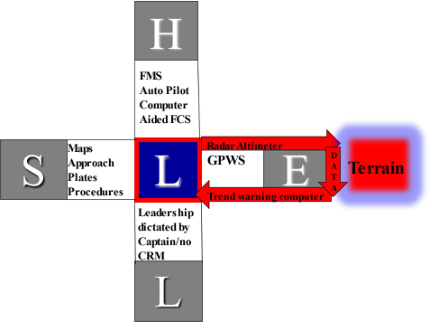
ANALYZING AI DEVELOPMENT ON THE FLIGHT DECK The jet age of the post-WWII era prompted rapid and extraordinary growth in commercial passenger travel due to reliability of jet engines, higher speeds, and smoothness of travel flying at higher altitudes. As the Boeing 707 departed on its first commercial service flight in 1958, the next decade marked a significant decline in commercial air accidents caused by aircraft malfunctions. However, accidents continued because of human error on the flight deck. A common global aviation safety problem stemming from these errors was Controlled Flight into Terrain (CFIT). With human error involved in the majority of commercial CFIT accidents, the industry actively sought a technological solution on the flight deck. This came in a narrow form of AI known as the Ground Proximity Warning System (GPWS) and is what the FAA now classifies as a Terrain Awareness Warning System (TAWS). By 1974 the FAA made it mandatory for all large U.S. aircraft to install GPWS. A report issued in 2006 (Sabatini) stated there had not been a single passenger fatality in a large commercial U.S. aircraft related to a CFIT accident in the U.S. since 1974. At the time of GPWS imple- mentation, the amount commercial flight deck automation was limited to Autopilot, Flight Management System (FMS) and computer aided Flight Control Systems (FCS). The GPWS consisted of a Radar Altimeter indicat- ing height of the aircraft above ground, trend calculation, and warning for the flight crew with visual and audio messages (seven altogether) if the air- craft was flying in high-risk modes. Voice-generated warnings were given for excessive descent, terrain closure or clearance rates. Announcements were made for unsafe terrain clearance or, excessive deviation below glides- lope (Pete, 2021). It was a breakthrough form of narrow AI and served its purpose to cognitively increase situational awareness (SA) of pilots to the terrain environment, although initially it did not gain the full trust of pilots.
Shortcomings of GPWS AI and Lack of Trust Among the shortcomings contributing to lack of the trust in GPWS dur- ing the 1970s and 1980s was unreliability due to a blind spot. The system could only gather data directly beneath the aircraft, resulting in a weakness for predicting forward terrain features along with an inability to calculate closure rates allowing for evasive action. Eventually multi-crew members received appropriate training and were required legally to respond accord- ingly when a GPWS alert was issued. However, during high workload situations, GPWS alerts could surprise the crew and confound reactions. In the 1990’s Enhanced GPWS (EGPWS) and Terrain Awareness Warning Sys- tem (TAWS) were installed in U.S. commercial aircraft to eliminate the blind spot. The EGPWS trend computer compares the aircraft GPS location with a terrain database. It is accompanied by a terrain display to aid the pilots visu- ally and prevent dangers of landing short (Joan, 2012). These improvements have improved the warning times and decreased late responses by pilots. EGPWS technology has improved to become standard TAI equipment on the DFD. Reliability of EGPWS contributed to TAI and has reduced CFITs
on a global level. Still, more work was needed within the human-machine interface (HMI) to attain increased operator trust and reliable operations.
GPWS/EGPWS; The AI Loop to Enhance SA at Human-Machine Interface
Figure 1 and the SHELL diagram illustrate the basic premise of AI on the flight deck as captured with GPWS in the Liveware-Environment linkage depicted as an AI loop. GPWS determines when the aircraft is outside pre- scribed parameters and the crew is warned to make the proper adjustment. When processed correctly, GPWS can increase the pilots’ Situational Aware- ness (SA) regarding terrain immediately ahead. A critical point is that the AI loop must be completed consistently to a level of reliability before pilots can trust it and improve SA. Using this model it can be seen that the AI loop might fail in terms of the components and crew involvement thus undermining relia- bility and trust in AI. The rudimentary AI behind GPWS and EGPWS/TAWS, as examples, has evolved successfully over the past 50 years to become a valid example of TAI. It has transformed the commercial aviation industry globally by significantly reducing CFIT and enhancing aviation safety while becom- ing a model for other narrow AI safety enhancements on the flight deck to include the AI Stall Warning System and Traffic Collision Avoidance System (TCAS). While both forms are safety successes and mainstays, they required time to implement, update the technology, and enhance training to become TAI. It follows, then, that more forms of narrow AI on the flight deck might be added.
Figure 1: Adapted SHELL (from Hawkins, 1987). Links: Early AI GPWS loop.
Failures of the AI Loop in the Boeing 737 Max 8 Accidents Recognizing the importance of TAI on the modern DFD, several major issues regarding trust were highlighted by the fatal Boeing 737 MAX 8 accidents of Lion Air Flight JT 610 in October 2018 and Ethiopian Airlines Flight 302 in March 2019. As the Boeing 737 Max 8 was created with a differ- ent size and location of the engines than the Boeing 737 NG series, it had
The Evolution of AI on the Commercial Flight Deck: Finding Balance 19
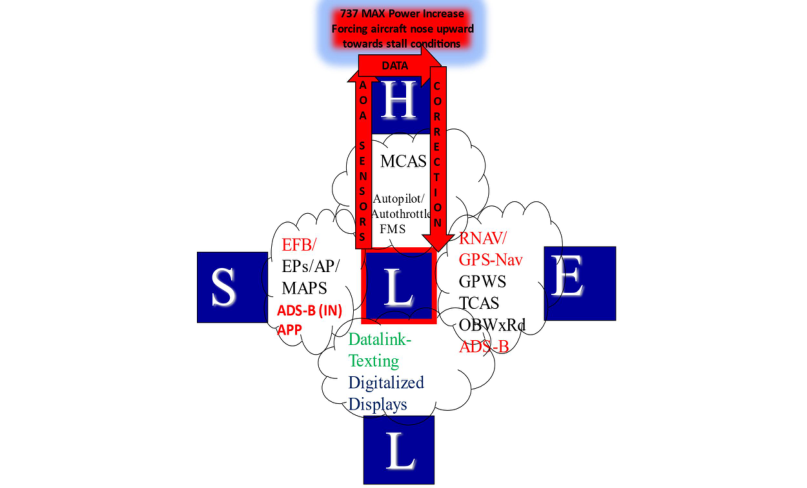
tendencies to push the nose up during certain maneuvers that could bring the aircraft into a stall condition. Concerned about compensating for the more powerful engines on the 737 Max 8, Boeing engineers installed the Maneuvering Characteristics Augmentation System (MCAS) to counter the nose-up tendency by sensing the angle of attack of the aircraft and automat- ically sending commands to the horizontal stabilizer flight control system to automatically lower the nose. Figure 2 shows an updated SHELL model that portrays MCAS (software) as a form of narrow AI where MCAS requires two functional Angle of Attack (AOA) sensors that send data to the MCAS computer (hardware) which commands the nose-down flight control inputs. A key characteristic of any AI system used on the flight deck with regard to trustworthiness is that pilots must be included in the AI loop as shown in Figure 2 for the Hardware-Liveware connection. Boeing did not include pilots in the MCAS AI loop initially. Further, the initial training manual did not describe the MCAS system to pilots. Finally, the FAA certified the 737 MAX 8 for use in the global industry by agreeing with Boeing and excluding the information accessible to pilots. Consequently, pilots could not remedy any problems generated with the MCAS system, including being left out of the AI MCAS loop when one of the AOA sensors failed. After the Lion Air acci- dent in 2018, Boeing issued a procedure for pilots to use when an AOA sensor failed and provided faulty MCAS system data. Months later that procedure failed when the Ethiopian crew were not able to overcome an AOA sensor failure. The two accidents resulted in grounding the 737 MAX 8 aircraft globally (NTSB, 2019).
Figure 2: SHELL model with computer automation/information.
Details of the MCAS system revisions for the 737 MAX 8 were eventu- ally published by Boeing and indicated the system would require both AOA sensors to operate effectively. Pilots were included in the MCAS loop giving them capability to override the system. Extensive pilot training on the MCAS system was required by 2021 as the aircraft returned to service. The MCAS accidents emphasize that TAI is an essential consideration for commercial DFD. Maintaining critical air safety standards by having the AI loop function- ing flawlessly and responsible implementation by manufacturers, regulators and pilots is paramount when considering future DFD configurations.
RESPONSIBLE AI IMPLEMENTATION ON THE MODERN DFD Responsible future AI implementation on the DFD will address machine learning and collaborative information exchanges. Figure 1 depicts early stages of narrow AI implementation on the commercial flight deck and the limited direct linkages among SHELL elements. Figure 2 is adjusted for added automation and information for the modern DFD and demonstrates how SHELL elements link devices indirectly. The concatenated cognitive clouds depict how pilots interacting on the commercial DFD must manage multiple interactive displays and automated system functions in various modes while processing large amounts of optical and auditory information. What should be of acute concern is how this affects the AI loop as shown in Figures 1 and 2. In the new concatenated SHELL, operators on the contemporary DFD need to be part of a reliable AI loop if they are to trust it. They also need to under- stand how it works and have overriding authority along with a plan should malfunctions occur. Lacking this, crews might be overwhelmed by cognitive overload. Not complying with these criteria could allow the conditions to overwhelm crews or create a startle effect should malfunctions occur as in the 737 MAX 8 accidents (NTSB, 2019).
Identifying the significance of trust in aviation systems, Chien et al., (2018) investigated human perceptions of reliability and use of automated systems. A key component was the extent to which operators would accept the actions of a system and how the system actions were displayed to the human, if at all. A second issue was automation bias, such as ignoring safety alarms, and discounting system notices. A principal conclusion was that trust stemmed largely from expectations for reliable help by the automated system func- tions. When task workload increased, factors such as feedback and reliability influenced trust. The researchers also noted that propensity to trust is a con- tributing factor in that some operators trust automation in general whereas others trust specific systems more than others. These issues become apparent in the survey data that follows.
A350 Single Pilot Operations Versus ALPA Stances and Future TAI Responsible AI implementation by all major stakeholders in the commercial industry is certainly one of the keys to gaining pilot TAI. For the commer- cial DFD it is not clear where new AI will be integrated, however, efforts for increasing automation and AI on the DFD are clearly evident in the Airbus collaboration with Cathay Pacific on development of A350 Single
The Evolution of AI on the Commercial Flight Deck: Finding Balance 21
Pilot Operations (SPO) for potential use in high altitude cruise on long haul flights that allows for one of the two pilots to rest (Frost, 2021). This is a clear impetus by one of the industry’s leading manufacturers to present a safe platform for SPO in the industry. With this effort and other forms of SPO in development one can reasonably expect increased use of AI on the DFD. This is supported from a European perspective with the International Air Transportation Authority’s (IATA) Technology Roadmap and the Euro- pean Aviation Safety Agency’s (EASA) Artificial Intelligence roadmap which provide overviews and evaluations of current technology trends for changes through the use of AI related to SPO and the accompanying challenges for certification (Ziakkas et al., 2023). Meanwhile, ALPA has currently promul- gated their stance in relation to SPO and attempts to eliminate one pilot from the flight deck. ALPA does not believe this is feasible and characterizes it as hazardous to operations citing the current body of evidence and experience, including more than a decade of study by NASA and the FAA showing that the safety risks and challenges associated with SPO far outweigh potential benefits. ALPA (2019) makes it very clear that to replace the second pilot machines would have to replicate the sensing, assessing, reacting, adapting, and interacting capabilities of a human in a complex and dynamic environ- ment. In this replication, the functions would require the more advanced general AI (Dilmegani, 2021) which far exceeds the functions of narrow AI as currently used. Commercial industry leaders and manufacturers desire to gain this general advanced form of AI, meanwhile pilots represented by ALPA stipulate there is not yet the capability to advance from narrow AI to general advanced forms of AI without jeopardizing safety. Wurfel et al., (2023) pro- pose technology that bridges narrow AI and futuristic AI with an intermediate level on the DFD as an AI-based decision support system for pilot use as a next step for TAI. Advancing this concept, in an insightful evaluation of SPO issues Harris (2023) describes scalable autonomy in systems with AI and adaptive automation, including variable effects on the human operator expressed as a continuum. The assessment extends to distributed crewing, as well. The Cog- nitive Adaptive Man-Machine interface project, which employed AI software to support adaptive automation systems in aircraft, is given as a valid pre- cursor for future aviation AI systems. Acknowledging the safety concerns of complex workload and potential cognitive overload, however, simulated flight trials indicated SPO cognitive resilience was inferior to multi-crew sce- narios. Noted was the reality that DFD are designed to be flown by SPO in emergencies.
Artificial Intelligence in Aviation Survey (Preliminary Results) A basic survey was designed for the U.S. aviation industry to canvas different segments of workers and gauge their level of trust in AI uses. The Technol- ogy Acceptance Model, or TAM, (Davis, 1989) served as the framework for the survey with intentions to better understand the behavioral inclinations of potential or current users of AI in the aviation realm. The data were gathered using an unfiltered online questionnaire with a primary interest in relevance to the TAM. A large-scale open-access survey, consisting of demographic data
and 33 closed-end statements, aggregated into five descriptive categories for use and trust, is evaluated on a 7-point Likert scale. The 17 position options for the role in the employer company for respondents included one for pilot, although the distinction is not made regarding private, commercial, or airline transport certification. Relevant to the current subject of AI use on the DFD, frequency data from the Trust category preliminary data were tabulated. The responses are from self-identified pilots (N = 42) of 273 total respondents (including the pilots) as of mid-July 2023. Table 1 shows pilot response fre- quencies to date for items in the Trust category. The survey items are not specific as to AI applications on the DFD.
Table 1. Extracted survey data for pilots regarding trust in AI.
Table available in the original PDF paper.
Survey Item Agree Neutral Disagree Trust AI to avoid mistake w/o intervention 35.7% 11.9% 52.4% Trust AI to make decisions in my best interest 23.8% 31.0% 45.2% Trust AI decision more than human decision 35.7% 33.3% 31.0% Advertising increases my trust in AI 31.0% 0.5% 64.3% Comfortable relying on AI for important decisions 31.0% 4.8% 64.2% Believe AI provides reliable results 69.0% 14.3% 16.7% Have confidence in accuracy of AI applications 59.5% 14.3% 26.2% Think AI applications are trustworthy 64.3% 26.2% 35.7%
What is immediately apparent is that pilots report an overall trust in AI applications, although with marked negative perceptions regarding AI as it relates to them personally. This might be extended to operations on the flight deck. There also is an indication that pilots regard it as important to retain the human in the decision loop. More extensive results are pending publication. Closer focus on the commercial airline pilot is planned, although the obvious challenges are evident.
CONCLUSION
Evolution of AI on the flight deck via GPWS, MCAS and other narrow AI applications provide clear lessons for pilot inclusion in the AI loop as illustrated with updated SHELL models. What is evident is the spectrum of evolution for AI moving from automation through machine learning applica- tions to more advanced AI interactions. In this study of evolution of AI on the commercial flight deck, a continuum is created that extends a trajectory from narrow AI to general AI and relevant applications. The realization of SPO and associated team collaboration among human operators and machine learn- ing systems, along with rapid evolution of integrated AI on the DFD portends a tumultuous and speculative experience for designers, operators, and those who will be along for the ride.
The Evolution of AI on the Commercial Flight Deck: Finding Balance 23
REFERENCES
ALPA Staff. (2019). The dangers of single-pilot operations. Airline pilot [online], August 2019. Available from: https://www.alpa.org/news-and-events/air-line-pi lot-magazine/dangers-of-single-pilot-operations [accessed 8 July 2023]. Chien, S.-Y., Lewis, M., Sycara, K., Liu, J.-S. and Kumru, A. (2018). The effect of
culture on trust in automation: Reliability and workload. ACM Transactions on interactive intelligent systems, 8(4), pp. 1–31. Davis, F. D. (1989). Perceived usefulness, perceived ease of use, and user acceptance of information technology. MIS Quarterly, 13(3), pp. 319–340. Dilmegani, C. (2023). When will singularity happen? 1700 expert opinions of agi.
Artificial intelligence, agi [online], August 2023. Available from: https://research.a im ultiple.com/artificial-general-intelligencesingularitytiming/ [accessed 3 August 2023]. Frost, L. (2021). Cathay working with Airbus on single-pilot system for long-haul.
Reuters [online], 17 June 2021. Available from: https://www.reuters.com/business . /aero space -defense/exclusive-cathay-working-with-airbus-single-pilot-system- long -haul-2021-06-16/ [accessed 21 July 2023]. Harris, D. (2023). Single-pilot airline operations: Designing the aircraft may be the easy part. The aeronautical journal, 127(1313), pp. 1171–1191. Hawkins, F. H. (1987). Human factors in flight, 2nd ed. Surrey, U. K.: Ashgate. Joan, B. (2012). Difference between GPWS and EGPWS. Difference between [online],
6 April 2012. Available from: communication -technology/difference-between- gpws- and-egpws/ [accessed 12 July 2023]. Kumar, P. (2023). Artificial intelligence in aviation market. Allied market research [online], August 2023. Available from: https://markwideresearch.com/artificia l-intelligence-inaviation-market/ [accessed 4 August 2023] Marais, K. B. and Robichaud, M. R. (2012). Analysis of trends in aviation mainte-
nance risk: an empirical approach. Reliability Engineering Systems Safety, 106, pp. 104–118. National Transportation Safety Board. (2019). Assumptions used in the safety assessment process and the effects of multiple alerts and indications on pilot per- formance online]. Available from: https://www.ntsb.gov/investigations/accidentre ports/reports /asr1901.pdf [accessed 2 August 2023]. Pete. (2021). GPWS- A definitive guide. Aviation matters [online], 27 January
2021. Available from: https://www.aviationmatters.co/gpws-ground-proximity-w arning-system/ [accessed 28 July 2023]. Poole, D. L. and Mackworth, A. K. (2010). Artificial intelligence: Foundations of computational agents. Cambridge, UK: Cambridge University Press. Sabatini, N. (2006). Downward pressure on the accident rate. [speech], 12 May
2006, Herndon, VA. Available from: https://www.chinaaviationdaily.com/news/ 0/456.html [accessed 3 August 2023]. Shirer, M. (2021). Investments in Artificial Intelligence Solutions. Business wire [online], 30 August 2021. Available from: https://www.idc.com/ getdoc.jsp?containerIdprUS48191221#:˜:text=The%20new%20Worldwide% 20Artificial%20Intelligence, 2025%20period%20will%20be%2024.5%25 [accessed 5 July 2023]. Stix, C. (2022). Artificial intelligence by any other name: A brief history of the conceptualization of “trustworthy artificial intelligence.” Discover artificial intelligence, 2(1), pp. 26–13. Strom, A. L., Fotheringham, D., and Bitner, M. J. (2019). Customer acceptance of AI
in service encounters: Understanding antecedents and consequences. In Maglio, P. P., Kieliszewski, C. A., Spohrer, J. C., Lyons, K., Patrício, L. and Sawatani, Y., eds. Handbook of service science, Switzerland: Springer, 2, pp. 77–103.
Thiebes, S., Lins, S., and Sunyaev, A. (2021). Trustworthy artificial intelligence.
Electronic markets, 31(2), pp. 447–464. Wurfel, J., Djartov, B., Papenfub, A. and Wies, M. (2023). Intelligent pilot advisory system: The journey from ideation to an early system design of an AI-based decision support system for airline flight decks. 14th International Conference on Applied Human Factors and Ergonomics, 20–24 July 2023, San Franciso, CA. AHFE, pp. 589–597 doi: 10.54941/ahfe1003844. Ziakkas, D., Pechlivanis, K. and Flores, A. (2023). Artificial intelligence (AI) imple-
mentation in the design of single pilot operations commercial airplanes. 14th International Conference on Applied Human Factors and Ergonomics, 20–24 July 2023, San Franciso, CA. AHFE, pp. 856–861.
LISTED IN THE AHFE DIGITAL BOOKSTORE CATALOGUE
Explore the complete digital volume
Artificial Intelligence, Social Computing and Wearable Technologies
Read this individual research paper free through the original publisher, or explore the full digital proceedings book.
ISBN 978-1-958651-89-6
Explore this ISBN in the AHFE Bookstore ↗Listed in the July 2026 bookstore catalogue; search by ISBN to confirm current availability · Digital book purchase optional