Mark Miller, Sam Holley, Leila Halawi, Bettina Mrusek, Mark Kanitz (2026). Trust in AI in commercial aviation maintenance: Gaining efficiencies while enhancing safety. In: Global Issues Challenge: Challenges in AI at the Human Level. AHFE Open Access, vol. 234, pp. 11–21. https://doi.org/10.54941/ahfe1007454
The commercial aviation industry is currently integrating AI throughout its infrastructure. While business applications of AI can quickly improve relations with customers and efficiently help increase profit, the higher risk operational areas of the industry related to flight safety, like the flight deck, air traffic control, and maintenance, require important human factors trust between the AI being implemented and the user. In the case of pilots and air traffic controllers, this trust is paramount to safe flight. How important is this trust in AI to the aviation maintainer, given that AI is being integrated into the current maintenance workforce as a rapid solution to address the shortage of Aviation Maintenance Technicians (AMT)? With the AMT shortage forecasted to continue over the next 20 years, these opportunities to make AI-aided maintenance decisions bring efficiency and safety gains to maintenance operations and have quickly become a reality. The current AI aviation maintenance technologies that are having the most significant impact in the aviation maintenance arena include diagnostics for engine health, predictive maintenance, automated visual inspections, and data-driven work management to predict and inform better maintenance decisions. The researchers developed an AXTENI framework for AI team decision-making in aviation. They introduced it for maintenance use to demonstrate the importance of trust in AI for ethical maintenance decision-making (DM) to occur. The research survey, ‘Fostering Trust: Maintainers and Artificial Intelligence in Aviation Maintenance”, is introduced to determine where aviation maintainers currently stand in their trust in their newly adopted AI decision-making tools. An analysis of the final survey data is presented.
Commercial aviation maintenance is currently addressing a serious shortage of aviation maintainers as global demand for air travel, and the maintenance required to support it continue to grow. According to the Boeing Global Aviation Report (Boeing, 2025) the shortage of aviation maintainers is projected to continue for the next twenty years. While this disruption in aviation manning levels in aviation maintenance does not seem like a problem as flights routinely carry passengers and cargo safely to their destinations, the burden puts the aviation maintenance technicians (AMT) and their managers in a precarious position to do more work with less help and no end to this Received February 20, 2026; Revised April 7, 2026; Accepted April 27, 2026; Available online July 20, 2026
predicament in the future. The current situation fosters unwelcome room for fatigue and stress, which can lead to poor decision-making, affecting the critical work they do to keep the aircraft at safe operational standards for flight service. Meanwhile, many of the most experienced AMTs and maintenance managers are retiring, leaving another critical void of inexperienced aviation maintainers who are expected to continue getting the job done. 25% of commercial flights in the US experience delays, and insufficient maintenance personnel and maintenance issues contribute to those delays. Many airlines use mandatory overtime to ensure the maintenance work is completed. For aviation maintenance-related incidents and accidents, 38% are related to procedures (Chapparo et al., 2002; Chang & Wang, 2010; Key et al., 2022). Fatigue is a significant contributing factor in 20-30% maintenance incidents (Herbic, 2020; Hobbs et al., 2011; Saleh et al., 2019; Key et al., 2022). While there is no clear manpower solution to the human resources dilemma facing aviation maintenance, a promising solution lies in integrating multifaceted uses of AI to quickly achieve efficiencies and safety through enhanced AI maintenance DM, as a trade-off.
THE IMPORTANCE OF TRUST IN AI IN AVIATION MAINTENANCE Although AI has great potential to enhance efficiency and safety in aviation maintenance quickly, it also poses many new ethical, legal, social, and technological challenges. Meanwhile, AI is projected to grow in the global aviation sector from US$653.74 million in 2021 and exceed US$9,985.85 million by 2030 (Kumar, 2023). The investment is intended to enable AI to proliferate quickly in aviation maintenance, but is the current AI policy and structure in place to ensure it is used correctly? Even more importantly, is the aviation maintenance arena ready to properly embrace AI within appropriate boundaries to ensure ethical decisions are made, and aviation safety is not jeopardized? While AI is being applied in commercial aviation maintenance, how much do the people working in aviation maintenance know that the AI they use is explainable and reliable, so they can trust it and use it to make good decisions in the critical context of aviation maintenance work? Examples of AI currently used in commercial aviation maintenance to enhance efficiency and safety include diagnostics for engine health, predictive maintenance, automated visual and other data-collected inspections, coordination of work management through gate-time prediction, and data collection to inform algorithms that inform management decisions. To reiterate, the importance of trust in AI, each of these active AI maintenance use areas are further explored. From this review of current AI use in maintenance, the researchers then analyse survey results on maintainer trust in AI.
Using AI in Aircraft Engine Health AI has already manifested itself in engine diagnostics, using machine learning to analyse terabytes of live sensor data and predict component failures before they occur. This type of proactive monitoring, using real-time data analysis systems such as the Honeywell Ensemble engine monitoring system
Trust in AI in Commercial Aviation Maintenance 13 (Honeywell, 2026), reduces unplanned downtime, extends engine lifespan, and lowers operating costs. Key uses of AI in relation to engine health monitoring are AI analyses of performance data like temperatures, pressures, and vibrations to allow maintenance teams to address potential problems before they are critical. Another key use of AI in engine health is through computer tools such as the GE Aerospace compressor blade inspection tool (GE Aerospace, 2025), which analyses images of turbine blades for damage and reduces inspection time by 50%. A unique use of AI in engine health is the digital twin engine. This virtual, data-driven replica simulates, monitors, and optimizes engine performance while predicting future maintenance needs. From an engine health perspective, AI is increasing reliability, lowering repair expenses, significantly improving efficiency at Maintenance, Repair, and Overhaul (MRO) facilities, and increasing safety by detecting failures.
AI-Driven Predictive Maintenance for Aircraft Health While AI has flourished in aviation engine maintenance, it is also beginning to impact airframe, structural, and avionics inspections by enabling more predictive maintenance. This is causing a shift from time-based scheduled maintenance inspections to condition-based maintenance, enabling airlines to reduce unscheduled maintenance events by 25% (IIOT World, 2025). The increased use of AI in airframe and structure inspections is driven by AI-powered cameras and drones that can scan large areas of the airframe for cracks, damage, and corrosion at much higher speeds and with greater accuracy than a human. AI algorithms analyse sensor data from landing gear structures, hydraulic systems, and different avionics to predict failures before occurring. The shift by airlines to digitalized maintenance logs and pilot maintenance reports is enabling natural language processing AI to analyse previous years of maintenance records to identify recurring, complex, or intermittent faults, speeding up troubleshooting. AI use also enables optimization of the maintenance schedules for aircraft from a fixed schedule to adjusting the maintenance schedule to actual parts usage. This allows for parts replacement only when warranted. It also directly affects the maintenance logistics inventory of forecasted parts, reducing inventory costs and ensuring parts are available when required. The benefits of predictive maintenance include reduced human error by optimizing inspections and lower operational costs. However, most importantly, proactive detection greatly enhances aircraft safety.
AI and the Transformation of Aviation Maintenance Management From an airline maintenance management perspective, using predictive AI enables scheduled aircraft repairs to be performed during regular stops rather than temporarily removing the aircraft from revenue service for scheduled maintenance. Real-time gate arrival data is used by AI to accurately predict gate arrival and departure times and is integrated with aircraft health data to reduce delays by enhancing maintenance DM. AI coordinates ground staff, fueling, and the maintenance team to improve gate turnaround efficiency. AI algorithms achieve over 90% accuracy (ePlane AI, 2025) for flight
arrival times, enabling gate planning, while dynamic resource allocation systems analyse weather, aircraft traffic flow, and ground crew availability to optimize gate assignments. With accurate slot window times for aircraft at the gate, maintenance managers can then identify the repairs they want done in that window. AI then uses predictive maintenance data from the aircraft to recommend the resources (parts and technicians) needed to maintain it during that time slot. Using this proactive model encourages a ‘fix it when needed’ maintenance strategy over the traditional ‘replace it just in case’ maintenance strategy, which brings significant cost savings and reduces maintenance cancellations in operational disruptions.
The Data Driven Trend of AI Use in Aviation Maintenance Overall, the trend toward using AI in aviation maintenance is growing, with algorithms making better maintenance management decisions by aggregating data from many high-fidelity sources. Enabled by powerful computer processors, this real-time, data-driven approach helps maintainers make better decisions on fleet deployment, budget allocations, effective inventory management, and maintenance workforce scheduling, while improving supply chain logistics. These long-term asset decision-making processes can only be achieved through a high volume of diverse sensor data, such as engine monitoring, real-time diagnostics for hydraulics, landing gear, and electrical systems, all collected and analysed by AI-driven algorithms to help maintainers make the best decisions. Other aircraft aggregate data is also obtained from AI analysis of digital records of past repairs in MRO logbooks and FAA audit logbooks. Operationally, more aggregate data is collected from aircraft flight history for AI algorithm analysis, including take-offs/landings (cycle counts), flight hours, specific routes flown, and environmental conditions. Supply chain and inventory data are also collected and analysed using specific AI. From all these real-time data collection points and AI synthesis, maintainers can make proactive strategic decisions on the type of maintenance and the specific workforce allocations required to get the work done by scheduling maintenance and inspections during natural ground times. Strategically, the maintenance manager now runs a proactive parts inventory and orders in advance of supplier lead times. In terms of aviation safety and signing off aircraft for safe flight, AI enables analysis of safety data, safety reports and fleet sensor data, to support detailed safety analysis and hazard assessment of new risks to be mitigated.
INTEGRATING ETHICS INTO AI-DRIVEN MAINTENANCE DECISIONS From a commercial aviation perspective, AI is certainly making a strong case for expanded future use in aviation maintenance, as it is ideally suited for making better maintenance-related decisions. These AI-aided decisions aim to enhance aircraft performance and maintenance efficiency, and, most importantly, ensure safe aircraft operations. The FAA’s standard of assurance to the traveling public and the purpose of maintenance are to keep aircraft continuously safe to fly. While performance and efficiency play a significant
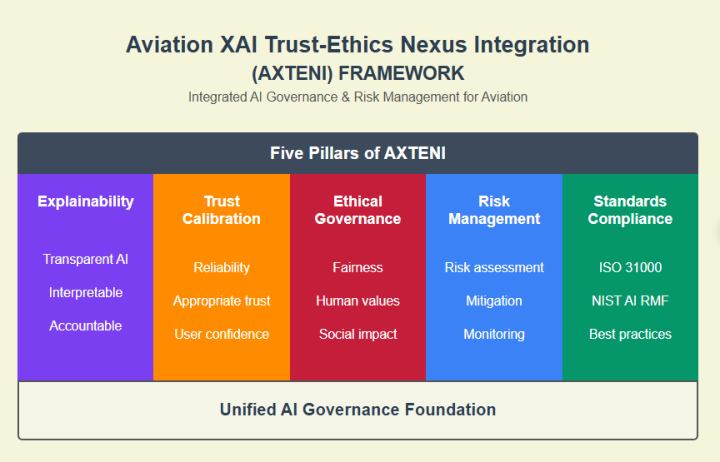
Trust in AI in Commercial Aviation Maintenance 15 role in maintenance, AI-aided business decisions can never supersede final decision-making for the safe flight of the aircraft signed off. Therefore, the correct overall ethical decision weighs the business decision-making against the safety decision but can never accept anything unsafe for flight. For this merger of two important decision influences to be ethical, they must meet the right combination of acceptable business standards and flight safety standards. However, to reach the point of making the correct ethical decision, the critical safe flight decision must be grounded in a framework of aviation AI human factors pillars that support the proper use of the AI by the end users. The reason for using such a framework is that through AI the maintainer will make the correct safety decision influenced with the business decision, to ultimately make the correct overall ethical decision. To identify the AI-aided DM process elements and their importance to AI-aided ethical DM in aviation, the researchers created the Aviation XAI (explainable AI) Trustworthy Ethical Nexus Integrated (AXTENI) framework shown in Figure 1. The AXTENI framework is built on the premise that, while AI-based aviation and aviation maintenance decisions are growing in the industry, specific constraints must be met to ensure humans using AI make the right, ethically correct maintenance decisions.
Figure 1: AXTENI framework (adopted from Halawi et al., 2026).
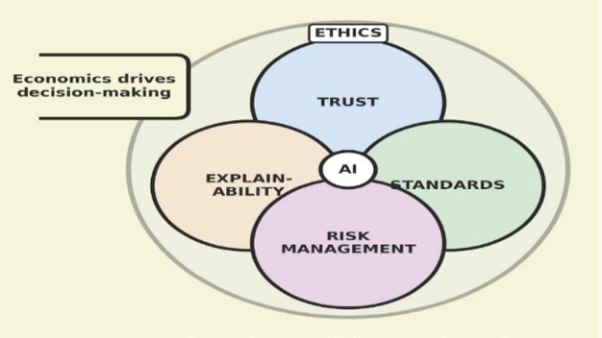
Using AXTENI Framework for Ethical Maintenance AI Aided DM While the main pillar elements in Figure 1 clearly show the importance of each AXTENI element and their core qualities, Figure 2 organizes these constraint elements into a more usable Venn diagram. The outside element surrounding all four elements is the ethics that represents the ethically correct maintenance decision using the AI with four elements. The economic business
DM influence must also be considered, as the industry and its businesses are profit-driven through cost and revenue. For the final ethically correct DM to have a chance, the four key elements surrounding that maintenance AI must represent human factors related to the AI loop to make the final ethical maintenance decision. While the four elements surrounding AI are individually important to the human and the AI, they also symbiotically affect and influence each other, as they touch one another in the diagram and feed into the AI’s ethical decision-making. Given the higher risks of aviation and the need for AI to ultimately help make maintenance decisions, it is important that the AI used in maintenance be explainable (XAI). The maintainers using it need to know, transparently, exactly which data streams are being downloaded into the AI’s algorithm, and that the output has been tested accurately over time to meet acceptable maintenance standards. Those safety-of-flight standards being met are ultimately the safe sign-off for that aircraft to fly. The safe flight standards are then supported by FAA and EASA aircraft certification approvals in the US and Europe, respectively. With the advent of Safety Management Systems (SMS) as an ICAO standard, now adopted by the US and Europe, all maintenance organizations must uphold the SMS standard. This means that the risk management standard, as a key pillar to any SMS program, must scrutinize an AI maintenance process for hazards. That risk management process affects the DM by analysing, assessing, and mitigating all hazards to manage their risk. In the AXTENI diagram, XAI, standards, and safety risk management all play significant roles in the maintenance AI loop, helping the maintainer make the best, ethically correct decisions. However, with the maintainer being the most important part of the AI loop to make the final ethical decisions with the AI, the last human factor of trust in that AI plays a significant role. Maintenance personnel using AI to make decisions must have confidence in the explainability of the AI, while also trusting that the AI is reliable and will meet stringent maintenance standards for safe flight. They must trust that those standards are certified as airworthy by the appropriate national aviation authority. Importantly, maintainers must trust that potential hazards to this AI loop and aircraft flight safety are being continually assessed and mitigated.
Figure 2: AXTENI Venn diagram (adapted from Halawi et al., 2026).
Trust in AI in Commercial Aviation Maintenance 17 Maintenance Trust in AI as a Critical Human Factor in the AI Loop
With trust as the key human factor in AI technology being so important for making the correct ethical decisions with AI use in maintenance, it is also important to note how the commercial aviation maintenance arena has quickly adopted AI, using it for purposes far beyond just aircraft engine health. AI is now widely used for overall aircraft health and for detailed predictive aircraft maintenance management. The cautious adoption phase of using AI to help make better maintenance decisions has ended, as more applications of AI in maintenance are becoming prevalent across the industry, driven by a growing number of algorithm-driven, successful predictive maintenance tools. The trade-off in aviation maintenance between AI’s current rise in use and the success of efficiency gains in combating labor shortages over the past 7 years is likely increasing maintainers’ trust in AI maintenance DM. We know that AI is used to reduce unplanned maintenance downtime, has very high predictive accuracy in identifying component failures, and dramatically increases efficiency to combat the labor shortage. We also know that AI use in aviation maintenance is currently very successful, with momentum driven by optimism fueled by praise from many aviation stakeholders. While this sounds great from an industry perspective, it is important at this juncture to understand how much the actual maintenance personnel (AMTs and maintenance managers), who use AI to make decisions, really trust it at this stage, as AI is rapidly integrated into their environment.
MAINTENANCE TRUST IN AI SURVEY DESIGN & DEMOGRAPHICS The survey was designed with several key trust factors to capture current levels of maintenance trust in AI. The survey was open from 1 June 2025 to 19 February 2026, administered online via SurveyMonkey, and received 102 complete responses. Preliminary survey information-oriented maintenance employees by explaining the need to assess current maintainer trust in AI. Examples of AI systems already used by maintenance, such as diagnostics of engine health, aircraft inspection, predictive maintenance, and maintenance management for better repairs, were emphasized, while the protection of maintainers’ identities through the survey was confirmed. Question 1 was an agreement to take the survey or opt out. Questions 2-7 covered demographics of gender, ethnicity, age, and experience. Questions 8-22 (Likert-scale survey questions) were about trust in AI. In Question 2, gender, 86% were male and 8% female. Question 4, age, was well distributed across ages 18-65, with 93% of the maintainers falling between 25-64 and 49% between 35-54. Question 5: Maintenance experience ranged from 33% of those surveyed being under 10 years to 66% being over 11 years to 33 years or more. In Question 7, 33% of the participants were maintenance managers, 36% AMTs, and 30% were classified as ‘other’.
Relevant Questions From 8-22 Related to Trust in Maintenance AI
Table 1 shows that 37% of the maintainers trust AI, 42% are neutral, and 20% do not trust AI. Even with the tremendous increase in the use of AI applications in maintenance, aviation maintenance needs to build greater trust in AI.
Table 1: Survey data relating to trusting AI to assist with maintenance; Question 8.
Table available in the original PDF paper.
Survey Item Strongly Agree
Agree Neutral Disagree Strongly Disagree
4.9% 32.35% 42.16% 15.69% 4.9%
Q8: How much do you trust AI to assist with maintenance tasks?
While Table 1 showed a need for improved Trust in AI, Table 2 shows that 72% of the maintainers believe that AI can make accurate, timely decisions.
Table 2: Survey data relating to AI making timely and accurate decisions; Question 9.
Table available in the original PDF paper.
Not so Not at all
Survey Item Extremely Very Somewhat (Confident)
4.9% 15.69% 51.96% 20.00% 7.84%
Q9: How confident are you in the ability of AI systems to make accurate and timely decisions in maintenance?
Table 3 shows that 96% of maintainers must understand their AI’s DM.
Table 3: Survey data relating to understanding the AI system being used; Question 11.
Table available in the original PDF paper.
Not so Not at all
Survey Item Extremely Very Somewhat (Important)
54.9% 25.49% 14.71% 3.92% 0.98%
Q11: How important is it for you to understand how AI systems make decisions?
Table 4 shows that maintainers not only need to understand how their AI systems work (as shown in Table 3), 94% also desire training in using those AI systems.
Table 4: Survey data relating importance of training on a specific AI system; Question 12.
Table available in the original PDF paper.
Not so Not at all
Survey Item Extremely Very Somewhat (Important)
46.08% 33.33% 14.71% 2.94% 2.94%
Q12: How important is specific focused training on a specific AI maintenance system?
Table 5 shows that 96% of the maintainers strongly desire to be proactively involved in the AI loop and to override the AI.
Table 5: Survey data relating to overriding and remaining in the AI loop; Question 13.
Table available in the original PDF paper.
Not so Not at all
Survey Item Extremely Very Somewhat (Important)
63.73% 25.49% 6.86% 1.96% 1.96%
Q13: How important is it to you to be able to override AI systems’ decisions and remain informed and engaged in the AI loop?
Table 6 shows that 67% of the maintainers believe their AI systems are safe and reliable, but this is still not enough to trust the AI, as shown in Table 1.
Table 6: Survey data relating to confidence in safety and reliability of AI; Question 14.
Table available in the original PDF paper.
Not so Not at all
Survey Item Extremely Very Somewhat (Confident)
8.82% 19.61% 38.24% 26.97% 6.86%
Q14: How confident are you in the safety and reliability of AI systems?
Table 7 shows the importance of maintainers’ participating in AI for DM, as only 30% of them trust AI enough to make the decision alone.
Table 7: Survey data relating to trusting AI without intervention; Question 18.
Table available in the original PDF paper.
Survey Item Strongly Agree
Agree Neutral Disagree Strongly Disagree
3.92% 25.49% 34.31% 27.45% 8.82%
Q18: I would trust an AI agent to decide without my intervention?
Table 8 shows that only 23% maintainers trust AI’s DM as much as human DM.
Table 8: Survey data relating to trusting an AI DM as much as a human DM; Question 19.
Table available in the original PDF paper.
Survey Item Strongly Agree
Agree Neutral Disagree Strongly Disagree
1.96% 20.59% 34.31% 25.49% 17.65%
Q19: I would trust an AI agent’s decision as much as a human decision.
Table 9 makes an important point: 72% of maintainers seem to clearly distinguish between automation and AI.
Table 9: Survey data relating to distinguishing AI from automation; Question 22.
Table available in the original PDF paper.
Survey Item Strongly Agree
Agree Neutral Disagree Strongly Disagree
24.51% 47.06% 20.59% 4.9% 2.94%
Q22: I perceive a clear distinction between automated systems and AI.
CONCLUSION
The survey showed that maintenance personnel who use AI believe AI can make timely, accurate decisions (72%). At the same time, they also believe that AI is safe and reliable (67%). They need to know how their AI systems work (96%), receive detailed training on them (94%), and insist on being integrated into the AI loop with the ability to override the AI (96%). While
the maintainers think highly of AI and want to have a working knowledge of it, their current trust in AI is weak (37%). Unfortunately, this falls short of where the industry needs to be, with trustworthy AI now and in the future a necessity. The survey revealed several reasons for the current lack of trust in AI, such as maintenance personnel not trusting AI for DM (70%) and instead strongly favor AI as a teammate to help them with DM. Very few maintainers (23%) trust AI agents to make decisions at the level of a human. The fact that maintenance personnel are generally able to distinguish between automated systems and AI (72%) is a positive trend. The overall survey data indicates very weak trust in AI for aviation maintenance among end users, suggesting a need for greater trust in AI. Building high trust in aviation maintenance will require that aviation maintenance personnel understand what the AI they use is doing at an explainable level. To achieve that level of explainable AI, maintenance personnel must be trained in the inner workings of the AI they use and how to use it properly to make the right decisions. The AI must also work complementarity with the maintainers, and the maintainers must remain in the AI loop to make the final decision together with the AI and to make the right ethical decision. Improving the current maintenance AI systems to make them faster, safer, more accurate, and more reliable will help boost the 67% of maintainers who currently believe in the safety and reliability of maintenance AI systems to much higher levels. Following the AXTENI framework, a great deal of improvement in the trust factor will lie in the front end, with better design, development, and implementation of the maintenance AI as a stronger partner with the manufacturer and regulatory certification processes to pass maintenance standards and SMS risk management safety standards. The AXTENI framework also points to maintenance personnel not just clearly understanding how their AI works but also having hands-on training with it. Maintainers need to be heavily integrated into the AI loop while teaming up with AI to make the final, ethically correct maintenance decision. For long-term trust success, better training in aviation education levels on the use of maintenance AI will be required. AMT training and designated collegiate aviation maintenance programs need to integrate the various AI maintenance applications into their curricula as part of a partnership with industry. Aviation maintenance students need exposure to AI maintenance tools and experience with AI before they start working at an MRO.
REFERENCES
Boeing. (2025). Pilot & Technician outlook 2025–2044. https://www.boeing.com/ content/dam/boeing/v2/products/pilot-technician-outlook/pdf Chang, Y.-H. & Wang, Y.-C. (2010) Significant human risk factors in aircraft
maintenance technicians. Safety science. [Online] 48 (1), 54–62. Chaparro, A., Groff, L., Chaparro, B., Scarlett, D. (2002). Survey of Aviation Technical Manuals: Phase 2 Report. User Evaluation of Maintenance Documents (Technical report No. DOT/FAA/AR-02/34), Washington, DC, FAA, Office of Aviation Research.
Trust in AI in Commercial Aviation Maintenance 21 ePlane AI. (2025). How AI Helps Forecast Unscheduled Maintenance Demand in
Airlines. ePlane AI website at: https://www.eplaneai.com/blog/ GE Aerospace. (2025). GE Aerospace Deploys AI-Driven Inspection Tool to Maximize Narrowbody Engine Time on Wing. GE Aerospace Website at: https:// www.geaerospace.com/news/press-releases/ Halawi, L., Miller, M. & Holley, S. (2026, Forthcoming). An Integrated Framework
of Explainable AI, Trust, and Ethics in Aviation, accepted for publication in the book title, “Artificial Intelligence Ethics, Law, and Policy”, ISBN 978 1 83635- 560-1. Herbic, J. (2020). Analysis of Database Online Aviation Safety Reporting System. In the ERAU Graduate Capstone, September 2020, Data retrieved from https://asrs. arc.nasa.gov/search/database.html. Hobbs, A., Avers, K., Hiles, J. (2011). Fatigue risk management in aviation
maintenance: Current best practices and potential future countermeasures. (Report No. DOT/FAA/AM). Federal Aviation Administration, Office of Aerospace Medicine. https://rosap.ntl.bts.gov/view/dot/20808 Honeywell. (2026). Honeywell Ensemble takes Engine Monitoring to new Heights.
Honeywell website at: https://aerospace.honeywell.com/us/en/about-us/blogs/ IIOT World. (2025). Moving from Reactive to Predictive: How IoT-Enabled Maintenance Drives Efficiency and Cost Savings. IIOT World website at: https:// www.iiot-world.com/predictive-analytics/predictive-maintenance/ Key, K., et al. (2022). Procedural Noncompliance in Aviation Maintenance: A Multi-
Level Review of Contributing Factors and Corresponding Mitigations. (Report No. DOT/FAA/AM-22/01) Kumar, P. (2023). Artificial intelligence in the aviation market. Allied market research[online], August 2023. Available from: https://markwideresearch.com/ artificial- intelligence-inaviation-market/[accessed 4 August, 2023]. Saleh, J. H. et al. (2019). Maintenance and inspection as risk factors in helicopter
accidents: Analysis and recommendations. PloS one. [Online] 14 (2), e0211424.
LISTED IN THE AHFE DIGITAL BOOKSTORE CATALOGUE
Explore the complete digital volume
Global Issues Challenge: Challenges in AI at the Human Level
Read this individual research paper free through the original publisher, or explore the full digital proceedings book.
ISBN 979-8-950676-10-9
Explore this ISBN in the AHFE Bookstore ↗Listed in the July 2026 bookstore catalogue; search by ISBN to confirm current availability · Digital book purchase optional