Mark Miller, Bettina Mrusek, Jeff Herbic (2023). Managing fatigue in aviation maintenance while promoting a human factors safety reporting system; a strategic approach to aviation safety. In: Safety Management and Human Factors. AHFE Open Access, vol. 105, pp. 54–63. https://doi.org/10.54941/ahfe1003070
The potential rise of fatigue in commercial aviation maintenance due to Aviation Maintenance Technician (AMT) personnel shortages supports a Human Factors (HF) Fatigue Risk Management (FRM) System be introduced in all major aviation maintenance programs in the US to complement a maintenance HF Safety Reporting System. The researchers have been strong advocates of a maintenance HF Safety Reporting System that can detect aviation maintenance procedural errors as research points to upwards of 38% of the aviation maintenance related accidents in Part 121 operations are caused by some form of maintenance procedural errors. However, as anonymous safety reporting tools like the HF REPAIRER (Miller and Mrusek, 2018) do hold promise for aviation maintenance safety and are also supported by Safety Management Systems (SMS), what is the point of having them if the maintainers are too tired and exhausted both mentally and physically to use such HF Safety Reporting Systems? The researchers take into consideration that the global (COVID-19) pandemic did bring chaos to the commercial aviation industry causing the AMT to do more work with less AMT personnel and allowing the fatigue problem to become greatly exacerbated. The researchers examine the basic HF fatigue problems in commercial aviation maintenance before the pandemic and then re-evaluate how fatigue has become a potential hazard in current maintenance operations through the lens of ASRS safety reporting data and utilizing a modified model of Human Factors Analysis Classification System (HFACS). From this analysis the researchers contend that the health of airline maintenance and the AMT calls for a strategy of a HF Two-pronged Safety Attack in aviation maintenance by reducing the consequences of fatigue through HF FRM while preventing human error in maintenance procedures through a HF Safety Reporting System like REPAIRER. This new complementary safety strategy would greatly enhance SMS in maintenance with a HF upgrade.
the job of being a maintainer. How much of a threat has fatigue now become in aviation maintenance since the pandemic with current AMT personnel shortages? The pilot side commercial operations have gone in a completely different direction with relevance to fatigue on the flight deck. Fatigue has been cited by the National Transportation Safety Board (NTSB) as a proba- ble cause and serious factor in several commercial aviation accidents from the 1990’s on. However, the 2009 Colgan Flight 3407 accident in Buffalo, New York finally forced a flight safety change to better manage flight fatigue in the US commercial industry. The NTSB investigation clearly highlighted that fatigue was not just a problem in the Colgan flight deck, but industry wide. Crew rest regulations that had not been updated from prior to WWII and the jet age were then scrutinized and finally updated by the Federal Aviation Administration (FAA) in 2011. In 2022 the FAA also updated crew rest rules for the flight attendants. At the same time the FAA has encouraged the airli- nes to start using FRM systems to better manage fatigue for their flight crews. While the flight safety side of the commercial industry recognizes how dan- gerous fatigue can be to flight operations on the flight deck and in the cabin, little has been done to help mitigate fatigue as one of the biggest threats to safety in aviation maintenance. This is mostly because when there is a com- mercial aviation accident human error is usually the culprit 80% (Rankin 2007) of the time and of that 80% the majority falls upon the operators on the flight deck. Therefore, the aviation industry’s attitude is that AMTs are simply not on the direct controls of the aircraft and hence can work through fatigue and not be dangerous. When maintenance is involved 10% of the time in a Part 121 aviation accidents, very rarely is fatigue mentioned rela- ted to why the maintenance human error was caused. However, maintenance procedures are usually heavily involved in at least 38% (Chapparo 2002) of the accidents caused by aviation maintenance. We can measure the likelihood that procedures will usually play a role in maintenance human error to cause incidents and accidents but measuring fatigue and all the potential variables that contribute to fatigue in maintenance is difficult and therefore it is not emphasized enough. Nonetheless, if flight attendants are now granted some regulatory protections from fatigue in 2022, should not the AMTs be given better regulatory protections as their flying counterparts now use?
The Silent, Costly Nature of Fatigue Just because fatigue is a seemingly silent and an invisible culprit in aviation maintenance does not mean it is not playing a detrimental safety role with today’s AMTs and their companies. How often is a maintainer injured or hurts their back from working in the awkward positions to complete a main- tenance procedure while they are fatigued? How often is something damaged or a tool lost because of fatigue? Lastly, how often is the maintenance proce- dure itself not carried out properly and must be later remedied due to fatigue? In these cases, the aircraft has not even left the ground, but the cost to the AMT in health costs and to the organization due to inefficiency cost cannot be good. The economic outlook of doing aviation maintenance in a state of fatigue is costly from a financial perspective. If this economic cost factor is
not alarming while trying to run an efficient maintenance operation, then the intrinsic cost damage of working fatigued and what it can do to the human AMT in terms of mental cognitive degradation and physical decline over time has got to take a toll on the AMTs’ attitude. The economic and moral damage caused by maintenance fatigue does not need to lead to a rare flight related accident or incident to be a concern and managed properly. It makes good business and leadership sense to manage fatigue and reduce its consequences.
Complexity of Fatigue in Maintenance Caused by Stress The demands of an aviation industry that is focused on generating revenue from a perishable seat model creates a severely pressurized modern aviation maintenance environment. Whether an aircraft comes in for scheduled main- tenance or unscheduled maintenance is of little consequence to the value of the empty seats on board or the empty cargo hold while the aircraft is in care of maintenance. This perishing seat mentality means that the maintena- nce environment is set receive the aircraft and complete the maintenance as fast as possible to return the aircraft to revenue generating flight. Delaying an aircraft in maintenance in anyway is a costly endeavour for the airlines’ bottom line. This therefore creates a pressure point in commercial aviation maintenance that is never ending. Hence an important contributor to fati- gue in commercial aviation maintenance and one to recognize to manage fatigue is the stress caused by the perishable seat economics of the industry as it relates to the demands placed on the AMT completing the maintena- nce work. It is well documented through research in industrial safety circles that stress greatly contributes to fatigue. The capacity for stress is different with everyone, but when stress exceeds the manageable amount for a per- son, fatigue is one of the main symptoms. It must be noted that stress caused fatigue is not like being sleepy at the end of the day, but instead is about extreme sleepiness, brain fog, loss of well-being and emotional exhaustion (Kocalevent et al. 2011). This is because stress can put the human brain and nervous system into high gear. If stress continuous over time it can cause chro- nic fatigue. The aviation industry in the US is one such industry where stress is well documented and aviation maintenance is certainly by nature perhaps one of the more stressful jobs in the industry. As the pressing continues and stress increases to get the aircraft back into revenue service, the build-up of stress over time can drain the maintainers energy and lead to burnout.
Complexity of Maintenance Fatigue Caused by Shift Work Although stress leading to fatigue is probably the biggest physiological human factors issue in aviation maintenance, the fact that returning aircraft back to revenue service as quickly as possible means that the maintenance work must go on continuously for 24 hours a day and 7 days a week by using shift work. This type of work is not conducive to long term producti- vity. Shift work simply challenges human nature by going against the average human being’s circadian rhythm where most people have a body clock that runs in a 24-hour cycle. The average person wants to sleep in the hours of 2a.m. to 6 a.m. in the morning called the window of circadian low. This
Managing Fatigue in Aviation Maintenance 57
is a time when sleepiness is at its peak and human performance capabilities are the lowest. The reason why this is such a challenging area for AMTs to navigate is that the AMT can sleep well during the day to compensate for working the night shift but working from 2 a.m. to 6 a.m. is still difficult as it is conducive to naturally wanting to sleep during that time. The dis- ruption to the body’s circadian rhythm takes its toll on the well-rested and the not so well-rested. Even the best rested AMT will be fighting the urge to sleep, and their productivity will not be at their best levels when working the window of circadian low. The challenge to this predicament is what about the AMT that must work the night shift yet has difficulty sleeping during the day to prepare for the night shift. Those individuals that work in aviation maintenance on a regular night shift or a rotating night shift are susceptible to cognitive impairment along with many different health problems that include type 2 diabetes and cardiovascular disease issues (Mcintosh, 2016). In terms of industrial safety, 10 to 40 % of these AMTs are suspect to a dangerous health issue called Shift Work Sleep Disorder (SWSD). SWDS is a sleep disor- der that commonly affects those who work non-traditional hours outside of the traditional 9 a.m. to 5 p.m. workday. SWSD causes difficulties adjusting to different sleep schedules and causes significant issues with falling asleep, staying asleep and trouble sleeping when desiring to sleep. The problem with SWSD is that it brings with it cognitive concentration issues, headaches, and problems with lower energy levels. Maintainers with SWSD are also dealing with human error, potential accidents, poor socialization, health complaints and potential drug and alcohol abuse (Cleveland Clinic 2021).
Complexity of Fatigue in Maintenance Caused by Long Work Hours The issues with stress and a shift work in maintenance are important because both are fatigue variables that are difficult to control. The last area of interest that contributes greatly to fatigue in aviation maintenance is the tendency to work long hours causing the AMTs to become susceptible to chronic fatigue and it can be controlled. The regulation that governs maintenance and pre- ventative maintenance personnel duty time limitations by the FAA is 14 CFR Part 121.377 (FAA 2011). This regulation ensures that each AMT that works seven consecutive days or the equivalent thereof in a month shall remove themselves from duty for 24 hours. This regulation allows a maintainer to work long hours over many consecutive days with over time if needed to get maintenance work completed on schedule. This is such a case where the regulation appears to almost invite AMTs to succumb to chronic cumulative fatigue.
Complexity of Fatigue in Maintenance; Everyone Is Different Fatigue in maintenance is a challenge to overcome as stress, shift work and long work hours can go on for potentially a week at a time. However, those are just the basic fatigue challenges. The maintenance working environment is also fraught with challenges in that temperatures in the hangar can vary grea- tly from extreme cold in the winter to that of excessive warmth in the summer. Poor lighting also can make the job site difficult for AMTs and therefore a
well-lit hangar space is an important optimal maintenance workplace con- dition. The maintenance can also require the AMT to work in awkward positions and difficult places along with potential aircraft spaces that all require a concerted effort to work in. Temperature, lighting, and work posi- tions can all contribute greatly to the AMTs’ fatigue. Every AMT also brings with them a multitude of personal variables to make themselves susceptible to fatigue. Individual problems like lack of sleep, illness, medications, poor health, improper diet, issues with alcohol and stressful relationships are some of the stronger fatigue variables that AMTs can bring to work. The work environment coupled to the individual issues both need to be accounted for as far as contributing to fatigue. In most cases it is assumed that the average professional AMT comes to work ready and willing to get the job done with- out disclosing what negatively could be affecting them individually related to fatigue. Many AMTs probably would never complain about their individual fatigue issues as they might think that would be unprofessional. Even if every AMT did show up to work 100% healthy, rested and about their jobs, stress, shift work, and long work hours along with the work environment would still be a fatigue challenge.
Re-Evaluating Maintenance Fatigue in 2023 Fatigue in Aviation Maintenance has been a longstanding member of the Human Factors Dirty Dozen for precursors of human error in aviation main- tenance (Dupont 1993). In this list: lack of communication, distraction, lack of resources, stress, complacency, lack of teamwork, pressure, lack of awa- reness, lack of knowledge, lack of assertiveness, norms and fatigue are all good to be educated on in terms of preventing human error in maintena- nce. Over the years these have been adopted by flight operations and other industries to prevent human error accidents and improve safety. There is no order of priority to them as they were all thought to be equally impor- tant in keeping aviation maintenance human error free and safe. 30 years later in 2023, this is no longer the case as fatigue has become more than just member of the Human Factors Dirty Dozen as it has now supplanted itself on top of the hierarchy of the other 11 in aviation maintenance. Fatigue is becoming the biggest threat to aviation maintenance throughout the US commercial industry.
The Maintenance Technician Shortage in North America The Boeing 2021 Aviation Labor Report for North America points to an AMT shortage that started during the COVID-19 pandemic in 2019 and will slowly be growing over the next two decades. Boeing reports that over the next 20 years the commercial aviation industry will need 626,000 AMTs worldwide. The report predicts the future shortage of AMTs for North Ame- rican to be 132,000 AMTs by 2040. This AMT shortage is at the center of the new heightened fatigue problem since there are less AMTs having to do more work due to attrition, lack of new talent, training time and costs. Natural attrition is simply caused by a whole generation of senior AMTs con- sisting of 30% of the current workforce (as of 2017) facing retirement age.
Managing Fatigue in Aviation Maintenance 59
Many AMTs left the industry during the global pandemic due to quality-of- life issues while others left due to being laid off and decided not to return. AMTs have also left the industry to go elsewhere due to the low pay where the average salary for an AMT is $68,000. This low pay is also not attractive for the replacement of AMTs from the next generation who are taking their services to other industries where they can earn higher salaries. The cost of training by attending AMT school has also gone up to $30,000 and takes 2 years to complete.
ASRS Part121 Maintenance Reports on Fatigue in Maintenance The number of ASRS report incidents in FAR part 121 commercial aviation maintenance that were attributable to fatigue over the 10-year period from 2010 to 2020 were analysed. The ASRS data collected produced a total of 828 fatigue-related incidents reported over that ten-years (Herbic 2020). Of this total, 163 of the 828 incidents were specifically attributed to fatigue as being the primary causal factor in the incident. In this data set, 163/828 = 0.196 or 19.6% (20% rounded) of the commercial maintenance incidents were caused by fatigue. Therefore, the AMT fatigue rate is determined to be one in every five reported incidents were directly attributed to maintenance fatigue during that timeframe.
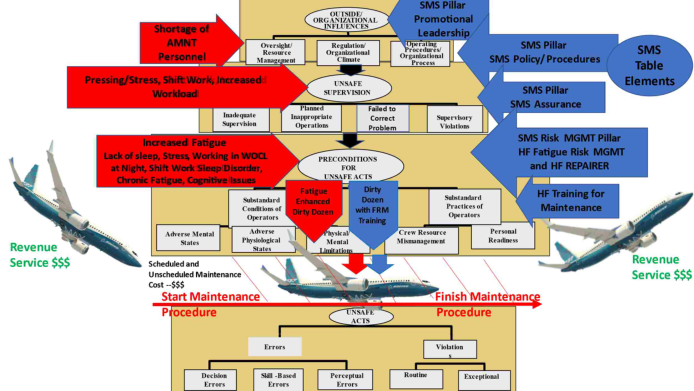
HFACS Analysis of the Effects the AMT Shortage To show the critical effect of the shortage of AMT personnel in commercial aviation maintenance operations in the US, a slightly modified HFACS dia- gram was designed in Figure 1 to demonstrate the basic economic revenue service of an aircraft while it goes into scheduled or unscheduled maintena- nce operations. The HFACS diagram is showing that the aircraft generates no revenue from empty seats and cargo holds when it is temporarily taken
Figure 1: HFACS analysis of an aviation maintenance operation with reduced AMNT personnel. Fatigue in red and SMS countermeasures in blue (Weigman 2005).
out of revenue service for maintenance. Once placed in the maintenance cue of the organization as depicted by the aircraft parked in the diagram, there now is tremendous pressure to complete the maintenance procedure and return the aircraft to revenue service. While that aircraft is in maintenance, the very bottom of the HFACS diagram shows how vulnerable the aircraft and the maintenance personnel are to AMT human error caused by ‘Unsafe Acts’ in the form accidental errors or purposeful errors. These maintena- nce human errors have always been there in aviation maintenance and they are generally caused by the HF Dirty Dozen. However, the global pandemic (COVID-19) has drastically reduced the manning levels of AMT personnel in commercial aviation maintenance organizations in the last 4 years. This is depicted in the HFACS diagram at the highest level as the shortage of AMT personnel is influencing the maintenance organization’s ‘(Human) Resource Management’. With the shortage of AMTs identified, the aviation maintena- nce organization is not going to stop or suddenly slow down maintenance with potential revenue generating aircraft being worked on. The pressing to maintain the aircraft to meet schedules and return the aircraft to reve- nue service increases as the maintenance supervisors now must get the same maintenance completed with less AMT personnel. This maintenance pres- sing increases stress on the AMTs while they continue to have to work their weekly night shifts in the window of circadian low with less assistance. To make sure the jobs are completed on a tight time schedule, AMTs must now work extra-long days and overtime until a 7-day consecutive workday limit is filled. With one day complete rest given by the maintenance supervisor, the AMT is then able to return and repeat the 7-day schedule. As the HFACS pro- gresses downward from ‘Organizational Human Resources’, to ‘Supervisory levels’, to ‘Preconditions for Unsafe Acts’, the AMT is working more with less AMT assets to help, and it is now accumulating in the form of AMT fati- gue. This fatigue includes enduring lack of sleep, the effects of stress fatigue, working late night shifts in the window of circadian low, possibly succum- bing to SWSD, all while dealing with chronic fatigue and hindered cognitive ability. This new heightened version of fatigue placed on the AMT now enti- ces the other elements of the HF Dirty Dozen to participate in human error when they were previously held in check with satisfactory numbers of AMT personnel available.
Leveraging SMS to Manage the Increased Fatigue Levels The FAA has mandated the use of SMS as an integral part of all Part 121 commercial operations in the US since 2015 (FAA 2015). Adopting a modi- fied SMS plan for the aviation maintenance organization might be the best thing to help mitigation efforts of the rising tide of fatigue caused by the AMT shortages. As illustrated on the right side of Figure 1 in blue are the 4 SMS pillar elements being integrated into the Part 121 maintenance organization. At the very top is the ‘SMS Promotional’ leadership element where top main- tenance managers endorse a safety minded just culture. From that point a maintenance ‘SMS Policy’ element is designated in writing with the details of the safety elements that will be infused in the maintenance operations. The
Managing Fatigue in Aviation Maintenance 61
SMS Policy will house the detailed procedures of a HF FRM system to be applied for the ‘SMS Risk Management (RM)’ element. Safety Policy is also where the important procedures for a maintenance HF REPAIRER Safety Reporting system need to be placed to be used in identifying and analysing the SMS RM hazards. The safety policy will include all the SMS Assurance tools to measure and to make sure that the SMS is working properly. Once the organizational leadership promotes the SMS and the SMS policy plan is written it is then time to introduce the maintenance organization to SMS RM tools of HF FRM and the HF REPAIRER Safety Reporting system (Mil- ler and Mrusek 2018) through a solid training plan for implementation into the work force. Due to the nature of aviation maintenance and the influence of the HF Dirty Dozen, it is recommended that the HF Dirty Dozen be incor- porated into both the HF FRM program and the HF Safety Reporting system training and implementation.
HF FRM Options to Combat the Fatigue in Maintenance The SMS model integrated into the Figure 1 HFACS of an aviation main- tenance organization shows promise to addressing the fatigue issues in commercial aviation maintenance through an HF FRM. A glimpse into a potential idea for a HF FRM model can be seen in the work of Wang and Chaung in 2014 when they used data from a study of two airline company surveys in the same region that compared fatigue rates with reported incidents attributed to fatigue. These fatigue questionnaires were used to gain insight to current stress and fatigue levels among unregulated shift work hour main- tenance employees to also determine the amount of fatigue at the beginning and end of shift based on time of shift, duration, and overtimes with surges. They assigned to each AMT surveyed a value related to their level of fati- gue. Analysis of the data showed that fatigue at end of shift was significantly higher than beginning of shift, and that fatigue was greater as shift-length and overtime increased. Regulating shift work hours is a possible solution in mitigating or lowering fatigue levels for AMTs. Reports show less errors and incidents along with better morale in regulated shifts that have breaks as compared to those that are unregulated and experience higher fatigue levels. To further promote a potentially successful form of HF FRM Liu and Wang in 2013 proposed building on the idea of identifying fatigue and the effe- cts on employees by using integer programming for work shifts. This is a way a manager can track AMTs’ current schedules and assign a value to those working odd-shifts or moving between shifts mid-cycles due to surges in required maintenance. The goal would be to maximize production hours and shifts for all AMT’s while at the same time maintaining a balance of shif- twork for all. This type of management is a key to a positive and just safety culture as it acknowledges that overuse of AMT personnel can come at a high cost. This also demonstrates there is a way to track and understand the effects of working in the window of circadian low and that changes in work schedules during the work week can reduce risks involved with the worker and production. This approach could be used as part of a HF FRM system which allows management to track and identify work shift and hours for
employees to avoid situations where employees could perform maintenance while fatigued. These research ideas applied to an HF FRM model demon- strate examples of how proactive safety management and just safety culture can mitigate fatigue in workers and improve safety while raising profitability by reducing errors. As promising as these research ideas are to the develo- pment of a useful SMS HF FRM model for aviation maintenance, it must be noted that they do not take into account the reduced AMT personnel levels that are currently a plague to aviation maintenance.
Challenging AMT Fatigue and Safety Through SMS and Beyond The fact remains that lower AMT manning levels will challenge the safety and efficiency of commercial aviation maintenance while AMT personnel will always be susceptible to fatigue. However, just because the threat is there does not mean it cannot be managed. Fatigue in maintenance is a threat that has been exacerbated, but it simply falls under the category of the other impor- tant side of aviation safety when HF are heavily involved. Hawkin’s (1988) coined this category in his HF Two-pronged Attack for aviation safety as the “reduce the consequences” prong of aviation safety to go along with the common safety philosophy of “prevention” as the other prong. No matter what we attempt in the future to improve aviation safety in maintenance, there will always be some level of human error and as long as the human is involved in maintenance work, fatigue will also be present. Therefore, the job of the future maintainer that is critical to air travel is one where regardless of the circumstances fatigue in AMTs must be managed to safe margins and still allow for efficient work levels to get the job done. Hence ‘reducing the consequences’ of the fatigue burden on AMTs will come in different ways. Technology cannot be discounted as part of the fatigue solution in that more modular maintenance like that used in the US Navy/Marine Corps F/A18 is finding its way into the commercial industry to allow maintenance work to become more efficient. Interactive Electronic Tech Manuals are also grow- ing in use to help and create a more efficient and safer maintenance work environment. The use of Augmented Reality technology will also improve maintenance tasks ergonomically. Meanwhile maintenance AMT education is becoming more affordable and faster for the commercial industry job market through programs like Embry-Riddle Aeronautical University’s Skill Bridge Maintenance AMT Program that works with military personnel and aviation companies to transition into AMT jobs after leaving the military. Though all these technological and educational venues are promising to back- fill and cope with the shortfall of AMT professionals, the SMS model of integrating some form of HF FRM to complement some form of HF Safety Reporting System like the REPAIRER would be optimal to gain a proactive SMS safety approach in aviation maintenance. The HF FRM system addres- ses the physiological threat in fatigue by reducing the consequences of it and the HF REPAIRER Safety Reporting System addresses the large percentage (39%) of aircraft accidents caused by human error in aviation maintenance related to the maintenance procedure using proactive prevention. SMS will therefore allow for the management of HF fatigue and procedural risks at
Managing Fatigue in Aviation Maintenance 63
the same time. The combination of advanced technologies, better AMT edu- cation and an SMS HF FRM integrated with an SMS HF REPAIRER Safety Reporting System are a solid strategy for aviation maintenance and the AMT to build a safer and more efficient maintenance system in the future. This proactive maintenance safety strategy will ensure that the vision of prospe- rity and growth for the US commercial aviation industry will meet future demands.
REFERENCES
Boeing. (2021). Pilot & Technician outlook 2021–2040. Report_PTO_R4_09131 AQ-Q-A. PDF. Chaparro, A., Groff, L., Chaparro, B., Scarlett, D. (2002). Survey of Aviation Tech-
nical Manuals: Phase 2 Report. User Evaluation of Maintenance Documents (Technical report No. DOT/FAA/AR-02/34), Washington, DC Federal Aviation Administration, Office of Aviation Research. Cleveland Clinic. (2021). Shift Work Sleep Disorder (SWSD): Symptoms & Treatment. at Cleveland Clinic online, https://my.clevelandclinic.org/health/diseases /12146-shift-work-sleep-disorder. Dupont, G. (1993). Human Performance Factors for Elementary Work and Servicing.
Transport Canada, TC14175, pp. 1–27. FAA. (2011). 14 CFR Part121.377, FAASTEAM Maintenance Safety Tip, online at https//www.faasafety.gov. FAA. (2015). Safety Management System, SMS for 121 Operators, https://www.faa.
gov/about/initiatives/sms/specifics_by_industry_type/121 Hawkins, F. H. (1987), Human Factors in Flight. 2nd ed. Ashgate, Aldershot. Herbic, J. (2020). Analysis of Database Online Aviation Safety Reporting System. In ERAU Graduate Capstone Project September 2020, Data retrieved from https: //asrs.arc.nasa.gov/search/database.html. Kocalevent, R., Hinz, A., Brahler, E., Klapp, B. (2011). Determinants of Fatigue and
Stress. Department of Mental Health, University of Leipzig, Germany, Published online. Liu, C. C., & Wang, T. C. (2013). Optimal aircraft maintenance crews work shifts with integer programming. Applied Mechanics and Materials, 319, 479–484. doi: 10.4028/www.scientific.net/AMM.319.479. Mcintosh, J. (2016). The Impact of Shift Work on Health, Medical News Today,
https://www.medicalnewstoday.com. Miller, M. D., Mrusek, B. (2018). The REPAIRER Reporting System for Integrating Human Factors into SMS for Aviation Maintenance. In: Proceedings of the AHFE 2018 in Advances in Safety and Management Systems, vol. 791. Springer. National Transportation Safety Board. (2010). Loss of Control on Approach
[online]. Available from: https://www.ntsb.gov/investigations/accidentreports/ reports/ aar1001.pdf. Rankin, W. (2007). MEDA Investigation Process. In Boeing AERO Issue 26_ Quarter 02, Boeing.com/commercial/aeromagazine. Web. 5 Feb. 2022. 15–21. Shappel, S. A., & Wiegmann, D. A. (2000). The human factors analysis and clas-
sification system--HFACS. Federal Aviation Administration, Office of Aviation Medicine. Wang, T., & Chuang, L. (2014). Psychological and physiological fatigue variation and fatigue factors in aircraft line maintenance crews. International Journal of Industrial Ergonomics, 44(1), 107–113. doi:10.1016/j.ergon.2013.11.003.
LISTED IN THE AHFE DIGITAL BOOKSTORE CATALOGUE
Explore the complete digital volume
Safety Management and Human Factors
Read this individual research paper free through the original publisher, or explore the full digital proceedings book.
ISBN 978-1-958651-81-0
Explore this ISBN in the AHFE Bookstore ↗Listed in the July 2026 bookstore catalogue; search by ISBN to confirm current availability · Digital book purchase optional