Mark Miller, Mandira Gerrels (2025). The Need for Ethics and Good Leadership as the Foundation for Aviation SMS Programs: Have we Forgotten Something?. In: Human Factors, Business Management and Society. AHFE Open Access, vol. 176, pp. 46–56. https://doi.org/10.54941/ahfe1006302
Safety Management Systems (SMS) in aviation is now mandated in the US by the Federal Aviation Administration (FAA). While SMS brings with it a strong safety standard in the areas of Safety Policy, Safety Promotion, Safety Risk Management (RM) and Safety Assurance for all aviation organizations using it, at the same time it can become potentially vulnerable to accidents and incidents from a historical conflict between economic decision making (DM) and safety DM. The researchers point out the dangers of this dilemma through the example of the Alaskan Airlines door plug decompression accident of 2024 where Boeing made the decision to eliminate many of their quality assurance inspectors on the 737 Max assembly line in favor of technology. The researchers note that while the standardized SMS themes represent 4 legs on the SMS table, the tabletop that holds the SMS together is accountability. Accountability from top management, accountability from every employee and accountability of the organization through its just culture. The researchers then commence an analysis by using a Human Factors Analysis and Classification Systems (HFACS) to demonstrate how SMS accountability and the DM is constantly being challenged by revenue service accountability and DM from levels of leadership to every employee and the organization’s culture. From the HFACS analysis the researchers determined that the SMS accountability and the DM on all levels of the organization need to be influenced by ethics and good leadership in some kind of human factors training intervention to prevent the human error of the wrong DM. To help substantiate this is an organizational influenced human factors training issue, the researchers complete a historical analysis of safety reporting systems as they relate to both proactive safety programs, SMS and aviation human factors. The historical analysis points to both RM safety programs and human factors playing significant roles with safety reporting systems in making the US commercial aviation industry proactively safer. It also shows that SMS and human factors complement another to eventually merge to reduce human error and increase efficiencies. This integration of SMS and human factors is significant toward what is missing in SMS in the form of organizational human factors training and specifically ethics and good leadership training toward better DM and stronger SMS accountability. Survey data from a graduate level SMS course with ethics and good leadership in it was analyzed with favorable results.
The Need for Ethics and Good Leadership as the Foundation for Aviation SMS Programs 47
INTRODUCTION
Commercial aviation safety is the glue to critical processes that allows passengers and cargo to routinely make it to their destinations at record times and has made air transportation in the United States and the rest of the world a preferred method of travel transportation. While this modern form of transportation is evolving with technology and human factors enhancements to make it safer, recent events of the last 5 years have identified safety issues related to poor ethics and leadership that can quickly take all the good intentions of the best aviation SMS programs and make them look seemingly bad when an accident occurs. The decompression accident of Alaskan Airlines Flight 1282 on 5 January 2024 is a glaring example of how important ethical decisions and good leadership are from an aviation organizational standpoint along with the dangers they can pose on an SMS if they are remiss (NTSB, 2024). The Boeing 737 MAX 900 was missing 4 bolts in the door plug due a new policy implemented during the Boeing 737 MAX manufacturing process that purposely retracted many of Boeing’s inspectors and replaced their jobs with different technologies. The intent was to become more efficient in the 737 MAX assembly process and cut costs by saving on costly human inspectors. Unfortunately, a subcontractor, Spirit Aerosystems failed to install the bolts on the door plug, the door plug was installed and the new technology driven inspection system failed to pick it up before the aircraft was delivered to Alaskan Airlines. The door plug subsequently blew out in flight causing a decompression emergency. In this case no one was sitting in the row of seats where the door plug malfunctioned. A woman seated directly behind the row had to grab her child from getting sucked out the missing door. The door plug decompression accident has left a scar on the industry that ethics and good leadership need to precede all safe flight operations.
The Influx of SMS Programs in US Aviation While the US commercial aviation industry continues to grow, the FAA has prepared for this growth by committing aviation operations in the United States to be standardized by mandatory safety programs in the form of SMS. This now includes commercial aviation businesses small to large to include FAR Part 91, 135 and 121 operations (FAA, 2024). No matter what the size of the aviation organization, SMS mandates 4 pillars of Safety Policy, Safety Risk Management, Safety Assurance and Safety Promotion. While the aviation organization adopts a Safety policy and implements Safety Risk Management to deal with hazards, it also has Safety Assurance techniques to discover and monitor hazards along with Safety Promotion to support the SMS. Safety Promotion has three important ingredients of Leadership, Culture and Training that seem to be directly related to ethics and good leadership. While the Safety Promotion elements sound like they should be the biggest ally to allow for ethics and good leadership to occur through the SMS, this is precariously not true as it is based the assumption that ethics and good leadership are just expected to happen in SMS when SMS is based on accountability where ethical and good leadership DM needs to be made.
48 Miller and Gerrels
SMS Based on Accountability Not Assumptions Safety in an aviation SMS must be a shared responsibility for all employees from leadership on down to every frontline employee to become an organizational effort. The only way to make this happen is through accountability. Only then can safety be enhanced and make it a key cultural element of the organization. Senior management is ultimately accountable while employees and supervisors are critical to be accountable in identifying and mitigating risks. Safety standards of accountability need to be emphasized in all operational decisions in the organization. Yes, having a safety culture with accountable employees that are empowered to report hazards anonymously without the fear of retribution is a big part of the SMS accountability, but there is also an accountability piece to SMS which requires holding all organizational stakeholders, and especially leadership responsible for doing something about the safety concerns that have been reported. The SMS Safety Policy lays out the accountable executives’ commitment to safety with clearly defined safety goals. But an effective SMS also has roles and responsibilities clearly defined to hold all leadership of different parts of the organization accountable (CFR, 2024). When a questionable practice or potential hazard is discovered where ethical decisions need to be made, the concerns need to be brought up through the organizational hierarchy to top management to be placed under the scrutiny of the FAA regulations, organizational policy and to make good leadership decisions. Senior management therefore is responsible for safety decisions, with an accountable executive is ultimately responsible. This is one aspect of SMS in which there is no leeway in that accountable executive must be clearly defined and have the financial and operational authority to execute and ensure the SMS’s is working as defined in 14 C.F.R. 5.25 (FAA, 2024). At the same time individuals throughout the organization must be held accountable for their decisions along with the accountable executive and others in leadership roles. Lastly, the organization must capture this in day-to-day operations and develop a way of doing business where both individuals and leaders are held accountable for their decisions in what is deemed a just culture (FAA, 2018).
SMS Accountable Decisions Versus Revenue Accountable Decisions Accountability is the act of being responsible for actions and the results they produce. SMS requires leadership accountability, individual accountability and organizational accountability (just culture) where all three elements must attain the proper safety results through the organizations SMS Policy, RM, Assurance and Promotion. While accountability and DM related to it is the glue that really holds the SMS together in terms of leaders, individuals and the just safety culture, it also brings with it its biggest ongoing challenge for the industry. That challenge is being responsible for actions and the results they produce. To be accountable, ethically correct and good leadership decisions need to be made in conflict with business decisions driven by a strong culture of revenue service.
The Need for Ethics and Good Leadership as the Foundation for Aviation SMS Programs 49
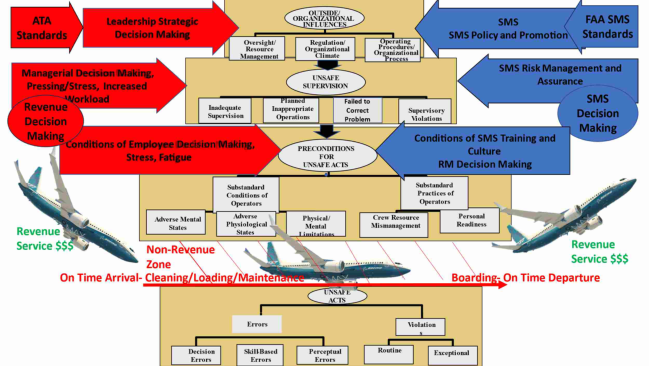
Underestimating DM Value in SMS Accountability With so much importance placed on accountability in SMS for it to optimally work throughout the organization; it’s leaders, employees, and safety culture are constantly challenged to make the correct decisions from two important aspects of the organization in revenue DM versus SMS DM. To demonstrate the cause and effect of revenue DM versus SMS DM for any aviation business in the US, the US airline industry is used as a highly competitive example. As depicted in the Figure 1 HFACS, an airline is a revenue business and has a social responsibility to the stakeholders to generate revenue to profit. All airlines in the US are heavily influenced by the Air Transportation Association (ATA) to meet standards. Leadership DM creates vision and strategy to profit at or above those business standards. To carry out that business vision and strategy supervisors in the organization send out their DM through schedules along with managing employee power to meet those schedules daily. All too often this managerial DM is marred through a slew of variables like weather, maintenance issues or costly fuel prices and all too often the decisions can turn into pressing, stress and fatigue in the workers environment where each employee is also responsible to make front line business DM that could also be skewed by the pressure, stress and fatigue. The whole organization is striving to be a good profitable business day after day, and this is the airline culture that delivers passengers and a cargo to the destination on time where everyone is accountable from top to bottom to provide good DM to profit. But as the HFACS shows, but revenue service only works when the aircraft is flying to the destination filled with passengers and cargo. When the plane is being cleaned, loaded, offloaded and maintained, the plane is not making money. Just as the pilots and crew are accountable to make good decision for flight, the pressing and pressure to get the aircraft ready for take-off cannot be taken for granted and leaves room for tremendous human performance success or errors to be made before the all-important flight phase even occurs.
Figure 1: HFACS: revenue and SMS decision making (Shappell & Wiegmann, 2003, p. 71).
50 Miller and Gerrels
Revenue Driven US Airlines: A Battleground for SMS Accountability While accountability and DM for revenue service has been part of the US airline industry for over 100 years, SMS safety accountability and the DM that must go with it is relatively new. This is especially the case for top airline leaders, managers, employees and the SMS culture that must be established. For the US industry this new SMS safety format has been made mandatory for FAR 121 operations by the FAA since 2017. For many US airlines it is an infusion of proven SMS international safety standards recommended by International Civil Aviation Organization (ICAO) since 2006. These standards include top leadership’s decisions on SMS Policy and SMS Promotion while having to continue to make key accountable strategic business decisions for the organization. Moving down the right side of the HFACS in Figure 1, managers now must start applying the cornerstone of SMS in a SMS Risk Management process for their area of management along with carefully adding SMS Assurance. Managers of different parts of the airline are now accountable for DM based on the SMS Risk Management process of identifying, analysing, assessing, mitigating and reevaluating hazards while leading their employees to do the same. Managers must be accountable with good DM by continuously monitoring their area of the airline with audits, data analysis and following up on voluntary hazard reporting to complete the SMS Assurance. In the case of both SMS RM and SMS Assurance, area managers must also strongly support SMS Policy and Promotion all while sustaining a revenue driven airline culture produce healthy profit. Whether it is top leadership working on strategic DM or managers with DM for their work area with supervisors carry out those decisions, revenue accountability business DM must be continuously cross- checked with SMS to achieve proactive safety. This merge of traditional economic driven airlines infusing business standards with SMS standards is meant to make the Figure 1 HFACS area of ‘preconditions for unsafe acts’ and below a balance of profitability and safety so that the pilots, flight attendants, cleaners, loaders, ramp workers, maintainers, gate agents, dispatchers and employees of the airline also become accountable and have good DM for both revenue and safety to form a new organization culture. The mindset of the airline employee should be about SMS hazard awareness and utilizing risk management. However, airline employees must still battle the traditions of 100 years of US airline revenue service as they apply their understanding of SMS to be accountable and have SMS DM. The FAA’s infusion of SMS in the US airline industry still does not change the fact that different types of human error will remain at the bottom of the HFACS diagram. The purpose of SMS should be to reduce the hazards and while doing so reduce human error in the process. Although the lasting safety impact of properly infused SMS standards in US airlines cannot be underestimated, at the same time it would be a mistake to think that there
The Need for Ethics and Good Leadership as the Foundation for Aviation SMS Programs 51
is not ongoing human factors influence battle of traditional revenue service culture versus an SMS culture vying for the accountability and DM. It seems obvious from the HFACS model that the right accountability and DM are critical SMS items. Ethics and good leadership are also critical to the success of SMS accountability and DM as they are needed to tame 100 years of aviation revenue culture.
Revenue Service Culture (Business) Versus SMS Culture (RM) US commercial aviation currently helps drive $1.4 trillion annually in US economic activity and more than 10 million US jobs (A4A, 2025). The 100 years of US airline revenue business culture has been driven and measured by output in the amount of profit gained after costs are accounted for from the revenue charged. One of the biggest costs along with fuel is the airline employee. So much of the business success of the aviation industry is based on the hard work of the employees. There have been times when financial managers have mismanaged their airline while neglecting the employees. This seemed fine for short term profit margins until some airline businesses went into financial disarray due to competition while the neglect for the employees sometimes turn into costly incidents and accidents. In some cases, a terrible accident would occur, and the tragic loss of life would suddenly force change on that airline business to be more employee focused by being more safety aware and reactive safety culture was formed with labour unions in full support. Over time reactive safety culture became too costly and a standard way to deliver a proactive style of safety culture was establish in SMS. SMS by human resources standards is an intervention meant to humanize aviation organizations by increasing safety awareness and vigilance to improve safety performance. In terms of the HFACS, this is considered a major organizational influence (Shappel and Wegman, 2007). The supporting SMS cast of top leaders, managers and employees along with the SMS safety culture have crucial accountability and DM roles for supporting the proactive SMS, but how does this accountability and DM be truly effective in an SMS. Strategically, SMS safety accountability and DM are the highest goal and standard to attain for an SMS, while ethics and good leadership are clearly how to strategically attain that high SMS safety standard. In the past this strategy using ethics and good leadership were assumed to automatically be there and were themselves latent human factors organizational influences that top leaders, managers and front-line employees just used. However, that is no longer the case. They now need to be taken out of the quiet in the shadows and placed in the forefront of organization SMS culture. Ethics and good leadership need to be not only a strong strategy as an organizational influence for a proactive SMS, but they also need to be treated as an outwardly compelling human factors organizational influence and taught as such with formal training methods. This formally trained ethics and good leadership is necessary to work balance with a revenue driven culture and SMS culture or that business culture will continue dominating. To shed light on the importance of this formal human factors training of ethics
52 Miller and Gerrels
and good leadership for the future of proactive SMS, the last 50 years of US aviation safety is analysed through a historical lens.
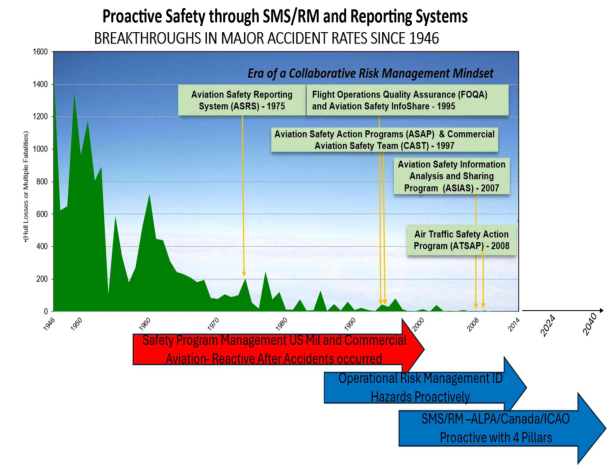
Trend of Aviation Hazard Reporting, Safety Programs, ORM and SMS Historical data on aviation safety relevant to understanding the importance of SMS can be seen with the high-rate hull losses and loss of life in the early 1950’s on the far left of Figure 2 based on reactional aviation safety of accidents happening and correcting for them. The strengthening of US military and commercial aviation safety programs came about in the 1960’s which signifies a decline in the US commercial accidents during that time, but these were still regarded as reactive safety programs, heavily involved accident investigation to lead to prevention. The beginning of trustworthy hazard reporting systems started in 1975 with the NASA Aviation Safety Reporting System (ASRS). From the success of the ASRS system, safety reporting began to grow with hazard identification as by product. This type of safety reporting system would play a role in shifting aviation safety from reactive to proactive. The US Army soon began to use a risk management system in the 1990’s based on exposure and severity integrated into a hazard assessment matrix to use for helicopter related hazards. The new method of managing hazards in aviation was based on accurate risk assessment of the hazard followed by a mitigation process. Deemed Operational Risk Management (ORM) by the Army, it became so successful that it was adopted by the US Department of Défense (DOD) in 2000. ORM was the next big step in moving towards proactive safety systems in US Aviation. While adopting ORM for in new millennium, the FAA also added to its proactive safety reporting systems in Flight Operations Quality Assurance (FOQA) and Aviation Safety Action Programs. As shown in Figure 2, these powerful reporting systems working with ORM as a process to manage hazards significantly continued to drive down the hull loss accidents moving past the year 2000. With appropriate reporting systems in place and a standard risk management system in place, proactive aviation safety in the US became more common. The last missing proactive safety entity missing was a standard aviation safety program of core elements that every aviation organization in the US could embrace. The Airline Pilots Association (ALPA) as the largest commercial pilot union in the world adopted a standard aviation safety program in 2000 based on proactive aviation safety management called SMS based on the following 4 elements: Policy, Promotion, Risk Management, and Assurance. ALPA (2025) worked closely with Air Transport Canada and in 2002 and 2003 to successfully implement the first SMS program in a Canadian airline called Air Transat. At the same time the International Civil Aviation Organization (ICAO) made SMS an international aviation standard. In 2008 Air Transport Canada made SMS mandatory for all Canadian Airlines. In 2018 the FAA required all FAR 121 operators to abide by the FAA regulations on SMS and that was soon followed in 2024 by all FAR Part 91 tour operators and 135 operations now obligated to have SMS. The US is now fully under the SMS guidelines of proactive aviation safety standards. While this history seems like the perfect solution to keeping the
The Need for Ethics and Good Leadership as the Foundation for Aviation SMS Programs 53
skies safe in the US, it is remiss by not accounting for another aviation safety force that has evolved strongly over the past 50 years in aviation human factors.
Figure 2: FAA 2024 graphic showing the reduction of US hull losses with multiple fatalities by reporting systems combined with the trend of proactive safety programs, ORM and SMS.
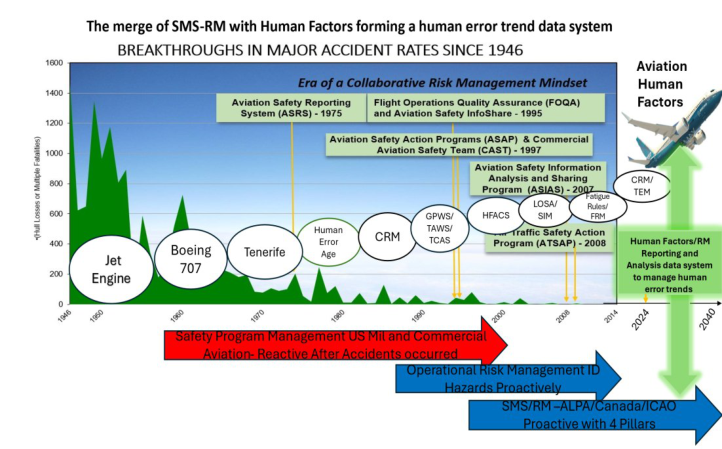
Historical Trend of Aviation Human Factors Merge With SMS While fatal commercial accidents have become rare in the US over the last 25 years, the recent midair collision on January 29, 2025, between an American Airlines commercial flight and Army helicopter at National Airport in Washington DC is a notice that they can still happen. As the US aviation industry rapidly grows, proactive aviation safety tools are the only thing to prevent accidents in US skies. While SMS is certainly a big step towards proactive safety for US commercial aviation to undertake, its counterpart in aviation human factors must also continue to be brought to the forefront of the aviation safety battlefield by increasing human performance and at the safe time drastically reducing human error. In Figure 3 aviation human factors appears on the far left of the chart in the form of a jet wake in the 1950’s as the jet engine appears in commercial use to bring reliability and safety to an industry that had accidents previously caused by the failures of the technology. The success of the jet engine and other technologies like the Boeing 707 soon brought about humans being at the root cause of most accidents. Human error soon became the international culprit to most of the world’s worst aviation accidents. Many of the commercial accidents of the 1970’s were caused by the pilots flying them. Special
54 Miller and Gerrels
attention was given to this phenomenon in 1977 when two new 747’s collided on a runway on Tenerife in the Canary Islands killing 583 people and destroying both aircraft. This and other futile accidents quickly turned the industries attention to aviation human factors. The first big human factors intervention in terms of changing flight deck performance to teamwork and reducing errors through a assertively trained crew was in the form of Cockpit Resource Management (CRM). What started as CRM 40 years ago has now evolved into modern generations of Crew Resource Management that have made made the industry safer. As CRM training and the new teamwork paradigm succeeded as a human factors solution to battle human error on the flight deck, so did human performance safety technologies like the Ground Proximity Warning Systems (GPWS), Traffic Collision Avoidence System (TCAS) and On Board Weather Radar. These technologies brought to the pilots much greater human factors situational awareness of terrain, other aircraft and weather. Eventually Reason’s Swiss Cheese Model on the influence of organization factors was supported by strong research to form the HFACS as reliable research backed human factors model. HFACS accounts for organizational failures that influence human error on the flight deck and other working areas of the organization. Meanwhile simulation and training have come to age with advanced high-fidelity simulators that enable pilots to become proficient in all aspects of flight including emergencies. Airlines now address pilot fatigue with realistic rules and Fatigue Risk Management (FRM) systems. CRM is now being infused with Threat Error Management (TEM). These latest RM renditions of human factors in FRM and CRM/TEM should be a relevant signal toward the industry of human factors.
The Merge of Human Factors and SMS With the tremendous amounts of data collected though sources like FOQA, ASAP reporting systems and incident and accident analysis, human factors/human error related causes can now be detected as hazardous trends that need to be dealt with in terms of SMS RM standards. Human error accounts for upwards to 80% of accidents in the US commercial industry. The merge of these two great aviation safety devices in SMS and human factors is not far away as they complement one another. If SMS requires accountability on all levels of personnel and that accountability requires good safety-oriented decision making, this is clearly a human factor’s issue that requires a human factor’s training stratagem in the form of ethics and good leadership to make the accountability and decision making a reality. It is time recognize that SMS and Human Factors can strongly work together and infuse SMS with deliberate human factors training stratagem like ethics and good leadership training. This is the best way to prevent the economic competitive culture of the industry from dominating SMS accountability and DM.
The Need for Ethics and Good Leadership as the Foundation for Aviation SMS Programs 55
Figure 3: FAA (2005) graphic showing the reduction of US hull losses with multiple fatalities by reporting systems, the trend of proactive safety programs ORM, SMS, human factors.
Graduate Survey: Ethics and Good Leadership Training Toward SMS 25 graduate students in a 9-week non-synchronous online aviation safety program management graduate course at ERAU Worldwide spent the first week of the course going over the importance of ethics and good leadership in the aviation industry. They first reviewed great examples of ethics and good leadership currently in the industry and then reviewed the Alaskan door plug failure case study before posting and commenting on the Alaskan case study with their classmates. At the end of the term after all the SMS subject areas were covered, the class was asked to take a short survey to find out the effectiveness of the ethics and good leadership training infused at the beginning of the course. 4 questions pertaining to the lesson were added to the course in a survey format. 11 out of 25 students participated in the survey. Results are as follows:
On a scale of 1 to 7, how well did Module 1 help you understand the importance of ethics and good leadership in the aviation industry in relation to safety and SMS?
Results: 11 favourable ranging from reasonably well to majority of 81% very well and extremely well.
Rate the Boeing/Alaskan Door Plug Failure Case study in Module 1 in terms of helping you understand the importance of ethics and good leadership in aviation organizations as you proceeded through the rest of the SMS course?
Results: 10 favourable with 81% ranging from great to excellent. My experience level working in the aviation industry is?
56 Miller and Gerrels
Results: 6 in the range of 11–20 years, 3 with less than 10 years and 2 over 20 years. The Module 1 lesson on ethics and good leadership in conjunction with the rest of the SMS course this term has helped me so I can apply these important concepts to do my job better?
Results: 11 favourable results with a majority 82% that strongly agree.
CONCLUSION
The human factors training on ethics and good leadership seems to be a tremendous boost of help to those working in and around SMS programs in the US aviation industry when infused as a foundational element at the beginning an aviation SMS course. Preliminary data seems to strongly support that the SMS element of accountability and DM should require a human factor’s training stratagem of ethics and good leadership to help people employed in various commercial aviation jobs be accountable and make the right SMS related decisions. More research data is required, but the preliminary research of the HFACS analysis and the historical research trend does strongly suggest that SMS and Human Factors need to work strongly together in the future for US commercial aviation to remain safe.
REFERENCES
A4A, (2025). Data and Statistics; Economic Impact of Commercial Aviation. Airlines for America website. https://www.airlines.org/impact/. CFR, (2024). Designation and responsibilities of required safety management
personnel. 14 CFR 5.25. https://www.ecfr.gov/current/title-14/section-5.25 FAA, (2018). FAA Transformation Initiatives: #3 Cultivating a Just Culture.
FAA Safety Website.https://www.faa.gov/about/office_org/headquarters_offices/ avs/offices/air/transformation/csp/initiatives/initiative_3 FAA, (2024). Safety Management Systems Final Rule. 14 CFR Parts 5, 21, 91, and
119. FAA. gov. https://www.faa.gov/newsroom/sms_final_rule.pdf FAA, (2024). Breakthroughs in Major Accidents since 1946. FAA Safety Culture Presentation by Sarbhpreet Sawhney of the FAA. 2024 Aviation Korean Safety Culture Forum. 25th, Sep. 2024, Grand Hyatt Incheon, Republic of Korea. Freeze, C., (2025). ALPA at 90: Safety Management Systems. ALPA website: News
& Events, Air Line Pilot Magazine. NTSB, (2024). Accident Investigation Preliminary Report, Alaskan Airlines 1282. https://www.ntsb.gov/investigations/Documents/ DCA24MA063%20Preliminary%20report.pdf Shappell, Scott., Wiegmann, Douglas., (2003). A Human Error Approach to Aviation Accident Analysis: The Human Factors Analysis and Classification System, Chapters 2, 3, pp. 21–71. https://doi.org/10.4324/9781315263878
LISTED IN THE AHFE DIGITAL BOOKSTORE CATALOGUE
Explore the complete digital volume
Human Factors, Business Management and Society
Read this individual research paper free through the original publisher, or explore the full digital proceedings book.
ISBN 978-1-964867-52-6
Explore this ISBN in the AHFE Bookstore ↗Listed in the July 2026 bookstore catalogue; search by ISBN to confirm current availability · Digital book purchase optional