Mark Miller, Sam Holley, Leila Halawi, Matt Mclaughlin (2025). The Technology Continuum on the Commercial Flight Deck and the Importance of Pilot Trust in AI. In: Human Factors in Design, Engineering, and Computing. AHFE Open Access, vol. 199, pp. 2022–2033. https://doi.org/10.54941/ahfe1007014
As AI continues to grow in the commercial aviation industry over the next decade it is imperative to study where and how its impact will be needed. While some areas like aviation maintenance need immediate implementation of AI to relieve maintenance personnel shortages, other areas like the flight deck could also benefit greatly from using AI. However, involving AI in commercial flight requires the trust of the pilots when using AI. This research defines AI and the needed trust that must go with it on the commercial flight deck from the perspective of a commercial flight deck technological continuum to show where AI has its origins, where it is now and where it will eventually find its place in the future. While the continuum shows how important it is for the pilots to work with AI to make efficient and safer decisions, it also clearly shows how vital pilot trust is in the AI as it is infused in the technology continuum over time. With the continuum analysis complete, the researchers then present the results of a recent commercial pilot trust in AI survey. The survey involved over 220 pilots to analyze where commercial pilot trust in AI currently stands as new AI technology continues to advance on their flight decks.
With AI use continuing to grow throughout the commercial aviation industry and an estimated 10-billion-dollar investment linked to it through 2030 giving it a compounded annual growth rate of over 35% from 2022 to 2030 (Kumar, 2023), it is easy to see the immediate use of AI in critical personnel shortage areas like aviation maintenance. However, while areas like aviation maintenance are burgeoning with AI implementation opportunities, the case is slower for pilots where aviation safety is of utmost importance and the pilots represented by their unions insist on having high trust in AI technologies before implementing them on their flight decks. To reiterate the importance of pilot trust in AI on the flight deck, the researchers first highlight why trust is so important through a lens of a continuum of flight deck technologies that include automation and AI. From this continuum the researchers account for the industry’s driving forces relevant to safety and
The Technology Continuum on the Commercial Flight Deck 2023
efficiency as automation becomes more autonomous and AI becomes more advanced influencing the pilots’ AI trust factor. Lastly, the researchers present their findings from the Commercial Pilots’ Trust in AI Survey.
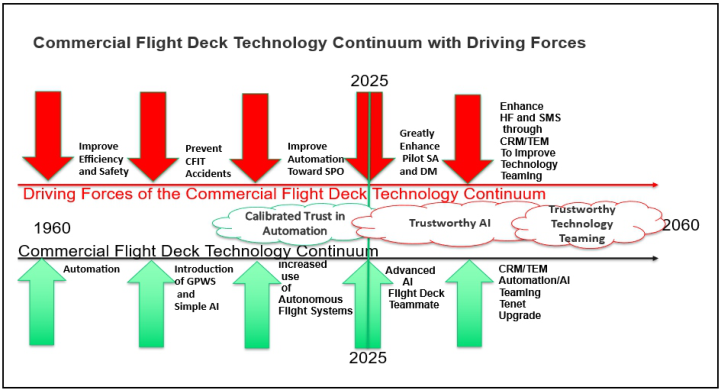
Defining the Technological Continuum of the Commercial Flight Deck To complete a thorough analysis of the importance of trust in AI on the commercial flight deck a technological continuum was first defined. The parameters set up for the continuum span from around 1960 and the advent of the Boeing 707 to 2060 and the potential of a large commercial aircraft flown by Single Piloted Operations (SPO). While the continuum is filled in as time moves forward with significant flight deck technologies (depicted by green arrows in Figure 1), and trust in the technologies is emphasized, simultaneously there is also a parallel continuum of driving forces depicted by red arrows that emphasizes why pilot trust in flight deck technological improvements is important from an industry perspective.
Figure 1: Commercial flightdeck technology continuum with driving forces.
Beginnings of Pilot Trust on the Flight Deck with Automation To gain proper perspective on pilot trust in AI on the commercial flight deck now and in the future, it is imperative first to discover the origins of pilot trust in computer automation integrated into the flight deck of commercial aircraft during the early jet age of commercial flight beginning in the 1960’s. Computer aided flight systems like the autopilot and autothrottle were designed and integrated into large commercial aircraft to allow pilots to become more efficient in flying while at the same time freeing up the pilots to monitor more in flight and increase their situational awareness (SA) to enhance safety. The addition of Flight Management Systems (FMS) would further project efficiency and a need for pilot trust. By inputting navigation data into the flight management computer, the FMS could then aid in flying the profile by taking over the routine tasks of calculating rate
of descent and managing the autothrottle all while navigating the aircraft through the inertial reference system. The aircrew needed only to monitor the flight progress on their Central Display Unit, while these efficiencies not only reduced workload and increased safety but, more importantly, gained fuel efficiency to drive down operating costs. A glimpse into future trust of AI as it is integrated onto the flight deck must certainly include many of the trust principles from pilots using automation over the last 60 years. Perhaps the most important being the ideal state of pilot-automation interaction in what is regarded as ‘calibrated trust’. Calibrated trust occurs when the users trust in automation accurately matches the automation capabilities encouraging appropriate and timely use of the automation (Meyer, 2024). While calibrated trust desires pilots to have balanced acceptance and reliance in using automation, the danger of over relying on the automation can lead to complacency, loss of SA, slow reaction times and deskilling of crucial flying skills (Blair, 2025). The factors that influence automation trust toward that ideal state of calibrated trust are making automation outputs more visible in design, providing high-quality information that is easy to understand, and limiting the amount of information to be cognitively managed. This further implies that pilots need good training to gain an understanding of the capabilities and limitations of automation.
Ground Proximity Warning System (GPWS) and Trust in Simple AI As pilots gained trust in the different automated systems that made their workload more manageable, the decade of the 1960’s also brought about an alarming number of global accidents where properly functioning commercial jet aircraft were being flown into the ground by qualified crews that were classified as Controlled Flight into Terrain (CFIT) accidents caused by human error. To remedy this alarming trend, research verified that CFIT accidents could be prevented using GPWS safety technology. Mandated for U.S. commercial aircraft in 1974, the GPWS initiative was so successful that a report issued by Sabatini (2006) stated there had not been a single passenger fatality in a large commercial aircraft related to a CFIT accident in the U.S. since 1974. The difference in GPWS at the time of its initial integration onto the flight deck as compared to other flight deck automation was that GPWS consisted of a Radar Altimeter indicating height of the aircraft above ground, a trend calculator and a warning system for the flight crew with both visual and audio messages (seven altogether) to make a safe flight deck decision related to excessive descent, terrain closure rates, unsafe terrain clearance or excessive deviation below the glideslope (Miller et al., 2021). GPWS was a breakthrough technology and would be considered a simple, narrow form of AI to help the aircrew increase their SA on terrain and, if need be, make a better safety decision. Initially GPWS did not gain the full trust of pilots because the GPWS could only pick up terrain directly beneath the aircraft and could not pick up potential terrain ahead of the aircraft preventing crews from taking proper evasive action. This was changed in the 1990s by an updated version called the Enhanced GPWS (EGPWS). Eventually the
The Technology Continuum on the Commercial Flight Deck 2025
EGPWS was upgraded to what is now called Terrain Avoidance Warning Systems (TAWS). It was this evolution of AI CFIT preventing technology that set precedence for pilots to desire trustworthy AI (TAI).
Rules of Trustworthy AI (TAI) Brought Forth by Safety Technologies Currently, forms of AI in different industrial settings are classified as either narrow AI or general AI. Narrow AI is referring to algorithmic applications designed for specific tasks (Strom et al., 2019). Conversely, general AI is classified as theoretical technology that uses computer systems to apply learned knowledge to multiple tasks beyond the system’s initial programming and adapts to environmental changes (Dilmegani, 2021). Poole and Mackworth (2023) defined AI as computational agents that exhibit intelligent behaviour, perceive their environment, and recommend actions that optimize success. The lesson learned from the GPWS (narrow AI) flight safety technologies is that pilots must perceive AI as reliable for it to become trustworthy due to the critical nature of safe flight operations. TAI is based on the belief that trust in AI technology is an important foundation for communities and economies’ long-term success. For commercial aviation, TAI is not just a way of business, it is also a constraint for critical flight safety areas like terrain and other aircraft. This type of AI, when used, cannot fail in helping pilot decision making as the result on the flight deck could be catastrophic. At the same time, AI must function reliably with other automated and digital systems used to gain FAA certification. Any compromise or deviation from TAI could have grave implications for an industry that relies on complimentary elements of safety and efficiency to produce thin margins of revenue. To understand why TIA is non-negotiable for commercial aviation and the pilots who use it, one must first understand that the primary threat is not from machine failure but comes from humans. 80% or more of U.S. commercial aviation accidents are caused by human errors (Marais, 2012). The integration of AI systems on board commercial aircraft is meant to reduce human error decision-making (DM) mistakes. To not have TAI on the flight deck would invite more human error involving DM. TAI can only be gained on the flight deck by ensuring pilots thoroughly understand the AI system they are working with, train with the AI system, and be an integral part of the AI loop. The whole concept of TAI on the flight deck is similar to automation in that it is there to work with the crew to increase efficiency and safety, but it also adds to increased SA and DM. The salient point of TAI on the flight deck is that it is designed to collect, manage, and analyse large amounts of data for the crew in a short window of time and then proactively work with the crew toward the best DM solution. From this perspective it becomes part of the flight deck team. While TAI can be an invaluable proactive asset to pilots in terms increasing SA of terrain (TAWS) or other aircraft (TCAS) to making better safety decisions, the biggest threat to the flight deck is automated flight deck systems that are rapidly becoming more autonomous which limits pilot interaction.
From Automation Improvements to Conflicts in Autonomous Systems The technological continuum on the commercial flight deck would not be complete without the driving force of the aircraft manufacturers and airline management pushing to eliminate more of the human element from the flight deck shown in Figure 1. Autonomous systems development on the commercial flight deck has the goal of using powerful computer technology to reduce pilot monitoring and limit interacting with flight systems. This increased autonomous systems use on the flight deck has an intended long- term goal to potentially eliminate a pilot on the flight deck of a large commercial aircraft to what is deemed Single Pilot Operations (SPO). Unlike the original automated systems that required constant pilot monitoring by the crew to make better flight decisions, autonomous systems reduce pilot monitoring and activity in the system’s DM loop. This problem of making automated systems more autonomous is deemed by Endsley (2016) as the ‘automation conundrum.’ The automation conundrum occurs when more automation is added to a flight deck system to make it more autonomously designed. The more reliable the automation is perceived to be, the more the pilot monitoring the automation could be unaware of critical information and less likely to take over manual control. More use of autonomous systems means automation is used for more functions, longer durations, and higher levels, which creates a barrier to autonomous safety-critical systems along the human-machine interface. Endsley’s (2016) research proposes that potential safety issues can occur when functions are automated, and the reliability of that autonomy increases, causing less attention to be given to those functions. SA of the pilot operator will be lowered, and the likelihood of an out of the loop situational awareness error could occur. To avoid this conundrum on the flight deck, good autonomous systems design calls for the development of a successful approach to human–autonomy teaming where trust needs to be factored in by the operator. Many variables apply to trust as they relate to autonomous systems on the flight deck to include the systems factors, individual factors and situational factors, however Hancock et al. (2011) determined that system factors (most notably system reliability and performance) had the greatest overall impact on automation trust. In contrast, individual and situational factors had a much lower impact. The aircraft manufacturers and aircraft certification authorities in the U.S. (FAA) and Europe (EASA) must provide approval supporting this reliability and performance confidence before a new aircraft model starts operational service in an airline so aircrews can be properly trained using it. This certification process will also bring with it higher automation reliability, performance, and trust. However, the goal of ‘Calibrated Trust’ with balance along the human machine interface still needs to be maintained and monitoring of the system still needs to occur. This monitoring will keep the pilots at the peripheral edge of that autonomous system’s loop of what it is doing. Meanwhile pilots are expected to monitor more data related to other flight systems, aircraft systems, and the environment all while communicating to their company, the crew, air traffic control and each other
The Technology Continuum on the Commercial Flight Deck 2027
while maintaining good SA for aeronautical DM. Most of this monitoring is done through an optical view that has some cognitive limitations. The big question from the outcome of this increased autonomous system design and the cognitive challenges it poses is how will the development of AI as DM tool for the flight deck properly team up with the crew to help it make better decisions not to be overwhelmed?
The Next Continuum Step: Commercial Flight Deck AI Teaming Since 2020 the US NextGen Air Traffic Control system requires digital aircraft identification through a GPS satellite technology onboard aircraft with ADS-B (Out). At the same time ADS-B (In) devices can provide GPS satellite information updates on terrain, other aircraft and weather to pilots’ Electronic Flight Bags (EFB). Digital flow of external data is now available to complement the internal data being used on board the aircraft. With the trend of more highly autonomous systems being integrated on the commercial flight deck with more data (both internally and externally) available and less monitoring from pilots, how can the important trust factor in the flight deck technology be asserted while managing all the information while maintaining high degrees of situational awareness to make competent flight deck decisions? The answer is in an AI system for the commercial flight deck that can go beyond current forms of singular flight deck AI systems (TAWS, TCAS) and can instead expand the roles of AI on the flight deck to form an information management/analysis asset featured as a proactive AI flight deck teammate. AI in an expanded role on the flight deck has the potential to not only collect data from different systems but can organize and analyse the data in record time (at any time) to keep the pilots in the monitoring loop of autonomous systems with simple updates. All this could be done while collecting and analysing data simultaneously from external systems to give pilots updates on things like weather and airport landing criteria. By teaming up with an AI teammate, the flight deck crew will increase situational awareness on both internal and external operations while teaming for better flight decisions. If designed and implemented properly with the flight deck crew to enhance their SA and make better decisions, it could be the answer to restoring calibrated trust and confidence in automation that has in some cases become too autonomous for pilots to remain engaged and in the automation loop. Design, development, and implementation are the keys to this next level integration of AI on the flight deck, as all the large aircraft manufacturers are currently vying to capture it as a prize technology for advancing the industry. For the purposes of this trust in AI research on the commercial flight deck, Honeywell’s Anthem AI is used as an example as it is currently being developed for flight deck integration since it was unveiled to the public in 2021(Persimos, 2025). In the case of Anthem, the AI flight deck system connects the aircraft to the digital cloud enabling real time monitoring of vast amounts of data along with predictive analytics all with high powered processors to gain faster processing and enhance AI to interact as a teammate with the crew. This change from an incremental use of AI to a deeply integrated AI system would be a big step in greatly enhancing flight
deck crew SA and DM. Anthem uses ‘deterministic AI,’ which anticipates what the pilot needs when the pilot communicates with it. To further build trustworthiness in this advanced flight deck AI system, Honeywell uses a heavy dose of oversight from human reviewers in customer exercises, human factors expert analysis and flight testing through pilot demonstrations and evaluations. In this AI trust-building process, Honeywell insists that humans are always the captain and the ultimate decision-maker, while AI’s job is to support and augment the team (Persinos, 2025). Anthem is also designed to support growing levels of aircraft systems autonomy as it is scalable and able to do more for the aircrew if needed. While the manufacturer can gain trust in more advanced AI systems on the flight deck in the design, development, and implementation, continued trust building in a robust flight deck AI system can only be achieved operationally through a human factors technology teaming protocol requiring the advancement of Crew Resource Management/Threat Error Management (CRM/TEM).
The Convergence of Human Factors and SMS in CRM/TEM AI Teaming Human factors have been a mainstay on the commercial flight deck since the 1970s, which highlighted the dangers of human error on the flight deck, along with some of the worst commercial aviation accidents in history. The human factors solution to this problem was in the form of teamwork training for the flight deck crew, which was called Cockpit Resource Management. Over the last 40 years, it has evolved into a more advanced flight deck teamwork strategy that utilizes crew, ATC, maintenance, and dispatch to become known as Advanced Crew Resource Management (ACRM). The last iteration added a form of safety risk management called TEM to the current version of CRM/TEM. The timing could not be better in adding the risk management component of TEM as the FAA mandated U.S. FAR 121 carriers to adopt the international Safety Management Systems standard in 2017 and both FAR 135 and FAR 91 operations the same in 2024. The whole U.S. commercial aviation system is now under SMS standards, and TEM allows for those standards specific to hazard identification, analysis, assessment, and mitigation to be extended to the flight deck. While CRM/TEM is a great potentially combined use of human factors and SMS risk management for futuristic flight deck teaming, at the same time it is remiss in modernizing to account for better management of automated systems that are becoming more autonomous, growing amounts of computer information and the potential for more advanced AI teaming integration. The projected flight deck continuum in Figure 1 calls for a crucial updated version of CRM/TEM integrated with a technology management teaming tenet. This new technology team management iteration added to the current model will encourage pilot calibrated trust in automated systems that are becoming more autonomous while being complimented by a supportive Trustworthy AI teammate. At some point calibrated trust for autonomous automation and TAI for the flight deck AI teammate will work together to form “Trustworthy Technology Teaming” as a strategy to manage and analyse information for optimal SA and DM.
The Technology Continuum on the Commercial Flight Deck 2029
Commercial Pilot Trust in AI Survey Design and Basic Demographics The survey was designed with several important trust aspects to capture the current commercial pilot trust in AI. The survey was open from 1 November 2024–30 August 2025 online through Survey Monkey. Preliminary survey information oriented the pilots taking the survey by explaining the need to discover current pilot trust in AI. Examples of simple AI systems already used by aircrews in the form of EGPWS were emphasized while the protection of pilots’ identity by taking the survey was confirmed. Question 1 was agreement to take the survey or stop by opting out. Questions 2–7 covered demographics of gender, ethnicity, age, flight hours, experience, rank. Questions 8–22 (Likert scale survey questions) were related to trust in AI. The total number of participants was 220. In Question 2, gender, 17% of the survey participants were women pilots. Question 4, age, was nicely distributed between the ages of 18–65, with 89% of the pilots falling between the ages of 25–64. Question 5: Flight-hour experience ranged from under 1500 hours to over 10000 hours, with 44% of the pilots having between 1500 and 10000 hours, and another 40% of the pilots having over 10001 hours. In Question 7, 41% of the survey participants were airline captains, 34% airline first officers, 12% flight instructors, and 1% chief pilots.
Relevant Questions from 8–22 Related to Trust in Simple AI Systems
Table 1 shows that 52% of the pilots’ trust AI, 29% are neutral and 19% do not trust AI. The industry has work to do to gain a level of TAI status for all pilots.
While Table 1 showed a need for improved pilot Trustworthy AI, Table 2 shows that 73% of the pilots do believe that AI can make accurate, timely decisions.
Table 1: Survey data for pilots regarding trust in AI; Question8.
Table available in the original PDF paper.
Survey Item Strongly Agree
Agree Neutral Disagree Strongly Disagree
13.18% 38.64% 29.09% 15.00% 4.09%
Q8: How much do you trust AI to assist with pilot tasks?
Table 2: Survey data for pilots regarding AI making timely and accurate decisions; Question 9.
Table available in the original PDF paper.
Survey Item Strongly Agree
Agree Neutral Disagree Strongly Disagree
7.27% 27.27% 38.64% 20.00% 6.82%
Q9: How confident are you in the ability of AI systems to make accurate and timely decisions on the flightdeck?
Table 3 shows that 94% of pilots must understand how their AI makes decisions.
Table 3: Survey data for pilots regarding pilots understanding of AI; Question 11.
Table available in the original PDF paper.
Survey Item Strongly Agree
Agree Neutral Disagree Strongly Disagree
35.91% 42.73% 15.45% 5.45% .45%
Q11: How important is it for you to understand how AI systems make decisions?
Table 4 shows the importance of pilots not only understanding how their AI systems work from Table 3 but 95.5% of them desire training on using their AI.
Table 4: Survey data for specific focused training of AI system on aircraft; Question 12.
Table available in the original PDF paper.
Survey Item Strongly Agree
Agree Neutral Disagree Strongly Disagree
45.00% 37.73% 12.73% 2.27% 2.27%
Q12: How important is specific focused training on a specific AI system for operating your aircraft?
Table 5 addresses the fact that 99% of the pilots strongly desire to be involved proactively in the AI loop and, most importantly, to be able to override the AI.
Table 5: Survey data relating to overriding and remaining engaged with the AI loop; Question 13.
Table available in the original PDF paper.
Survey Item Strongly Agree
Agree Neutral Disagree Strongly Disagree
74.09% 19.09% 5.91% .45% .45%
Q13: How important is it to you to be able to override AI systems’ decisions and remain informed and engaged in the AI loop?
Table 6 shows that 71% of the pilots believe in the safety and reliability of their AI systems but still not enough to obviously trust the AI as related to Table 1.
Table 6: Survey data relating to confidence of safety and reliability of AI systems; Question 14.
Table available in the original PDF paper.
Survey Item Strongly Agree
Agree Neutral Disagree Strongly Disagree
5.45% 27.27% 38.69% 21.36% 7.27%
Q14: How confident are you in the safety and reliability of AI systems?
The Technology Continuum on the Commercial Flight Deck 2031
Table 7 shows the importance of pilots feeling strongly about participating with AI for DM as only 25% of them trust AI enough to make their own DM.
Table 7: Survey data relating to trusting AI to prevent mistakes without intervention; Question 18.
Table available in the original PDF paper.
Survey Item Strongly Agree
Agree Neutral Disagree Strongly Disagree
4.09% 21.36% 38.64% 25.45% 10.45%
Q18: I would trust an AI agent to prevent a mistake without my intervention?
Table 8 also shows that only 17% of pilots trust AI’s DM as much as human DM at this juncture.
Table 8: Survey data relating to trusting AI’s decision as much as a human; Question 19.
Table available in the original PDF paper.
Survey Item Strongly Agree
Agree Neutral Disagree Strongly Disagree
3.18% 13.64% 36.36% 31.82% 15.00%
Q19: I would trust an AI agent’s decision as much as a human decision?
Table 9 makes an important point in that upwards to 40% of pilots seem to have a problem clearly seeing the distinct differences between automation and AI.
Table 9: Survey data relating to differentiating between AI and automation; Question
Table available in the original PDF paper.
22.
Survey Item Strongly Agree
Agree Neutral Disagree Strongly Disagree
19.09% 41.82% 25.91% 11.82% 1.36%
Q22: I perceive a clear distinction between automated systems and AI?
CONCLUSION
The survey showed that pilots think that AI can make timely and accurate decisions (75%). At the same time, they also believe that AI is safe and reliable (71%) They need to know the how their AI systems work (91%) all while having detailed training with the AI systems (95.5%) and insist on being integrated into the AI loop with the ability to override the AI (99%). While the pilots think highly of AI and want to have a working knowledge of it, their current trust in AI is weak (52%). Unfortunately, this falls short of where the industry needs to be, with trustworthy AI being a necessity for the future flight deck. The survey revealed several reasons for falling short in current trust in AI, such as pilots not trusting AI for DM (75%) and instead greatly
favouring AI as a teammate to help them in DM. Very few pilots (17%) trust AI to make decisions on the level of humans. The fact that pilots are having a difficult time distinguishing between their automation as it becomes more autonomous and AI (40%) is perplexing. The data from the survey points to an erosion of trust in AI on the flight deck that requires Trustworthy AI levels. Building high TAI levels for the future commercial flight deck will require that pilots gain calibrated trust levels (good balance) in using their more autonomous flight deck automation all. At the same time, the AI works complementary with the pilots and the automation as a team. Improving the AI systems to make them faster, safer, more accurate and reliable to better manage and analyse computer data will also improve TAI levels. A great deal of improving the TAI factor will lie in the front end by designing, developing, and implementing AI better as a new team partner through the manufacturer and regulatory certification process. Pilots must be able to clearly understand how their AI works, have hands on training with it and be heavily integrated to participate in the AI loop while teaming up with AI to make the final DM while still having overriding authority over the AI. For long-term TAI success, a better human factors management protocol for flight deck teaming with technology will have to be instituted. CRM/TEM will have to be upgraded to better account for managing the flight deck technology with AI teaming to maintain SA and good DM. Trust on the commercial flight deck will eventually not just be related to calibrated trust in automation or TAI levels but instead will shift toward trust in complementary teaming with flight deck technology.
REFERENCES
Blair, J. (2025). The Dangers of Overreliance on Automation; Safety Concerns and Mitigation Strategies for Pilots. FAA Safety Briefing Magazine. faasteam.medium.com. Dilmegani, C. (2023). When will singularity happen? 1700 expert opinions of
agi. Artificial intelligence, agi [online], August 2023. Available from: https:// research.aim ultiple.com/artificial-general-intelligencesingularitytiming/ [accessed 3 August 2023]. Endsley, M. R. (2017). From Here to Autonomy: Lessons Learned from Human– Automation Research. Human factors. [Online] 59 (1), 5–27. Hancock, P. A. et al. (2011). A Meta-Analysis of Factors Affecting Trust in Human-
Robot Interaction. Human factors. [Online] 53 (5), 517–527. Kumar, P. (2023). Artificial intelligence in aviation market. Allied market research [online], August 2023. Available from: https://markwideresearch.com/artificia l- intelligence-in aviation-market/ [accessed 4 August 2023]. Marais, K. B. and Robichaud, M. R. (2012). Analysis of trends in aviation
maintenance risk: An empirical approach. Reliability Engineering Systems Safety, 106, pp. 104–118. Meyer, T. (2024). The Dynamics of Human Trust in Aviation Automation Technology. In. Research Week 2024, Liberty University Scholars Crossing. https://digitalcommons.
liberty.edu Miller, M., Holley, S., Halawi, L. (2023). The Evolution of AI on the Commercial Flight.
The Technology Continuum on the Commercial Flight Deck 2033
Deck: Finding Balance Between Efficiency and Safety While Maintaining Integrity of of Operator Trust. Applied Human Factors and Ergonomics Hawaii Conference Proceedings. DOI: 10.54941/ahfe1004175 Persimons, J. (2025). Honeywell and NXP Forge Path to AI-Driven Autonomous
Aviation. In Aviation Today, Avionics International. https://aviationtoday.com. Poole, D. L. & Mackworth, A. K. (2023). Artificial intelligence: foundations of computational agents. Third edition. [Online]. Cambridge: Cambridge University Press. Strom, A. L., Fotheringham, D., & Bitner, M. J. (2019). Customer acceptance of AI in
service encounters: Understanding antecedents and consequences. In Handbook of service science, Switzerland: Springer, 2, pp. 77–103.
LISTED IN THE AHFE DIGITAL BOOKSTORE CATALOGUE
Explore the complete digital volume
Human Factors in Design, Engineering, and Computing
Read this individual research paper free through the original publisher, or explore the full digital proceedings book.
ISBN 978-1-964867-75-5
Explore this ISBN in the AHFE Bookstore ↗Listed in the July 2026 bookstore catalogue; search by ISBN to confirm current availability · Digital book purchase optional