Sam Holley, Mark Miller, Leila Halawi (2026). The Gold and the Failed Results of Artificial Intelligence in Aviation. In: Advances in Human Factors of Transportation. AHFE Open Access, vol. 224, pp. 96–106. https://doi.org/10.54941/ahfe1007837
When James Lee wrote his perceptive assessment of management theories in 1980, he described the achievements (gold) and failed results (garbage) as a caution to practitioners. Considered in the light of current applications of artificial intelligence (AI) in the aviation arena, this approach proves beneficial in examining the pros and cons currently and assessing the positive achievements as well as the less successful efforts. Following a brief review of the origins of AI, representative successes of AI applications in flight deck operations, air traffic management, maintenance, aircraft design, airport operations and airline management are provided with specific examples that demonstrate how AI is proving beneficial. Among these are uses in fleet operations, crew scheduling, safety risk management, fuel efficiency, and twelve other uses. Conversely, two seasons of AI growth and decline are explained and the ensuing resiliency which is propelling the current momentum of expectations. The Gartner Hype Cycle of AI is described with attendant promises and potential disappointments related to aviation. Then, an overlay of the AI roadmaps from aviation safety agencies are given to indicate timelines for expected development and growth. When the seasons, Hype Cycle, and roadmaps are considered together, patterns emerge indicating likely milestones and breakthroughs for AI in the aviation environment. These combine to show pathways that the gold and garbage may take. Illustrations of how AI fails are discussed with perspectives on operator trust in AI and limitations that are becoming more evident. Looking forward, technologies that are advancing AI in aviation are identified and the growing use of agenic AI is considered in the aviation context. Neural versions of AI and quantum computing are assessed as next generation AI applications.
With a nod to James Lee and his incisive book, “The Gold and the Garbage in Management Theories and Prescriptions” (Lee, 1980), it seems once again a useful time to assess an expanding and prolific body of developing notions and prescriptions. This time it is for the expanding universe of applications in artificial intelligence (AI) with a particular focus on human factors in the commercial aviation arena. There is little question of the potential for artificial intelligence in aviation systems and operations. There is a concerted effort to integrate and embed more dedicated and domain- specific AI applications into aircraft systems and risk management processes. Alternatively, creative applications abound and excitement builds for how Received October 20, 2025; Revised March 31, 2026; Accepted April 15, 2026; Available online July 20, 2026
The Gold and the Failed Results of Artificial Intelligence in Aviation 97 generative AI might accelerate complex decision-making, coalesce multiple variants of information, and supplant human cognitive processing (Holley et al., 2024). Woven throughout these two trajectories are positive and solid advancements that employ aspects of AI, representing golden achievements and promising beneficial opportunities. Conversely, there are less successful early efforts and projected improbable concepts that, collectively, represent failed results. Lee questioned the scientific validity of many management streams and theories, elaborated on some of the disastrous results and dubious claims made, and contended that the gullibility of interested and involved parties was at the core of perpetuating theories that lacked supporting evidence. He summarized the many theories as contingent on the variables involved and cautioned practitioners and academics to exercise an agnostic and questioning stance when confronted with new theories or prescriptions (Lee, 1980). This advice rings even more true in light of the current speculation and claims surrounding AI in the aviation arena.
The term artificial intelligence often is attributed to John McCathy, who originated it in 1956. An early promoter was Minsky who advocated for heuristic programming and pattern-recognition techniques, likening AI to having machines perform with an intelligence as though done by humans. The group following was inspired by biology and worked to create artificial neural networks as a path to artificial general intelligence. Rosenblatt’s concept of artificial neurons, known as perceptrons, was seen to create neural networks but advanced development was truncated by his premature death. Creating multiple layers of artificial neurons became known as deep learning. Lenat took the developments from deep learning and combined them as symbolic AI. Together, the work of Rosenblatt and Lenat evolved as the Cyc ontology which attempts to encode common sense in a machine. The need for expert specialized hardware brought an early end to many of the pioneering efforts due to inadequate data. (Strickland, 2021). It was not until sophisticated gaming developed that sufficient data became available to train the neural networks where the growth of AI learning doubles every 15 weeks and could become unsustainable. The current solution entails a process known as catastrophic forgetting (Kirkpatrick et al., 2016) where AI must erase everything it knows about how to solve a task performed previously, which confounds generalizing to another task. This would not be an acceptable process for aviation. And so we arrive at the threshold of AI in aviation and what has proven to be genuine success and what has been discarded, at least in the current iterations.
THE GOLD There is abundant evidence of positive and effective applications of AI in the aviation sector to date that have provided enhanced safety of operations and equipment, maintenance processes, navigation aids, aircraft systems, air traffic management, and airline operations. By no means an exhaustive list, these AI implementations have shown there is reason to trust the new applications and to expect further developments of a similar kind. Multiple examples are evident. Swiss International Airlines has applied AI to optimize fleet operations. Lufthansa Airlines has used AI to more accurately predict
wind patterns, improve fuel usage, and reduce flight delays. Other applications include pricing optimization, inventory management, check-in and baggage processing, crew scheduling, and streamlining repairs (Sahota, 2024).
Aircraft design can be expedited using AI models like LGM-Aero that speed up calculations and simulations for various functions like fluid dynamics, structural loads, and aeroelastic applications. With its speed advantage, LGM-Aero can be used across the entire range from conceptual design to process control (Warwick, 2025). The digital assistant concept is under development by researchers such as the German Aerospace Center and their Next Generation Intelligent Cockpit (NICo). Further developments at the Massachusetts Institute of Technology and the Air Guardian system that uses liquid neural networks, intended to complement human judgment, are closing the gap. Still, AI systems on the flight deck may be approaching a saturation point as complex machine learning moves into less reliable territory as learning expands in the system (Bashatah and Sherry, 2022). Similar efforts are underway with multiple airlines pursuing reduced crew operations, distributed crewing, or single pilot operations (Brooker, 2024), although recent indications suggest that these efforts may be placed on hold temporarily. Further examples of successful AI use are shown in Table 1.
Table 1: Uses of AI in aviation (Schmelova, 2020).
Table available in the original PDF paper.
Collaborative decision making with operators during air navigation flight emergencies Cooperative decision making and resolutions during air traffic conflict detections
Deep learning in processing multispectral images Fight management systems
Radioelectronic equipment operation Managing systems of systems for small unmanned aircraft
Computerized design of intelligent airborne instrumentation control systems Reliability of electrical supply systems for airports using neural networks
Detecting and correcting temperature errors of piezoelectric sensors Analysis and transmission of meteorological information
Various geometric parameters regarding complex aircraft parts Aircraft load optimization processes
The European Aviation Safety Administration (EASA) has included even more uses that are under development or already in operation. In the AI Roadmap, which covers three distinct periods of development and potential implementation through 2050, a possible evolution of AI applications is forecast. Among the categories influenced are air traffic management efficiencies, airport operations, cybersecurity, environmental assessments, and safety risk management (EASA, 2025). On the digital flight deck, applications like the Airborne Collision Avoidance System are in place to reduce potential hazards (Federal Aviation Administration, 2025). AI will be used for dynamic ticket pricing at Delta Airlines. A pricing engine known as Fetcherr is powered by generative AI and the model is designed for large markets, forecasting demand and market trends while learning in the process by collecting data on
The Gold and the Failed Results of Artificial Intelligence in Aviation 99 airline schedules, aircraft inventory, and availability, public data from vendors, weather, and financial market information. Also, AI is used to improve fuel efficiency and reduce emissions at Alaska Airlines. American Airlines uses Smartgating to assign gates with the shortest taxi times. Airbus uses a system called Skywise to analyze in-flight data, optimizing flight routes, reducing fuel consumption, and enhancing overall efficiency by monitoring aircraft health and predicting needed maintenance (Schmelova, 2020). Boeing has adopted machine learning to streamline supply chain management, manufacturing processes, and fleet reliability with a suite of AI-based analytics. This system provides predictive alerts, often while aircraft are flying, for faults and potential failures before they arise. With the updated information, affected aircraft can enter unscheduled maintenance that results in schedule reliability and availability (Boeing Company, 2025). Taken in the aggregate, these achievements and contributions have aided materially in the progress of safety and effective operations in aviation. They represent the gold.
THE FAILED RESULTS As a category, the failed results are more a collection of poorly conceived or unsuccessful efforts to embed AI in systems like airliner cockpits (Boeing Maneuvering Characteristics Augmentation System or MCAS) and spacecraft (NASA Demonstration of Autonomous Rendezvous Technology or DART) (McGregor, 2021). In particular, the original MCAS design lacked a human factors perspective regarding pilot awareness which resulted in multiple fatalities. It vividly demonstrated system hazards when human operators were not included in the decision-making loop. These early versions of autonomous operating systems were well-intentioned but lacked a solid foundation in research and trial experience. On a broader scale, there have been two winters of AI where initiatives have fallen apart (following prior summers of success). The first summer began at the Dartmouth Conference of 1956 primed by Alan Turing’s developments and carried forward by the work of Minsky, Newell and Simon, and others. The General Problem Solver model was designed to emulate problem solving processes of the human brain. Disappointing results and funding cuts truncated the hype and expectations starting in 1960, largely due to inaccurate algorithms and lack of appreciation for the complexity involved with neural networks. This ushered in the first winter. By 1980, expert systems had emerged as scalable, domain-specific algorithms based on a greater understanding of convolutional neural network architectures which spawned the second summer of AI boosted by billions of dollars in investments. Once again, though, the ambitious intentions of manufacturers could not keep pace with expert systems’ demands and the industry declined precipitously during the early 1990s. During the ensuing second winter, developers revisited the backpropagation algorithm (a primary learning mechanism for artificial neural networks), which created a more conservative approach using Markov and Bayesian models. By the late 1990s, microchip technology and deep learning-based methods ushered in the current surge in AI, gaining substantial momentum around 2012. During this period, from 2000 to 2020, 61 airline accidents were attributed to the failure of flight crews to override expert AI system functions that had initiated an inappropriate command (Bashatah
and Sherry, 2022). Entering the 2020s, the combined influences of parallel processing, increased memory capacity, and massive data collection have created the next wave of expectations and start-ups (Toosi et al., 2021). While the winters in AI resonate with Lee’s garbage notion (inadequate concepts and exaggerated promises), the evolution has been resilient.
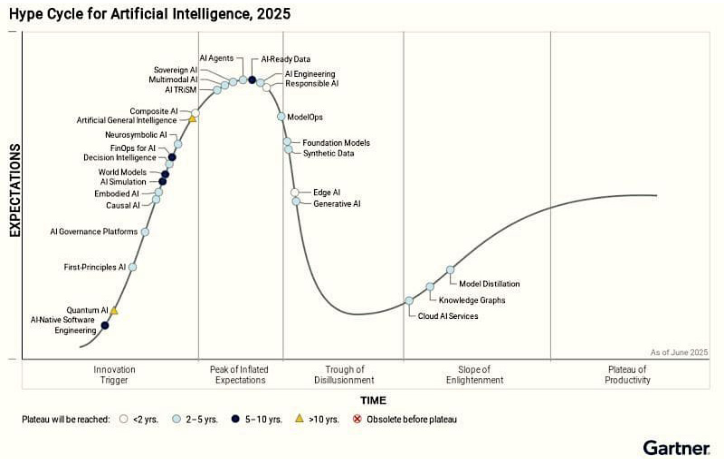
Similar to the seasonal aspects, there is the Gartner Hype Cycle of Artificial Intelligence shown in Figure 1, which is created from growing interest by potential manufacturers and end users. One value provided is in showing the projected lifecycle, which illustrates how expectations and perceived value are likely to change over time and is provided as a means to assist developers and organizations in understanding the potential impact of AI. There are five phases: trigger, peak of inflated expectations, trough of disillusionment, slope of enlightenment, and plateau of productivity. At a glance, one can see where the fallout may occur and where the concepts or efforts may be discarded, modified, or recycled. Note that the peak occurs when the majority of developments are realized in the 5 to 10-year period, and then falls precipitously after that. Consistent with what has been observed earlier, intelligent applications are in a shorter window of two to five years and achieve the enlightened era. Gartner characterizes the Hype Cycle as an embryonic quantum AI enterprise with relatively low impact currently but with a massive competitive advantage once validated techniques mature. (Gartner, 2025). The time periods closely align with the seasonal fluctuations expressed earlier. Acknowledging that the failed results are replaced by growth in the seasons or cycles, it nonetheless lacks the gold standard. Implications for the aviation industry are that, until the issues are resolved reliably, incorporation into aircraft design and operation is restrained. Already, the European Union Aviation Safety Agency has pulled back from more aggressive developments of single-pilot operations and reduced crewing operations (Rolen and van Droogenbroeck, 2025) and has suspended further efforts.
Figure 1: Gartner hype cycle of artificial intelligence (Gartner, 2025).
The Gold and the Failed Results of Artificial Intelligence in Aviation 101 Taken from a different perspective, there are other examples of how AI fails. These are ably described by Choi (2021) and characterized by the seven characteristics shown in Table 2, which explains where AI lacks the capability to execute reliably. The descriptions fit well into the Hype Cycle expectations and further indicate challenges that must be resolved.
Table 2: How AI fails (Choi, 2021).
Table available in the original PDF paper.
AI Characteristic Description Brittleness Not capable of mental rotation or recognizing patterns never seen before
Embedded bias Result of the training material used to develop algorithms Catastrophic forgetting Evident when deep fakes are artificially generated
Explainability Attribution methods are unstable and unreliable Unable to calculate uncertainty reliably Quantifying uncertainty
Common sense Unable to take context into account reliably Mathematics Neural networks solve problems in a parallel manner while math problems require a series of steps
Each of the seven has implications for flight decks, maintenance, airports, and air traffic management operations. Where they might fail could result in a near-certain disaster.
A revealing perspective on AI failures over the last 10 years is described by Olvasrud (2024) regarding high-profile blunders produced by AI, often the generative type (Note the placement in the Trough of Disillusionment on the Hype Cycle). A theme among these episodes is the confusion created for humans when AI is not able to comprehend their inquiries or explain the actions needed. Such occurrences in commercial aircraft or related operations would potentially be problematic, as experienced by Air Canada and false information that was provided by their chatbot regarding bereavement discounts. The reliability issue is paramount for aviation and will be closely scrutinized by certifying agencies. A survey of commercial pilots regarding trust in AI revealed that 69% trust AI to produce reliable results, although only 52% trust AI to make important flight operation decisions without pilot intervention (Halawi et al., 2024).
AI uses algorithms to perform tasks and develop solutions. This is contingent on the quality and accuracy of the data used for these calculations. If an organization’s data is biased or incomplete, the results will be flawed and potentially safety critical. A factor often noted with AI is that it can be incapable of explaining the reasoning contributing to a decision or solution. An additional factor is the inability of AI to address ethical and security issues. This is due, in part, to the complexity and dynamic characteristics encountered with AI. Consequently, companies and organizations have created protections, of sorts, to aid in establishing improved reliability and in safety applications. Among these are cybersecurity efforts by Airbus, lifecycle development by Boeing, and a secure operations center by NASA (Patil, 2023).
ON THE HORIZON Agentic AI performs autonomous decision-making and goal-oriented actions, an objective in AI-human teaming concepts for advanced flight decks. This differs from generative AI, which creates content. Agentic AI systems (derived from the word agent), currently placed at the peak of the Hype Cycle, make decisions without human input. The application uses machine learning, automation, and language processing to perform tasks. This is the more familiar AI application that has been in practice for some time in commercial aviation (e.g., passenger rebooking, routing, crew assignments, and optimizing revenue). On the horizon is getting agents to get other agents to perform tasks. Herein lies a prospect of an agentic system replacing a human to perform certain functions. The human, consequently, moves into a role where more nuance, critical thinking, or emotional intelligence is central. This engenders a trend that shifts from doing the work to managing the work (Decant, 2025). This is at the heart of reduced or minimum crewing concepts and single-pilot operations.
Known challenges for AI in aviation include data management (unifying diverse data sets), scalability and safety (need for explainable AI and rigorous validation regarding decision making), avoiding unintended consequences from complex reward systems, and data distribution shift (mismatches between expected and real-world data compromise accuracy) (VREF, 2024). Physical threats, such as effects from electromagnetic interference, pose a threat to AI onboard systems resulting in communications breakdowns, navigation errors, and engine failures (Faster Capital, 2024).
For more advanced or complex AI, the concepts of teaming machine intelligence and human cognition face several significant hurdles, namely function allocation and inter-operator trust. In addition to promoting generative AI, there are identified technologies required to advance the current state of AI applications. These are shown in Table 3.
Table 3: Technologies to advance generative AI (Brooker, 2024).
Table available in the original PDF paper.
Technologies Description
Accomplish any intellectual task a human performs
Artificial general intelligence Autonomic systems Self-managing domain-specific tasks
Composite AI Combines AI techniques to broaden knowledge levels Operational AI systems Enable automation and scaling of machine learning and generative AI
Synthetic data Artificially generated ILO real-time observations AI simulation Testing prior to deployment
Multi-agent systems Independent and interactive agents capable of taking actions Neurosymbolic AI Combined machine learning and symbolic systems (more trustworthy AI models)
The Gold and the Failed Results of Artificial Intelligence in Aviation 103 Many of these apply to the aviation domain, such as single-pilot operations, distributed crewing, autonomous flight, and similar desired operations. In this regard, a challenge for AI will be in accountability for AI system mistakes, reducing risks of bias and discrimination in AI systems, and in establishing regulations and standards for use (Brooker, 2024).
The problem of defining AI is evident in how the components interact, as illustrated with the differences between DO-178C (Avionics software) and DO-254 (avionics hardware). The deterministic software that is traditionally used in aircraft certification, and which, when given the same input, produces the same output, differs from machine learning software that learns from input data without being specifically programmed, and therefore constantly evolves. This presents a significant challenge for regulatory agencies seeking to certify aircraft applications. As noted in the definition of AI adopted by EASA, which states that it is a technology that appears to emulate the performance of a human, this introduces opportunity for error, as would be the case with a human operator. A significant effort for consistent safety- critical systems is the DO-178C Software Considerations in Airborne Systems and Equipment Certification guidelines that encompass 71 objectives applied to software to ensure safe performance in an airborne environment based on five developmental assurance levels related to effects of a system failure. This document, used by manufacturers and regulators, was developed by the Radio Technical Commission for Aeronautics. In a similar effort, EASA has moved to ensure AI safety by suggesting that developers (1) keep a human in the loop, (2) monitor AI through an independent agent, and (3) examine AI output through a backup system (Hilderman, 2022).
ADVANCED CONCEPTS AND COMPLEX AI Comparisons between the human brain and machine cognition have been the subject of speculation and various efforts over decades, including applications on the commercial flight deck. A recent development regarding tunneling nanotubules, discovered in 2006, indicates a dynamic cytostructure environment where neurons are connecting with glia in the brain. This has been identified with neurodegenerative issues as well as cognitive processing benefits. This may strengthen the understanding of AI functions, or conversely, could cast further doubt on whether machine intelligence can replicate human brain processing. There is also the statement that a single neuron in a human brain has the computing equivalence of a supercomputer (Kirkpatrick et al., 2016). This coincides with discoveries that neurons do not produce a single bit of information in exchanges, rather, they produce a nearly incalculable amount. When considering the functions of brain hubs and the geo-reorganization of brain regions, the processing functions have become even more convoluted and difficult to map out. The reliability of the explication of results and evidence for quantum coherence suggest an unlikely near-term re-creation in machines or software. Quantum computing is central to AI development and operations. In that state, it is possible to calculate solutions to problems simultaneously (Rao, 2024) which is critical in multifactor emergency situations on the flight deck.
An incisive summary in Aviation Week and Space Technology of commercial AI developments in aviation taken from industry leaders noted that (1) strategic autonomy, a term describing managing large fleets or systems while minimizing risk to human operators, may emerge successfully within ten years, (2) AI is particularly well suited for structured environments and predictable tasks, however, it requires extensive adaptive technologies to perform with reliability in rapidly changing or less well known situations, (3) fully autonomous decision-making in novel or unpredictable situations has potential but will need capability to exercise morals and the accompanying breakthroughs that address trust and accountability; among the many challenges, AI lacks the capability for self-reflection, recognizing its biases, or the ability to explain its reasoning, (4) AI may imitate sentience but will not be able to generate it independently and is a fusion of art and science that will need major human expertise to be applied effectively; it presents as a system or subsystem; AI systems are inherently imperfect, so they make errors, and (5) the challenge of standards and compatible definitions limits interoperability among various aircraft systems. Also, finding consistent applications for natural language applications, e.g. with trans-cockpit communication, is difficult given the nuances in human communication like sarcasm, silence, context, and tone (Aviation Week, 2025). Each of these developments resides on the Gartner Hype Cycle and the AI Roadmaps of EASA and FAA. Which will prove to be gold and which may be discarded will define their place in the current season of AI.
CONCLUSION
Examining the gold contrasted with the failed results for AI in aviation to date, the pros and cons present a complex environment for potential development. In the aggregate, AI is a tool for aviation purposes being continually reimagined and redesigned. On the commercial aviation continuum for AI, applications progress through the dual tracks of domain specific and complex versions. We find uses for personal assistance, automation, machine learning, human-robot teaming, and fully autonomous operations. As we evaluate the summers and winters of AI, along with the hype cycles and road maps, the gold will continue to emerge, and the less successful will be discarded until they are taken up in new forms. In this retrospective embrace, cycles are refreshed and maps are redrawn.
REFERENCES
Bashatah, J. and Sherry, L. (2022). Lessons Learned from Human Operator Intervention for AI Navigation and Flight Management Systems, Integrated Communication, Navigation and Surveillance Conference (ICNS). Dulles, VA, 05-08 April. New York: IEEE, pp. 1-15. doi: 10.1109/ICNS54818.2022.9771518 Boeing Company (2025) Airplane Health Management. Available at: https://services.
The Gold and the Failed Results of Artificial Intelligence in Aviation 105 Brooker, A. (2024) What is AI and Why is it Important for Aviation? Available at:
https://www.cirium.com/thoughtcloud/beyond-chatbots-how-ai-can-transform- aviation-and-challenges/ Choi, C. (2021) 7 Revealing Ways AIs Fail. Available at: https://spectrum.ieee.org/ ai-failures Descant, S. (2025) What is Agentic AI? A Look at New Tech Reshaping Government.
Available at: https://www.govtech.com/artificial-intelligence/what-is-agentic-ai-a- look-at-new-tech-reshaping-government EASA (2025) Artificial Intelligence and Aviation. Available at: https://www.easa.
europa.eu/en/light/topics/artificial-intelligence-and-aviation-0 Faster Capital (2024) Effects of EMI on Aviation Systems. Available at: https:// faster capital.com/topics/effects-of-emi-on-aviation-systems.html#:~:text=EMI% 20or%20 Electromagnetic%20Interference%20is,errors%2C%20and%20 even%20engine%20failures. Federal Aviation Administration (2025) Airborne Collision Avoidance System
(ACAS). Available at: https://www.faa.gov/about/office_org/headquarters_ offices/avs/offices/afx/afs/afs400/afs410/airborne-collision-avoidance-system-acas Gartner (2025) Gartner Hype Cycle Identifies Top AI Innovations for 2025. Available at: https://www.gartner.com/en/newsroom/press-releases/2025-08-05-gartner- hype-cycle-identifies-top-ai-innovations-in-2025 Halawi, L., Miller, M., and Holley, S. (2024) Fostering trust in artificial intelligence
in commercial aviation: An exploratory study, Issues in Information Systems, 25(2), pp. 397–407. doi: https://doi.org/10.48009/2_iis_2024_131 Hilderman, V. (2022) AI in the Sky: How Artificial Intelligence and Aviation are Working Together. Available at: https://interactive.aviationtoday. com/avionics magazine/may-june-2022/ai-in-the-sky-how-artificial-intelligence-and-aviation- are-working-together/ Holley, S., Miller, M., and Halawi, L. (2024) “Artificial Intelligence on the Digital Flight
Deck: A Continuum with Parallel Trajectories”, proceedings of the 68th HFES Annual Meeting, Phoenix, AZ. doi: https://doi.org/10.1177/10711813241260403 Kirkpatrick, J et al. (2016). ‘Overcoming Catastrophic Forgetting in Neural Networks”, proceedings of the National Academy of Sciences, 114 (13), pp. 3521–3526. Lee, J. A. (1980 The gold and the garbage in management theories and prescriptions.
Athens, OH: Ohio University Press. McGregor, S. (2021) “Preventing Repeated Real World AI Failures by Cataloging Incidents: The AI Incident Database”, proceedings of the Thirty-Fifth AAAI Conference on Artificial Intelligence [virtual], pp. 15458–15463. Olavsrud, T. (2025) 11 Famous AI Disasters. Available at: https://www.cio.com/
article/ 190888/5-famous-analytics-and-ai-disasters.html Patil, A. (2023) The Good, the Bad, and the Awful of AI in Aerospace, Available at: https://www.aerospacemanufacturinganddesign.com/news/the-good-the-bad- and-the-awful-of-ai-in-aerospace-most-read-2023/ Rao, R. (2024) Quantum Computers Can Now Run Powerful AI That Works
Like a Brain, Available at: https://www.scientificamerican.com/article/quantum- computers-can-run-powerful-ai-that-works-like-the-brain/ Rolen, A. and van Droogenbroeck, C. (2025). eMCO SIPO, D-8 Report on the Preliminary Safety Risk Identification for SIPOS, Available at: https://www.easa. europa.eu/en/research-projects/emco-sipo-extended-minimum-crew-operations- single-pilot-operations-safety-risk
Sahota, N. (March 29, 2024). Navigating the Skies With AI: How Airlines Are Transforming Air Travel. Available at: https://www.forbes.com/sites/neilsahota/ 2024/ 03/29/navigating-the-skies-with-ai-how-airlines-are-transforming-air- travel/ Shmelova, T., Sikrida, Y., and Sterenharz, A. (eds.) (2020) Handbook of research on
artificial intelligence applications in the aviation and aerospace industries. Hershey, PA: IGI Global Publishing Strickland, E. (2021) Is There a Way Out of AI’s Boom and Bust Cycle? Available at: https://spectrum.ieee.org/special-reports/the-great-ai-reckoning/ Toosi, A. et al. (2021) A Brief History of AI: How to Prevent Another Winter, PET
Clinics, 10(4), pp. 449–469. doi: 10.1016/j.cpet.2021.07.001 VREF. (2024) Implications of AI in Aviation: The Good, Bad, and Ugly, Available at: https://vref.com/news/implications-of-ai-in-aviation-the-good-bad-ugly/ Warwick, G. (2025) Physics-based AI Promises to Accelerate Aerospace Design
Optimization, Available at: https://aviationweek.com/aerospace/emerging- technologies/physics-based-ai-promises-accelerate-aerospace-design-optimization Reim, G. (2025) ‘The State of AI’, Aviation Week and Space Technology, 06 January, pp. 40–42.
LISTED IN THE AHFE DIGITAL BOOKSTORE CATALOGUE
Explore the complete digital volume
Advances in Human Factors of Transportation
Read this individual research paper free through the original publisher, or explore the full digital proceedings book.
ISBN 979-8-950676-00-0
Explore this ISBN in the AHFE Bookstore ↗Listed in the July 2026 bookstore catalogue; search by ISBN to confirm current availability · Digital book purchase optional