Dimitrios Ziakkas, Debra Henneberry (2025). The Challenges of Integrating AI in Aviation Incident-Accident Investigations: A Human-Centric Approach. In: Intelligent Human Systems Integration (IHSI 2025): Integrating People and Intelligent Systems. AHFE Open Access, vol. 160, pp. 246–255. https://doi.org/10.54941/ahfe1005830
Integrating Artificial Intelligence (AI) into aviation incident-accident investigations presents unique opportunities and significant challenges. This paper explores the complexities of incorporating AI into the aviation investigation process, emphasizing the importance of a human-centric approach to ensure the technology's reliability, transparency, and accountability. The application of AI in investigations necessitates thorough adherence to existing international frameworks, including ICAO Annex 13 and regulatory guidelines from the Federal Aviation Administration (FAA), the European Union Aviation Safety Agency (EASA), and the National Transportation Safety Board (NTSB). However, AI provides improved data analysis, predictive modeling, and pattern recognition capabilities. Through the examination of crucial case studies, such as the investigation into the Lion Air Flight 610 and Ethiopian Airlines Flight 302 (Boeing 737 MAX) accidents, we illustrate how AI-driven data analytics helped investigators to analyze large quantities of flight data recorder (FDR) and cockpit voice recorder (CVR) information (FAA, 2024). AI-based systems contributed to investigating the Air France Flight 447 accident (Airbus A-330), where advanced data analysis techniques provided insights into pilot responses under adverse conditions (Stewarts, 2017). These case studies highlight AI's strengths and limitations in understanding complex system failures and human-machine interactions.Moreover, these examples underscore the necessity of human oversight in interpreting AI outputs and ensuring accurate, context-driven conclusions. Considering regulatory differences, the research findings address the intricate challenges of harmonizing AI systems with established human-led investigative methodologies. Specifically, the research focuses on how AI can be effectively integrated without compromising the critical decision-making processes traditionally managed by human investigators.Furthermore, the presented research examines how human factors must be prioritized to prevent over-reliance on AI outputs, maintain investigative integrity, and foster cross-disciplinary collaboration between AI experts and aviation safety professionals. By analyzing these case studies and providing a comprehensive review of AI's role in modern aviation safety, the research team aims to illuminate the path toward developing AI frameworks that complement human expertise rather than replace it. Ultimately, this paper calls for a balanced approach that leverages AI's strengths while addressing its limitations, ensuring that future aviation incident-accident investigations remain human-centered and safety-focused.
The Challenges of Integrating AI in Aviation Incident-Accident Investigations 247
INTRODUCTION
Human error remains one of the primary causes of aviation accidents, and understanding these errors requires more than just technical analysis. Strauch (2017) emphasizes the importance of viewing human error within a broader systemic context, where errors are not isolated events but the result of complex interactions between humans, machines, and organizational systems. The systemic nature of error aligns with the Systems-Theoretic Accident Model and Processes (STAMP) approach, arguing for a broader understanding of safety in complex systems (Leveson, 2012). Leveson advocates for an approach that looks beyond individual errors to consider how various system components interact to create unsafe conditions. Artificial intelligence (AI) can support this approach by helping investigators analyze interactions across systems, providing data-driven insights that might otherwise be missed.
Additionally, AI’s ability to analyze complex data sets and simulate various outcomes can be advantageous in identifying systemic issues in aviation safety. However, as with human error, AI must be implemented to enhance investigators’ ability to draw meaningful conclusions from the data. AI should be seen as an extension of human expertise, providing additional insights and supporting decision-making processes, but not as a substitute for human intuition and experience. This approach ensures that AI enhances investigators’ abilities to understand the broader systemic issues in aviation accidents without introducing new risks associated with over-reliance on technology.
AI offers several promising applications in aviation safety investigations, each aimed at improving the efficiency and accuracy of the investigative process (Ziakkas et al., 2023). AI can significantly enhance the process of gathering and analyzing vast amounts of data from diverse sources such as flight data recorders (FDR), cockpit voice recorders (CVR), maintenance logs, air traffic control communications, and sensor data. By employing machine learning (ML) algorithms, AI can sift through massive datasets in a fraction of the time it would take human investigators to identify patterns, anomalies, and correlations that may not be immediately apparent. For example, AI systems can process CVR data using natural language processing (NLP) to detect stress or fatigue in pilot communications or use pattern recognition to track irregularities in flight control inputs (Kayten, 1989).
Moreover, AI-driven simulation tools allow investigators to recreate accident scenarios accurately. These simulations can consider many variables, such as weather conditions, aircraft performance data, and pilot actions, helping to test different hypotheses about what might have caused an incident (Cookson, 2023). AI algorithms can also run multiple variations of scenarios, identifying potential alternative outcomes that human investigators may not have considered, thus providing a more comprehensive understanding of the incident. Additionally, AI can streamline the report generation process by automatically compiling and organizing investigation findings. Natural language generation (NLG) algorithms can produce coherent, detailed reports based on data inputs, significantly reducing the time it takes for
248 Ziakkas and Henneberry
human investigators to draft and finalize accident reports. While this automation can save time, it must be managed carefully to ensure the accuracy of interpretations and conclusions drawn by the AI system (ICAO, 2024). One of the most powerful applications of AI is its ability to predict potential risks before they result in accidents. By analyzing historical incident data, maintenance records, and operational environments, AI systems can flag patterns that suggest an increased likelihood of a future incident. For instance, AI can predict maintenance issues by analyzing subtle sensor data trends or identify human factors like pilot fatigue based on flight schedules and operational stress indicators. This predictive capability allows airlines and safety regulators to take preemptive actions, potentially averting accidents before they occur. This shift toward predictive safety aligns with Crew Resource Management (CRM) principles, emphasizing proactive risk management and communication among aviation teams (Helmreich et al., 1999). By providing real-time data and predictive models, AI systems can support CRM by helping pilots and investigators anticipate potential risks and develop strategies to mitigate them. However, human oversight is still essential in interpreting these predictions. Predictive models cannot account for all variables, especially those related to human behavior under stress, and must be used as a tool to support human decision-making rather than replace it.
Moreover, AI systems with advanced ML algorithms can analyze human performance data, such as eye-tracking, physiological sensors (heart rate, stress levels), and behavior during flight. These systems can help investigators understand how pilots or other crew members reacted during critical moments, identifying cognitive overload, fatigue, or other human factors that contributed to an incident. For example, AI could analyze the timing and sequence of pilot actions during an emergency to determine whether standard operating procedures were followed or if the crew deviated from protocol due to stress or confusion (Ziakkas, 2023).
METHODOLOGY
This study adopts an interpretivist research philosophy as it aims to explore the subjective complexities and challenges of integrating AI into aviation incident-accident investigations. The human-centric approach focuses on understanding how AI systems interact with human investigators, considering the socio-technical implications of this integration within aviation safety frameworks. By interpreting multiple perspectives from aviation authorities, such as the Federal Aviation Administration (FAA), European Union Aviation Safety Agency (EASA), United Kingdom Civil Aviation Authority (UKCAA), and the National Transportation Safety Board (NTSB), the research delves into human factors, regulatory issues, and technological integration challenges in the aviation sector.
The study follows an inductive research approach, which aligns with interpretivism by building a theory grounded in real-world data and case studies. Given the complexity of AI integration in aviation safety,
The Challenges of Integrating AI in Aviation Incident-Accident Investigations 249
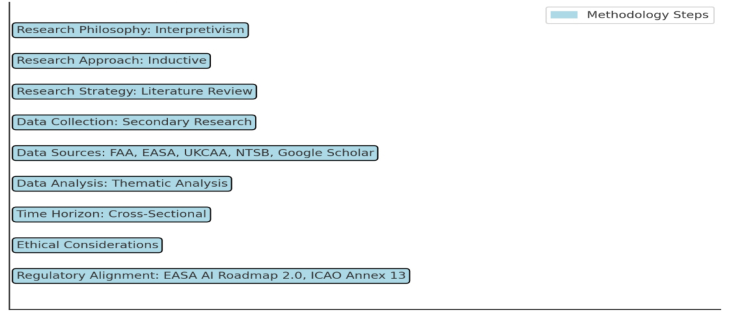
this approach allows for a nuanced understanding based on empirical findings from institutional reports, academic publications, and industry case studies (Saunders, 2019). The aim is to uncover emergent themes regarding AI’s role in augmenting human expertise in accident investigations while addressing regulatory and operational challenges. The methodology overview is presented in Figure 1.
Figure 1: Methodology overview of the AI integration in aviation investigations.
The research methodology involves a literature review of academic sources, regulatory reports, and industry case studies. A systematic search was conducted in databases such as Google Scholar, FAA, EASA, UKCAA, and NTSB websites. AI and Human Factors journals and conference proceedings were also reviewed. The keywords used include “OR,” “AND,” “Artificial Intelligence,” “Machine Learning,” “FAA,” “EASA,” “NTSB,” “ICAO,” “Aviation Accidents,” and “Investigations,” focusing on AI’s role in complex aviation systems. This study uses a cross-sectional time horizon, gathering data from publications and regulatory reports from 2005 to 2023. The focus on recent developments ensures the inclusion of the latest technological advancements and regulatory adaptations in AI applications for aviation safety. The initial search across the above-mentioned platforms yielded 312 journal articles. After screening based on titles and abstracts for relevance to AI integration in aviation investigations and its regulatory challenges, 173 articles were selected for further review. Based on full-text reading and assessment of their relevance to the research topic and inclusion/exclusion criteria, 61 articles were finally selected for detailed analysis. The 61 papers were categorized into critical themes: AI in aviation investigations, regulatory challenges, and human-centric approaches. Data were analyzed using a thematic analysis approach to identify recurring patterns and key themes, which include AI’s impact on incident investigation efficiency, challenges of human-AI collaboration, and regulatory barriers. Findings were corroborated by comparing various regulatory bodies’ case studies and real-world aviation applications (Stewarts, 2012).
250 Ziakkas and Henneberry
ANALYSIS The literature review involved a detailed analysis of 61 articles discussing AI’s integration in aviation investigations. The key themes and findings from these articles are as follows and presented in Table 1 below:
1. AI and ML Applications in Aviation Investigations: Out of the 61 selected articles, 15 specifically addressed AI and ML’s capability to analyze large sets of aviation data to detect anomalies and predict risk factors in complex aviation systems. These articles highlighted the potential of AI in speeding up data analysis but also pointed out the challenge of ensuring accurate training of AI models with high-quality datasets (EASA, 2023).
2. Human-Centric Approach and AI Integration: Eighteen articles emphasized the importance of a human-centric approach when incorporating AI in safety-critical domains such as aviation. These studies argued that while AI can assist investigators, human judgment is indispensable in interpreting complex, context-specific factors during investigations.
3. Regulatory and Ethical Challenges: Ten articles focused on regulatory and ethical challenges, specifically discussing FAA and EASA guidelines on transparency, accountability, and standards for AI use in aviation safety. The articles pointed to the need for clear frameworks to ensure that AI tools augment, rather than replace, human expertise.
4. Complex Systems and AI’s Role: Twelve articles discussed the challenges posed by aviation as a complex system, exploring AI’s limitations in modeling interactions between various factors, including human behavior, environmental conditions, and mechanical systems.
5. Case Studies and Practical Applications: Six articles provided real- world case studies with practical examples of AI’s role in actual aviation investigations. These case studies showcased successful applications and limitations where human investigators had to intervene due to AI’s inability to interpret complex or unexpected variables.
Table 1. Literature review findings.
Table available in the original PDF paper.
Relevant Journals & Sources
Key Theme No. of Articles AI and Machine Learning Applications in Aviation Investigations 15 - Journal of Air Transport Management - Safety Science - IEEE Transactions on Intelligent Transportation Systems Human-Centric Approach and AI Integration
18 - Safety Science - Aviation Safety Journal - Human Factors and Ergonomics in Aviation Regulatory and Ethical Challenges
10 - Aviation Safety - Journal of Air Law and Commerce - Aerospace
(Continued)
The Challenges of Integrating AI in Aviation Incident-Accident Investigations 251
Table 1. Continued
Table available in the original PDF paper.
Relevant Journals & Sources
Key Theme No. of Articles Complex Systems and AI’s Role 12 -Complex Systems -Journal of Aviation Technology and Engineering -Aviation Safety Journal Case Studies and Practical Applications
6 - Journal of Air Transport Management - Accident Analysis and Prevention - NTSB Reports
Recent advancements in AI have significantly impacted aviation safety investigations, particularly in analyzing FDR and CVR information. This has been particularly evident in high-profile accidents such as those involving the Boeing 737 MAX and the Airbus A-330 (FAA, 2024, Stewarts, 2012). AI-driven data analytics have allowed investigators to sift through vast datasets and identify critical elements that human investigators could have overlooked or would have taken much longer to analyze.
Both the Lion Air Flight 610 and Ethiopian Airlines Flight 302 tragedies involved the Boeing 737 MAX aircraft, where malfunctions in the Maneuvering Characteristics Augmentation System (MCAS) led to fatal crashes (FAA, 2024). Investigators faced the challenge of understanding how a system designed to enhance safety by compensating for aerodynamic changes inadvertently contributed to these accidents. AI applications were instrumental in managing and analyzing the enormous volumes of data from the FDRs and CVRs. Algorithms were used to detect anomalies in in- flight data that pointed toward the MCAS’s unexpected activations, which were not evident or anticipated based on standard flight parameters alone. Moreover, ML’s models identified patterns in the data that suggested a repetitive, uncommanded downward pitch, which was crucial in linking the two accidents despite occurring in different regions and under different operational conditions. AI-driven simulations helped recreate the flights’ last moments by feeding the recovered FDR data into flight simulators (EASA, n.d.). This provided visual insights into the pilots’ struggles and the aircrafts’ behavior under the influence of the flawed MCAS. These applications of AI allowed investigators to focus quickly on the MCAS as a contributing factor, leading to the worldwide grounding of the 737 MAX fleet and significant software modifications (FAA, 2024).
The Air France Flight 447 accident in 2009 (Airbus A-330) faced a series of flowing failures following the icing over of its pitot tubes, leading to unreliable airspeed readings and subsequent inappropriate pilot responses under stress (Stewarts, 2012). The investigators analyzed the correlations between different data points in the FDR, such as airspeed discrepancies, autopilot status, and the pilots’ manual inputs. This comprehensive analysis helped establish a timeline of events that led to the stall. Advanced algorithms analyzed the CVR data to interpret the pilots’ situational awareness and stress levels. NLP techniques assessed communication breakdowns and
252 Ziakkas and Henneberry
decision-making during critical moments (EASA, n.d.). AI simulated different scenarios based on the FDR data, including how the aircraft would have behaved if different corrective actions had been taken. The insights gained from AI-based analyses were crucial in formulating recommendations for training on high-altitude stalls and enhancing pitot tube designs to prevent similar incidents in the future (Stewarts, 2012).
FINDINGS The literature research findings highlight the capacity of AI and ML to revolutionize aviation incident and accident investigations by automating data processing and identifying patterns within intricate systems. According to International Civil Aviation Organization (ICAO) Annex 13, which establishes the standards for investigating aviation accidents and incidents, the primary goal of an investigation is to improve safety, not to assign blame (ICAO, 2024). AI can assist in achieving this objective by rapidly analyzing large datasets, including flight data, maintenance records, and operational logs, to identify the root causes of incidents and accidents. Moreover, while AI can enhance the efficiency of investigations, Annex 13 stresses the need for thorough and impartial investigations. AI systems must align with these requirements, ensuring transparency and reliability in their outputs. As highlighted in the EASA AI Roadmap 2.0, AI should be designed with a human-centric approach, ensuring that human investigators retain the final authority in interpreting AI-generated insights (EASA, 2023). This aligns closely with the principles of Annex 13 of ICAO, which mandates that investigations should be objective, transparent, and focused on improving safety. AI can assist in analyzing data. However, human investigators must play a key role in interpreting AI findings, particularly in areas involving human factors, crew interactions, and decision-making under stress. AI systems must provide outputs that human investigators understand and interpret, ensuring they can verify AI-generated insights. Additionally, the roadmap emphasizes the need for transparency in AI decision-making processes, allowing investigators to challenge AI outputs when necessary (EASA, 2023). This reflects the broader goals of Annex 13, which requires that investigations be holistic, considering both human and technical factors.
The NTSB in the United States has similarly embraced AI in enhancing its investigative capabilities. The NTSB has focused on data-driven insights, utilizing AI to process vast amounts of flight data, voice recordings, and maintenance records to identify trends and potential anomalies that could contribute to accidents. Moreover, the NTSB has acknowledged the limitations of AI, particularly in areas involving human factors and emergent behaviors, where human investigators still play a critical role. Recent announcements emphasize the NTSB’s commitment to maintaining human oversight while leveraging AI to improve the efficiency and accuracy of its investigations (NTSB, n.d.). This aligns with global best practices and is consistent with the regulatory principles outlined by the FAA and EASA.
Both EASA and NTSB stress the importance of cross-agency collaboration to establish unified standards for AI in aviation safety investigations. They aim to ensure that AI systems used in investigations across Europe and
The Challenges of Integrating AI in Aviation Incident-Accident Investigations 253
the United States are subject to consistent regulatory oversight. The EASA- NTSB collaboration also involves sharing insights and best practices for AI use in aviation, ensuring that both agencies maintain high safety standards while integrating new technologies into their investigative frameworks. While the potential benefits of AI in aviation investigations are undeniable, its integration must be handled with caution, particularly in maintaining a human-centric approach (EASA, n.d., FAA, 2024).
One of the critical risks of integrating AI is automation bias, where investigators may over-rely on AI-generated conclusions, assuming the machine’s analysis is infallible. This can lead to overlooking critical contextual or situational factors that AI algorithms cannot fully understand. Human investigators must remain actively involved in the analysis, interpreting AI results within the broader context of the incident. AI systems, particularly deep learning, can sometimes act as “black boxes,” providing results without clearly explaining how those conclusions were reached. This lack of explainability can be problematic for aviation investigations where transparency and accountability are critical. Investigators must ensure that AI tools provide clear, understandable pathways to their conclusions, allowing human experts to verify and validate the findings (EASA, 2023).
Using AI in accident investigations raises critical ethical questions about responsibility and accountability. If an AI system makes an error in its analysis, it can complicate the determination of responsibility—whether it lies with the human operator, the designer of the AI, or the institution deploying the technology. Clear guidelines must be established to define AI’s role in investigations and ensure that ultimate accountability remains with human investigators (Ziakkas, 2023). While AI can handle data processing and pattern recognition at scale, the nuances of aviation investigations often require expert human judgment. Investigations demand technical analysis and understanding of organizational cultures, human behaviors, and decision-making processes. Human investigators are needed to interpret the insights generated by AI, ensuring that critical thinking and expert judgment remain central to the investigative process (Ziakkas et al., 2023).
With the increasing use of AI, particularly in analyzing sensitive data like cockpit voice recordings and personal performance data, ensuring data privacy and security is a significant concern. AI systems must incorporate stringent security mechanisms to safeguard sensitive information and adhere to legal and ethical requirements around data utilization in investigations.
CONCLUSION
The use of AI in aviation investigations is growing, particularly in areas such as data processing and predictive analytics. AI applications have made significant advances in analyzing real-time transport data, providing the ability to predict flight paths, monitor traffic patterns, and improve overall operational efficiency. AI’s role in incident-accident investigations leverages these capabilities to analyze vast amounts of sensor data and flight recordings. For instance, AI systems can analyze data from CVRs and FDRs to detect anomalies that might not be immediately apparent to
254 Ziakkas and Henneberry
human investigators (Ziakkas & Plioutsias, 2024). Integrating AI in these areas can reduce the time required for accident investigations while enhancing the accuracy of findings. However, AI systems must be designed to work alongside human investigators. Over-reliance on AI can lead to automation bias, where investigators may trust AI outputs without critically engaging with the rationale behind them (EASA, n.d.). This concern highlights the importance of maintaining human involvement throughout the investigative process, ensuring that AI enhances rather than undermines human judgment.
Integrating AI into aviation safety investigations presents promising opportunities and significant challenges. This research has shown that AI can significantly enhance the efficiency of aviation investigations by processing vast amounts of data and identifying patterns in complex systems, as seen in recent developments highlighted by EASA and NTSB announcements. However, to maintain the integrity and impartiality of investigations, as required by Annex 13 of ICAO, human oversight remains critical. The EASA AI Roadmap 2.0 has been instrumental in outlining a human- centric approach to AI integration, stressing the importance of transparency, accountability, and explainability in AI systems. EASA’s focus on ensuring that AI enhances rather than replaces human judgment aligns with global best practices, reinforcing the need for harmonized regulatory frameworks across different aviation authorities.
ACKNOWLEDGMENT
The authors thank faculty members of Purdue University and Human Factors analysts from HF Horizons for their invaluable feedback and contribution to this work.
REFERENCES
Cookson, S. (2023). CVR data unavailable: A study of 52 airline accidents and incidents 2014–2022. AHFE International. https://doi.org/10.54941/ahfe 1003840 European Union Aviation Safety Agency. (2023, May 10). EASA Artificial Intelligence Roadmap 2.0 - A human-centric approach to AI in aviation. https://www.easa.europa.eu/en/document-library/general-publications/easa-artif icial-intelligence-roadmap-20 European Union Aviation Safety Agency. (n.d.) Investigation and prevention of accidents and incidents in civil aviation. Retrieved October 20, 2024, from https://www.easa.europa.eu/en/regulations/investigation-and-prevention-a ccidents-and-incidents-civil-aviation. Federal Aviation Administration. (2021). FAA Updates on Boeing 737 MAX.
https://www.faa.gov/newsroom/faa-updates-boeing-737-max-0 Federal Aviation Administration. (2024). Accident & Incident Data. Retrieved October 20, 2024, from https://www.faa.gov/data_research/accident_incident. Helmreich, R. L., Merritt, A. C., & Wilhelm, J. A. (1999). The Evolution of Crew
Resource Management Training Commercial Aviation. International Journal of Aviation Psychology, 9(1), 19–32. https://doi.org/10.1207/s15327108ijap0901_2
The Challenges of Integrating AI in Aviation Incident-Accident Investigations 255
International Civil Aviation Organization. (2014). The Postal History of ICAO. https://applications.icao.int/postalhistory/annex_13_aircraft_accident_an d_incident_investigation.html International Civil Aviation Organization. (2024). Artificial intelligence (AI). https: //www.icao.int/safety/Pages/Artificial-Intelligence-(AI).aspx Kayten, P. (1989). Human performance factors in aircraft accident investigation. SAE
Technical Paper 892608. https://doi.org/10.4271/892608 Leveson, N. G. (2012). Engineering a safer world. The MIT Press. https://doi.org/10.
7551/mitpress/8179.001.0001 National Transportation Safety Board. (n.d.) Investigations. Retrieved October 20, 2024, from https://www.ntsb.gov/investigations/Pages/Investigations.aspx. Saunders, M., Lewis, P., & Thornhill, A. (2019). Research methods for business
students (8th ed.). Pearson Education Limited. Stewarts. (2012, July 6). Air France 447 final report: French air accident agency.
https://www.stewartslaw.com/news/air-france-af447-final-accident-report/ Strauch, B. (2017). Investigating human error. CRC Press. https://doi.org/10.1201/ 9781315589749 Ziakkas, D., Vink, L.-S., Pechlivanis, K., & Flores, A. (2023). Implementation guide
for artificial intelligence in aviation: A human-centric guide for practitioners and organizations. HF Horizons. Ziakkas, D. (2023). Artificial intelligence applications in aviation accident classification: A preliminary exploratory study. Decision Analytics Journal, (9). https://doi.org/10.1016/j.dajour.2023.100358 Ziakkas, D., & Plioutsias, A. (2024). Artificial intelligence and human performance in transportation. CRC Press. https://doi.org/10.1201/9781003480891
LISTED IN THE AHFE DIGITAL BOOKSTORE CATALOGUE
Explore the complete digital volume
Intelligent Human Systems Integration (IHSI 2025): Integrating People and Intelligent Systems
Read this individual research paper free through the original publisher, or explore the full digital proceedings book.
ISBN 978-1-964867-36-6
Explore this ISBN in the AHFE Bookstore ↗Listed in the July 2026 bookstore catalogue; search by ISBN to confirm current availability · Digital book purchase optional