Katja Gutsche, Julian Genovese, Paul Serstjuk, Selin Altindis (2025). User-centered design of professional social service robots. In: Intelligent Human Systems Integration (IHSI 2025): Integrating People and Intelligent Systems. AHFE Open Access, vol. 160, pp. 10–20. https://doi.org/10.54941/ahfe1005806
Professional services are services provided by businesses. These commercial services strongly differ in their complexity, volume and human interaction. Depending on the service task, robots within service operation have the potential to increase service quality and reduce costs. Additionally, they are indispensable in ageing industrial nations with an increasing shortage of skilled workers. One form of service robots are professional social service robots. They provide employees and customers with interactive situation-specific services like a robot guide or a restaurant service robot. A social service robot not only has technological features needed for services, but also has to have the ability to interact with people. Due to their level of human-robot interaction and needed adaptability, their design is a challenging task, but indispensable for their acceptance by customers and employees. Methodology: As a social service robot a predefined use case of a cloakroom robot was chosen for which a prototypic implementation and its validation through usability testing was conducted. A literature review was the starting point for a concept definition of the robot. Results: The results indicate that users require an intuitive user interface with feedback for each step. Process speed also turned out to be a crucial design requirement, as a slow process speed led to waiting time and user dissatisfaction. It has been shown that the robot itself served as a unique attraction - users preferred the service robot over the common solution of a cloakroom attendant. This work contributes to the understanding of the design requirements of a collaborative service robot, emphasizing the importance of HMI, logical process sequence and process speed to ensure a positive user experience. The findings emphasise the need for user-friendly design of professional social service robots and underline their capability within service operation.
Service robots, defined as “system-based, autonomous and adaptable interfaces that interact, communicate and deliver service to an organisation’s customers” (Wirtz et al., 2018) and are “following behavioural norms
User-Centered Design of Professional Social Service Robots 11
expected by the people”(Bartneck & Forlizzi, 2004, p. 592) are implemented in diverse business or consumer service use scenarios. Their use scenario is not as narrow as within production processes where in general immobile industrial robots are performing in a standardized, clearly structured work routine. Service robots instead have to fulfil or support in service tasks whose characteristic is to be more customer-driven and therefore more heterogeneous (Zeithaml et al., 1985) (Bruhn et al., 2019, pp. 32 ff.). Service robots are becoming more and more important in private and business, leading to a remarkable increase in service robot sales by 48% from 2022 to 2023 (IFR, 2023). Further they are a promising low-cost variant of service providence as they allow a reduction or replacement of cost-intensive service staff (Belanche et al., 2020) (Wirtz et al., 2021). Therefore, service robots have the potential to properly reduce the obstacles coming along with staff shortage as experienced in many service fields, e.g. hospitality, care work, logistics without a reduction in quality (Lee, 2021).
Whereas the need for and the potential of service robots is clear, their design is still an open field (Sampson, 2020; Lee, 2021; Belanche et al., 2020). This is mainly due to the variety in customer service journeys and the necessity to realize unstructured human-robot-interactions. Therefore basics from the field of industrial robotics can be used and have to be enlarged by the service aspects to be fulfilled by service robots. Dominant service robot requirements are (1) flexible customer interaction, (2) customer error tolerance and (3) the ability for service recovery (Wirtz et al., 2018).
PROFESSIONAL SOCIAL SERVICE ROBOTS Professional Services
Professional services are services provided by a business for either organisations (B2B) or consumers (B2C) (Bruhn et al., 2019). Following the service task segmentation given by Wirtz and colleagues (Wirtz et al., 2018) such services can be either more emotional-social as for example care and hospitality services or more cognitive-analytical as for example repair or security services. Professional service tasks also differ in their tangibility (intangible: i.e. professional chatbot vs. tangible: i.e. logistics) and the service recipient (person: i.e. professional training vs. object: i.e. maintenance). Further segmentation can be done by the level of standardisation of the service (low: i.e. consulting vs. high: i.e. check-in service) and its volume (low: i.e. advisory services vs. high: i.e. logistics). In addition, customer distance (close: i.e. bank teller vs. distant: i.e. 3rd level support) is a differentiating characteristic.
Professional social services are professional services for which social interaction with the service customer is required (i.e. professional training, personal care) (Lee, 2021).
Service Task Automation Full Automation occurs when a machine exclusively oversees and executes a task. Distinct levels of automation (LOA) can be identified for service
task automation (Parasuraman et al., 2000; Endsley and Kaber, 1999). High level of service task automation is reality especially of routine service tasks (van Doorn et al., 2017). But as service technology like Artificial Intelligence enhances (Huang and Rust 2018)), tasks within professional services which require more extensive training and preparation and are less routine can be automated (Sampson, 2020). Service task automation can be realized by self-service technologies (SSTs) as well as service robots. Whereas service robots are able to handle unstructured user interactions, SSTs allow less user variance (Wirtz et al., 2028). However, the transition between these two service technologies is fluent. The potential of service task automation depends on the mentioned service tasks characteristics. The Professional Task-automation framework (P-TAF) given by Sampson (Sampson, 2020) incorporates most of these service task characteristics and is a starting point for service task automation. The Automated service impact model (ASIM) expands this framework by the integration of the effect of service task automation on human performance (Gutsche and Griffith, 2023).
Service Robots and Human-Robot-Interaction Service robots are a crucial element for service automation. They are implemented in various fields (Ivanov et al., 2017) and can lead to an increase of productivity (Wirtz et al., 2021). Especially routine services have been automated in the past (Sampson, 2020). Social robots are robots providing social services and therefore represent the interaction counterpart of a customer in automated services (Wirtz et al., 2018). As these robots have to adopt to changing customer requests and incorporate variance in human behaviour, their design is more demanding.
The Human-Robot-Interaction is defined by the form of robot interaction and the human role. The form of interaction can be distinguished in three categories (1) collaboration, (2) cooperation and (3) co-existence. Depending on the form of interaction the human is either (A) supervisor, (B) operator, (C) collaborator or (D) co-operator. (Onnasch et al., 2016). The closer human and robot interact the more safety issues become relevant. A comprehensive risk assessment is essential in order to identify potential hazards and take appropriate protective measures (ISO 13482, 2014; ISO TS 15066, 2016).
Use Case A cloakroom service robot was chosen as use case. This service fulfils the criteria of the currently most relevant field of service robot applications where service tasks are rather homogeneous, frequent and require mostly analytical capacity (Afflerbacher, 2021) and deliver service in the event business where robots are expected to take a strong influence (Singh et al., 2021). That the focus currently lays on this field of service robotics is due to the remarkable increase of system complexity the more variant the service task and the human interaction becomes (Reis et al., 2020). The cloakroom service robot’s task is to store and retrieve personal items like jackets or umbrellas before
User-Centered Design of Professional Social Service Robots 13
and after an event. The cloakroom robot therefore provides logistic services and as the service customer is directly affected, the cloakroom service robot belongs to the category of professional social service robots.
The robot’s characteristics are summarized in Table 1. Even though the cloakroom attendants, which could be replaced by a cloakroom robot, take professional service role for which in general a high level of social competences are needed, emotional-social capabilities are less important, instead reliable service operation is dominant. Making sure that the customers items are properly stored is of importance. The cognitive task is a) finding a free spot, b) matching the spot to the customers items and c) finding the spot with the least distance. The volume of this service is high and homogeneous. Creativity is barely necessary as the items to be stored and the service procedure are mostly the same (high standardisation). As handling the personal belongings of the event attendee is the service task, the service recipient are objects (jacket, umbrella etc.) and therefore tangible actions which grab and move the personal belongings are needed. The customer distance is low as cloakroom attendants are typical frontline service employees.
Table 1. Characterisation of cloakroom robot.
Table available in the original PDF paper.
Robot Characteristics Low Medium High emotional-social x cognitive-analytical x tangibility x standardisation x volume x Customer distance x person object recipient x
USER-CENTERED SERVICE ROBOT DESIGN The research is based on a self-developed cloakroom robot and an experimental study. Therefore requirements for a user-centred service robot design are derived from a
1. literature review on service robots as indicated in the section above, 2. a concept development using design thinking and LEGO® Serios Play, 3. a prototype development and testing.
No matter if a service is performed by a robot, a human or within a human-robot interaction (Wirtz et al., 2018), a service product has to be characterized by its dimensions (1) product, (2) process and (3) resources (Abdel Razek et al., 2019). Whereas the product is predefined (cloakroom service), process and resources have to be addressed in the concept and prototype.
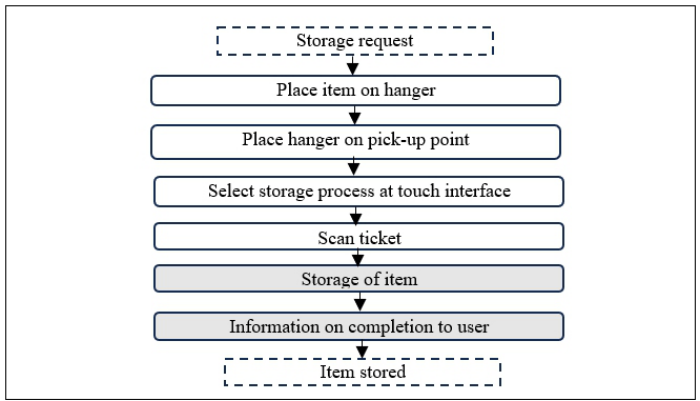
Concept Process The process definition was based on the observations of cloakroom attendants in theatres, music events and trade shows. The attendees event ticket is used for initializing the storage and retrieval process. Figure 1 shows the process steps for the storage process. The retrieval process is vice versa.
Resources As a professional social service robot, the cloakroom robot has to provide customers with interactive situation-specific services and “should prompt to customers’ service needs and [be] sensitive to the customers’ and employees’ satisfaction levels” (Lee, 2021).
The first step in the concept development was to discuss the decision between a stationary and a mobile robot solution. Following an analysis of the advantages and disadvantages of both options, a decision was made in favor of the stationary robot due to its speed and scalability, reduced error propensity and lower complexity. Unlike mobile robots, a stationary robot does not require complex sensors and camera setups to scan the environment to choose its movement pathway (Bensalem et al., 2009). It also does not require extensive logic to navigate around obstacles. Additionally, the stationary robot allowed a simple restriction of the robot workspace and enabled an easier safety concept, which ensures that the robot does not come in physical touch with the users (Seo & Lee, 2021). User and robot workspace are separated (EN ISO 13482).
Figure 1: Cloakroom service process (white box – user task; grey box – robot task).
The robot can be either humanoid and therefore has human-like qualities or features (anthropomorph) or non-humanoid. Intense research is done on the question on how much human-like a social service robot should be with
User-Centered Design of Professional Social Service Robots 15
regard to the user service experience. As there are pros (Riener et al., 2006; Broadbent et al., 2009; Li et al., 2010; Keeling et al., 2010; Kohler et al., 2011; Verhagen et al., 2014).) and cons (Duffy, 2003; Mori, 1970; Breazeal, 2003; Bethel et al., 2009; Mori et al., 2012) and it is agreed upon that humanoid service features are especially relevant for emotional-social service tasks, the cloakroom robot has a non-humanoid appearance.
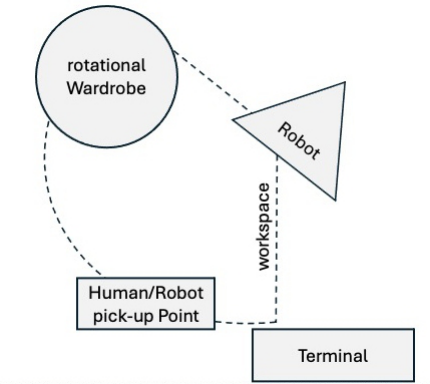
A robotic arm was responsible for the transportation of the users items between a defined pick-up point and the wardrobe in the back. At the pick-up point the event attendee is supposed to place the items to be stored. As free view on the item storage by the service robot increases trust (Stock & Merkle, 2017), a counter was set up which allows the users to observe the storage process and also ensures safe robot operation as physical human-robot interaction (HRI) is blocked. Instead the HRI is done through a tablet as touch-interface. Figure 2 shows the layout of the service setup.
Considerable emphasis was placed on the Human-Machine-Interface (HMI) during the concept definition. For acceptance and a positive user experience, intuitive operation based on a logical service script and interface design are essential (Jeon et al., 2020). Through a self-programmed HMI, clear instructions can be communicated to users. Besides a touch display a scanner for scanning the attendees ticket was part of the HMI. The communication between robot, rotating wardrobe, HMI and data management was realized through a control unit.
Figure 2: Layout of automated cloakroom service.
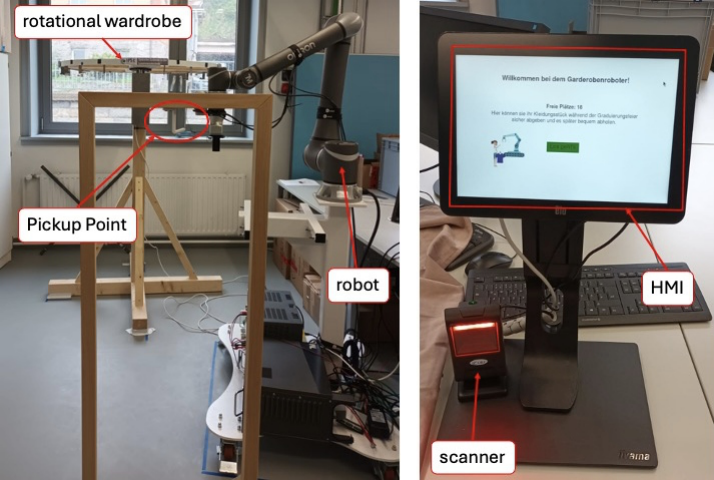
Prototype The developed prototype (Figure 3) is a show-case of a professional social service robot working collaborative with its user. Its setup maps the described concept.
Figure 3: The prototypical setup of the cloakroom emphasizing technical resources.
The robotic arm, an Omron TM 12, was selected due to its build-in safety features and capabilities. The task of the robot includes the safe grasping and transportation of hangers and placed jackets from the pickup-point to the rotational wardrobe. The placement at the wardrobe is constant. A precise, automated rotation of the wardrobe ensures that a free storage location is moved towards the defined transfer place. The human-robot-interaction is realized with a touchscreen and programmed in Python. Instructions are given via text and images. The control unit as central unit is a Raspberry Pi running a Python program. This control unit is responsible for various tasks. It manages the clothing database, including the allocation of wardrobe spaces and customer ticket numbers. The ticket number is used for identification and a correct matching of customer and stored item. Furthermore, the control unit controls the stepper motor of the rotating wardrobe and manages the TCP-IP communication with the robot and the user commands at the HMI.
Testing Two usability tests were carried out with the cloakroom robot to evaluate the performance and user-friendliness of the system. Design recommendations were retrieved from user feedback and are therefore based on the use of the cloakroom robot prototype as defined above. In sum 23 German-speaking subjects tested the robot. A first test was done at a live event, 18 voluntary participants gave unstructured feedback on their user experience. Especially unclear instructions, missing feedback and problems in the data acquisition procedure using the barcode reader led to a reduced success rate of only 44% and 45 seconds of processing time per service. A second test was done after
User-Centered Design of Professional Social Service Robots 17
optimizing the sequence and the instruction and feedback providence during the service. Five test subjects of different genders and ages took part in this test, which was carried out in a laboratory setting. This test was structured into a pre-questionnaire, prompts and a post-questionnaire to assess the performance and user-friendliness of the cloakroom robot. None of the participants had any previous experience of operating robots. The majority favored touch Human-machine-interfaces. The simplicity of operation and the clear instructions were appreciated by all participants. The success rate in the second test was 100%, with an average processing time of 30 seconds per jacket. Test subjects appreciated being informed of how long they had to wait to store or collect their items. A clear display of this information in the form of an hourglass could further improve the service experience. The speed of the robot was perceived as too slow by the majority of test subjects.
Findings Based on the usability tests and the literature review, the following design requirements emerged for a professional social service robot with low emotional task level:
Robot Safety realized by – separated work spaces of human and robot if applicable, – minimizing physical contact between human and robot, – alternating work sequences of human and robot initiated only by commands given by the user through the Human-Machine-Interface
Human-Machine-Interface (HMI) Design assuring ease of use: the interface should be intuitively designed to ensure smooth interaction. This includes clear instructions and seamless navigation.
– Image-supported instructions: The integration of pictorial instructions facilitates user guidance and contributes to the comprehensibility of the process. – Clarity of instructions: All instructions should be clear and understandable to avoid misunderstandings. – Clarity of the interface: A well-structured user interface is important to facilitate navigation. This also includes clear visual feedback on the waiting time.
Intuitive, robust robot Work Process by – easy to follow work process: simple, comprehensible step definition integrating feedback on successful completion of work steps (i.e. storage and retrieval), – Adequate speed: The speed of the system should be at least as fast as human, waiting time has negative effects on user experience. – Robust robot performance including a well-performing data management
Regarding the future prospects of a robot as a cloakroom attendant, testing the cloakroom robot prototype 60% of participants were open to it, while 40% still favored a human.
SUMMARY & CONCLUSION As the technology for service robot as sensors, data handling and AI advances and service employee shortage form an obstacle in service providence, professional service robot implementations increase. Their design is crucial for them being successful. Besides clear safety standards, the customer- perception within the service journey is most relevant. However, as the service journeys differ depending on the service category (professional vs. domestic; emotional vs. analytic; homogeneous vs. heterogeneous), a general statement cannot be made. This work focuses on the currently most relevant field of service robot applications where service tasks are rather homogeneous, frequent and require mostly analytical capacity.
The findings are based on a prototypic cloakroom robot which is intended to be used in public events. The findings are in line with well-established technology acceptance models (Davis, 1989; Venkatesh, 2003). Especially perceived ease of use (clear visual instructions and feedback) and perceived usefulness (process speed, safe item storage and retrieval) foster behavioural intention. Humanoid robot features were not identified as being relevant – neither by theory nor by testing.
However, as the results of this paper are based on a prototypic robot implementation and a low number of usability tests, further empirical studies are needed to validate user design-requirements for professional social service robots.
FUNDING The author(s) received no financial support for this research.
CONFLICT OF INTEREST The author(s) declared no potential conflicts of interest with respect to the research.
REFERENCES
Abdel Razek, A. R., Raban, M., van Husen, C. (2019). “Service Prototyping: Design Dimensions”. In: Stich, V., Schumann, J., Beverungen, D., Gudergan, G., Jussen, P. (eds.) Digitale Dienstleistungsinnovationen. Springer Vieweg, Berlin, Heidelberg. Afflerbach, T. (2021). Serviceroboter, Springer Gabler, Wiesbaden. Bartneck, C., Forlizzi, J. (2004). “A design-centred framework for social human-
robot interaction”. RO-MAN 2004. 13th IEEE international workshop on robot and human interactive communication. IEEE Catalog No. 04TH8759. Belanche, D., Casaló, L. V., Flavián, C., Schepers, J. (2020). “Service robot implementation: a theoretical framework and research agenda”. The Service Industries Journal, 40:3–4, 203–225. Bensalem, S., Gallien, M., Ingrand, F., Kahloul, I. and Thanh-Hung, N. (2009).
“Designing autonomous robots”. IEEE Robotics & Automation Magazine, vol. 16, no. 1, pp. 67–77. Bethel, C. L., Salomon, K., Murphy, R. R. (2009). “Preliminary results: Humans find emotive non-anthropomorphic robots more calming”. In Proceedings of the 4th ACM/ IEEE international conference on human-robot interaction (HRI 2009), San Diego, CA.
User-Centered Design of Professional Social Service Robots 19
Breazeal, C. (2003), “Towards sociable robots”. Robotics and Autonomous Systems, Vol. 42, Nos. 3–4, pp. 167–175. Broadbent, E., Stafford, R., Macdonald, B. (2009). “Acceptance of healthcare robots
for the older population: Review and future directions”. International Journal of Social Robotics, 1(4), 319–330. Bruhn, M., Meffert, H., Hadwich, K. (2019). Handbuch Dienstleistungsmarketing, Springer Nature. Davis, F. D. (1989). “Perceived usefulness, perceived ease of use, and user acceptance
of information technology”, MIS Quarterly, Vol. 13, No. 3, pp. 318–340. Duffy, B. R. (2003), “Anthropomorphism and the social robot”. Robotics and Autonomous Systems. Vol. 42, Nos. 3–4, pp. 177–190. Endsley, M. R. and Kaber, D. B. (1999). “Level of automation effects on performance,
situation awareness and workload in a dynamic control task”. Ergonomics, 42, 462–492. Gutsche, K., Griffith, J. (2023). “Human performance as an asset value creator: an automated service impact model”. International Journal of Strategic Engineering Asset Management, 4(1), 47–60. Huang, M.-H., Rust, R. T. (2018). “Artificial Intelligence in Service,” Journal of
Service Research, 21 (2), 155–172. IFR International Federation of Robotics (2023). Staff Shortage Boosts Service Robots – Sales Up 48%, press release, https://ifr.org/ifr-press-releases/news/staf f-shortage-boosts-service-robots-sales-up-48 International Organization for Standardization (2014). “Robots and robotic devices
— Safety requirements for personal care robots (ISO 13482:2014).” International Organization for Standardization (2016). “Robots and robotic devices — Collaborative robots” (ISO TS 15066: 2016). Ivanov, S., Webster, C., Berezina, K. (2017). “Adoption of robots and service
automation by tourism and hospitality companies.” Aveiro, Portugal: INVTUR Conference. Jeon, H. M., Sung, H. J. and Kim, H. Y. (2020). “Customers’ acceptance intention of self-service technology of restaurant industry: Expanding UTAUT with perceived risk and innovativeness”. Service Business, vol. 14, no. 4, pp. 533–551. Keeling, K., Mcgoldrick, P., Beatty, S. (2010). “Avatars as salespeople: Communication style, trust, and intentions”. Journal of Business Research, 63(8), 793–800. Kohler, C. F., Rohm, A. J., de Ruyter, K., Wetzels, M. (2011). “Return on interactivity:
The impact of online agents on newcomer adjustment”. Journal of Marketing, 75(2), 93–108. Lee, I. (2021). “Service Robots: A Systematic Literature Review”. Electronics 2021, 10, 2658. Li, D., Rau, P. L., Li, Y. (2010). “A cross-cultural study: Effect of robot appearance
and task”. International Journal of Social Robotics, 2(2), 175–186. Mori, M. (1970). “The uncanny valley”. Energy, 7(4), 33–35. Mori, M., MacDorman, K., Kageki, N. (2012). “The uncanny valley [from the field]”. IEEE Robotics and Automation Magazine, 19, 98–100. Onnasch, L., Maier, X., Jürgensohn, T. (2016). “Mensch-Roboter-Interaktion-
Eine Taxonomie für alle Anwendungsfälle”. Bundesanstalt für Arbeitsschutz und Arbeitsmedizin, Dortmund/Germany. Parasuraman, R., Sheridan, T. B., Wickens, C. D. (2000). “A model of types and levels of human interaction with automation”. IEEE Transactions on Systems, Man and Cybernetics, 30, 286–297.
Reis, J., Melão, N., Salvadorinho, J., Soares, B., Rosete, A. (2020). “Service robots in the hospitality industry: The case of Henn-na hotel, Japan”. Technology in Society, 63, 101423. Riener, R., Lünenburger, L., Colombo, G. (2006). “Human-centered robotics
applied to gait training and assessment”. Journal of Rehabilitation Research and Development, 43 (5), 679. Sampson, S. E. (2021). “A Strategic Framework for Task Automation in Professional Services”. Journal of Service Research, 24(1), 122–140. Seo, K. H., Lee, J. H. (2021). “The Emergence of Service Robots at Restaurants:
Integrating Trust, Perceived Risk, and Satisfaction”. Sustainability, vol. 13, no. 8, p. 4431. Singh, S., Olson, E. D., Tsai, C. H. K. (2021). “Use of service robots in an event setting: Understanding the role of social presence, eeriness, and identity threat”. Journal of Hospitality and Tourism Management, 49, 528–537. Stock, R. M., Merkle, M. (2017) “A service Robot Acceptance Model: User acceptance of humanoid robots during service encounters”. 2017 IEEE International Conference on Pervasive Computing and Communications Workshops, Kona, USA, pp. 339–344. van Doorn, J., Mende, M., Noble, S. M., Hulland, J., Ostrom, A. L., Grewal, D.,
Petersen, J. A. (2017). “Domo Arigato Mr. Roboto: Emergence of Automated Social Presence in Organizational Frontlines and Customers’ Service Experiences”. Journal of Service Research, 20 (1), 43–58. Venkatesh, V., Morris, M. G., Gordon B. D. ; Davis, F. D. (2003). “User Acceptance of Information Technology - Toward a Unified View”. MIS Quarterly 27(3), 425–478. Verhagen, T., Nes, J. V., Feldberg, F., Dolen, W. V. (2014). “Virtual customer
service agents: Using social presence and personalization to shape online service encounters”. Journal of Computer-Mediated Communication, 19(3), 529–545. Wirtz, J., Patterson, P., Kunz, W., Gruber, T., Lu, V. N., Paluch, S., Martins, A. (2018). “Brave New World: Service Robots in the Frontline”, Journal of Service Management, Vol. 29, No. 5, p. 909, https://doi.org/10.1108/JOSM-04- 2018-0119 Wirtz, J., Kunz, W., & Paluch, S. (2021). “The service revolution, intelligent
automation and service robots”. European Business Review, 29(5), 909. Zeithaml, V. A., Parasuraman, A. and Berry, L. L. (1985). “Problems and strategies in service marketing”, Journal of Marketing, Vol. 49, No. 2, pp. 33–46.
LISTED IN THE AHFE DIGITAL BOOKSTORE CATALOGUE
Explore the complete digital volume
Intelligent Human Systems Integration (IHSI 2025): Integrating People and Intelligent Systems
Read this individual research paper free through the original publisher, or explore the full digital proceedings book.
ISBN 978-1-964867-36-6
Explore this ISBN in the AHFE Bookstore ↗Listed in the July 2026 bookstore catalogue; search by ISBN to confirm current availability · Digital book purchase optional