Chen Junwu, Wenyu Wu, Jiayu Guo (2025). The effect of Hue difference in vibration environment on the cognitive performance of aircraft HUD Interface for pilots. In: Intelligent Human Systems Integration (IHSI 2025): Integrating People and Intelligent Systems. AHFE Open Access, vol. 160, pp. 110–118. https://doi.org/10.54941/ahfe1005816
In the aviation domain, the color design of the aircraft head-up display (HUD) is crucial for flight safety and operational efficiency. However, the effect of color difference on pilots' cognitive performance in a vibrating environment remains inadequately studied. This experiment aimed to address this gap. A precise experimental method was employed. For color variables, four basic hues in the HSB color system served as backgrounds, and foreground colors with specific color differences were carefully selected. The vibration conditions were set to 5Hz, 10Hz, 15Hz, 20Hz, and a non-vibration environment, simulating diverse flight scenarios. Subjects were required to perform a HUD information search task, and their reaction times and accuracy rates were recorded.The results showed significant interaction effects. In a high-vibration environment, a color difference of 60 degrees led to the shortest reaction time. In a low-vibration environment, 90 degrees performed better under certain backgrounds. In a non-vibration environment, color difference had a relatively minor impact on accuracy. Different background hues also affected the relationship between color difference and performance. For example, the green background had a lower accuracy rate at a 30-degree color difference.This study provides a solid basis for HUD color coding design. It helps optimize color design in a vibrating environment, enhance information recognition efficiency, and thus improve flight safety and operational efficiency. It offers valuable references for related fields and promotes the development of human-computer interaction technology in aviation.
Head-Up Display (HUD) is used in aircraft to project critical flight information. The rationality of its color coding directly affects flight safety and mission performance. As aviation technology continues to advance, the vibration environment encountered by aircraft during flight becomes increasingly complex and diverse, posing significant challenges to the visual display performance of HUD. Harding pointed out that the combination of HUD display colors with the surrounding environment may lead to incorrect perception of image information (Harding et al., 2016). Shieh and Chen found that low color contrast severely reduces users’ visual search
The Effect of Hue Difference in Vibration Environment on the Searching Performance 111
performance (Shieh and Chen, 1997). Niu discovered that, compared to monochrome or tricolor schemes, the use of a two-color coding for HUDs resulted in superior performance (Niu et al., 2022). Puhalla emphasized that the hierarchical perception of colors is crucial for optimizing the human- machine interaction experience (Puhalla, 2008). By applying hierarchical color combinations based on the three-color elements, distinct visual contrasts can be created, effectively guiding users to categorize and identify visual information. Karar confirmed through research that the contrast between symbol color and background color in HUD displays is closely related to attention capture (Kumar et al., 2023). The results indicated that color contrast significantly impacts the effectiveness of flight information capture and recognition. Among the many factors affecting HUD visual performance, Hue Difference, as one of the key color attributes, has not yet been fully understood in terms of its impact on pilots’ visual search performance under different vibration frequencies, necessitating further research. Visual search performance plays a crucial role in flight operations, directly determining the speed and accuracy with which pilots acquire and process critical information. Laar conducted visual search experiments using three different color-coding methods, and their results revealed that the visual hierarchical coding method outperformed the other two methods (Van Laar and Deshe, 2007). Besides color, vibration also has a significant impact on visual search. Chen found that low-frequency vibrations, especially in the 4-6Hz range, severely affect visual function, with human tolerance to vibration being lowest in this frequency range (Chen et al., 2017). The longer the vibration duration and the greater its intensity, the more significant the ergonomic effects. Sundström and Khan found that lateral vibration at 5Hz interferes most with visual function (Sundström and Khan, 2008). In a vibrating environment, pilots must quickly identify various flight parameters on the HUD under unstable visual conditions. For example, during critical flight phases such as takeoff and landing, pilots must rapidly and accurately read information such as altitude, speed, and heading. Vibration can cause visual blurring and reduced information recognizability. Therefore, the rational setting of Hue Difference may effectively improve the recognizability of information, mitigating the negative impact of vibration on visual search performance. Although previous studies have acknowledged the importance of color design in HUD interfaces, Hue Difference in vibrating environments has not been systematically and deeply studied.
STUDY PURPOSE While some studies have examined the impact of color coding on information display, there is still a gap in research regarding how Hue Difference specifically affects visual search performance under different vibration frequencies, and the cognitive mechanisms behind this (Ojanpää and Näsänen, 2003; Ou et al., 2015). This experiment aims to investigate the impact of different Hue Difference combinations on pilots’ cognitive performance within the HUD system under vibrating conditions. Specifically, the study simulates HUD information search tasks to analyze how
various Hue Difference combinations affect pilots’ ability to recognize information and search efficiency under different vibration frequencies. Through these analyses, the experiment aims to determine the most suitable foreground/background Hue Difference matching values for different vibration environments, providing both theoretical support and practical guidance for the color coding design of aircraft HUD interfaces.
METHOD
Participants A total of 20 participants were selected for the experiment, consisting of 10 females and 10 males from Southeast University. All participants had not previously participated in similar experiments, with ages ranging from 21 to 27 years. None of the participants had color blindness or color weakness, and their corrected vision was above 1.0, ensuring they had normal visual perception abilities to guarantee the validity and reliability of the experimental data. Prior to the experiment, all participants signed an informed consent form, understanding the purpose, procedure, and any potential risks involved. During the experiment, participants’ personal information will be kept strictly confidential, and only anonymized data will be used for analysis to protect their privacy. Participants have the right to withdraw from the experiment at any stage, and withdrawal will not have any negative consequences.
Experimental Equipment The experimental process used the psychology experiment development software E-prime 3.0 to write the vibration environment program and present stimulus pictures as well as real-time recording of performance data. The experiment used a 23-inch Dell display with a resolution of 2560*1440 pixels, connected to a host computer with a screen refresh rate of 60Hz, and controlled the brightness of the screen to 130cd/m2 to ensure the clarity and accuracy of the experimental stimuli. The distance between the subject and the center of the screen was 550-600mm, and the room was illuminated normally with two 40W OPPLE LED lamps.
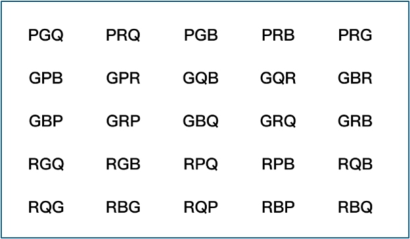
Experimental Preparation In the experiment, participants performed a target search task. To ensure accuracy, the target materials were strictly controlled, using the capital letters showed in Fig. 1, “R”, “G”, “P”, “Q”, and “B” in PingFang SC font. These letters contain both straight lines and curves, with similar visual complexity, and were randomly arranged to minimize interference from target differences. A pilot experiment was conducted with the same task but desaturated images, with a white background and black letters as the target. Participants identified the target location and provided feedback, with reaction times recorded. The pilot experiment showed a flat reaction time curve, confirming that the letter combinations effectively reduced data variability.
The Effect of Hue Difference in Vibration Environment on the Searching Performance 113
Figure 1: Target search materials.
Based on the sensitivity of the human eye to vibration and related aircraft vibration studies, the impact of aircraft vibration on visual function and task performance primarily occurs within the 2-20Hz low-frequency range, with a 1.6mm amplitude confirmed as the sensitivity threshold. This experiment selects 5Hz, 10Hz, 15Hz, and 20Hz as core variables, with an amplitude of 1.6mm to simulate real aircraft vibration environments. A no-vibration condition is set as the control group, with vibration frequencies arranged from high to low. The vibration direction follows a cycle of left-right and then up-down, aiming to comprehensively reveal the impact of vibration on visual function and ensure the reliability of the results.
This study used the HSB color model, as it allowed for intuitive adjustment of hue, making it especially effective for precise color control in specific applications (Yang et al., 2010). The experiment selected four basic hues (orange, green, blue, and purple) from the HSB system as background colors, with a 90-degree interval between each pair and a brightness and saturation of 70%. For foreground colors, hues with hue differences of 30
, 45
, 60
, 75
, and 90
were selected based on each background color. Due to the properties of the hue circle, each background color corresponded to 10 foreground colors. This selection of color combinations helped explore the impact of hue difference on visual cognition under vibration conditions.
Experimental Procedure The experiment designed 40 (4 background colors × 10 hue difference combinations) × 5 (5 vibration environments) = 200 experimental combinations, conducted in 5 groups, with an estimated total duration of 45 minutes. The main measurements were reaction time, accuracy, and completion rate, where shorter reaction times and higher accuracy and completion rates indicated better visual search performance due to hue difference combinations.
Before the experiment, participants were given sufficient rest to ensure they were in a good mental state. After reading and understanding the task and procedure, they filled out personal information (name, gender, age). Before the formal experiment, participants underwent a practice phase, identical to the main experiment, with 7 practice trials to familiarize them with the task, especially adapting to visual search under different vibration conditions.
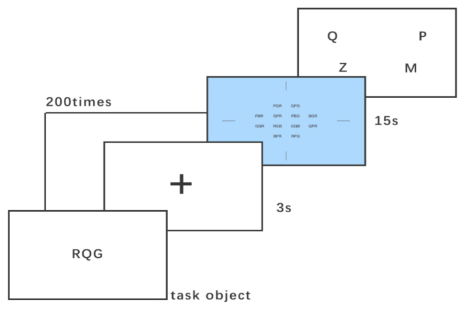
The formal experiment used a within-subject design, divided into 5 groups, each with 40 trials, totalling 200 trials and estimated to take 40 minutes. Each trial included three pages: first, a black background page (3 seconds), with the target material in the center. After confirmation, participants pressed the spacebar to proceed to the next page. Then, a fixation point page (centered “+”, lasting 3 seconds) followed by an automatic transition to the target search page (15 seconds). This page was divided into four modules (top-left, top-right, bottom-left, bottom-right), where participants needed to find the target material and identify its location by pressing the corresponding key (Q for top-left, P for top-right, Z for bottom-left, M for bottom-right). To avoid feedback errors from individual habits, participants were instructed to place both hands evenly on the keyboard. Throughout the experiment, the order of trials and batches within each group was randomly set without repetition to ensure randomness and scientific rigor. The overall experimental procedure is illustrated in Figure 2.
Figure 2: Experimental procedure.
DATA ANALYSIS The raw data was thoroughly processed and checked to ensure accuracy and completeness, providing a reliable foundation for subsequent analysis. Then, a three-way ANOVA was used to assess the effects of hue difference, vibration environment, and background hue on participants’ accuracy and reaction times in the visual information search task, with accuracy and reaction time as the dependent variables and hue difference, vibration environment, and background hue as the independent variables. The analysis aimed to determine the main effects of each factor and their interactions, including two-way interactions (hue difference * vibration environment, hue difference * background hue, vibration environment * background hue) and a three- way interaction (hue difference * vibration environment * background hue). For significant interaction effects, simple effect analyses were conducted. Finally, for factors with significant main effects or interactions, post hoc multiple comparisons were performed to clarify the specific differences between levels of each factor.
The Effect of Hue Difference in Vibration Environment on the Searching Performance 115
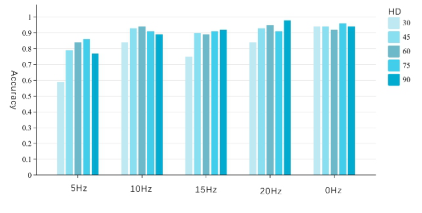
In this experiment, the analysis of overall accuracy revealed the participants’ performance in the visual information search task. After data processing and statistical analysis, the overall accuracy remained above 88%, indicating that most participants understood the task and performed it attentively. However, despite the high overall accuracy, certain tasks exhibited varying levels of difficulty, leading to an overall accuracy that did not exceed the ideal 95% level (see Figure 3). This may be attributed to the different impacts of Hue Difference combinations, vibration frequencies, or background hues on the participants’ cognitive load. Particularly in stronger vibration environments, the complexity of the task and cognitive burden may have increased, thus affecting the participants’ accuracy performance.
Figure 3: Accuracy of different vibration environment.
The reaction times of 20 participants completing the visual information search task were analyzed using a three-way ANOVA, as shown in Table 1.
Table 1. Within-subjects effects test for reaction time in vibration environment, Hue Difference, and background Hue Difference.
Error term (Hue Difference * Vibration Environment * Background Hue)
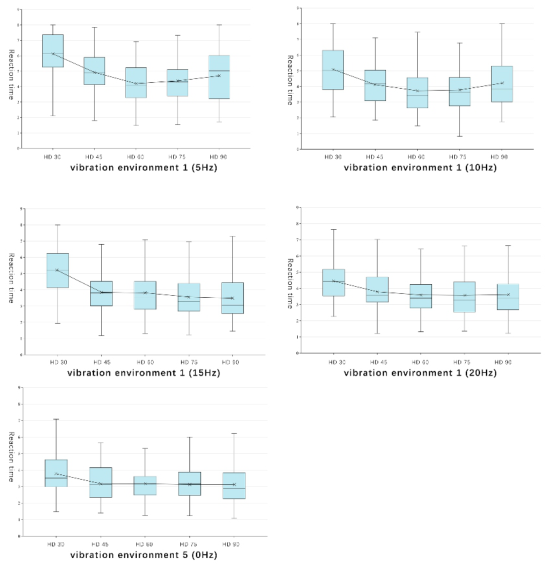
In Vibration Environment 1(5Hz), the main effect of Hue Difference was significant (F(3.747, 296.006) = 29.036, p < 0.01, η2 = 0.269). Post- hoc multiple comparisons revealed significant differences in reaction time between Hue Difference 30 and 45, 60, 75, and 90, as well as between Hue Difference 45 and 30, 60, and 75. Significant differences in reaction time were also found between Hue Difference 90 and 30, 60, with a marginal significance (p = 0.061) between Hue Difference 90 and 75.
In Vibration Environment 2(10Hz), the main effect of Hue Difference was significant (F(4, 316) = 14.357, p < 0.01, η2 = 0.154). Post-hoc multiple comparisons indicated significant differences in reaction time between Hue Difference 30 and 45, 60, 75, and 90, and also between Hue Difference 75 and 90.
In Vibration Environment 3(15Hz), the main effect of Hue Difference was significant (F(4, 316) = 20.234, p < 0.01, η2 = 0.204). Post-hoc analysis showed significant differences in reaction time between Hue Difference 30 and 45, 60, 75, and 90.
In Vibration Environment 4(20Hz), the main effect of Hue Difference was significant (F(3.772, 298.002) = 8.442, p < 0.01, η2 = 0.097). Post- hoc multiple comparisons indicated significant differences in reaction time between Hue Difference 30 and 45, 60, 75, and 90. There were also significant differences between Hue Difference 45 and 60, 75, with a marginal significance (p = 0.071) between Hue Difference 45 and 90.
In Vibration Environment 5(no vibration), the main effect of Hue Difference was significant (F(4, 316) = 4.191, p = 0.003 < 0.01, η2 = 0.050). Post-hoc analysis showed significant differences in reaction time between Hue Difference 30 and 45, 60, 75, and 90.
CONCLUSION
From the perspective of accuracy, the interaction between vibration environment and Hue Difference was found to be significant. In the absence of vibration, Hue Difference did not show a significant effect, and accuracy remained unchanged regardless of variations in Hue Difference. In contrast, under vibrating conditions, a Hue Difference of 30 consistently resulted in the lowest reaction times. Furthermore, the interaction between background Hue and Hue Difference was significant, with no further significant effect on
The Effect of Hue Difference in Vibration Environment on the Searching Performance 117
the background Hue when Hue Difference reached 45 or higher. The green background exhibited the lowest average accuracy, and when the Hue Difference was 30, the accuracy dropped below 70%. Based on the data analysis and Figure 4, it can be observed that: Hue Difference had a direct effect on the efficiency of visual search and the fluency of information extraction. Based on the experimental data, the following gradient design for Hue Difference under different vibration environments was established: In the absence of vibration, the optimal foreground/background Hue Difference for the aircraft HUD interface color coding is 120; under low vibration conditions, the optimal Hue Difference is 90; and under high vibration conditions, the optimal Hue Difference is 60.
Figure 4: Hue difference and reaction time.
ACKNOWLEDGMENT
The authors appreciate the participants in the experiment for their time and commitment to this study.
REFERENCES
Chen, Y., Yapa, U. S., Price, A., Wickramasinghe, V., 2017. Evaluation of aircrew whole-body vibration and mitigation solutions for helicopter flight engineers, in: Annual Forum Proceedings - AHS International. Fort Worth, TX, United states, pp. 1015–1024.
Harding, T. H., Rash, C. E., Lattimore, M. R., Statz, J., Martin, J. S., 2016.
Perceptual issues for color helmet-mounted displays: luminance and color contrast requirements, in: Sanders-Reed, J., Arthur, J. J. (Eds.),. Presented at the SPIE Defense + Security, Baltimore, Maryland, United States, p. 98390E. https://doi. org/10.1117/12.2223035 Kumar, J., Singh Saini, S., Agrawal, D., Karar, V., Kataria, A., 2023. Human Factors While Using Head-Up-Display in Low Visibility Flying Conditions. Intell. Autom. Soft Comput. 36, 2411–2423. https://doi.org/10.32604/iasc.2023.034203 Niu, Y., Zhou, T., Bai, L., 2022. Research on color coding of fighter jet head-
up display key information elements in air–sea flight environment based on eye-tracking technology. Proc. Inst. Mech. Eng. Part G J. Aerosp. Eng. 236, 2010–2030. https://doi.org/10.1177/09544100211049025 Ojanpää, H., Näsänen, R., 2003. Effects of luminance and colour contrast on the search of information on display devices. Displays 24, 167–178. https://doi.org/ 10.1016/j.displa.2004.01.003 Ou, L., Sun, P., Huang, H., Ronnier Luo, M., 2015. Visual comfort as a function
of lightness difference between text and background: A cross-age study using an LCD and a tablet computer. Color Res. Appl. 40, 125–134. https://doi.org/10. 1002/col.21873 Puhalla, D. M., 2008. Perceiving hierarchy through intrinsic color structure. Vis.
Commun. 7, 199–228. https://doi.org/10.1177/1470357208088759 Shieh, K.-K., Chen, M.-T., 1997. Effects of screen color combination, work-break schedule, and workpace on VDT viewing distance. Int. J. Ind. Ergon. 20, 11–18. https://doi.org/10.1016/S0169-8141(96)00026-1 Sundström, J., Khan, S., 2008. Influence of stationary lateral vibrations on train
passengers’ difficulty to read and write. Appl. Ergon. 39, 710–718. https://doi.or g/10.1016/j.apergo.2007.11.009 Van Laar, D., Deshe, O., 2007. Color Coding of Control Room Displays: The Psychocartography of Visual Layering Effects. Hum. Factors J. Hum. Factors Ergon. Soc. 49, 477–490. https://doi.org/10.1518/001872007X200111 Yang, J., Liu, C., Zhang, L., 2010. Color space normalization: Enhancing the
discriminating power of color spaces for face recognition. Pattern Recognit. 43, 1454–1466. https://doi.org/10.1016/j.patcog.2009.11.014
LISTED IN THE AHFE DIGITAL BOOKSTORE CATALOGUE
Explore the complete digital volume
Intelligent Human Systems Integration (IHSI 2025): Integrating People and Intelligent Systems
Read this individual research paper free through the original publisher, or explore the full digital proceedings book.
ISBN 978-1-964867-36-6
Explore this ISBN in the AHFE Bookstore ↗Listed in the July 2026 bookstore catalogue; search by ISBN to confirm current availability · Digital book purchase optional