Ziwei He, Wenyu Wu, Zhijie Xia, Chengqi Xue (2022). Layout of Emotional Elements and Functional Modules in Web Design Based on Aesthetic Indicators. In: Ergonomics In Design. AHFE Open Access, vol. 47, pp. 373–378. https://doi.org/10.54941/ahfe1001959
In the era of big data, opening web pages to search for information and obtain resources has become an important behavior for users to use the Internet. The beauty of the webpage will affect the user experience. A good layout can successfully guide users to browse the page. Based on aesthetic indicators, this paper first analyzes the emotional elements and functional modules of the webpage through the Kansei engineering method, and obtains the user's attitude towards the combination of website color and layout; then through correspondence analysis, the paper analyzes the user's views on the functional elements of the webpage, and finally combines color and layout data form three types of differentiated (i.e. best matching) designs for web products to meet the different needs of standardized color layouts and web page modules.
Nowadays, digital informatization has become an international development trend. In daily life, people turn on their computers and browse the web more frequently to obtain more information resources. Web pages present the resources and content that users need in an interface by organizing them. However, the page views and user traffic of different web pages of the same type are very different, which are closely related to the user’s experience when viewing.
In the late 1990s, a large amount of text, tables, hyperlinks, and a small number of images constituted the main elements of web pages (Xu, 2018), and they were mostly functional elements without considering the emotio- nal aesthetic point of view. With the improvement of user aesthetics and literacy in the 21st century, when viewing web pages, they will pay more attention to the color, layout, and content modules of web pages, and at the same time have higher requirements for elements such as video, animation, and text. To get more traffic, traditional web page layouts or overly unco- nventional layouts cannot meet the needs of most users. Today’s web market is generally classified into several different market segments according to functional factors, such as “service-based website”, “content-based website”, “e-commerce website”(Song, 2017), and then the page market differentia- tion is formed through the aesthetic differences of users, and the elements in
specific web pages are selected to meet the requirements of users. It can be understood that web designers need to plan a relatively standardized layout design in different web page types to meet the requirements of most users and give people a beautiful experience.
This research combines the user’s emotional aesthetic perspective with the web page functional perspective, and combines the layouts that satisfy the three types of web pages.
RESEARCH FRAMEWORK
1) The combination attitude of users to the color and layout of website is analyzed by the Kansei Engineering method, and the ideal color layout of users is obtained; 2) The correspondence analysis method is used to analyze users’ views on the functional elements in the web page, and determine the functional elements that users think are the most important; 3) Combine the color and layout data to form the product differentiation (i.e. the best match) of three web page types.
Based on previous studies and public data surveys, this paper considers the color and layout in web pages to be analyzed as user sentiment factors. There are many types of web pages in the market. This article mainly com- pares and analyzes three types of web page layouts: brand homepage (such as Dyson official website, Nike official website, Apple official website, etc.), e-commerce web pages (such as Taobao, Alibaba, etc.) and portal web pages (such as China Automotive Network, China Valve Network, etc.).
EXPERIMENT Combine Different Colors and Layouts
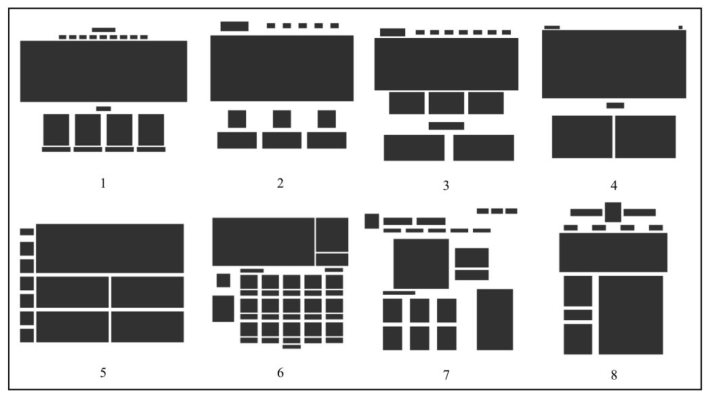
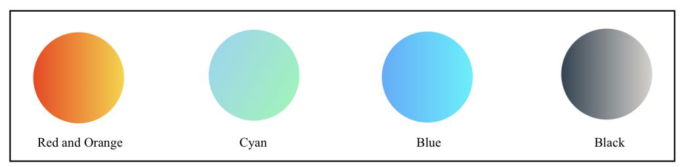
The experiment is based on perceptual engineering, namely, Kansei Enginee- ring (KE) rule, which translates the sensibility into engineering, converts the results of human perceptual analysis into product physical design elements, and manufactures products according to people’s preferences. It belongs to a new branch of engineering (Cao and Wan, 2020). At present, the layout of web pages on the market mainly includes Chinese font, corner type, frame type, cover type, and flash page type. Based on the popular page layouts abroad, eight different layouts are selected for flat display (see Figure 1). After beauty calculation, these eight pages have high beauty values and can be used for research. Previous literature indicates that users pay attention to the color and layout of web pages (Zhou et al. 2013). Choose these two factors as emotional aesthetic factors. Through the questionnaire survey of users, among the colors of “red, orange, yellow, green, cyan, blue and purple”, the colors that users think are suitable for making websites include red, orange, cyan, blue and black (see Figure 2). There are four color factors and eight layout factors in the user aesthetic perspective. Therefore, there are 32(4*8) possible combinations as samples to investigate users’ aesthetic attitudes tow- ards web pages. Ten students were invited to conduct a questionnaire survey.
Layout of Emotional Elements and Functional Modules in Web Design Based 375
Figure 1: Eight different layouts.Figure 2: Colors for websites.
The question they needed to answer was “do you think this combination is suitable for the brand homepage, e-commerce or portal website?” Finally, 320 samples were collected and divided into three categories: brand home page, e-commerce page and portal page.
Different Combinations Form the Basis of Web Page Division After data processing, the scheme with a support rate of more than 70% is regarded as an ideal scheme, that is, it is considered that there are the fol- lowing nine color layouts suitable for the brand official website: red-orange and No.6 layout, black and No.1 layout, black and No.2 layout, black and No.4 layout, blue and No.4 layout, blue and No.6 layout, cyan and No.1 layout, cyan and No.3 layout, cyan and No.8 layout; There are four layouts suitable for e-commerce web pages: red-orange and No.1 layout, red-orange and No.2 layout, red-orange and No.4 layout, red-orange and No.7 layout; There are three layouts suitable for portal pages: blue and No. 2 layout, blue and No. 3 layout, cyan and No.7 layout.
From the overall analysis of the data, it is found that users generally believe that red is suitable for e-commerce web pages, blue is suitable for portal web
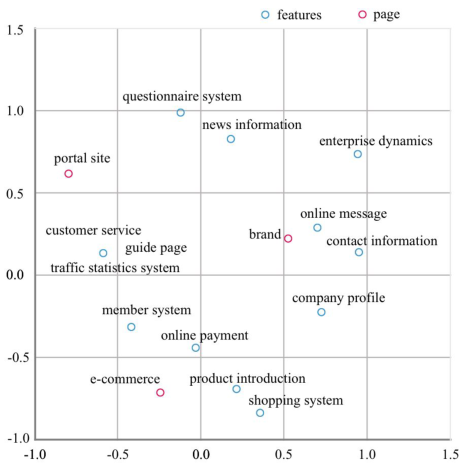
Figure 3: Degree of association between each module and different web pages.
pages, and the layout suitable for becoming the brand official website has few elements and is relatively uncomplicated as a whole.
Analyze Users’ Needs for Web Page Function Correspondence analysis is used in this part. Correspondence analysis can reveal the differences between the categories of the same variable and the corresponding relationship between the categories of different variables. It is a visual data analysis method, which can show several groups of data that cannot see any connection through a visually acceptable location map (Yang, 2013).
Conventional web page function modules include landing bar, navigation, website logo, advertising area, search box, website map, authentication infor- mation, copyright information, statistical code, etc. In this study, in addition to these conventional functions, 13 additional modules are selected for user division. They are news information, company profile, enterprise dynamics, product introduction, customer service, contact information, online message, guide page, member system, online shopping system, online payment, questi- onnaire system, and traffic statistics system. By asking the user: “which of the following functional modules do you think to appear in the brand home page, e-commerce, or portal? You can choose repeatedly.”Through correspondence analysis, Figure 3 shows the relationship between 13 functional modules and 3 pages in a low dimensional space in the form of points, showing the degree of association between each module and different web pages. The results show that all 13 are suitable for the layout of the brand official website; Pro- duct introduction, customer service, guide page, membership system, online shopping system, online payment, and traffic statistics system are suitable
Layout of Emotional Elements and Functional Modules in Web Design Based 377
for e-commerce web pages; News information, customer service, guide page, membership system, questionnaire survey and traffic statistics are suitable for portal pages. According to Figure 3, portal web pages seem to be relatively independent.
CONCLUSION
The following conclusions can be drawn from the experiment.
1) The colors suitable for the brand home page are:red-orange and No.6 layout, black and No.1 layout, black and No.2 layout, black and No.4 layout, blue and No.4 layout, blue and No.6 layout, cyan and No.1 layout, cyan and No.3 layout, cyan and No.8 layout. The requi- red functional modules include news information, company profile, enterprise dynamics, product introduction, customer service, contact information, online message, guide page, member system, online shop- ping system, online payment, questionnaire system, and traffic statistics system. 2) There are four layouts suitable for e-commerce web pages: red-orange and No.1 layout, red-orange and No.2 layout, red-orange and No.4 layout, red-orange and No.7 layout; The required functional modu- les are: product introduction, customer service, guide page, member system, online shopping system, online payment and traffic statistics system. 3) There are three layouts suitable for portal pages: blue and No. 2 layout, blue and No. 3 layout, cyan and No.7 layout; The required functional modules are news information, customer service, guide page, member system, questionnaire survey, and traffic statistics.
This experiment integrates the emotional aesthetic module and functio- nal module, and the layout conclusion can be applied to the comprehensive layout of most websites. Market division and product differentiation can reduce the designer’s design cost and time, and obtain greater benefits. The functional modules obtained by correspondence analysis can help designers achieve a balance between considering the necessary modules and the design cost. However, the experiment still has great limitations:
1) The number of subjects is small, and there is no division of age, identity, and other factors, so the experimental results are not accurate enough; 2) The emotional factors considered in the experiment are limited, such as point line surface relationship, module shape, and so on; 3) People’s perception is fuzzy, so fuzzy scale or fuzzy reasoning system should be considered to make the results more accurate; 4) In the first part, there are no specific evaluation rules for the classification of page types in the market. If there are rules, the results will be more authoritative if the cart classification tree is used for data statistics; 5) The chi-square value of each functional module obtained after correspon- ding analysis and processing can be sorted (such as the VIKOR method) to screen the most critical functional modules.
REFERENCES
Cao X., Wan L. (2020). Interface design method of mobile library based on compound inferential perceptual engineering. Design. Song Z.L. (2017). Analysis of layout and typesetting in computer web design.
Computer fan. Xu S. (2018). On the layout of web design. Electronic technology. pp. 108-109. Yang Y. (2018). Analysis of page layout in web design. Da Guan. Zhou L., Xue C.Q., Tang W.C., Li J., Niu Y.F. (2013). Aesthetic evaluation method of interface element layout design. Journal of computer aided design and graphics.
LISTED IN THE AHFE DIGITAL BOOKSTORE CATALOGUE
Explore the complete digital volume
Ergonomics In Design
Read this individual research paper free through the original publisher, or explore the full digital proceedings book.
ISBN 978-1-958651-23-0
Explore this ISBN in the AHFE Bookstore ↗Listed in the July 2026 bookstore catalogue; search by ISBN to confirm current availability · Digital book purchase optional