This paper describes an interdisciplinary curriculum design that integrates design, technology, and business, aiming to cultivate students' design thinking and innovation, and entrepreneurship skills. Design thinking emphasizes desirability, feasibility and viability. Understand the concepts and methods of design thinking, technical implementation tools, and business analysis tools through literature research. Taking the basic process of design thinking as the overall framework of the course, integrating the theoretical knowledge and tools of design, technology and business for course design. Then, teaching practice was carried out in the Design Thinking and Smart Hardware Course of the School of Design and Art of Beijing University of Technology in 2021. The teaching effect shows that the interdisciplinary course teaching integrating design, technology and business helps college students to establish innovative consciousness, expand innovative thinking, enhance entrepreneurial ability, and improve collaboration ability.
Cultivating college students’ innovative spirit and entrepreneurial ability is an important task of higher education teaching, and curriculum is an impor- tant carrier to guide innovative thinking and teach entrepreneurial methods. In recent years, design thinking as an innovation methodology and tool has been widely used in many fields, driving many changes in business, educa- tion and society. Design thinking has also been applied to innovation and entrepreneurship education, and there are significant similarities between design thinking and entrepreneurship teaching in terms of core concepts, thin- king models, and engagement approaches. Relevant research shows that the development of design thinking can significantly improve the innovation and entrepreneurship ability of college students (Wang et al. 2021).
In the Design Thinking and Smart Hardware course of the School of Design and Art of Beijing Institute of Technology in 2020, students have completed excellent works and have basic technical realization ability. However, due to the lack of business knowledge learning and entrepreneurship guidance in the
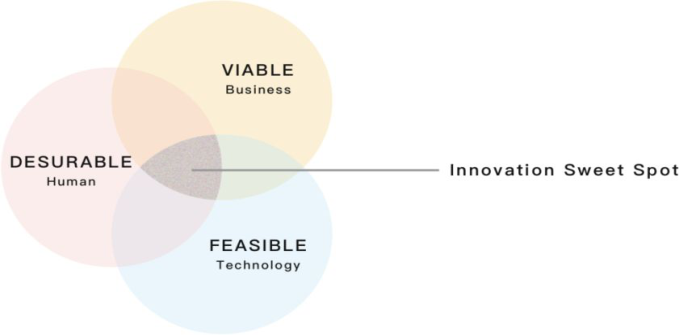
Figure 1: Desirability, feasibility and viability.
course, only one group further deepened the design plan in the course into an entrepreneurial project and participated in the college student innovation and entrepreneurship competition. Based on teaching experience, this project integrates design thinking into interdisciplinary course design and reconstru- cts the course structure to integrate design, technology and business in order to achieve the goal of improving students’ innovation and entrepreneurship. In 2021, we have conducted teaching practice again.
THEORETICAL OVERVIEW Design thinking is a “people-oriented” way of thinking, processes, tools and methodology to find the right problems, explore the root causes of problems, and find innovative solutions to complex problems. Design thinking emphasi- zes observation, interdisciplinary collaboration, rapid learning, visualization of ideas, rapid conceptual prototyping, etc (Li et al. 2017).
Design thinking is a design spirit and method that uses the sensitivity of designers and design methods to meet people’s needs on the premise of technical feasibility and commercial viability. Innovation needs to find the intersection of desirability, feasibility and viability (Brown and Katz, 2011).
Design thinking is widely used in engineering, management, and education. In terms of innovation and entrepreneurship education, relevant research shows that the cultivation of design thinking can significantly improve the innovation and entrepreneurship ability of college students (Wang et al. 2021). However, we find that much of the design thinking applied in inno- vation and entrepreneurship courses place emphasis on the desirability, but ignores feasibility and viability.
This research applies the method of design thinking to interdisciplinary teaching. It is hoped that students from different majors will work together, adopt design thinking processes and tools, and start from the needs of custo- mers, through systematic divergent thinking and integrated thinking, to find and apply feasible technology, and then transform it into real customer value and market opportunities through corresponding business models.
Interdisciplinary Curriculum Design Integrating Design, Technology, and Business 11
COURSE DESIGN Course Situation
The Design Thinking and Smart Hardware course of Beijing Institute of Tech- nology are offered from 2020 to 2021 and is a public elective course. In 2021, the program enrolled 15 students from a variety of professional backgrounds. The teaching objectives of this course are: to enable students to master the basic process of design thinking and specific methods of design in the process of completing real problem-oriented projects; enable students to have the abi- lity to identify problems, analyze problems, and comprehensively use various technologies to solve problems, master the basic knowledge of Arduino; ena- ble students to use business analysis tools to analyze problems from a business perspective, evaluate solutions, write business plans, and have the ability to transform innovative designs into entrepreneurial solutions; enable students to form a design thinking model and innovative spirit, cultivate Innovative and entrepreneurial talents with interdisciplinary collaboration ability.
Incorporate Technology Into the Curriculum This course cooperated with Lezhi Company, introduced the technical lear- ning content of smart hardware and cloud technology, and used the practical teaching mode to promote the implementation of the works. Arduino is an open-source platform for building and programming electronics (Badamasi, 2014). It packs and integrates the electronic circuit and the underlying dri- ver library into a black box, thereby omitting most of the operations related to the circuit and hardware driver, and finally only the simple control logic is left. Add Arduino-related knowledge to the course, so that students with- out a programming foundation can have a certain programming thinking, understand the implementation logic of some hardware products, and qui- ckly prototype, test and iterate their creative ideas. You can even realize your ideas.
Integrate Business Into the Curriculum This course integrates the learning of business knowledge, guides students to consider commercial viability when designing, and makes creating an entre- preneurial project. First, incorporate the use of business analysis tools into the course. Students can use the SWOT analysis to synthesize and summarize the internal and external conditions of the company, and analyze the strengths, weaknesses, opportunities and threats as a design basis (Hill and Westbrook, 1997). PEST analysis can also be used to analyze the external macro envi- ronment of the company from the four aspects of politics, economy, society and technology, and help them formulate strategies and business models (Sammut-Bonnici and Galea, 2014).
Second, incorporate the use of the business model canvas into the curri- culum. The business model canvas diagram consists of 9 squares, including customer segmentation, value proposition, channel, customer relationship, revenue streams, key resources, key activities, key partners, and cost structure (Osterwalder and Pigneur, 2010). By analyzing these nine modules, students
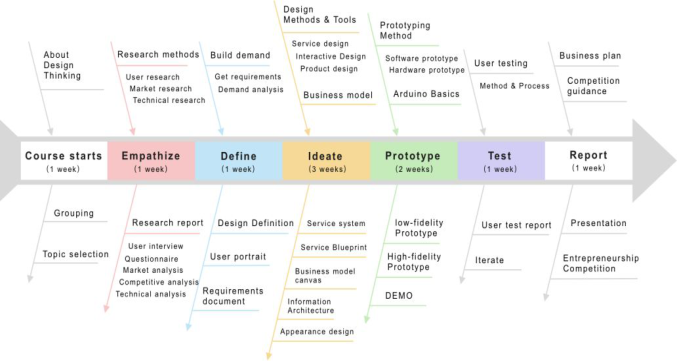
Figure 2: Course structure.
can construct and objectively examine their business model and plan future business development.
Finally, we add the business plan to the course to explain the content and share excellent business plan cases. A business plan is a comprehensive project plan that can help entrepreneurs or start-ups to draw a business blueprint, attract investment or raise funds. At the same time, the business plan is a key element for college students to submit works to the entrepreneurship competition. The business plan contains a great deal of content. The course mainly focuses on project introduction, industry background and market sta- tus analysis, project specific content, development status and future plans, analysis of the project team’s execution ability, financing plan and financial forecast (Zhang, 2021).
Curriculum Structure Supported by Design Thinking This paper adopts Stanford University’s design thinking model, which is divided into five sessions: Empathize, Define, Ideate, Prototype, and Test (Wolniak, 2017). The course is divided into two aspects: teaching and pra- ctice. In teaching, teachers impart relevant theoretical knowledge and the use of tools. In practice, students use the tools taught in the classroom to complete projects. At the end of the class, in addition to completing the project speci- fication, PPT and prototype and reporting, it is also necessary to complete a business plan. The course structure is shown in the figure.
Teaching Process In the first class, teachers taught students the basics of design thinking and analyzed excellent design cases. Then students were grouped and selected topics. The final selected topics were healthy eating, health management, smart flowerpot and aquarium system. In the empathy stage, teachers tau- ght students the methods and tools of research. The team used these research methods and tools to understand users, markets and technologies. Students
Interdisciplinary Curriculum Design Integrating Design, Technology, and Business 13
had to find out not only the needs of the users, but also the market situ- ation and related technologies. Then a research report was completed. In the definition stage, teachers need to teach students to perform requirements analysis, define what kind of problems our products are intended to solve, and how to write requirements documents. The team obtained requirements from the research results, analyzed the requirements, completed user portraits and requirements documents, and defined the features of the product.
In the conception stage, the teacher introduced the theoretical knowledge and methods of service design, interaction design and product design respe- ctively. Students were able to meet the needs of users in different ways and provide a better experience. Then the teacher explained the knowledge of the business model and how to use the business model canvas. After the class, the team members brainstormed together to complete the blueprint and system map of the service, the information architecture of the software and the modeling design of the product. They completed the business model canvas by considering the business model of the project in conjunction with the services and products.
In the prototype stage, the teams completed the design of low-fidelity inter- face and high-fidelity interface through the teaching of theoretical knowledge and software demonstration by teachers. The smart hardware sponsor, Lezhi Company, came to the classroom to teach students how to use and write Arduino. The teams were able to basically implement the simple functions in the idea through learning. In the testing stage, the teams applied the testing methods and processes taught in the classroom, invited users to participate in usability testing and completed test reports. Based on the results of the tests, students modified and iterated on the prototype.
In the final reporting stage, postgraduate teaching assistants with expe- rience in entrepreneurship competitions taught the students the content of the business plan and analyzed excellent cases. Students completed their business plans after class, turned their ideas into an entrepreneurial pro- ject, and participated in the “Internet +” College Student Innovation and Entrepreneurship Competition. In the final presentation of the course, all the teams showed their rich project results and expressed their gains in this course.
Analysis of Teaching Effect The students all showed their enjoyment of the course during the sharing of their feelings at the end of the course. Most of the students participated in the entrepreneurship competition for the first time. They generally agreed that the course enhanced their innovative and entrepreneurial skills, and that the interdisciplinary collaboration allowed them to analyze the feasibility of the design from the perspective of different disciplines. In interviews with professors and teaching assistants, they also generally agreed that students had improved their innovative thinking and entrepreneurial abilities.
In terms of course output, each team has completed a rich project. All four groups completed business plans and participated in an entrepreneurship competition. Students have developed the ability to follow a design thinking
model to identify problems, define them and synthesize various techniques to solve them. They also improved their entrepreneurial and teamwork ability.
CONCLUSION
This research introduces design thinking into the interdisciplinary curricu- lum, integrates design, technology and business, redesigns teaching mode, and implements teaching activities. The results show that students developed design thinking and improved their awareness and ability of innovation and entrepreneurship through theory and practice in the course. However, there are some limitations in this study, such as the faculty team are all from design schools and students lack professional guidance from business and techno- logy. The lack of financial support made it difficult for the students to move forward with their projects. There is also no quantitative analysis of teaching effectiveness using relevant tools. How to give full play to the role of teachers within the limited course length, make good use of the resources of schools and society, and cooperate with enterprises to better promote the effective learning of students is a direction worthy of research.
ACKNOWLEDGMENT
The authors would like to acknowledge Professor Sun Yuanbo of Beijing Institute of Technology for his guidance, as well as the Innovation and Entrepreneurship Practice Center of Beijing polytechnic for their support.
REFERENCES
Brown, T. and Katz, B. (2011). Change by design. Journal of product innovation management, 28(3), pp. 381–383. Badamasi, Y.A. (2014, September). The working principle of an Arduino. In
2014 11th international conference on electronics, computer and computation (ICECCO) (pp. 1–4). Hill, T. and Westbrook, R. (1997). SWOT analysis: it’s time for a product recall.
Long range planning, 30(1), pp. 46–52. Li, Y., Liu, H., Li, M. and Yuan, P. (2017). A Review of Design Thinking Research.
Chinese Journal of Mechanical Engineering (15), 1–20.(in Chinese). Osterwalder, A. and Pigneur, Y. (2010). Business model generation: a handbook for visionaries, game changers, and challengers (Vol. 1). John Wiley & Sons. Sammut-Bonnici, T. and Galea, D. (2014). PEST analysis. Wang, Z., Wei, L., Liao, S., Lin, Y. and Wu, Q. (2021). Research on the Influence
of Design Thinking on College Students’ Innovation and Entrepreneurship Abi- lity: An Intermediary Mechanism Based on Creativity Self-efficacy. Innovation Technology (04), 85–91. (in Chinese). Wolniak, R. (2017). The Design Thinking method and its stages. Systemy Wspomagania w In˙zynierii Produkcji, 6. Zhang, K. (2021). Analysis of the key elements of the teaching design of the business
plan for college students and the core elements of the road show. Science and Education Wenhui (late issue) (03), 27–28. (in Chinese).
LISTED IN THE AHFE DIGITAL BOOKSTORE CATALOGUE
Explore the complete digital volume
Ergonomics In Design
Read this individual research paper free through the original publisher, or explore the full digital proceedings book.
ISBN 978-1-958651-23-0
Explore this ISBN in the AHFE Bookstore ↗Listed in the July 2026 bookstore catalogue; search by ISBN to confirm current availability · Digital book purchase optional