Qianqian Lin, Chenxi Wang (2022). Construction of the Educational Model of Vocational College Students' Career Planning Based on Design Thinking. In: Ergonomics In Design. AHFE Open Access, vol. 47, pp. 1–8. https://doi.org/10.54941/ahfe1001912
Design thinking is an integrated thinking method with mature concepts, methods and tools, which is widely used in the field of education. Career planning education includes five aspects: Self-analysis, Environmental Analysis, Goal Establishment, Strategy Development, Evaluation and Modification, which fits well with the five steps of Empathy, Define, Ideate, Prototype and Test of design thinking. This study introduces the design thinking method and structure into the curriculum, puts forward the teaching activity model and strategy based on design thinking, and makes an empirical study on the strategy. The study mainly adopts the experimental research method and evaluates the effect of the teaching mode by comparing the improvement of the career planning ability of learners between the experimental group and the control group. The results show that the teaching mode based on design thinking has a positive effect on promoting students' career planning ability.
In 2019, the Government Work Report put forward the policy of giving priority to employment for the first time. In 2020, due to the outbreak of COVID-19, China’s employment market Climate Index dropped significan- tly (China Institute for Employment Research, 2022). In 2022, the number of Chinese college graduates will reach 10.2 million, and an estimated 1 million overseas students and workers will return to China to find jobs (China State Information Center, 2021). College students are facing more and more severe employment situation, individuals who have made career plans during their university years are considered important both in terms of contribution to the individual and society in the future (Erolu, 2020). College students are in the exploratory period of career planning, and high-quality career planning courses are very important to promote the employment of college students, but there are still many problems in career planning (CP) courses in China: (1) The teaching content is mainly based on short-term guidance such as inte- rview skills, and lack of ability training guidance; (2) The teaching form is
mainly lectures, focusing on courses and reports, and less classroom intera- ction, practice and career experience; (3) The students are lacking of interest in career planning courses, and most of them think that career planning cour- ses are useless courses for the purpose of completing credits (Jin et al. 2020). The author surveyed 115 third grade vocational college students from sch- ool of Art and Design, Beijing Polytechnic through questionnaires and found that the problems related to career planning include: (1) Lack of awareness of career planning; (2) Lack of understanding of their own career orientation and social needs; (3) Lack of clear learning goals and learning plans that are conducive to employment; (4) Paying no attention to employment guidance courses. In career planning education, it is particularly important to improve students’ attention to CP courses, enhance their self-awareness and career planning awareness, and transform them from passive recipients to active planners.
TEACHING DESIGN Fit of Desing Thinking and Career Planning
Simon first proposed in 1969 that design is a universal way of thinking. In 1987, Peter Rowe, a professor at Harvard School of Design, published the book Design Thinking, which brought design thinking into the public. In 1992, Richard Buchanan pointed out that design thinking can creatively solve wicked problems (Peng and Ronghai, 2019). At present, design thinking has been maturely applied in the fields of engineering, management and educa- tion, and a variety of tools and models have been derived, such as Stanford University’s 5-step design thinking and the British double diamond model. Due to its goal-oriented, integrates technology and business, emphasizes cul- tivating students’ thinking methods, it has been proved to be effective in cultivating students’ higher-order thinking and promoting the realization of innovative achievements, is an excellent model of education.
Career planning originated in the United States. In 1908, engineer Frank Parsons established the Career Bureau in Boston and began to have the concept of career coaching. Modern career education guides students to combine medium and long-term goals and learn to make dynamic adju- stment to make more suitable career plans through the analysis of themse- lves and surrounding environment, which pays more attention to cultivate students’ analytical ability, innovation ability, self-recognition ability and environmental adaptability. Modern career planning generally includes five aspects: Self-analysis, Environmental Analysis, Goal Establishment, Strategy Development, Evaluation and Modification (Rengong and Qiquan, 2002).
Through the research on the basic theories of design thinking (DT) and career planning(CP), it can be clearly seen that there are several similarities between them: (1) Both DT and CP are goal-oriented and solve problems by using forward and reverse thinking comprehensively; (2) As the empa- thy emphasized in DT fits the process of self-analysis and environmental analysis in CP, the tools in DT are suitable to applicate in CP; (3) DT not only imparts knowledge, but also emphasizes nurturing the ability to solve
Construction of the Educational Model of Vocational College Students’ Career Planning 3
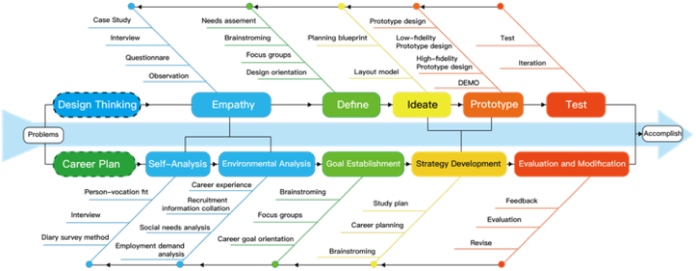
Figure 1: Structure of CP course based on DT.
complex problems, which is consistent with the ability cultivation goal of CP courses – cultivating students’ ability of long-term career planning.
Teaching Design of Career Planning based on Design Thinking Based on the above analysis, we combine DT and CP courses to propose a DT based CP teaching model. According to the principle of authority and simplicity, the 5-step model of Professor D. School from Stanford Univer- sity is adopted for DT, including: Empathy, Define, Ideate, Prototype, Test (D-School, 2018). Integrate it with the 5 steps of CP: Self-Analysis, Environ- mental Analysis, Goal Establishment, Strategy Development, Evaluation and Modification, (see Figure 1). It is organized into “Teaching” and “Practice”: (1) In “Teaching”, the concept, tools, methods and evaluation of CP are tau- ght, as well as the development of DT, basic concepts, tools and application methods are introduced. The teaching part enables students to master the the- oretical basic knowledge. (2) In terms of “Practice”, each group chooses an actual career goal problem to practice the steps and tools of DT and defines the iterative direction of CP through sharing and evaluation.
TEACHING PROCESS The CP course is offered in the first semester of the third grade of higher vocational college. It consists of 8 teaching links, a total of 32 class hours, and 115 students in 3 classes are from the College of Art and Design. In order to verify the teaching effect, one class was taught the course based on DT, and the other two classes were taught the traditional CP course.
Before class, each student writes down the goal they want to achieve in 5 years. After discussion by the teachers and teaching assistants based on the principle of combining similar goals, the themes are identified: finding a sta- ble job, opening a studio, entering a big company, etc. These goals basically cover all the positive goals described by the students. The goal of this stage is not the final goal, while first set a goal as the guidance, then guide students to think in reverse in DT. In class, teachers guide the groups to find urgent pro- blems in the theme and put forward solutions through research and analysis. Details are as follows.
4 Lin and Wang
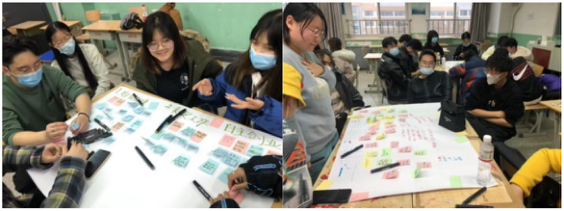
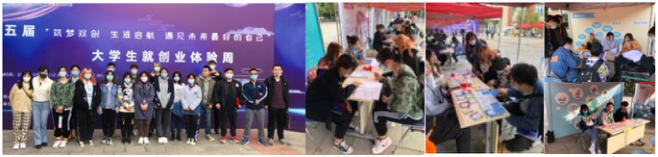
Figure 2: Students in self-analysis stage.Figure 3: Students in environmental analysis stage.
Self-Analysis Teachers teach Holland’s professional theory of person-job matching in career planning, as well as user research methods such as observation method, interview method and the diary survey method commonly used in DT and provide students with learning materials such as personal log template, interview template and interview skills. After group discussion, students rede- signed the research template that fits their own themes. Groups conducted research activities after class by interviewing each other (see Figure 2), obse- rving and journaling to clarify individual needs and personal strengths and weaknesses, so as to have a deeper understanding of themselves.
Environmental Analysis Teachers guide students to collect information from recruitment websites, government public information networks and provide career experience opportunities. Then, each group makes research plans for the topic sele- ction, and teachers give guidance and opinions. students conduct research after class: Through search online recruitment information, they can under- stand occupation needs, employment requirements of target career, and pay attention to career development and benefits. By browsing the government’s public information network, they can make clear the correlation between career development and social needs. Through college students’ employment experience week, they experience short-term job (see Figure 3), it can help them deeply understand the target occupation. After the above steps, students can deepen their understanding of career development and social needs.
Construction of the Educational Model of Vocational College Students’ Career Planning 5
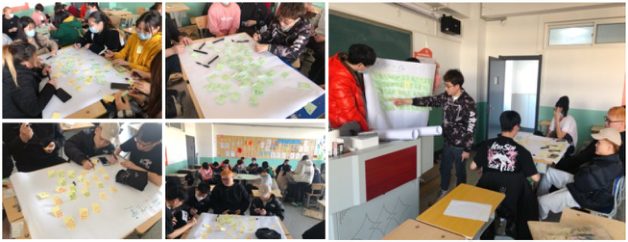
Figure 4: Students in evaluation and modification stage.
Goal Establishment Based on the results of self-analysis and environmental analysis, team mem- bers define problems to be solved to achieve their career goals by brainstorm and focus groups, then grade the problems according to their importance.
Strategy Development Groups mobilize individual and team strength, to seek solutions to key pro- blems by brainstorm from diverse perspectives. After the process, each group draws a career blueprint in combination with career goals and career plans, to clarify what needs to be done to achieve career goals.
Evaluation and Modification Each group report the employment strategy, students and teachers put forw- ard suggestions for revision (see Figure 4). Teachers’ comments and students’ suggestions can focus on problems and make employment strategies more effective. After class, students will discuss these suggestions with group mem- bers and formulate individual employment strategies according to their per- sonal circumstances. Teachers and teaching assistants will propose revisions for each student’s employment strategy.
TEACHING EFFECTIVENESS RESEARCH The teaching effectiveness was studied by questionnaire survey, the contents of the questionnaire include career planning awareness, self-awareness abi- lity, environmental awareness ability, and attitude to career planning courses. The research object is 115 students in the third grade of higher vocational college of Art and Design, Beijing Polytechnic. 30 students in the experimen- tal group implemented the career planning course teaching based on design thinking, and 85 students in other 2 classes are taught the traditional career planning course. 115 questionnaires were distributed, and 100 valid questi- onnaires were recovered after excluding invalid questionnaires. By comparing the questionnaire results of the experimental group and the control group before and after class, it can judge whether CP courses based on DT can help improve the teaching effect.
6 Lin and Wang
Table 1. Proportion of students’ improvement in career planning awareness.
Table available in the original PDF paper.
Career planning awareness
Promotion proportion of traditional CP
promotion proportion of CP teaching based on teaching DT
Clear understanding of career planning 14.05% 14.48% Clear learning goals 21% 29.43% Clear make learning plan 5.8% 18.05%
Table 2. Proportion of students’ improvement in self-awareness.
Table available in the original PDF paper.
Promotion Proportion of CP Teaching Based
Self-Awareness
Promotion Proportion of traditional CP on DT teaching
Clear understanding of career tendency 37.28% 38.74%
Table 3. Proportion of students’ improvement in environmental awareness.
Table available in the original PDF paper.
Promotion Proportion of CP Teaching Based
Environmental Awareness
on DT
Promotion Proportion of Traditional CP Teaching
Clear understanding of career title 4.17% 11.15% Clear understanding career development 5.52% 7.39%
Career Planning Awareness Career planning awareness includes understanding of career planning, clear learning goals and making corresponding learning plans. According to the analysis of the questionnaire results, compared with the traditional CP teach- ing mode, the teaching mode based on DT improves students’ understanding of career planning by 0.43%, determining learning objectives by 8.43% and making learning plans by 12.75%.
Self-Awareness Ability Self-awareness is based on a clear understanding of one’s career tendency. According to the analysis of the questionnaire results, the teaching mode based on DT can improve the clear understanding of own career tendency by 0.46% higher than the traditional CP teaching mode.
Environmental Awareness Ability Environmental awareness includes the knowledge of career title and the pros- pects for career development. According to the analysis of the questionnaire results, compared with the traditional CP teaching mode, the teaching mode based on DT improves the understanding of the career title by 6.08% and the understanding of the career development prospect by 1.77%.
Construction of the Educational Model of Vocational College Students’ Career Planning 7
Table 4. Proportion of students’ improvement in positive attitude to CP course.
Table available in the original PDF paper.
Promotion Proportion of CP
Attitude to CP Course Promotion Proportion of Traditional CP Teaching
Teaching Based on DT Very important 5.67% 15.74% Unimportant −0.17% −16.21%
Attitude to Career Planning Courses According to the analysis of questionnaire results, the teaching mode based on DT improves the positive attitude to career planning course 10.07% than the traditional CP teaching mode.
According to the statistics, it can be seen that CP courses based on DT is higher than the traditional CP courses in improving students’ learning effe- cts. In class, some students mentioned that career planning ability cannot be changed by teaching, plans cannot catch up with changes, young students pay more attention to their dreams, after growing up, they have to pay more attention to the reality, the practice experience is the most important, etc. All these answers indicate that students begin to pay attention to their own ability improvement and realize that career planning is focusing on cultiva- ting long-term ability. All above indicates that CP teaching based on DT has positive effect on the improvement of students’ long-term planning ability.
CONCLUSION
This exploration redesigns the teaching mode by introducing DT into CP course and verifies the effect of the teaching mode through questionnaires and interviews. According to the research results, the teaching mode can improve the learning effect and the ability of long-term career planning of students. Admittedly, there are shortcomings in this study, such as in the stage of envi- ronmental analysis, there is in not enough time for career experience link. And in the modification of career strategies, teachers and students’ suggestions are limited, it will be better if industry experts can be hired to give suggestions. Therefore, future research will set up more course time and invite industry experts to participate in the teaching.
ACKNOWLEDGMENT
The authors would like to acknowledge Professor Sun Yuanbo of Beijing Institute of Technology for his guidance, as well as the teachers and students at the School of Art and Design of Beijing polytechnic for their cooperation.
REFERENCES
China Institute for Employment Research. (January 24, 2022) China’s Employment Market Report for the fourth quarter of 2021. The China Institute for Employ- ment Research Website: http://www.cier.org.cn/UploadFile/news/file/20211026/ 20211026102514791399.pdf
8 Lin and Wang
China State Information Center. (September 7, 2021) Big data analysis: 2021 students returning from studying abroad for employment will exceed one million for the first time. National Development and Reform Commission Website: https:// www.ndrc.gov.cn/xxgk/jd/wsdwhfz/202109/t20210907_1296152_ext.html D-School. (2018) Design Thinking Bootleg2018. Standford D-School Website:
https://dschool.stanford.edu/resources/design-thinking-bootleg Erolu, Y. (2020). Career planning levels: a study on students of physical education and sports school, INTERNATIONAL JOURNAL OF EDUCATION TECHNOLOGY AND SCIENTIFIC RESEARCH Volume 5 No. 11. pp. 596–630. Jin, Cao. Jing, Lu. and Xueyong, Qi. (2020). The Introduction of Career Planning
Education System in American Colleges and Universities and the Inspiration from Them-Take University of Minnesota as an Example, China University Student Career Guide, Volume 9 No. 5. pp. 49–53. (in Chinese) Peng, Chen. Ronghai, Huang. (2019). What Does Design Thinking Bring? -Based on the Analysis of Web of Science Literature Between 2000 and 2018, MODERN DISTANCE EDUCATION RESEARCH Volume 6 No. 31. pp. 102–111. (in Chinese) Rengong, Lou. Qiquan, Zhao. (2002). Exploration and Practice of career planning
guidance for College students, China Higher Education Research Volume 6 No. 6, pp. 87–88. (in Chinese)
LISTED IN THE AHFE DIGITAL BOOKSTORE CATALOGUE
Explore the complete digital volume
Ergonomics In Design
Read this individual research paper free through the original publisher, or explore the full digital proceedings book.
ISBN 978-1-958651-23-0
Explore this ISBN in the AHFE Bookstore ↗Listed in the July 2026 bookstore catalogue; search by ISBN to confirm current availability · Digital book purchase optional